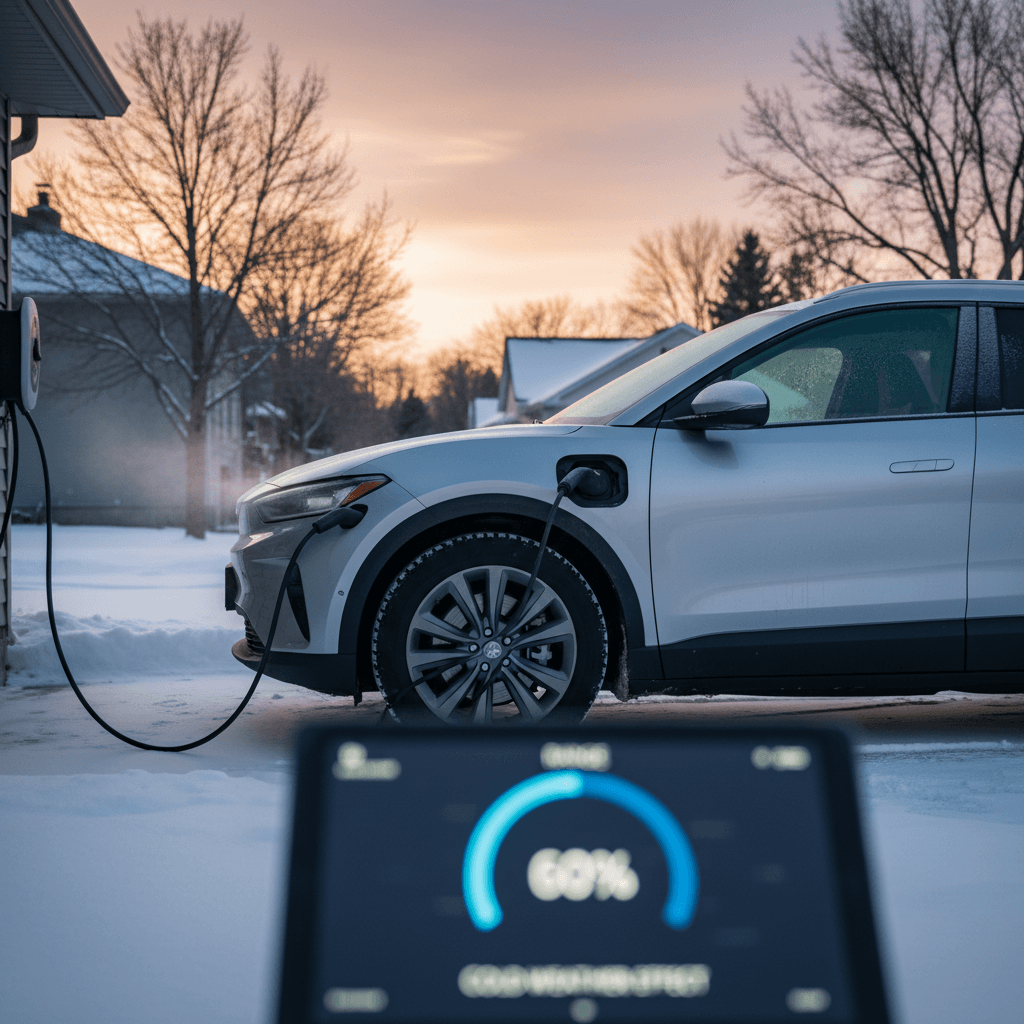
If you’ve watched your EV range drop in winter, you’re not imagining it. Cold weather can trim 20–40% off the number you’re used to seeing in mild temps, and on some days it might be more. The good news is that most of this loss is predictable, explainable, and manageable with a few smart habits and the right hardware.
Short answer
Why your EV range drops in winter
What’s happening under the hood
- Battery chemistry slows down as temperature drops, so each kWh can deliver less power efficiently.
- Internal resistance increases, so more of each kWh is lost as heat inside the pack.
- Thermal management has to work harder to keep the battery in its happy zone.
What you feel in the driver’s seat
- Cabin heating pulls 3–6 kW, or more in extreme cold, straight from the battery.
- Thicker winter tires, cold lubricants, and slush add drag.
- Reduced regen braking when the pack is cold means more friction braking and wasted energy.
In a gasoline car, the engine throws off lots of waste heat, so warming the cabin is essentially "free" from a range perspective. In an EV, there is no hot engine. Every BTU of cabin heat, and every watt used to warm the battery, comes directly from the same battery that moves the car, so cold weather hits both efficiency and comfort at once.
Typical winter EV range loss at a glance
How much EV range loss in winter is normal?
Every EV and every climate is different, but there are some reasonable benchmarks that help you decide whether what you’re seeing is normal or a red flag.
Typical winter range loss by scenario
Approximate real-world winter range loss for a healthy battery, compared with mild-weather driving of the same route and speed.
| Scenario | Outside temp | Driving style | Typical range change |
|---|---|---|---|
| Cool, not cold | 40–50°F | Mixed city/highway | +5% to -10% |
| Freezing, city-heavy | 25–32°F | Stop-and-go, short trips | -15% to -30% |
| Freezing, highway | 25–32°F | 65–75 mph | -20% to -30% |
| Deep cold | 0–20°F | Mixed driving | -25% to -40% |
| Arctic cold | Below 0°F | Short trips, high heat | -40% or more |
Use these as ballpark figures; your exact numbers will depend on speed, terrain, wind, and how warm you keep the cabin.
When to worry
The science: battery chemistry in the cold
Your EV’s battery is a big box of lithium‑ion cells. Those cells work thanks to a chemical reaction that moves lithium ions back and forth between two electrodes. Temperature has a huge influence on how smoothly that reaction happens.
- Lower temperatures slow reactions. At cold temps, lithium ions move more sluggishly through the electrolyte, so the pack can’t deliver current as efficiently.
- Internal resistance increases. Think of it as "friction" inside the battery. More resistance means the pack wastes more energy as heat and voltage sags sooner under load.
- Usable capacity shrinks temporarily. The pack still holds the same total energy, but in the cold it can’t give up as much of it without hitting voltage limits, so the car "sees" fewer usable kWh.
- Thermal management kicks in. Many EVs warm the pack using heaters or by recirculating heat from the motor and inverter. That protects long‑term health, but it costs energy while the pack warms up.
The key point: for a healthy battery, this is a temporary efficiency hit, not permanent damage. Once temperatures rise, either from weather or from the pack warming during a long drive, available range returns to normal. Long-term degradation is driven more by age, high mileage, repeated fast charging, and being stored at very high or very low states of charge than by a few cold weeks each year.
Cabin heat: the biggest winter range killer
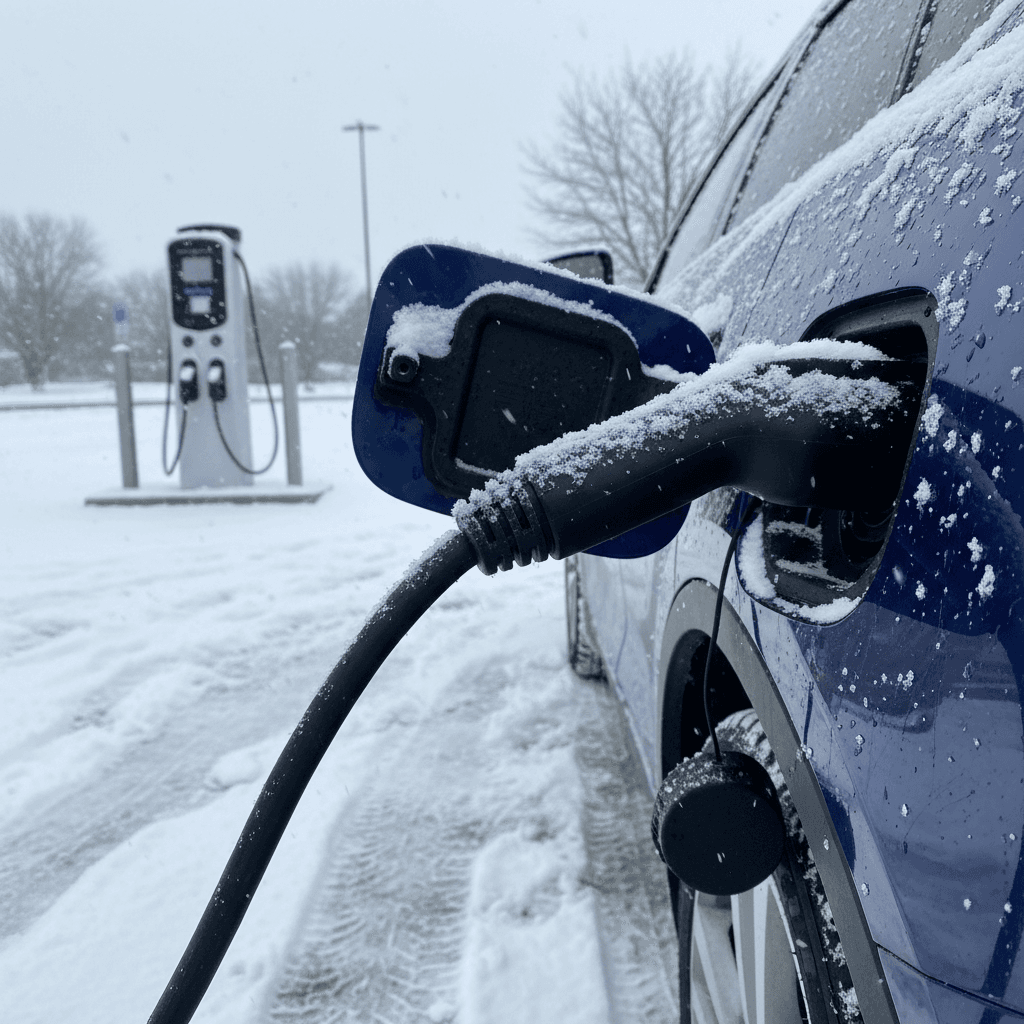
Once temperatures drop into the 20s and below, keeping you warm can use almost as much energy as moving the car, especially on low‑speed city errands. A typical resistive cabin heater can pull 5–7 kW on its own. Over an hour of driving, that’s 5–7 kWh, enough energy to drive 15–25 miles in mild weather.
How your comfort impacts your range
Different ways of staying warm have very different energy costs.
Seat & wheel heaters
These are surprisingly efficient. Many draw only a few hundred watts combined.
Use them as your first line of defense when it’s chilly but not brutally cold.
Cabin fan only
Moving air alone uses very little energy, but it won’t raise temperature. You still need heat on truly cold days.
Full cabin heat
A resistive heater can pull 5–7 kW, and even a heat pump may use 1.5–3 kW in tough conditions.
That draw is continuous on long drives, so the miles add up quickly.
Smart comfort strategy
Other factors that shrink winter range
Winter details that quietly eat into range
Short, frequent trips from cold-soak
If the car sits outside and you make a lot of short drives, the battery and cabin never really warm up. The heater has to start from scratch each time, so energy per mile skyrockets.
Higher rolling resistance
Cold air increases tire rolling resistance and thickens lubricants in wheel bearings and gearboxes. Add snow or slush on the road and every mile asks more of the battery.
Worse aerodynamics
Cold air is denser, and driving into a winter headwind at 70 mph can compound losses. Roof boxes and snow-covered cars add even more drag.
Limited regenerative braking
Until the battery warms up, many EVs limit regen to protect the pack. That means more energy is lost as heat in the brake pads instead of being fed back into the battery.
Winter tires
Dedicated snow tires or aggressive all‑terrains improve traction but add drag. Expect a few percent additional range hit versus efficient all‑season tires in good condition.
Hardware matters: heat pump vs. resistive heater
If you’re wondering why your friend’s EV seems to hold range better in the cold than yours, the answer often comes down to how the car makes heat.
Resistive heater (electric space heater)
- Heats air by passing current through a high‑resistance element.
- Simple and reliable, but efficiency is fixed: ~1 kW in, ~1 kW of heat out.
- Can easily consume 5–7 kW in sustained winter use, which adds up quickly on long highway drives.
Heat pump (mini home heat pump in your car)
- Moves heat rather than creating it, using refrigerant and a compressor.
- Can deliver 2–3 units of heat for every 1 unit of electricity in moderate cold.
- In many conditions, trims winter range loss by roughly 8–10 percentage points versus resistive-only systems.
Why this matters for used EV shoppers
Ready to find your next EV?
Browse VehiclesPractical ways to get your winter range back
You can’t change physics or the weather, but you have a lot of control over how hard winter hits your range. Here are the most effective levers you can pull, roughly in order of impact for most drivers.
Winter range optimization checklist
Precondition while plugged in
Use your app or in‑car settings to warm the cabin and, if your EV supports it, the battery <strong>before you unplug</strong>. That shifts a big chunk of heating energy to the grid instead of your battery.
Use eco or efficiency drive modes
Most EVs have an Eco mode that softens accelerator response, optimizes climate control, and sometimes limits top speed. It’s an easy one‑button way to squeeze extra miles from each kWh.
Lean on seat and wheel heaters
Turn those on early and lower the cabin temperature a few degrees. Heating your body directly is dramatically more efficient than heating all the air in the cabin.
Plan fewer cold starts
If possible, combine errands into one longer drive so the battery and cabin warm fully once instead of several times from stone‑cold.
Watch your speed
Aerodynamic drag goes up with the square of speed, and dense winter air makes it worse. Dropping from 75 to 65 mph can claw back a meaningful chunk of range on long freeway runs.
Clear snow and ice before driving
Snow on the roof, hood, and underbody adds drag and weight. Clearing it improves both safety and efficiency.
What not to do
Winter charging tips to protect range and battery
Charging behaves differently in the cold, too. You might notice slower fast‑charge speeds and that the car prefers to start charging gently until the pack warms.
Smarter winter charging habits
These habits help you preserve range and keep your battery happy when it’s cold.
Time charging before departure
If you can, set your car to finish charging shortly before you leave. The last part of the charge warms the pack, so you start your drive with a battery that’s already closer to ideal temperature.
Be patient with DC fast charging
In cold weather, your EV may arrive at a fast charger with a cold pack and start charging slowly. Many cars automatically warm the battery during the initial phase, speeds usually increase as it warms.
Favor home or workplace charging
Level 2 charging in a garage or carport keeps the car out of the worst of the wind and snow. That can modestly reduce cold‑soak and make preconditioning more effective.
State of charge sweet spot
Shopping for a used EV? Think about winter
If you live where winter is real, Upper Midwest, Northeast, Rockies, your EV choice and battery health matter even more. A car that barely covers your daily needs on a sunny 70°F day can start to feel tight when February arrives.
Winter-focused questions to ask before you buy used
Does this EV have a heat pump?
Look for a build sheet or sales listing that calls out a heat pump or cold‑weather package. If you’re not sure, ask the seller directly or check a trusted spec database by VIN.
How healthy is the battery?
A battery that’s already lost a big chunk of capacity will feel that much tighter in winter. With Recharged, every car comes with a <strong>Recharged Score</strong> battery health report so you can see real, measured capacity before you commit.
What’s the real-world winter range?
Manufacturer EPA or WLTP range numbers are based on standardized tests, not January in Minnesota. Look for owner reports and independent winter tests to understand realistic cold‑weather range.
Is there active thermal management?
Most modern EVs actively heat and cool the pack. Some early or budget models rely mainly on passive cooling, which can struggle more at temperature extremes.
Will this comfortably cover my worst-case day?
Think about your longest regular winter day, commute plus errands, maybe with a side trip and no chance to charge. Aim for a used EV that can handle that day even with a 30–40% winter hit built in.
Recharged was built to make that decision simpler. Along with battery diagnostics and fair-market pricing, our EV specialists can walk you through how a specific used EV will behave in your climate, including winter range estimates and whether a heat‑pump model might be worth stretching for.
Winter EV range FAQ
Common questions about EV range in winter
Key takeaways on EV winter range drop
Cold weather doesn’t mean your EV is broken, it means physics is doing what physics does. Lower temperatures slow the battery’s chemistry, increase resistance, and force the car to spend precious energy on heat instead of motion. That’s why your EV range drops in winter, often by 20–40% on the coldest days.
What you can control is how hard those factors hit you. Preconditioning while plugged in, moderating cabin heat, combining short trips, keeping speed in check, and choosing an EV with a heat pump and solid thermal management can all add back meaningful miles. And if you’re shopping used, paying attention to battery health and winter hardware up front will pay you back every time the temperature dips.
At Recharged, we’re focused on making EV ownership predictable, winter included. From transparent Recharged Score battery reports to EV‑savvy guidance tailored to your climate, you don’t have to guess how a particular car will behave in January. You can buy, sell, or trade into the right EV for all four seasons with your eyes open.