If you rely on public charging, you’ve almost certainly stared at a screen in the rain, trying to decide whether an EV charging membership is worth it or just another monthly fee stalking your bank account. In 2025, with rising fast‑charge prices and more networks chasing your loyalty, the right membership can absolutely save you money, but only if it fits your driving pattern.
The big idea
How EV charging memberships actually work
Most networks sell you the same product in two costumes: guest pricing (no monthly fee, highest rate) and member pricing (monthly fee, discounted energy). The logic is simple: if you buy enough kWh each month, you cross a break‑even point where the discount more than covers the subscription.
- You pay a fixed monthly fee (typically $6–$13).
- In exchange, you get lower per‑kWh or per‑minute rates at that network’s chargers.
- Some plans also waive session fees and add perks like rewards or idle‑fee grace periods.
- You can usually cancel or change plans monthly, but not always instantly mid‑trip.
Watch the unit
Typical pricing: what networks really charge
2025 public DC fast charging snapshot (typical ranges)
As of 2025, a typical DC fast‑charging session on big networks like Electrify America or EVgo will land you somewhere in the mid‑40‑cents‑per‑kWh neighborhood on standard rates, and perhaps in the mid‑30s with a subscription. The exact number depends on location, time of day, and whether your state allows per‑kWh pricing.
Common EV fast‑charging memberships in 2025 (U.S.)
Representative plans and pricing ranges; always check the app for current rates in your area.
| Network & plan | Monthly fee | Typical member rate | Typical guest rate | Notes |
|---|---|---|---|---|
| EVgo Plus | $6.99 | ~$0.33–$0.52/kWh | ~$0.39–$0.59/kWh | + higher tiers like PlusMax around $12.99 promise up to ~30% savings for heavy users. |
| Electrify America Pass+ | ≈$7.00 | ~25% cheaper than standard at many sites | ~$0.43–$0.55/kWh | Discount varies by station; some locations already cheap even without Pass+. |
| ChargePoint (no single plan) | Varies | Host‑set; sometimes discounts via employers or utilities | Host‑set | Often no formal membership; you just pay what the site owner sets. |
| Tesla Supercharger (non‑Tesla access) | Varies by country | Monthly membership in some regions lowers price toward Tesla‑owner rates | Higher guest/non‑member rate | In North America, many non‑Tesla drivers pay per‑kWh without a subscription but pricing can differ by app tier. |
These numbers are directional, not promises. Your state, charger, and time of day may differ.
Pro move: stalk the rate before you plug in
Quick answer: when a charging membership is worth it
Who actually benefits from EV charging memberships?
Think in use cases, not slogans.
Great candidates
- Apartment/condo drivers with no reliable home charging, leaning on DC fast chargers several times a month.
- High‑mileage commuters who regularly exceed what overnight Level 1 or Level 2 can comfortably refill.
- Frequent road‑trippers who tend to favor one network’s stations along their routes.
Usually better off as guests
- Home chargers who only fast‑charge on trips a few times a year.
- Workplace‑charging owners whose daily needs are covered at home or the office.
- Multi‑network users in patchy regions where loyalty to one brand is impossible.
Rule of thumb
Break‑even math for real-world scenarios
The only honest way to answer “Is an EV charging membership worth it?” is with a little math. Fortunately, the math is middle‑school simple: divide the monthly fee by the per‑kWh discount to find how many kWh you need to buy before you’re ahead.
Scenario 1: EVgo Plus commuter
Say EVgo in your area charges:
- $0.49/kWh as a guest
- $0.39/kWh on the $6.99/month EVgo Plus plan
Your discount is $0.10 per kWh. Break‑even volume:
$6.99 ÷ $0.10 = 69.9 kWh
If your monthly DC fast‑charging use is:
- ~70 kWh (about 2–3 typical fast‑charge stops for many EVs) → you’re roughly even.
- 120 kWh/month or more → membership is clearly saving you money.
Scenario 2: Electrify America Pass+ road-tripper
Assume a station where:
- Guest price is $0.44/kWh
- Pass+ price comes out near $0.33/kWh (about 25% off)
Discount: $0.11 per kWh. With a ~$7 monthly fee:
$7 ÷ $0.11 ≈ 64 kWh
Drive a 75 kWh battery EV from 10%–80% once or twice in a month and you’ve already crossed that threshold. But if you only hit DC fast chargers twice a year on road trips, Pass+ is wasted money for the other 10 months.
DIY formula
Beyond price: perks, fine print, and pitfalls
Membership perks that matter (and those that don’t)
Not all benefits show up in a price chart.
Session & idle fee changes
App features & reliability
Promos & bundled deals
Common gotchas
How your living situation changes the answer
If you have home charging
If you have a Level 2 charger in your driveway or garage, home will almost always be your cheapest and least stressful fuel. Many utilities now offer off‑peak EV rates that make public DC fast charging look usurious by comparison.
In that world, a membership only makes sense if:
- You road‑trip often, on predictable routes dominated by a single network.
- Your work or kids’ activities routinely push you beyond your overnight range.
For most homeowners, it’s smarter to skip the membership and pay the higher guest rate on the handful of DC fast sessions you actually need each year.
If you don’t have home charging
This is where memberships start to look less like a luxury and more like rent.
- If your apartment complex has only a couple of Level 2 ports and they’re always busy, you’ll lean harder on DC fast charging.
- If your city’s infrastructure is fragmented, you may bounce between multiple networks just to get plugged in at all.
Here, a single membership can meaningfully cut your fuel bill, as long as one network has decent coverage in your daily orbit. In some cities, the cheapest play is actually two low‑cost memberships, one on each of the networks you hit every week.
Map your real life, not your ideals
Used EV owners: how to think about memberships
If you’re buying or driving a used EV, the membership question is tangled up with two unglamorous realities: battery health and charging curve. Older packs and some early‑generation models charge slower at DC fast stations, which means that per‑minute billing can punish you compared with a newer EV on the next stall over.
Key questions for used EV drivers
Memberships, aging batteries, and real‑world costs.
How fast does your car actually charge?
How much do you lean on public DC?
Where Recharged fits in
Step-by-step checklist: should you get a membership?
Decide if an EV charging membership is worth it for you
1. Track 1–2 months of charging
Use your car’s app or odometer to note how often you fast‑charge, where, and roughly how many kWh you add each session. Don’t guess, real data beats vibes.
2. Identify your top two networks
Look at your history and map. Are you mostly on Electrify America, EVgo, Tesla, a utility network, or a mix? If no single network handles at least a third of your sessions, a membership is harder to justify.
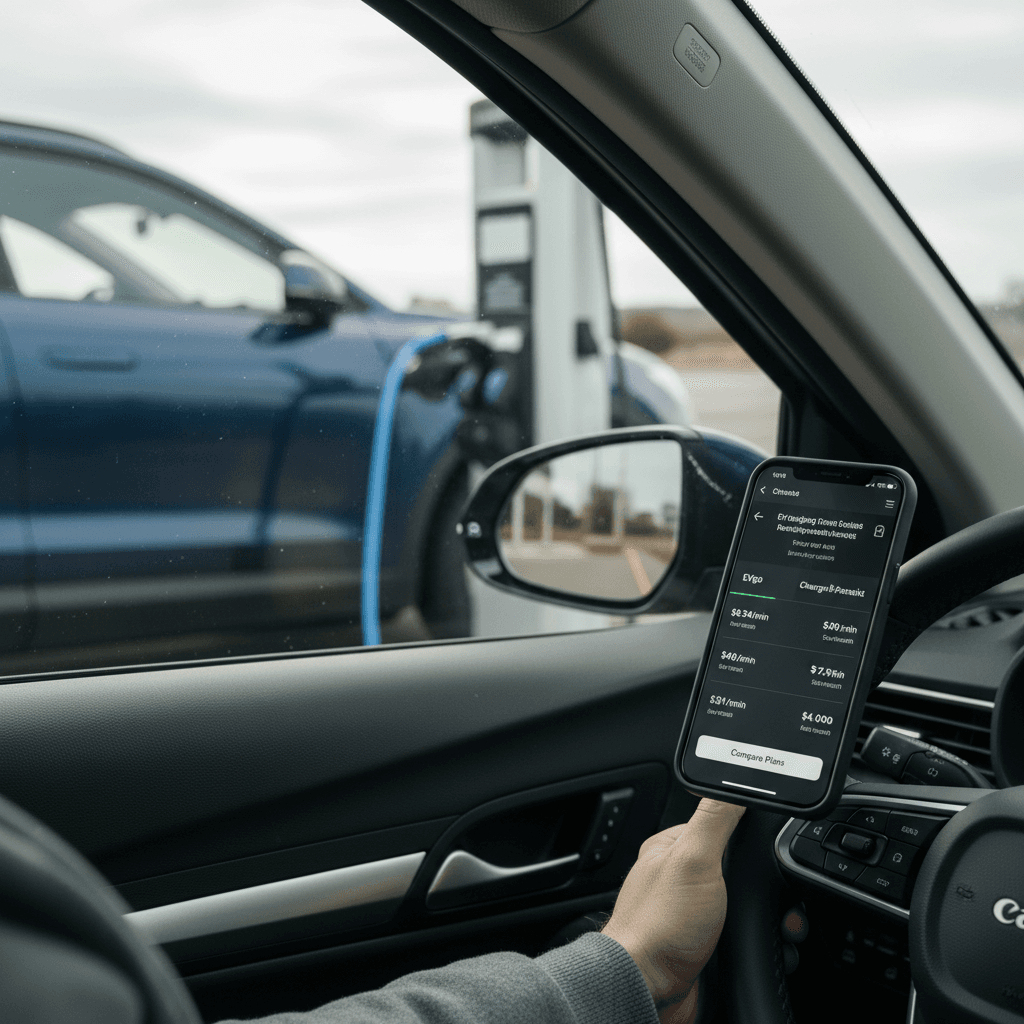
3. Compare guest vs member rates in the app
Open each network’s app and check actual station pricing near you. Write down guest and member rates at the specific sites you frequent.
4. Run the break-even formula
Subtract member price from guest price to get your per‑kWh discount. Divide the monthly fee by that discount. If your monthly usage is consistently above that kWh threshold, membership is a financial win.
5. Check contract terms and hidden fees
Scan for session fees, idle fees, minimum terms, and how quickly you can cancel. Avoid any plan that makes it painful to hop off after a road‑trip month.
6. Re‑evaluate every 6–12 months
Charging prices are not carved in stone. Re‑run the math when you move, change jobs, or see a big pricing email from your favorite network.
FAQ: EV charging memberships and subscriptions
Frequently asked questions about EV charging memberships
Bottom line: are EV charging memberships worth it?
EV charging memberships are neither a scam nor a universal necessity. They’re a blunt financial instrument that works beautifully for some drivers and not at all for others. If you’re an apartment‑dwelling, high‑mileage commuter living in the shadow of an Electrify America or EVgo station, the math usually works in your favor. If you’re a homeowner sipping cheap electrons from a Level 2 in your garage and fast‑charging a few times a year, the answer is almost certainly no.
Run the numbers for your real life, not the one in the commercial. Track your usage, compare rates, and don’t be sentimental about canceling when the math changes. And if you’re cross‑shopping used EVs, talk to Recharged about how each model’s range, battery health, and charging speed will shape your dependence on public networks, and whether a membership belongs in your monthly budget at all.