If you’ve shopped quotes for an electric vehicle lately, you’ve probably noticed a pattern: EVs often cost more to insure than comparable gas cars. That’s led a lot of shoppers to ask a simple question: why do EVs cost more to insure, and is that a permanent reality, or just a growing-pains problem as the market matures?
The short version
Do EVs Really Cost More to Insure in 2026?
What the latest data says about EV insurance
Those numbers vary by model, zip code, and insurer, but the pattern is clear: on average, EVs are still more expensive to insure as of early 2026. The good news is that the gap has started to narrow compared with the early 2020s as insurers gain more data and repair networks catch up.
How Insurers Actually Price Your EV
To understand why your EV quote looks the way it does, it helps to know how insurance pricing works. Insurers care about two big things: how often claims happen (frequency) and how expensive they are when they do (severity).
What drives your EV insurance premium?
The same fundamentals as gas cars, plus some EV twists
Vehicle value & type
Repair cost & time
Driver & usage profile
From an insurer’s perspective, EVs are a relatively new, complex category with high parts costs and a still-maturing repair ecosystem. That pushes up expected claim severity, and premiums follow.
7 Core Reasons EVs Often Cost More to Insure
- Expensive, difficult-to-repair battery packs
- More complex technology and safety sensors
- Limited EV-certified repair shops and technicians
- Higher average vehicle prices and trim levels
- Uncertain residual values and total-loss decisions
- Heavier vehicles and strong acceleration
- Insurers still learning real-world EV risk profiles
1. Battery packs are expensive, and fragile from an insurance standpoint
In most EVs, the traction battery is the single most valuable component, often representing 30–40% of the vehicle’s value. When a crash impacts the underbody or pack area, insurers and repairers have to assume worst-case risk: physical damage, compromised cooling, or internal short circuits that might not be obvious at first glance.
Why small hits can total an EV
2. High-tech sensors make bodywork more expensive
EVs tend to be technology flagships. Cameras, radar, ultrasonic sensors, and sometimes lidar are baked into bumpers, fenders, windshields, and grilles. That’s great for safety, but it’s not so great for repair bills.
More parts to damage
On many EVs, a low-speed parking-lot tap can damage not just plastic and paint, but also parking sensors or forward-facing cameras. Replacing and calibrating those parts can easily turn a modest dent into a four-figure repair.
Specialized recalibration
Advanced driver-assistance systems (ADAS) need precise calibration after repair. That usually requires specialized equipment and certified technicians, which means higher hourly rates and more billable time.
3. Fewer EV-certified shops and technicians
High-voltage systems bring real safety risks for untrained technicians. As a result, not every body shop is willing or qualified to work on EVs. Vehicles may need to be towed farther to reach a capable facility, sit in line longer, and spend more days in the shop. Those delays add rental-car costs and storage fees to every claim.
Why time in the shop matters
4. Higher average vehicle prices
Even as prices have come down, the average new EV in the U.S. still tends to be more expensive than the average new gas vehicle. When the sticker price is higher, the maximum potential payout for a total loss is higher, so the base premium starts from a higher floor.
5. Uncertain repairability and residual values
Insurers like predictability, and EVs are still a moving target. Battery chemistry, structural design, and repair techniques are evolving quickly. For some early EVs, a single major claim can exceed the vehicle’s resale value, encouraging insurers to total cars more often than they would a comparable gas model. That uncertainty gets priced into your premium.
6. Weight, performance, and crash dynamics
EVs pack heavy battery packs low in the chassis, which improves stability but also adds mass. Heavier vehicles can cause more damage in multi-vehicle crashes. Many EVs are also very quick, instant torque and sub-5-second 0–60 times are common. Insurers factor these physical realities into rating models, especially for performance-oriented trims.
7. Insurers are still learning the EV risk curve
Compared with a century of gas-car data, insurers have only a decade or so of meaningful EV claims history, and most of that is concentrated in a few models. Until underwriters have a deep, stable dataset across many EVs, they tend to price conservatively, and conservative pricing usually means higher premiums for you.
When EVs Don’t Cost More to Insure
The headline story, “EVs cost more to insure”, is an average, not a law of physics. In some situations, your EV can actually be as cheap or cheaper to insure than a comparable gas vehicle.
Situations where EV insurance can be competitive
The model, brand, and driver profile matter as much as the powertrain
Legacy-brand EVs with shared parts
Lower-trim, non-performance models
Clean records & EV-specific programs
The trend line is improving
Used EVs: Insurance Pros, Cons & Battery Health
If you’re considering a used EV, the insurance story gets more nuanced. On one hand, lower vehicle value usually means lower premiums. On the other, older EVs can be more vulnerable to being totaled by battery damage, and insurers know it.
How used EVs compare on insurance vs new EVs
General patterns you’ll see when you compare quotes (your exact numbers will still vary).
| Factor | New EV | Used EV (5–8 years old) | What this means for insurance |
|---|---|---|---|
| Vehicle value | High | Lower | Lower value usually reduces comprehensive and collision premiums. |
| Battery replacement vs. value | Battery often worth less than car | Battery may equal a large share of car value | Moderate damage is more likely to total an older EV, raising average claim costs. |
| Parts availability | Good for current models | Can be mixed | For discontinued models, limited parts can increase repair times and costs. |
| Safety tech | Latest sensors & software | May lack newest features | Older EVs might miss the latest crash-avoidance tech, but that doesn’t always translate into higher premiums. |
| Data for insurers | Improving but limited | More years of history on popular models | Mature models give insurers more confidence, sometimes translating into better pricing. |
Used EVs can soften the insurance hit, but only if you understand how age and battery health affect repairability.
Where Recharged fits in
Battery health is especially important for insurance. A used EV with verified, above-average battery health is less likely to suffer range issues or need an early pack replacement. While most insurers won’t give you a line-item discount for a battery report yet, it can influence how they view the car’s overall value, and it gives you leverage if you ever need to challenge a low valuation after a claim.
10 Practical Ways to Lower Your EV Insurance Bill
Concrete steps you can take before and after you buy
1. Compare quotes from EV-friendly insurers
Prices vary more for EVs than for many gas cars. Get quotes from at least 3–4 carriers, including any that advertise EV or telematics programs. Some are far ahead of others on pricing electrics fairly.
2. Adjust coverage, not just price
Don’t just chase the lowest number. Look at deductibles, liability limits, and rental coverage. Increasing your comprehensive and collision deductibles by $250–$500 can meaningfully reduce premiums if you can afford the risk.
3. Take advantage of ADAS and safety discounts
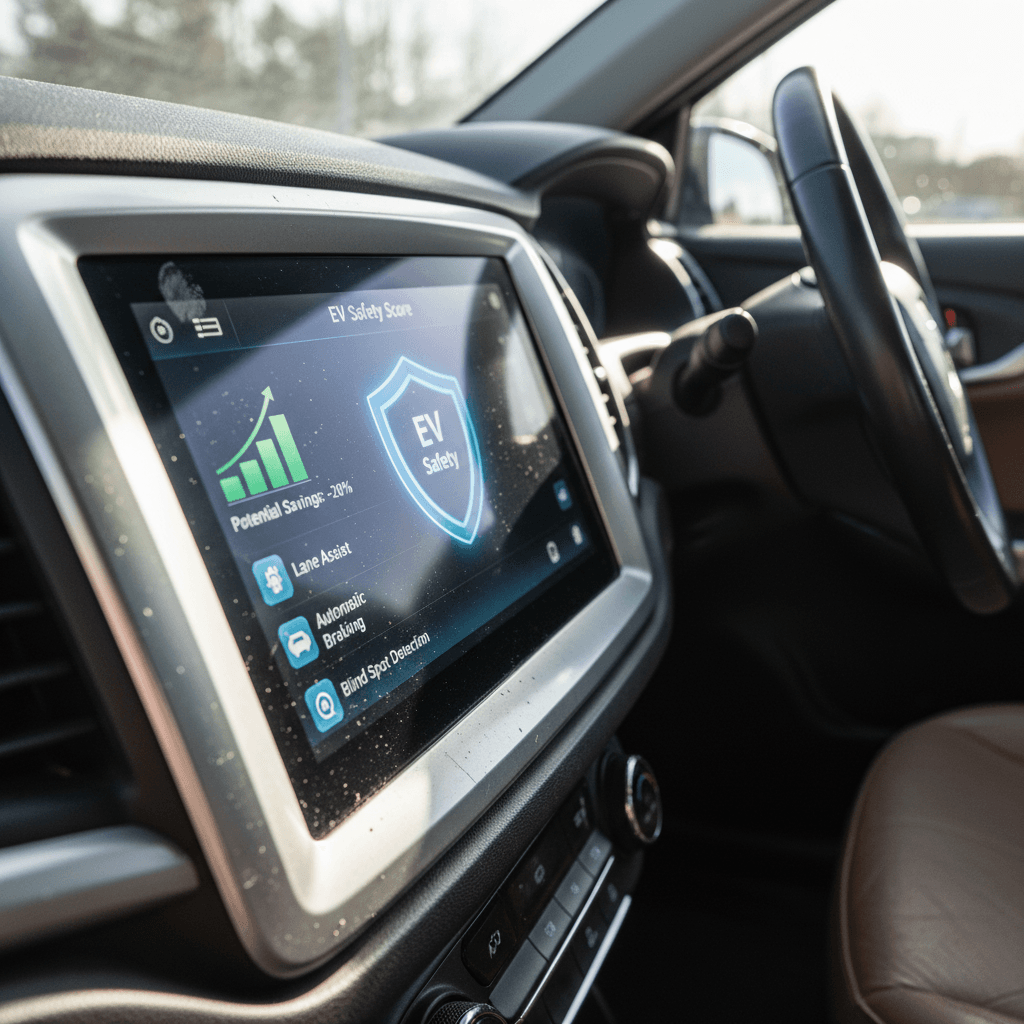
Many EVs come loaded with safety tech. Make sure your insurer knows your car has automatic emergency braking, lane-keeping assistance, and other features, those can qualify for discounts.
4. Ask about mileage-based or telematics plans
If you drive relatively few miles, usage-based insurance can erase much of the EV premium gap. Connected EVs make it easy for insurers to verify low mileage or safe driving, often for significant savings.
5. Choose wheels, tires, and mods carefully
Oversized wheels or performance tires can raise repair costs and accident risk. Likewise, aftermarket modifications may bump your premium. If keeping insurance low is a priority, keep the spec sensible.
6. Bundle with home or renters insurance
Multi-policy discounts still apply to EVs. Bundling home, renters, or other vehicles with the same insurer can trim 10–20% off the premium in many markets.
7. Prioritize models with robust repair networks
Before you buy, research how many certified repair shops in your area can handle your chosen EV brand. Popular, long-running models with good parts availability generally attract lower premiums than obscure or brand-new nameplates.
8. Consider a slightly older, non-performance trim
A two- or three-year-old EV in a moderate trim often offers similar range and features with lower premiums than a brand-new, performance-oriented version, especially if battery health is verified.
9. Maintain a clean driving and credit profile
For better or worse, your record and credit score (in most states) still matter more than what powers your car. Safe driving, avoiding claims on small dings, and keeping credit healthy can offset the EV-specific premium bump.
10. Re-shop regularly as the market evolves
EV insurance pricing is changing fast. If you haven’t checked quotes in 12–18 months, you may be overpaying. Set a reminder to compare rates annually, especially as more insurers launch EV-specific products.
EV Insurance in the Bigger Ownership Cost Picture
It’s easy to fixate on insurance because you feel it every month, but it’s only one part of EV ownership economics. When you add up fuel, maintenance, and depreciation over 5+ years, many EVs still come out ahead of comparable gas cars even with higher premiums, especially if you charge mostly at home and drive more than average miles.
Where EVs save you money
- Fuel: Electricity is typically cheaper per mile than gasoline, especially with off-peak home charging.
- Maintenance: No oil changes, fewer moving parts, and less brake wear thanks to regenerative braking.
- Incentives: Federal and state incentives (where available) can offset upfront price and taxes.
Where EVs still carry a premium
- Insurance: As we’ve covered, EV premiums are still higher on average, though the gap is narrowing.
- Registration & fees: Some states add EV-specific fees to replace lost gas-tax revenue.
- Depreciation: Certain EV models depreciate faster than gas cars, though well-known models can hold value strongly.
Using insurance quotes as a shopping tool
The bottom line: EVs cost more to insure today mostly because they’re more complex and costly to repair, not because they’re more dangerous. As the industry scales up, data improves, and repair networks expand, that premium gap should continue to shrink. In the meantime, choosing the right model, buying used thoughtfully, and being proactive about quotes can put you in an electric vehicle that fits both your values and your budget.
FAQ: Why EV Insurance Costs More
Frequently asked questions about EV insurance costs
If higher premiums have you hesitating on an EV, zoom out. Insurance is a real cost, but it’s also a lever you can control with smart vehicle choice, better information, and a little shopping effort. With tools like battery health reports, transparent pricing, and EV-savvy support from marketplaces like Recharged, you can sidestep the worst of the EV insurance penalty and enjoy the upside of driving electric.