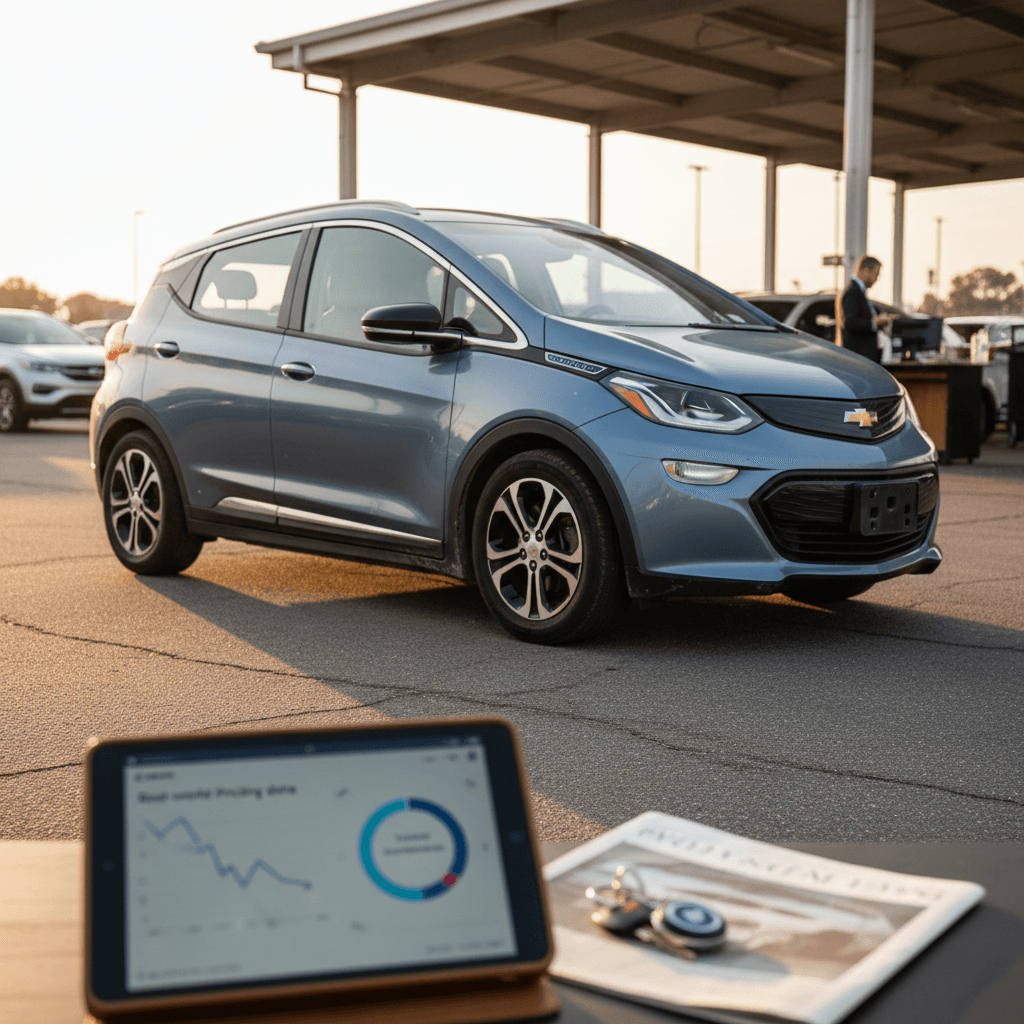
If you’re asking, “What is my Chevy Bolt EV worth?” you’re not alone. Early Bolts have been on the road for nearly a decade, Chevy stopped then restarted Bolt production, and EV prices have seesawed since 2020. The result: used Bolt values are all over the map, and knowing a fair number is the first step to deciding whether to sell, trade in, or hang on.
Snapshot: 2026 Chevy Bolt EV values
How much is my Chevy Bolt EV worth right now?
Used‑car pricing data sites suggest an average used Chevrolet Bolt EV price around the mid‑teens in dollars in early 2026, with late‑model cars commanding more and early models less. One national pricing index pegs the average used Bolt EV around **$14,000–$15,500**, with 2020–2023 model years closer to the upper end and 2017–2018 cars toward the lower end.
Chevy Bolt EV value at a glance (early 2026)
Online values are ballparks, not verdicts
Quick value estimates by model year
Let’s talk ballpark numbers first. These ranges are **typical retail asking prices** in the U.S. for Bolts in average condition and mileage as of early 2026, not trade‑in numbers, and not guaranteed offers. Think of them as a sanity check for what you’re seeing online.
Approximate 2026 Chevy Bolt EV value ranges by model year
Estimated retail asking ranges for Bolts with average mileage and clean history. High miles, heavy wear, or weak battery health will push a car toward or below the low end; low miles and strong battery health can justify the high end or more.
| Model year | Typical mileage (2026) | Rough retail range | Notes |
|---|---|---|---|
| 2017 | 80k–120k mi | $7,500–$11,000 | First model year. Many cars have had battery recall work completed. |
| 2018 | 70k–110k mi | $8,000–$12,000 | Similar to 2017, with condition and battery history driving spread. |
| 2019 | 60k–100k mi | $9,000–$13,000 | Mid‑cycle cars; values hinge on mileage and cosmetic condition. |
| 2020 | 50k–90k mi | $11,000–$15,000 | Five‑year‑old cars; one analysis pegs an average around $14,500 for an LT. |
| 2021 | 40k–70k mi | $12,000–$16,000 | Facelifted interior for 2022, but late‑2021 builds straddle both pricing worlds. |
| 2022 | 30k–60k mi | $13,500–$17,000 | KBB data suggests resale in the mid‑teens, with strong examples higher. |
| 2023 | 20k–40k mi | $15,000–$19,000 | Last of the original Bolt generation; lower MSRP when new but still relatively fresh. |
These are directional ranges, not appraisals. Local market conditions can shift prices up or down.
Retail vs. trade‑in vs. private party
Six big factors that change your Bolt’s value
What really moves your Chevy Bolt EV’s price
Year and mileage are just the starting point. Here’s what shoppers and appraisers notice next.
1. Model year
2. Mileage & usage
3. Battery health
4. Recall & repair history
5. Trim & options
6. Where you live
Know your trim and features
Battery health: how much does it really matter?
For a used EV, the battery pack is the story. If a buyer worries that they’re inheriting a tired pack with shrinking range, they’ll either walk away or lowball you. The good news for Bolt owners is that, aside from the recall‑related cells, many packs have aged reasonably well in normal use, but shoppers want proof, not promises.
Signs of a healthy Bolt battery
- Real‑world range is still close to what you saw in the first couple of years.
- No high‑voltage battery warnings or reduced‑power messages.
- Charging speeds at DC fast chargers seem consistent with what other owners report.
- You’ve avoided constant 100% charges and deep discharges when possible.
Red flags that spook buyers
- Noticeable, unexplained range loss compared to similar Bolts.
- Open battery or high‑voltage system recalls in GM’s system.
- Repeated shutdowns, no‑start conditions, or traction‑battery error codes.
- No service records at all, especially if mileage is high.
Turn battery health into a selling point
Ready to find your next EV?
Browse VehiclesChevy Bolt recalls and warranty: impact on what it’s worth
The Bolt’s battery recall headlines scared some shoppers away from the nameplate entirely. But if your car has already had its battery replaced or the recall software installed, that story changes in your favor. In some cases, a replaced pack even offers **more usable range** than what the car had when new.
- If the recall work is complete, keep copies of the GM recall letter and service invoice handy.
- If your Bolt got a new pack, note the date and mileage of the replacement, this is gold when you’re selling.
- If recall work is still open, your car effectively has a cloud over its head until the job is finished. Expect lower offers until it’s resolved.
- Powertrain and battery warranties vary by model year and state. If you’re still under high‑voltage warranty, that makes your car more attractive.
Don’t dodge the recall question
How the EV market is moving in 2026
Your Bolt doesn’t live in a vacuum. Two big currents are tugging on its value in early 2026: **EV prices have softened in general**, and Chevrolet has announced a new‑generation Bolt that will once again be one of the most affordable new EVs in America. Both events lean on used values, especially for older, higher‑mileage cars.
Market forces shaping what your Bolt is worth
Why the same car might have been worth more, or less, just a year ago.
1. Softer used‑EV demand
2. The new Bolt is coming back
The flip side: Bolt is still a value hero
What’s my Bolt worth to a dealer vs a private buyer?
Once you have a rough sense of what your Chevy Bolt EV might retail for, the next question is: **who’s cutting the check?** A dealer, a private buyer, or an EV‑focused marketplace like Recharged will each see your car a little differently, and that shows up in the numbers.
Dealer trade‑in or instant offer
Fast and simple, but usually the lowest dollar amount.
- Expect offers to land **below wholesale auction values**, since the dealer needs room for reconditioning, transport, and profit.
- Convenient if you’re swapping into another vehicle the same day.
- Great if time and paperwork stress matter more than squeezing every dollar out.
Private sale or EV marketplace
More work, more upside.
- Well‑presented cars with **battery documentation and clean history** can sell for thousands more than trade‑in.
- You’ll handle photos, listings, and meeting buyers, or let a consignment service like Recharged manage it for you.
- EV‑specific marketplaces attract shoppers who understand range, charging, and recalls, which can translate into stronger offers.
A simple rule of thumb
How to get the best price for your Chevy Bolt EV
Seven steps to maximize your Bolt’s value
1. Confirm recall and warranty status
Run your VIN on Chevy’s recall site and gather paperwork for completed repairs. If high‑voltage battery or powertrain warranty remains, note the expiration date and mileage cap in your listing.
2. Get a battery health report
If you plan to sell through <strong>Recharged</strong>, your Bolt gets a <strong>Recharged Score</strong> battery‑health diagnostic as part of the process. Otherwise, consider a third‑party EV inspection that can quantify remaining capacity and charging behavior.
3. Detail inside and out
A small car shows dirt and wear quickly. A careful wash, clay, wax, and interior detail can move your Bolt up an entire price bracket in a shopper’s mind.
4. Fix simple, visible issues
Burned‑out bulbs, cracked taillights, curb‑rashed wheels, and cheap worn floor mats say “neglect.” Address what you can afford before listing, these items often cost less to fix than the discount a buyer will demand.
5. Gather records and accessories
Service receipts, recall documentation, both key fobs, mobile charge cord, and manuals all add confidence. If you’ve upgraded tires or done recent brake work, lead with that in your description.
6. Price using real comps
Search for Bolts of the same **year, trim, mileage, and region**. Filter out obviously rough or unusually cheap cars, then price yours slightly below the best comparable if you want it to move quickly.
7. Choose the right selling channel
If you value speed and simplicity, a trade‑in or instant offer may be worth the money left on the table. If you want to maximize return with EV‑savvy buyers and guided support, explore selling or consigning through <strong>Recharged</strong>.
Why battery diagnostics matter: buyers are getting picky
In 2019, you could list an EV with a handful of photos and a VIN and call it a day. In 2026, shoppers have learned the hard way that two Bolts with the same model year and mileage can feel very different on the road. The question they’re really asking is: **“How much useful life is left in this battery for me?”**
What serious buyers want to see on a used Bolt
Think like a shopper comparing three Bolts on three different tabs.
Battery health score
Charging behavior
Clean diagnostics
How Recharged can help
FAQ: Chevy Bolt EV value and selling
Common questions about what your Chevy Bolt EV is worth
Bottom line: what your Chevy Bolt EV is worth
Your Chevy Bolt EV’s true value is a combination of its **year, miles, battery story, and local market mood**, not just a single number from a pricing site. In early 2026, many Bolts live in the **$8,000–$18,000** retail window, with especially clean, low‑mile cars stretching higher and rough, high‑mile examples dropping lower.
To land on the right side of that range, treat your car like the serious little electric workhorse it is: handle the recall and maintenance details, document battery health, clean it up, and price it using real local comps. If you’d rather not navigate that alone, Recharged can help you value, market, and sell your Bolt with transparent battery diagnostics and EV‑specialist support, so you walk away confident you got a fair deal.