You park your EV with 220 miles of range, come back a day or two later, and it’s down to 210, for no obvious reason. That silent loss of energy while your car is just sitting is what most drivers call EV phantom drain, or “vampire drain.” It can be annoying, but it’s also one of the most misunderstood parts of EV ownership.
Quick definition
What is EV phantom drain?
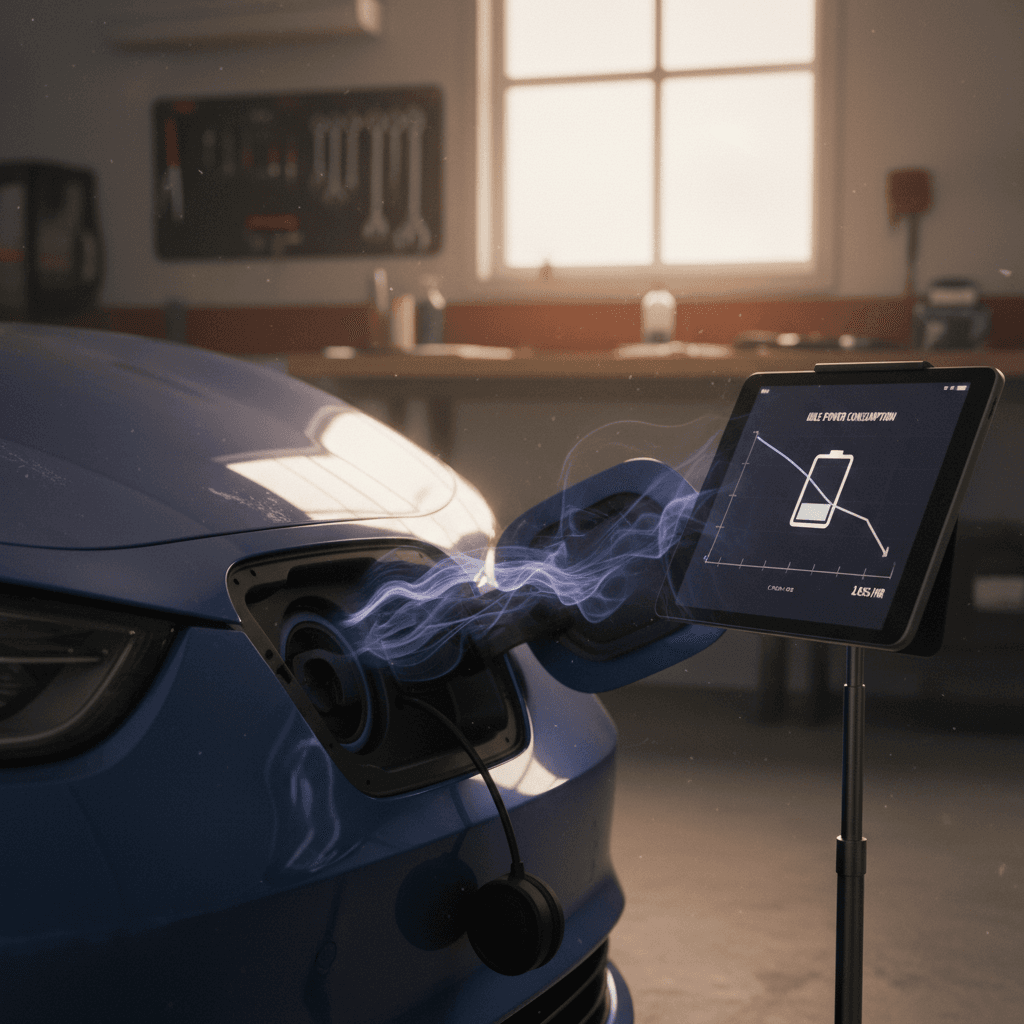
Every modern EV is basically a smartphone on wheels. Even when it’s “off,” background systems stay awake: security, connectivity, and the battery management system. That standby usage shows up as range or % charge lost while parked, what owners call phantom or vampire drain.
- It happens whether the car is plugged in or not (though plugged-in cars may automatically top the pack back up).
- It’s usually measured in % per day or miles of range per day.
- You’ll notice it more if you park for several days in a row without driving.
Typical real‑world examples
How phantom drain actually works inside an EV
To understand what EV phantom drain is, it helps to break down what’s sipping power while your car is parked. Most of the draw comes from relatively small loads, but they add up over hours and days.
Key systems that run while your EV is parked
Vehicle computers
Connectivity
Thermal management
High-voltage vs. low-voltage
EVs actually have two electrical systems:
- A high-voltage pack (hundreds of volts) that drives the motor and main electronics.
- A low-voltage battery (12V or 48V) that powers accessories, locks, telematics, and interior electronics.
Why that matters for phantom drain
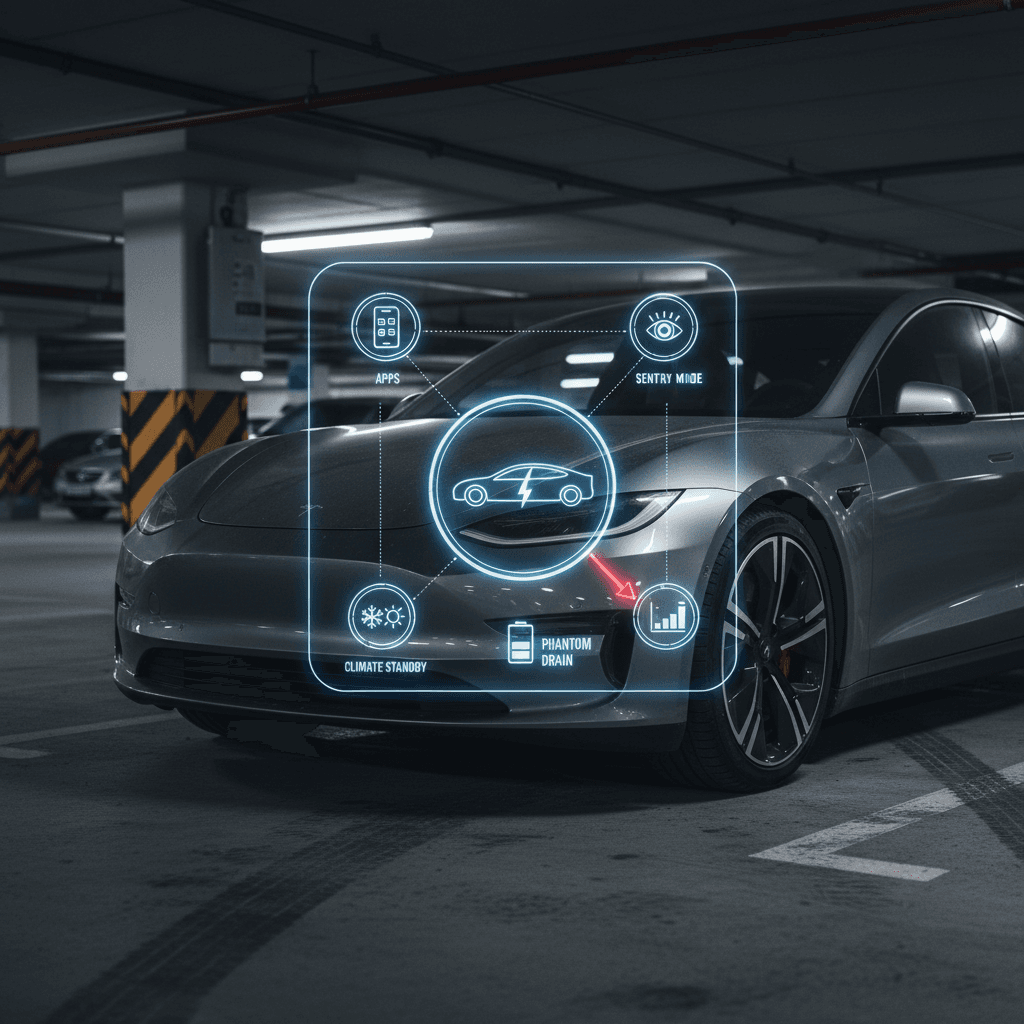
Most parked loads draw from the low‑voltage system. When that drops, the car briefly wakes the high‑voltage pack to recharge it. Those periodic wake‑ups are a big part of phantom drain, and why opening the app over and over can noticeably increase it.
How much phantom drain is normal for an EV?
Different brands and software versions behave differently, but there are some useful ballpark numbers. These assume mild weather, the car is in good health, and major "always‑on" features are off.
Typical EV phantom drain ranges (rule‑of‑thumb)
Approximate parked energy loss for modern EVs in normal conditions. Always check your owner’s manual and in‑car energy tools for model‑specific guidance.
| Phantom drain level | Approximate loss | What it usually means | Should you worry? |
|---|---|---|---|
| Very low | ~0–0.5% per day | Vehicle sleeps deeply, minimal background activity. | No. This is about as good as it gets. |
| Normal | ~0.5–1.5% per day | Computer wake‑ups, connectivity, and BMS activity. | Usually no, especially over short trips or weekends. |
| Elevated | ~2–4% per day | Some feature is keeping the car awake (security cameras, climate protection, frequent app pings). | Worth investigating settings and software updates. |
| High | 5%+ per day | Car rarely sleeps, stuck process, or extreme climate. | Yes. Time to troubleshoot or talk to service. |
Numbers below assume no Sentry/Gear Guard, no preconditioning, and no extreme heat or cold.
Cold weather can mislead you
Main causes of EV phantom drain
Once you know what EV phantom drain is at a high level, the next step is figuring out why your car, specifically, is losing more energy than you expect. In practice, the culprits fall into a few predictable buckets.
Top contributors to EV phantom drain
These factors vary by brand and software, but the patterns are remarkably consistent.
Always‑on camera/security modes
Mobile apps & third‑party services
Cabin overheat & climate protection
Extreme heat or cold
Frequent software activity
Bugs or misconfiguration
Look at the car’s own energy tools first
How to reduce EV phantom drain without going crazy
The goal isn’t zero phantom drain, that’s neither realistic nor necessary. The goal is to keep it in the “normal” range without turning your high‑tech EV into a brick. Here’s a practical, brand‑agnostic game plan.
Practical steps to cut EV phantom drain
1. Turn off nonessential security recording at home
If your EV has camera‑based modes (Sentry, Gear Guard, etc.), disable them in locations you trust, like your garage or workplace. Many cars let you set <strong>location‑based exclusions</strong> so you still get full security in unfamiliar places.
2. Relax cabin overheat protection when safe
In a shaded private driveway or cool garage, you may not need aggressive overheat protection. Use the least aggressive setting that still keeps pets, people, and electronics safe, or set it to time‑out rather than run indefinitely.
3. Let the car actually sleep
Constantly opening your app or using third‑party services can keep the car awake. Try a 24‑hour experiment where you <strong>don’t touch any apps</strong>. If your phantom drain drops, you’ve found a big contributor.
4. Audit third‑party apps and services
If you use multiple EV apps, logging tools, or smart‑home integrations, disable them one at a time and watch parked loss. Many modern tools offer "deep sleep" modes, make sure they’re enabled.
5. Use energy‑saving or power‑down modes
Some EVs offer a “power saving,” “deep sleep,” or “camp/storage” mode. These reduce connectivity and background wake‑ups in exchange for more aggressive sleeping. They’re ideal for airports and long‑term parking.
6. When in doubt, plug in
Manufacturers generally <strong>recommend leaving your EV plugged in</strong> when practical. The car will top itself up as needed, so any phantom drain shows up on your electric bill rather than as lost range when you need to drive away.
What “fixed” looks like
Does phantom drain hurt EV battery health?
Many owners worry that phantom drain is secretly killing their battery. The reality is more nuanced: the drain itself is usually small, but what you do about it can help or hurt long‑term health.
Why phantom drain itself is usually harmless
- Most EVs are designed to handle low‑power standby 24/7; the pack expects this kind of use.
- Losing a few percent over a day or two is negligible compared to the energy moved during driving and fast charging.
- Battery management systems maintain buffers at the top and bottom of the pack, so 0–100% on the display isn’t literally 0–100% of the cells.
Habits that matter more for battery longevity
- Avoid leaving the car at 100% or near 0% for long stretches. Phantom drain is more concerning if it pulls the pack down from 20% to nearly empty at an airport.
- For long‑term parking, aim for a mid‑range state of charge (roughly 40–70%) and, ideally, leave it plugged in.
- High temps are the bigger enemy. A car slowly draining in a cool garage is far less of a concern than one baking in the sun at high state of charge.
The real risk: deep discharge while parked
Checklist: Parked for days, weeks, or months
If you’re heading to the airport, military deployment, or snowbirding for the season, phantom drain planning matters a lot more. Use this checklist to keep things simple and safe.
Before you leave your EV for an extended time
1. Choose the right starting charge
For trips up to a week, starting at <strong>60–80%</strong> is usually fine. For multi‑week or seasonal storage, something in the 40–60% range is ideal if the car will stay plugged in. If it will remain unplugged, err a bit higher and consider conservative settings.
2. Whenever possible, park plugged in
A standard Level 2 or even Level 1 (120V) connection lets the car top the pack up automatically as background systems run. That’s the manufacturer‑recommended way to store most EVs.
3. Disable energy‑hungry extras
Turn off camera‑based security modes, smart summon/standby, and nonessential remote‑access features that keep the car awake. If your car offers a storage or power‑saving mode, enable it.
4. Consider the climate
In very cold climates, parking in a garage helps the pack stay warmer with less active heating. In very hot climates, seek shade or covered parking and avoid leaving the car near 100% for days on end.
5. Verify settings with a short test
A week or two before a long trip, try parking the car for 24–48 hours with your intended settings and <strong>don’t touch the app</strong>. Measure % loss so you know what to expect.
6. For months‑long storage, follow the manual
Some brands have specific long‑term storage instructions, state‑of‑charge targets, whether to leave the car plugged in, and how often to check it. Don’t guess; check your owner’s manual or brand support pages.
What phantom drain tells you about a used EV
If you’re shopping for a used EV, phantom drain is more than a nuisance, it’s a diagnostic clue. A car that won’t sleep properly may have a misbehaving module, problematic third‑party integrations, or simply be running outdated software.
Using phantom drain to evaluate a used EV
Ask the seller about parked loss
Do an overnight sanity check
Pair with battery health data
How Recharged approaches this
Why this matters for total cost of ownership
EV phantom drain FAQ
Frequently asked questions about EV phantom drain
EV phantom drain is one of those concepts that sounds scarier than it is. Once you understand what EV phantom drain is, what counts as normal, and which settings move the needle, it becomes a background detail instead of a daily worry. Focus on simple habits, letting the car sleep, dialing back always‑on features where you can, and parking at a sensible state of charge, especially before long trips. And if you’re stepping into the used EV market, pairing real‑world behavior like phantom drain with a professional battery health report, like the Recharged Score on every Recharged vehicle, gives you a much clearer, more confident picture of the car you’re buying.