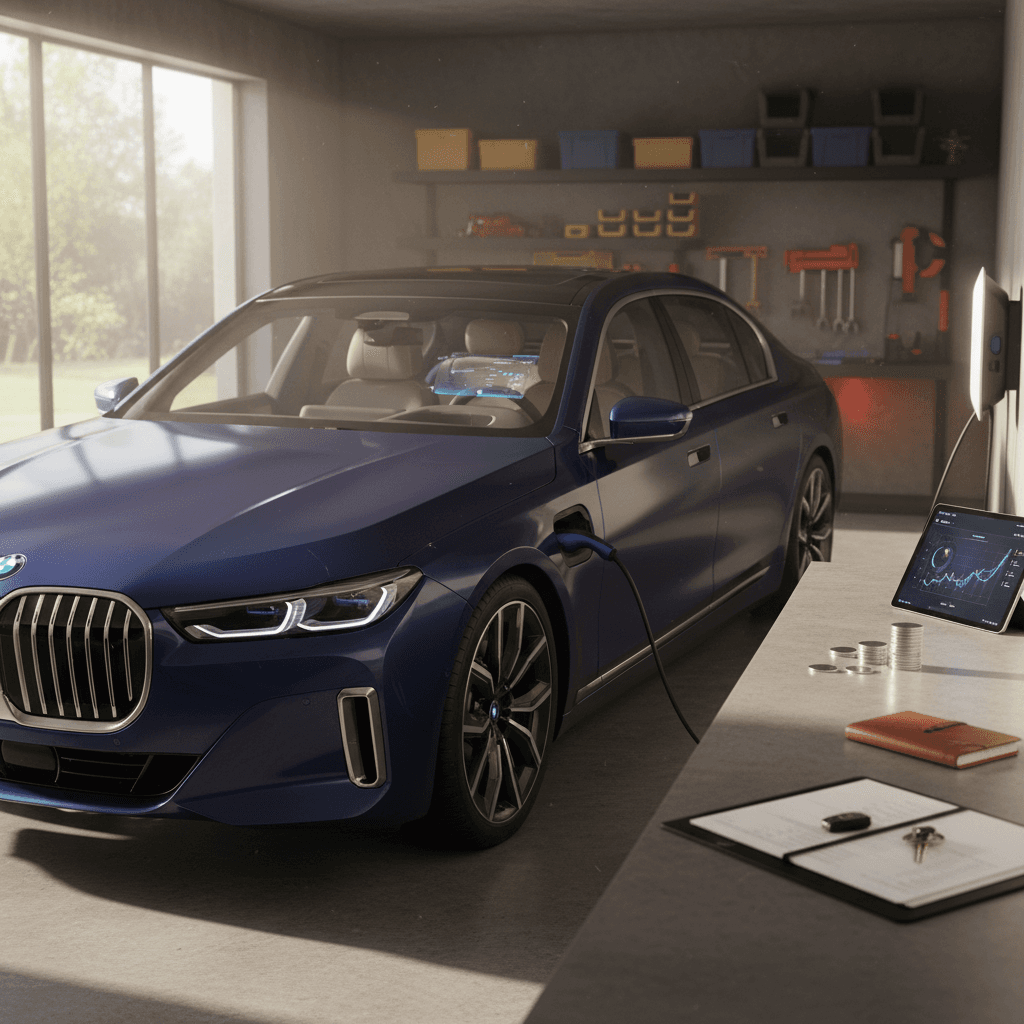
If you’re eyeing a flagship luxury EV, it’s natural to ask, “How much does it cost to own a BMW i7 per year?” Between a six‑figure sticker price, high‑end tires, and powerful dual motors, the numbers can add up fast. The good news: once you break it into buckets, payment, electricity, insurance, maintenance and depreciation, you can see whether an i7 fits your budget and how buying used can bring that total down.
Quick answer
BMW i7 annual ownership cost overview
Typical annual BMW i7 ownership costs (new, early years)
Add those buckets together and a new BMW i7 often runs $20,000–$27,000 per year in real‑world ownership cost early on. That’s the combination of what goes out of your bank account (payments, power, insurance, maintenance) plus the value the car is losing while you drive it (depreciation).
Why used often wins
Key assumptions behind the BMW i7 cost estimates
- Location: Typical U.S. owner using a mix of city and highway driving.
- Mileage: 12,000–15,000 miles per year.
- Charging: Mostly home Level 2 charging, some public DC fast charging on road trips.
- Model: BMW i7 xDrive60 or similar, well equipped (not the absolute base spec).
- Time horizon: First 3–5 years of ownership, where depreciation is steepest.
- Financing: 60–72 month loan with average credit, modest down payment.
Your numbers may differ
Annual BMW i7 loan or lease payments
The biggest visible cost on a BMW i7 is usually the payment itself. A new i7 commonly stickers north of $120,000 once you add options. With a standard down payment and typical interest rates, that can translate into a four‑figure monthly payment.
Illustrative annual payment scenarios for a BMW i7
These examples assume no major discounts and average credit. They’re ballpark figures, not quotes.
| Scenario | Vehicle price | Down payment | Term | Estimated monthly | Estimated annual |
|---|---|---|---|---|---|
| New i7, light options | $120,000 | $12,000 (10%) | 72 months | $1,750–$1,900 | $21,000–$22,800 |
| New i7, heavily optioned | $135,000 | $13,500 (10%) | 72 months | $2,000–$2,200 | $24,000–$26,400 |
| Used i7, 2–3 years old | $80,000 | $8,000 (10%) | 72 months | $1,150–$1,300 | $13,800–$15,600 |
| Used i7, higher mileage | $65,000 | $6,500 (10%) | 72 months | $950–$1,050 | $11,400–$12,600 |
How your annual BMW i7 payment changes with price and loan term.
Leasing can reduce the monthly payment in the short run, but you’re paying rent on a rapidly depreciating asset and typically face tight mileage limits. For many shoppers planning to keep the car beyond three years, financing a used i7 often delivers a better long‑term cost picture.
Where Recharged fits in
BMW i7 charging costs per year
The i7’s large battery and dual‑motor setup make it energy‑hungry, but electricity is still cheaper than premium gasoline on a per‑mile basis. To estimate annual charging cost, you only need three numbers: how efficient the car is, how far you drive, and what you pay per kilowatt‑hour (kWh).
Example BMW i7 annual charging cost
Illustrative charging costs for different mileage and electricity prices, assuming 2.5–3.0 miles per kWh.
| Annual miles | Miles per kWh | kWh needed | Home rate | Estimated annual cost |
|---|---|---|---|---|
| 12,000 | 3.0 | 4,000 | $0.14/kWh | ≈ $560 |
| 12,000 | 2.5 | 4,800 | $0.20/kWh | ≈ $960 |
| 15,000 | 2.8 | 5,357 | $0.18/kWh | ≈ $964 |
| 15,000 (road‑trip heavy) | 2.5 | 6,000 (mix home & DCFC) | Blended ≈ $0.22/kWh | ≈ $1,320 |
Home charging usually keeps BMW i7 energy costs under $1,400 per year for typical drivers.
Control your charging bill
Insurance, taxes, and registration
On a vehicle that can crest $120,000 new, insurance will not be cheap. Luxury EVs tend to carry higher repair costs, and the i7 is packed with sensors, cameras, and advanced driver‑assist tech. That all flows into your premium.
Typical annual BMW i7 fixed costs
What you’ll likely pay before charging or maintenance
Insurance premiums
In many U.S. markets, expect $2,000–$3,500 per year for full‑coverage insurance on a BMW i7, depending heavily on your driving record, credit tier, age, and ZIP code.
Registration & fees
Registration on a high‑value luxury EV can add $300–$700 per year, especially in states with value‑based or EV‑specific fees.
Sales & property taxes
At purchase, sales tax can add thousands to your out‑the‑door cost. Some states also levy annual property taxes on vehicles, which function like an extra ownership fee.
Shop insurance before you sign
Maintenance, tires, and unexpected repairs
EVs like the i7 avoid oil changes, spark plugs, and many transmission issues, but that doesn’t mean they’re low‑cost to maintain, especially in the luxury segment. You’re still dealing with complex air suspension, big brakes, wide high‑performance tires and intricate electronics.
BMW i7 maintenance and repair cost snapshot
Typical annualized costs once you average rare but expensive items over several years.
| Item | Typical cadence | Estimated cost | Annualized impact |
|---|---|---|---|
| Scheduled service & inspections | Every year | $400–$800 | $400–$800/yr |
| Tires (performance set) | Every 25,000–35,000 miles | $1,600–$2,200 | ≈ $500–$900/yr |
| Brakes & rotors (light EV wear) | 80,000+ miles | $1,200–$2,000 | ≈ $200–$300/yr |
| Repairs & out‑of‑warranty items | Varies widely | $0–$2,000+ | Budget ≈ $400–$800/yr |
Even without engine work, an i7 can carry $1,500–$3,000 per year in maintenance and wear items.
Don’t ignore tire costs
If you buy a used i7, pay very close attention to warranty coverage and battery health. That’s where a transparent, third‑party inspection helps. Every EV sold through Recharged includes a Recharged Score with verified battery diagnostics and condition checks, so you’re not guessing about major‑ticket items.
Depreciation: the silent big-ticket item
Depreciation is the largest but least visible cost of BMW i7 ownership. It’s the difference between what the car is worth today and what it’ll be worth when you sell or trade it. Luxury sedans historically lose value faster than mainstream crossovers, and many EVs depreciate faster than their gasoline equivalents, especially in the early years.
New BMW i7 depreciation
- Expect the typical new i7 to lose a big chunk of value in the first 3 years, simply because it starts so high.
- It’s not unusual for a six‑figure luxury EV to shed tens of thousands of dollars over that window.
- On an annual basis, that can mean $6,000–$8,000 per year (or more) in lost value, depending on mileage and spec.
Used BMW i7 depreciation
- By year 3–4, the depreciation curve usually starts to flatten.
- Buying a 2–3‑year‑old i7 means the first owner has already eaten the steepest part of the curve.
- Your annual depreciation may come down to the $3,000–$5,000 per year range over the next several years, all else equal.
How Recharged helps with depreciation
Ready to find your next EV?
Browse VehiclesNew vs. used BMW i7: how costs change
The biggest lever you control is whether you buy a new or used i7. The same car can look totally different on your balance sheet depending on when you step into the ownership cycle.
Estimated annual cost of owning a BMW i7: new vs. used
Approximate ranges for a typical U.S. driver over the first few years of ownership.
| Cost bucket | New i7 (early years) | Used i7 (2–3 yrs old) |
|---|---|---|
| Loan/lease payments | $21,000–$26,000/yr | $12,000–$16,000/yr |
| Charging | $800–$1,400/yr | $800–$1,400/yr |
| Insurance & fees | $2,300–$4,200/yr | $2,000–$3,500/yr |
| Maintenance & tires | $1,500–$3,000/yr | $1,800–$3,500/yr |
| Depreciation (non‑cash) | $6,000–$8,000+/yr | $3,000–$5,000/yr |
| Total est. annual cost | $20,000–$27,000 | $13,000–$18,000 |
Buying used significantly reduces both annual payments and depreciation on a BMW i7.
Cash cost vs. economic cost
Practical ways to lower your BMW i7 cost per year
7 ways to rein in BMW i7 ownership costs
1. Start with a well‑priced used i7
Let the first owner absorb the steepest depreciation. A 2–3‑year‑old i7 with a clean history and strong battery health can dramatically reduce both your payment and your annual value loss. That’s exactly the segment Recharged focuses on.
2. Right‑size your spec
Skip over‑the‑top packages you don’t need. Fewer add‑ons mean a lower purchase price, smaller loan, and reduced insurance exposure, all of which trim your yearly cost.
3. Charge mostly at home
Rely on Level 2 home charging where electricity is cheaper and predictable. Use DC fast charging strategically for trips, not as your daily habit, to keep your per‑mile energy cost and battery wear in check.
4. Shop insurance aggressively
Luxury EV insurance varies wildly by carrier. Get quotes from multiple companies and ask specifically about EV‑friendly discounts, telematics programs, and bundling with home insurance.
5. Protect your tires
Run the correct pressures, rotate on schedule, and avoid aggressive curbing or potholes. Stretching a high‑end tire set from 25,000 to 35,000 miles meaningfully lowers your annualized tire bill.
6. Follow smart maintenance, not upsells
Use the car’s service schedule and a trusted shop familiar with BMW EVs. Avoid unnecessary add‑ons and fluid changes that don’t apply to an EV drivetrain.
7. Consider ownership length
If you churn out of luxury cars every 24–30 months, you’ll live in the steepest part of the depreciation curve. Planning a longer holding period once you’re in a well‑bought used i7 can smooth out your cost per year.
Leverage expert guidance
BMW i7 ownership cost FAQ
Frequently asked questions about BMW i7 annual costs
Bottom line: what a BMW i7 really costs per year
When you tally everything, payments, electricity, insurance, maintenance, and depreciation, the real annual cost of owning a BMW i7 is substantial. A new example will often run you $20,000–$27,000 per year in economic cost during its early life, while a carefully chosen used i7 can often deliver the same core experience for roughly $13,000–$18,000 per year.
If the i7’s blend of silent speed and executive‑class comfort speaks to you, the smartest move is usually to let someone else pay for the steep first years of depreciation. A well‑vetted used i7 with a clean Recharged Score report, fair‑market pricing, and EV‑savvy financing can give you the flagship BMW experience with a much more livable annual ownership bill.