
If you’re shopping for an electric vehicle, especially a used one, you’ll keep running into the term battery State of Health (SoH). It sounds technical, but it’s simply a way to answer the question every EV shopper has: “How much life is left in this battery compared with when it was new?” Understanding SoH can help you avoid unpleasant surprises and spot genuinely good-value EVs.
In simple terms
What is battery State of Health (SoH)?
In an EV, State of Health is a measure of how “aged” the high-voltage battery is. Engineers define SoH as the ratio of the battery’s current usable capacity to its original design capacity, usually expressed as a percentage. Over time, chemical changes inside the battery cells reduce how much energy they can hold, this is called degradation, and SoH gradually declines.
- 100% SoH ≈ battery has essentially its original usable capacity
- 90% SoH ≈ battery has lost around 10% of usable capacity
- 80% SoH ≈ roughly 20% loss vs. new, often used as a “warranty threshold”
- Below ~70% SoH = noticeable range reduction and lower resale value
Think of SoH like a fuel tank that shrinks
SoH vs SoC vs battery capacity: what’s the difference?
State of Health (SoH)
- Long‑term measure
- Changes slowly over months/years
- Reflects aging and degradation
State of Charge (SoC)
- Short‑term “fuel gauge”
- Changes every time you drive or charge
- Shows how full the battery is right now
Battery Capacity
- Measured in kWh (e.g., 60 kWh)
- New capacity is what the pack could store when new
- Actual capacity is what it can store today, tied to SoH
It’s easy to confuse these terms because they’re all about the same battery. The key is timing: SoH changes slowly, SoC changes constantly, and capacity is the amount of energy the pack can actually hold. A used EV might show 80% SoC on the dash (plenty of charge for today), but the pack itself could be at 85–90% SoH compared with when it left the factory.
Typical EV battery aging patterns (very rough guidance)
Numbers vary by model
How EV battery State of Health is actually measured
Unlike a simple fuel tank, you can’t open an EV battery and dip a stick inside. So manufacturers use battery management systems (BMS) and diagnostic tests to estimate SoH based on how the pack behaves over time.
Common ways to estimate EV battery SoH
Most real-world SoH numbers come from one or more of these approaches
Onboard BMS estimate
The car’s BMS constantly tracks voltage, current, temperature, and usage patterns. Over many charge/discharge cycles, it derives an internal estimate of usable capacity, which underpins the SoH number.
Full charge/discharge analysis
Some diagnostic tools perform a controlled test, charging to a high state of charge and then discharging under known conditions, to calculate how many kWh the pack can actually deliver.
Historical data modeling
Advanced tools combine live measurements with historical data from similar vehicles, temperature histories, and charging behavior to refine SoH estimates and flag outliers.
Why different tools give different SoH numbers
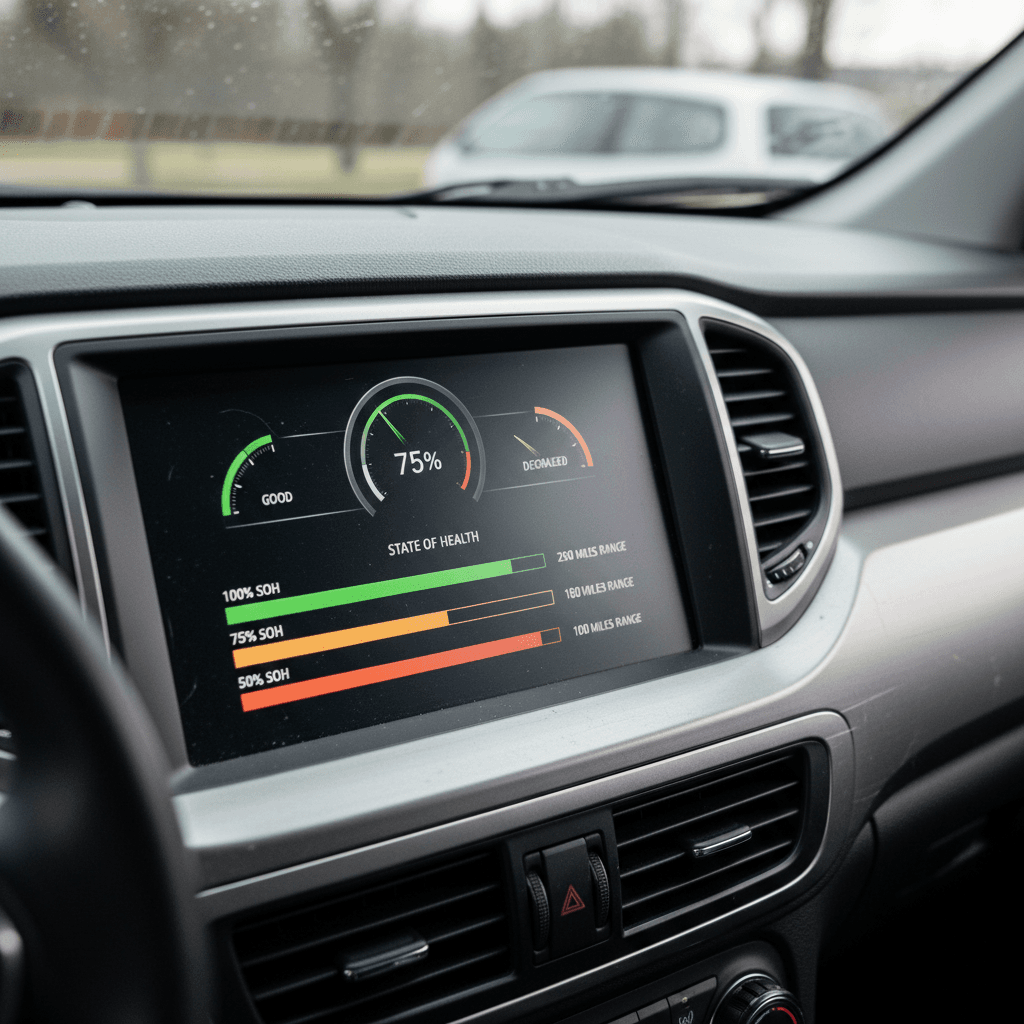
What is a good SoH for a used EV?
There’s no single magic cutoff, but you can use broad ranges to judge where a battery stands. You’ll also want to look at age and mileage, an 8‑year‑old EV at 88% SoH is much more impressive than a 2‑year‑old EV at the same number.
How to interpret EV battery State of Health when shopping used
Use these bands as a practical guide. Always consider age, mileage, and price alongside SoH.
| SoH Band | Typical Story | Impact on Range | What It Means for a Buyer |
|---|---|---|---|
| 95–100% | Very low mileage or gently used, often newer | Range is essentially like new | Excellent, but expect to pay a premium. |
| 90–94% | Normal early‑life degradation | Range loss usually hard to notice | Healthy for most used EVs, especially 2–5 years old. |
| 85–89% | Moderate aging | Range typically down ~10–15% vs. new | Still fine for many commuters; factor into price. |
| 80–84% | Significant but manageable loss | Range down ~15–25% vs. new | Good value if the price reflects the shorter range. |
| 70–79% | End of warranty territory for many OEMs | Range reduction is very noticeable | Treat as a budget buy and negotiate strongly. |
| Below 70% | Heavily aged or abused pack | Range can be half of original in extreme cases | Only consider if deeply discounted and you understand the limitations. |
SoH isn’t the only thing that matters, but it’s a powerful lens for comparing similar used EVs.
A practical rule of thumb
How SoH affects real-world range and resale value
SoH is about capacity, and capacity is the foundation of range. If a car had an EPA‑rated 250‑mile range when new, and its SoH has fallen to 85%, its effective full‑charge range might now be closer to 210–215 miles in similar conditions. In the real world, weather, speed, and driving style can move that number up or down, but SoH sets the ceiling.
- Lower SoH → fewer miles from 100% to near‑empty, even though the dash still reads 0–100%.
- On small‑battery EVs, a 10–15% loss can be the difference between making a commute comfortably or needing a midday charge.
- On large‑battery EVs, the same percentage loss may matter less because you were starting from a much higher range.
Resale value follows battery health
Examples: How SoH changes range and value in practice
These are illustrative examples, not quotes, actual numbers vary by model and market.
Compact EV with 150‑mile original range
- At 92% SoH: effective range maybe ~135–140 miles.
- At 80% SoH: effective range closer to ~115–120 miles.
- Result: High‑SoH cars remain viable for longer commutes; low‑SoH cars become city‑only options.
Long‑range EV with 300‑mile original range
- At 90% SoH: still around ~270 real‑world miles.
- At 80% SoH: roughly ~240 miles, still plenty for many drivers.
- Result: Larger packs can tolerate more degradation before daily usability is affected.
What makes battery SoH go down faster, or slower
Battery aging is unavoidable, but the rate of decline is not fixed. Your habits and environment can noticeably influence how quickly SoH drops. If you’re buying a used EV, clues about the prior owner’s routine can tell you a lot about how the pack was treated.
Key factors that influence EV battery State of Health
Frequent fast charging
DC fast charging (especially repeated back‑to‑back sessions) stresses the battery more than slower Level 2 charging. Occasional use is fine, but a steady diet of fast charging can accelerate SoH loss.
High average state of charge
Keeping a battery near 100% SoC for long periods, especially in hot weather, tends to increase degradation. Many manufacturers now recommend daily charging targets around 70–90% unless you need full range.
Deep discharges to very low SoC
Regularly running the battery down to near 0% before charging again can add wear over time. It’s fine in emergencies, but as a habit it’s better to stay out of the single digits when you can.
Heat and cold
Batteries hate extreme heat and, to a lesser extent, extreme cold. Parking in blazing sun or living in very hot climates without good thermal management can speed up SoH loss.
Aggressive driving and heavy loads
Frequent full‑throttle launches, towing at the limit, or driving at very high speeds puts more stress on the pack. Enjoy the torque, but understand it’s not free from a battery‑aging standpoint.
Smart charging habits
Gentle use, overnight Level 2 charging, moderate SoC targets, covered parking, helps preserve SoH. When you see a used EV with high SoH for its age, it’s often because the prior owner followed these practices.
What you can control as the next owner
How to check battery SoH on a used EV
Unlike odometer readings, SoH isn’t always obvious on the dashboard. Some manufacturers make it easy to see, others bury it, and a few don’t expose it at all. But you have several ways to get a meaningful view of battery health before you buy.
Four ways to assess SoH before buying a used EV
Use as many of these as you can, more data beats guesses.
1. Built‑in battery or range screen
Some EVs show usable capacity or degradation in a service menu or owner‑facing screen. Others show a battery health bar graph. It’s a rough but helpful indicator.
2. Third‑party diagnostic apps and dongles
For certain models, Bluetooth OBD‑II dongles plus an app can read BMS data and estimate SoH. This requires some setup and familiarity with EV‑specific tools.
3. Service records and warranty history
Dealer records may note any battery repairs or replacements. A relatively new pack in an older car can be a big plus, but verify whether it was new or refurbished.
4. Independent or marketplace battery report
Some sellers and marketplaces provide professional battery health reports based on dedicated diagnostic equipment. This is often the most straightforward and objective view.
Don’t rely on guesswork
How Recharged evaluates and reports battery SoH
Because battery health is the single most important factor in a used EV’s long‑term value, Recharged builds SoH into every vehicle listing. Instead of asking you to trust a dashboard estimate or a seller’s memory, each car comes with a Recharged Score that includes verified battery diagnostics.
What goes into the Recharged Score battery health section
Model‑specific test procedures
Different EVs expose battery data in different ways. Our technicians use <strong>model‑specific methods</strong> to read BMS information, perform controlled charge/discharge tests where appropriate, and normalize results.
Independent SoH estimate
We calculate an objective <strong>State of Health estimate</strong> and cross‑check it against vehicle age, mileage, and known patterns for that model line.
Context for real‑world range
Instead of throwing a bare percentage at you, the Recharged Score explains what that SoH means for <strong>expected driving range</strong> in normal use.
Fair‑market pricing aligned to SoH
Battery health feeds directly into our pricing analysis. Cars with stronger batteries are priced accordingly; cars with lower SoH are discounted, so you’re not overpaying for diminished capacity.
Expert guidance during the process
If you’re unsure how a specific SoH number should affect your decision, our EV specialists can <strong>walk you through the trade‑offs</strong> and help you compare vehicles on an apples‑to‑apples basis.
Nationwide, digital‑first experience
Whether you’re browsing inventory online or visiting our Experience Center in Richmond, VA, you’ll see <strong>transparent battery health data</strong> up front, no guesswork, no special tools required on your end.
Why this matters for your wallet
Ready to find your next EV?
Browse VehiclesBattery State of Health (SoH) FAQ
Frequently asked questions about battery State of Health (SoH)
Key takeaways before you buy a used EV
- SoH is the battery’s age in percentage form. It compares today’s usable capacity to what the pack could hold when new.
- Don’t confuse SoH with the charge level on the dash. State of Charge (SoC) is today’s fuel gauge; SoH is long‑term battery health.
- High‑80s and above is generally a comfortable SoH range for most used‑EV shoppers, assuming age, mileage, and price all make sense.
- Your habits matter. Gentle charging and avoiding extreme heat can slow further SoH loss and preserve range over the years you own the car.
- Documentation beats guesswork. Whenever possible, ask for a professional battery health report or buy from a marketplace like Recharged that includes SoH in a transparent Recharged Score.
An EV’s battery doesn’t have to be perfect to be a smart buy, but you should know where it stands. Understanding battery State of Health (SoH) gives you a clear, comparable way to judge different vehicles, negotiate price, and choose the car that truly fits your range needs. If you’d like help interpreting SoH numbers or comparing used EVs, Recharged can provide expert guidance, fair‑market pricing, and verified battery diagnostics so you can shop with confidence from your couch, or at our Experience Center in Richmond, VA.