If you’re eyeing a VW ID.4 for road trips, or already own one and wonder how it will handle a few hundred miles in a day, you’re asking the right questions. Highway range, charging stops, and comfort matter more on the open road than they do in your daily commute. This VW ID.4 road trip review pulls together real‑world range data, charging behavior, and long‑distance comfort to help you decide if it fits the way you actually travel.
Who this review is for
VW ID.4 Road Trip Fast Facts
Why the VW ID.4 Makes Sense for Road Trips
On paper, the Volkswagen ID.4 checks a lot of road‑trip boxes: a roomy cabin, quiet ride, generous cargo space, and a usable EPA range up to about 291 miles on some rear‑drive Pro S trims. In practice, that translates into comfortable 2.5–3.5‑hour stints between charges with a family’s worth of gear on board. The ID.4 isn’t the quickest‑charging or longest‑range EV on the market, but it’s one of the more relaxed and predictable ways to cover serious miles, especially if you value comfort as much as outright speed.
Main road trip strengths
- Comfort-first tuning: Soft ride and quiet cabin reduce fatigue over long days.
- DC fast charging capability: 10–80% in roughly 30–36 minutes on a strong 135–175 kW charger.
- Spacious interior: Adult‑friendly back seat and big cargo area rival many compact SUVs.
- Standard driver assists: Adaptive cruise and lane centering make highway slogging far easier.
Main road trip tradeoffs
- Not a range champion: Real‑world highway range lags some rivals and Tesla crossovers.
- Charging curve matters: Best speed is between roughly 10–55% state of charge; above that, speeds taper.
- Charging network dependence: In 2024–2025, you’re still leaning heavily on Electrify America, with Tesla access relying on an adapter.
- Software quirks: Infotainment lag and learning curve can be annoying if you’re used to simpler systems.
Real-World Highway Range: What You Can Actually Expect
On a road trip, the question isn’t “What’s the EPA number?” It’s “How far can I drive at 70 mph with passengers, bags, and maybe a headwind?” For most 77–82 kWh ID.4 models, you should plan around 220–260 miles per highway leg in mild weather, not the full EPA rating.
Typical VW ID.4 Highway Range by Scenario
Assuming a 77–82 kWh battery, starting near 90–100% and stopping around 10%
Mild weather (60–75°F)
Rear‑drive Pro / Pro S: 250–260 miles at 70 mph is realistic if you’re not climbing mountains.
AWD models: Expect roughly 230–245 miles, thanks to extra weight and dual motors.
Cold weather (below ~35°F)
With heat on and winter tires, real‑world highway range can drop by 20–35%.
Think 170–210 miles as a planning number, especially for the first leg with a cold-soaked battery.
High speeds / heavy loads
Running 75–80 mph, loaded with people and cargo, can push you toward the low 200s even in good weather.
If you’re towing a small trailer, be conservative, cut expectations roughly in half and plan more frequent stops.
Plan legs, not max range
Charging on the Road: Electrify America, Tesla Superchargers, and More
The VW ID.4 is most at home on DC fast chargers in the 150–175 kW class. Earlier U.S. cars typically peak around 125–135 kW and can go from roughly 10–80% in about 36 minutes on a healthy charger; newer SK On–equipped packs can peak as high as about 175 kW and trim that 10–80% window to around 28–30 minutes. In real life, that’s a coffee‑and‑bathroom stop, not a full lunch break.
VW ID.4 Road Trip Charging at a Glance
Approximate values for 77–82 kWh battery packs on strong chargers
| Charger Type | Power Level | 10–80% Time | Miles Added (Approx.) | Best Use Case |
|---|---|---|---|---|
| DC fast | 135–175 kW | 28–36 min | 180–220 mi | Highway legs on busy corridors |
| DC fast | 50–75 kW | 45–70 min | 120–170 mi | Rural areas or older sites |
| Level 2 public | 7–11 kW | 3–5 hrs (20–80%) | 80–150 mi | Overnight stay, long meals, sightseeing stops |
| Home Level 2 | 7–11 kW | 7.5–11.5 hrs (0–100%) | Full charge | Start the trip full and precondition in winter |
Your real times depend on temperature, charger quality, and starting state of charge.
Electrify America perks for newer ID.4s
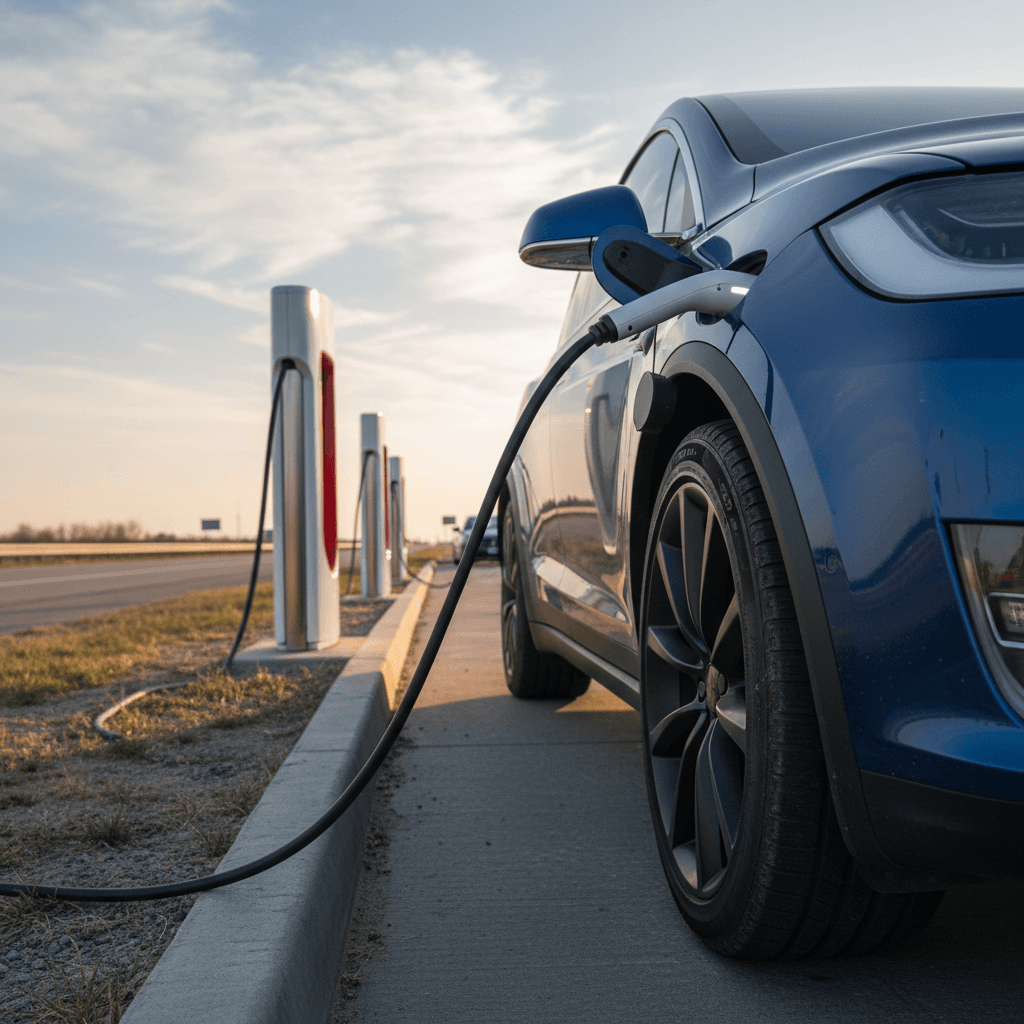
For now, most ID.4 owners rely heavily on Electrify America and similar CCS networks. Starting in late 2025, U.S. VW EV owners also gain access to Tesla’s Supercharger network via a Volkswagen‑approved NACS adapter sold separately. If you drive a compatible 2024–2025 ID.4 and add the adapter plus software update when available, your road‑trip options expand considerably, especially in regions where CCS infrastructure is thin.
Check for recalls and charging updates
Comfort and Quiet Over Long Distances
If your last long trip was in a compact gasoline SUV, the ID.4 will feel like a step up in refinement and quiet. The suspension tuning is on the soft side, which pays dividends on broken pavement and long interstate stretches. Road and wind noise are well controlled, and the instant electric torque makes merging and passing less stressful, even if the ID.4 isn’t a performance EV.
Long-Distance Comfort Highlights
Where the ID.4 shines when the odometer starts to climb
Supportive seats
Front seats remain comfortable into hour three and four, especially on Pro S trims with power adjustments and lumbar support. Heated seats and steering wheel help in winter.
Quiet, simple climate control
Automatic climate and seat heaters keep everyone comfortable. Just remember climate use does trim range, especially in very cold or very hot weather.
Roomy rear seat
Adults can sit behind adults without knees in the seatback. For families, that means fewer arguments about who gets the front on long days.
Dial in your driving position before you leave
Cargo Space: Family- and Dog-Friendly
With the rear seats up, the ID.4 offers a generous cargo hold for luggage and strollers, and with the rear seats folded, you get up to about 64 cubic feet of space. That’s on par with many compact crossovers, and the low load floor makes it easy to get heavy items in and out. The wide hatch opening and squared‑off roofline make the space more usable than sleeker, coupe‑style EVs.
- Suitcases for four plus a cooler fit easily under the cargo cover.
- Fold the rear seats and you can carry bikes, camping gear, or even small furniture.
- A mostly flat load floor makes it dog‑friendly with the right barrier or harness.
Roof boxes and range
Software, Tech, and Driver Assistance
Volkswagen’s software has improved since the earliest ID.4s, but it still isn’t the most intuitive in the EV world. That said, once you’re past the learning curve, the built‑in navigation, Travel Assist, and adaptive cruise control can take a lot of stress out of highway driving.
Driver-assistance worth using
- Adaptive cruise control: Smoothly maintains following distance in traffic, ideal for busy interstates.
- Lane centering (Travel Assist): Gently keeps the ID.4 in its lane on clearly marked highways, great for fatigue reduction, but keep your hands on the wheel.
- Traffic sign recognition: Helpful reminder of current speed limits in unfamiliar areas.
Infotainment & apps
- Wireless Apple CarPlay/Android Auto: Use your favorite navigation and charging apps instead of relying solely on the built‑in system.
- Charging integration: The ID.4’s native maps can show charging options, but most road‑trippers still prefer third‑party tools alongside it.
- Over‑the‑air updates: Later model years get improvements to software and features; make sure your used ID.4 is fully updated.
Bring backup navigation
Winter Driving and Range Hit
Cold weather doesn’t just make you and your passengers uncomfortable, it makes your battery less efficient. In freezing temperatures, expect your highway range to drop by 20–35%, especially on the first leg of the day when the battery is cold. Cabin heat, heated seats, and defrost all draw energy, and charging itself can be slower until the pack warms up.
Cold-Weather Road Trip Tips for the ID.4
1. Precondition while plugged in
On cold mornings, heat the cabin and (if available in your software version) precondition the battery while you’re still on Level 2 at home or the hotel. That energy comes from the grid instead of your battery.
2. Use seat and wheel heaters
Seat and steering‑wheel heaters use less energy than blasting cabin heat. You stay just as comfortable with a smaller range penalty.
3. Shorten your planned legs
If you’d normally plan 180–200‑mile legs in mild weather, think closer to 140–160 miles in sub‑freezing temperatures, especially in snow or heavy rain.
4. Watch charging speeds
A cold battery charges more slowly. If you can, drive 20–30 miles before your first DC fast charge so the pack is warm enough to take advantage of the ID.4’s full power.
Road Trip Planning Tips for ID.4 Owners
A successful VW ID.4 road trip is less about hero numbers and more about rhythm: consistent legs, predictable stops, and backup options if a charger misbehaves. With a bit of planning, the ID.4’s comfort and quiet start to matter more than the stopwatch.
Step-by-Step: Planning a Road Trip in Your ID.4
1. Start with a full battery at home
Install or use a solid Level 2 charger so you leave with 90–100% in the pack. This first, long leg is often your most efficient and buys you flexibility later.
2. Map your charging spine first
Identify DC fast chargers every 120–180 miles along your route, then pick primary and backup stops. Pay attention to power level (kW) and recent user reports in apps like PlugShare.
3. Aim to charge from roughly 10–60%
The ID.4 charges fastest in this window. Stopping a bit earlier and more often can actually cut your total charging time versus pushing to 5% and charging to 90% each time.
4. Synchronize stops with meals and breaks
Time one or two 30–40‑minute DC fast charges to overlap with lunch, a coffee break, or a leg‑stretching walk. It makes charging feel like part of the trip instead of a delay.
5. Bring your charging ‘toolkit’
Carry your portable Level 1/2 cable, any needed adapters, and your main network RFID cards. Redundancy pays off at older stations or in rural areas.
6. Keep an eye on weather and elevation
Headwinds, hills, and extreme temperatures all trim range. Build in extra buffer if you’re crossing mountain passes or driving into a stiff headwind.
How Recharged can help you start strong
Ready to find your next EV?
Browse VehiclesUsed VW ID.4 Road Trip Readiness Checklist
A lightly used ID.4 can be a terrific value, especially if someone else already absorbed the initial depreciation. But before you point the nose at another state, it’s worth verifying a few things that matter more on the open road than they do around town.
Key Road Trip Checks for a Used VW ID.4
Review these items before committing to a long journey in a pre-owned ID.4
| Item to Check | What to Look For | Why It Matters on a Road Trip |
|---|---|---|
| Battery health | Evidence of good usable capacity and balanced cells; third‑party or dealer report | Determines how much real‑world range you have and how consistent your charging speeds will be. |
| DC fast charging behavior | Test a 10–60% DC fast charge on a reputable station | Reveals whether the car can hit expected kW levels or tapers too early. |
| Software & recalls | Proof that all campaigns and OTA updates are current | Reduces risk of charging glitches, safety issues, or missing features on the road. |
| Tires & alignment | Even tread wear and correct EV‑rated tires | Uneven wear can hurt range and stability; EV‑rated tires handle weight and torque better. |
| Brakes & suspension | No clunks, pulls, or vibration at highway speeds | You’ll spend hours at speed, any small issue becomes a big annoyance over time. |
| Charging equipment | Included mobile cable, any adapters, and their condition | Gives you flexibility if a DC fast charger is out of service or a hotel only has Level 2. |
A structured inspection plus a battery health report gives you confidence far beyond what a basic test drive can reveal.
Leverage the Recharged Score Report
FAQ: VW ID.4 Road Trip Questions Answered
Frequently Asked Questions About VW ID.4 Road Trips
Verdict: Is the VW ID.4 a Good Road Trip EV?
If your idea of a perfect EV road trip is non‑stop runs between ultra‑fast chargers and triple‑digit speeds, the VW ID.4 isn’t the hero of your story. But if you value comfort, calm, and predictability over outright bragging rights, the ID.4 is a quietly excellent companion for long‑distance travel. Its real‑world range, especially in rear‑drive 77–82 kWh trims, is more than adequate for 2.5–3‑hour legs, and its DC fast‑charging performance is competitive enough that your charging stops feel like natural breaks, not roadblocks.
For shoppers considering a used VW ID.4, the key is understanding the specific car’s battery health, charging behavior, and update status before your first big adventure. That’s where tools like the Recharged Score Report and EV‑specialist guidance really pay off. Get those fundamentals right, build a realistic route plan, and the VW ID.4 will carry you and your crew across states with a lot less drama, and a lot more quiet, than many gas crossovers ever could.