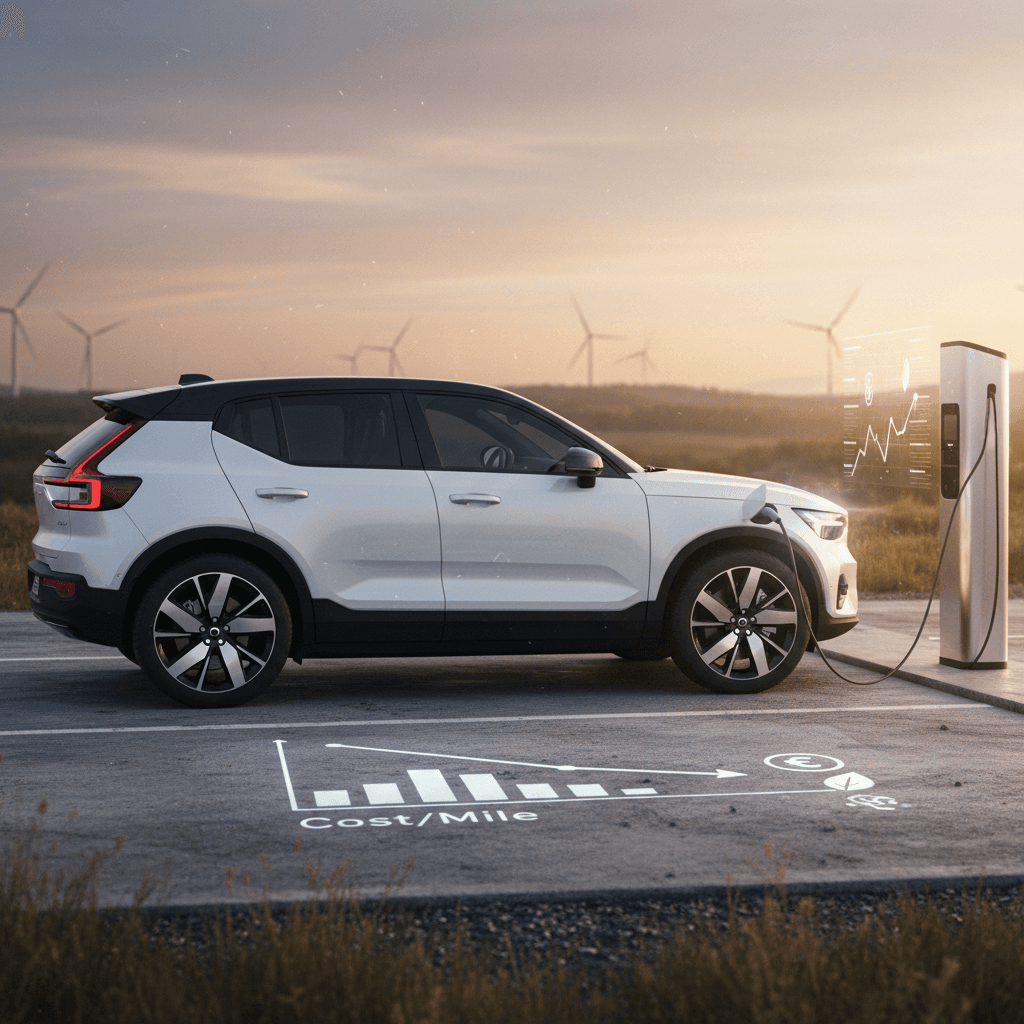
You don’t buy a Volvo EX30 just because it’s cute and quick. You buy it because you want an electric SUV that’s cheap to run. The natural question is: what does it actually cost per mile to drive a Volvo EX30 on electricity in 2026?
Cost per mile in one glance
Volvo EX30 cost per mile: quick overview
Typical Volvo EX30 electricity cost per mile (U.S. 2026)
Those numbers are averages drawn from the EX30’s EPA efficiency ratings and real‑world owner reports, layered on top of current U.S. electricity prices around $0.17–$0.19 per kWh as of late 2025 and early 2026. Your personal cost per mile will live somewhere on that spectrum.
How we calculate Volvo EX30 cost per mile
Whether we’re testing cars for a magazine or helping shoppers at Recharged, the math behind cost per mile is the same. You only need two numbers:
- Your Volvo EX30’s efficiency (how many kWh it uses to go a certain distance).
- Your electricity price (what you pay per kWh).
The basic formula is straightforward:
Cost per mile = (kWh per 100 miles ÷ 100) × electricity price per kWh
Or, if you prefer to think in reverse:
Cost per mile = electricity price per kWh ÷ miles per kWh.
Two ways to grab your efficiency number
EPA efficiency for each Volvo EX30 trim
Volvo publishes EPA efficiency ratings in MPGe, but it also backs into combined consumption and range numbers. To keep this simple, we’ll convert that into easy, shopper‑friendly kWh per 100 miles and miles per kWh estimates for each trim.
Volvo EX30 EPA-style efficiency by trim
Approximate consumption figures based on EPA ratings for 2025–2026 EX30 models. Your real-world numbers will vary with weather, speed, and terrain.
| Trim | EPA range (mi) | Battery (usable kWh est.) | Approx. kWh/100 mi | Approx. mi/kWh |
|---|---|---|---|---|
| Single Motor Extended Range (RWD) | ~261 | ~64 | ~24–25 | ~4.0–4.2 |
| Twin Motor Performance (AWD) | ~253 | ~64 | ~25–26 | ~3.8–4.0 |
| Cross Country Twin Motor | ~227 | ~64 | ~28 | ~3.6 |
Use these numbers for cost-per-mile estimates when shopping or comparing.
Those are back‑of‑napkin numbers, but they line up with the EX30’s published efficiency and what we see in early testing. The Single Motor RWD is the star here; AWD and Cross Country trims pay a small penalty in kilowatt‑hours to push more power and more tire through the air.
Remember: EPA isn’t the weather forecast
Electricity price scenarios: cheap, average, expensive power
Electricity is the wild card in your EX30 cost per mile. Nationally, the U.S. is sitting in the high‑teens per kWh. December 2025 data puts the average residential rate around $0.18–$0.19 per kWh, with some states well under $0.15 and others, California, for example, north of $0.25 per kWh.
Three electricity price scenarios for EX30 owners
Plug your local rate into these examples to get your own number.
Low-cost power
Example: $0.13/kWh (cheap Midwest or Southeast utility, off‑peak EV rate).
Single Motor EX30:
24 kWh/100 mi × $0.13 = $3.12 per 100 miles → about $0.03/mi.
Average U.S. rate
Example: $0.18/kWh (around current U.S. average).
Single Motor EX30:
24 kWh/100 mi × $0.18 = $4.32 per 100 miles → about $0.04–$0.05/mi.
High-cost power
Example: $0.26/kWh (pricey coastal state, standard tier).
Single Motor EX30:
24 kWh/100 mi × $0.26 = $6.24 per 100 miles → about $0.06–$0.07/mi.
If you drive a Twin Motor Performance or Cross Country, add roughly 10–15% to those numbers in similar conditions. You’re buying extra traction and punch; it comes with a slightly higher energy appetite.
Cheapest miles: home, off‑peak, and Level 2
Real-world EX30 efficiency vs EPA, and what it does to cost per mile
The EX30 is a stubby little thing with big power, and owners are discovering what that means for efficiency. Plenty of drivers report fantastic numbers in gentle use, but others see 25–33 kWh/100 miles on everyday trips, especially with highway speeds, hills, or cold weather.
EPA-style, gentle driving
- Single Motor: ~24–25 kWh/100 mi (about 4.0–4.2 mi/kWh).
- Twin Motor: ~25–26 kWh/100 mi (about 3.8–4.0 mi/kWh).
- Cross Country: ~28 kWh/100 mi (about 3.6 mi/kWh).
At an average $0.18/kWh, that’s roughly $0.04–$0.05 per mile in pleasant, mixed driving.
“I drive it like I stole it” reality
- Many Twin Motor owners report 27–33 kWh/100 miles at 70–80 mph or in colder climates.
- That’s closer to 3–3.5 mi/kWh.
At $0.18/kWh, 30 kWh/100 mi costs about $5.40 per 100 miles, or roughly $0.05–$0.06 per mile.
Why winter hurts your cost per mile
Volvo EX30 cost per mile vs a comparable gas SUV
Numbers are nice, but they mean more when you line them up next to something familiar. Let’s pit the EX30 against a typical compact gas SUV, think a well‑equipped, all‑wheel‑drive model rated around 26 mpg combined.
Electric Volvo EX30 vs gas compact SUV: cost per mile
Fuel-only comparison using approximate national averages for electricity and gasoline in early 2026.
| Vehicle | Energy use | Energy price example | Approx. cost per mile |
|---|---|---|---|
| Volvo EX30 Single Motor (mixed driving) | 26 kWh/100 mi (3.8 mi/kWh) | $0.18/kWh | ~$0.05/mi |
| Volvo EX30 Twin Motor (spirited driving) | 30 kWh/100 mi (3.3 mi/kWh) | $0.18/kWh | ~$0.06/mi |
| Gas compact SUV (AWD, 26 mpg) | 1 gal/26 mi | $3.00/gal gas | ~$0.12/mi |
| Thirstier compact SUV (22 mpg) | 1 gal/22 mi | $3.00/gal gas | ~$0.14/mi |
This doesn’t include maintenance or insurance, just what it costs to make the car move.
Even when you give the EX30 a realistic, not‑so‑heroic efficiency number and use solid, not bargain‑basement electricity prices, your cost per mile is roughly half that of a comparable gas SUV. Over 12,000 miles a year, that’s easily $700–$1,200 in fuel savings.
Where used EX30s shine
Ready to find your next EV?
Browse Vehicles7 ways to lower your Volvo EX30 cost per mile
Practical ways to keep your EX30 cheap to run
1. Hunt for a better electricity rate
Check if your utility offers time‑of‑use or EV‑specific plans. Shifting most of your EX30 charging to off‑peak hours can knock <strong>20–40%</strong> off each kWh, and that slices your cost per mile instantly.
2. Charge primarily at home
DC fast charging is convenient but often more expensive per kWh than home power, and it can be less efficient. Treat public fast charging as your road‑trip or emergency solution, not your daily habit.
3. Keep highway speeds in check
The EX30’s short, boxy profile means aerodynamic drag ramps up fast above 70 mph. Backing off by 5–10 mph on the highway can save several kWh per 100 miles, trimming a cent or two off each mile.
4. Use preconditioning smartly
In cold weather, preheat the cabin and battery while the car is still plugged in. That way more of the energy to get you comfortable comes from the grid, not your battery pack, improving miles per kWh once you hit the road.
5. Watch your wheels and tires
Bigger wheels and stickier tires look terrific but can sap efficiency. If you live in a climate that doesn’t demand aggressive rubber, consider lower‑rolling‑resistance tires when it’s time to replace them.
6. Mind your cargo and roof racks
Roof boxes and bike racks punish efficiency on any EV, and the EX30 feels it. Removing them when you’re not using them is an easy way to win back a few miles of range and nudge your cost per mile down.
7. Track your own numbers
Use the Volvo app to watch your average kWh/100 miles over weeks, not just one trip. Then treat it like a game, see how low you can get it without making yourself miserable. Little improvements add up.
Cost per mile on a used Volvo EX30
When you’re looking at a used EX30, you’re not just buying a car, you’re buying a bundle of future miles. Electricity is only one piece of the total cost of ownership puzzle, but it’s a big one, and it’s wonderfully predictable if you have good data.
What a used EX30 changes
- Purchase price drops, which lowers depreciation per mile.
- Electricity cost per mile stays similar as long as the battery is healthy.
- Maintenance is still low compared with gas (no oil changes, fewer wear items).
Where Recharged helps
Every EX30 listed on Recharged includes a Recharged Score Report, with verified battery health and detailed vehicle history. That tells you whether the car’s pack is still delivering the efficiency you’re counting on for those cheap electric miles.
Battery health and your cost per mile
Volvo EX30 cost per mile: FAQ
Frequently asked questions about Volvo EX30 cost per mile
Bottom line: what you should budget per mile
If you’re cross‑shopping the Volvo EX30 against a gas compact SUV, the story is clear: even with real‑world driving and today’s electricity prices, the EX30 usually costs about half as much per mile in energy as a similar gasoline model.
In most of the U.S. in 2026, it’s reasonable to pencil in $0.05–$0.09 per mile for electricity in an EX30, depending on your trim, driving style, and utility rates. Drive gently on cheap off‑peak power and you’ll be closer to 3–4 cents per mile. Hammer the Twin Motor all winter on pricey coastal power and you’ll inch toward ten.
If you want to stack the deck even further in your favor, a used EX30 with a clean battery health report gives you low energy costs and a lower purchase price. That’s where Recharged earns its keep: every EV comes with a Recharged Score Report, transparent pricing, and EV‑savvy guidance so you know exactly what each mile will cost you before you ever plug in.