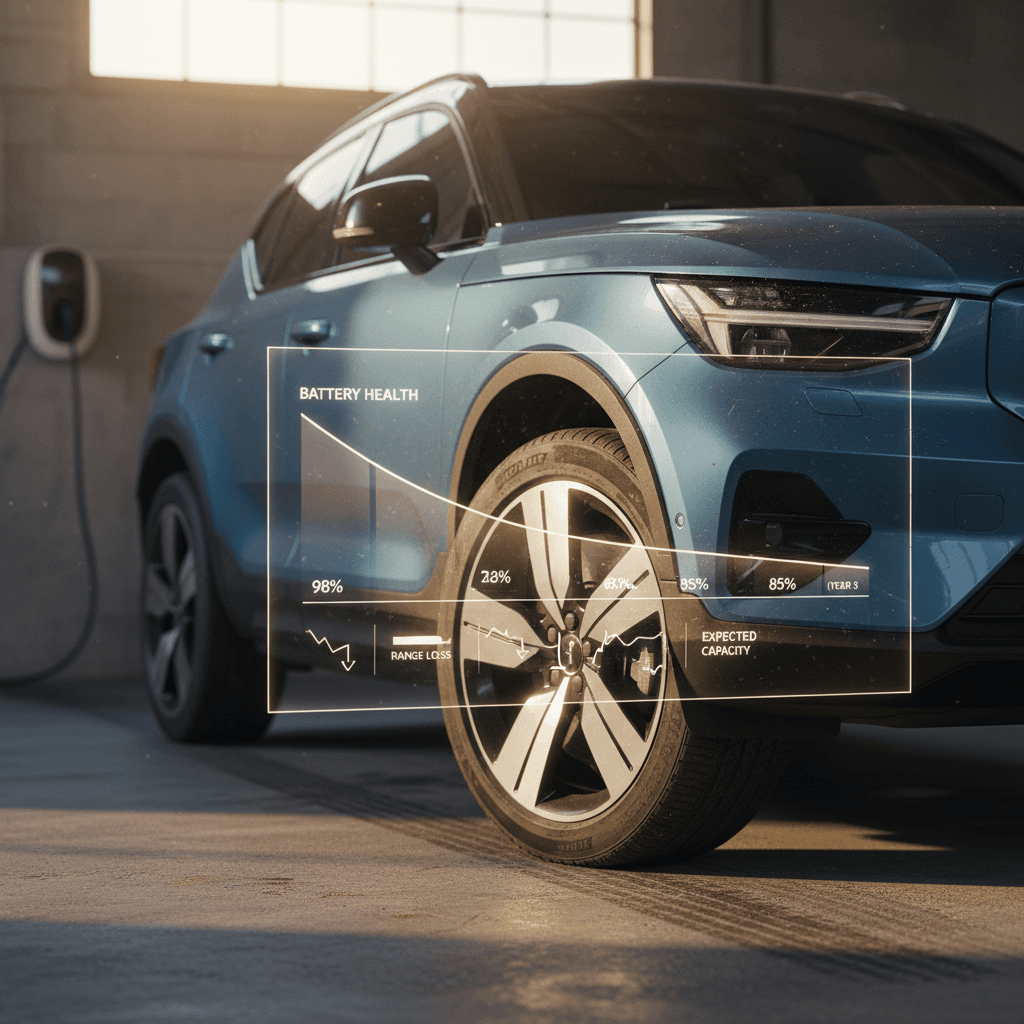
If you’re considering a Volvo C40 Recharge, or already own one, the big question is how much **battery degradation per year** you should realistically expect. Battery health directly affects range, resale value, and how confident you feel on longer drives, especially once the car is a few years old.
Quick Answer
Overview: How the Volvo C40 Recharge Battery Degrades Over Time
The C40 Recharge uses a large **lithium‑ion traction battery** (roughly 75 kWh usable, depending on model year and software) designed to last the life of the vehicle. Like all EVs, it slowly loses usable capacity over time. That means less range, but not an overnight cliff, more of a gentle slope.
- Degradation is **normal and expected**, not a defect by itself.
- The **steepest drop** typically happens in the first 1–2 years as the pack “beds in.”
- After that, **degradation tends to slow**, especially with gentle charging habits.
- Volvo’s battery management system (BMS) keeps a buffer at the top and bottom of the pack to protect long‑term health.
Don’t Fixate on 100%
How Much Do EV Batteries Degrade Per Year? Where the C40 Fits
We don’t have a decade of fleet data specific to the C40 Recharge yet, but we do have solid data from **similar Volvo EVs and other modern packs**. When you put that together with Volvo’s conservative thermal management, a realistic picture emerges.
Typical Modern EV Battery Degradation
Put simply, if you treat the battery reasonably well, a **C40 Recharge that starts at about 225–275 miles of real‑world range** (depending on drive style, trim, wheel size, and climate) might lose something like **10–15% of that range over 7–8 years**. That’s enough to notice, but not enough to make the car unusable for most daily driving.
Rule of Thumb for Volvo C40 Recharge
Real-World Volvo C40 Recharge Degradation Patterns
Real‑world C40 Recharge owners commonly report range changes that fall inside the same pattern we see in other liquid‑cooled EVs from established brands.
What Owners Commonly See Over Time
Examples based on typical use, not guarantees
Years 0–2
2–5% capacity loss is common. Many owners barely notice because seasonal weather swings can hide the trend.
Years 3–5
Degradation often slows. You might see a total of 6–10% loss versus new, especially with gentle home charging.
Years 6–8+
Most well‑cared‑for packs land around 10–15% total loss. Hard‑used or hot‑climate cars might be higher.
Cold Weather vs. Degradation
7 Factors That Speed Up C40 Recharge Battery Degradation
Two C40 Recharge models with the same odometer reading can have very different battery health. The difference usually comes down to **how the pack was treated**. Here are the big levers.
Main Drivers of Faster Battery Degradation
1. Frequent DC fast charging
Regularly charging at high‑power DC stations (especially from low SOC up to 100%) heats the battery and accelerates wear. Occasional road‑trip use is fine; daily use is not ideal.
2. Living in extreme heat
Sustained exposure to high ambient temperatures, especially when the car sits at high state of charge, can age cells faster. Shaded parking and garages help a lot.
3. Keeping the battery at 100%
Parking at or near 100% for many hours is harder on the chemistry. It’s better to charge to a moderate level for daily use and save full charges for trips.
4. Always running very low
Repeatedly driving down near 0% and then fast‑charging back up is stressful. Occasional deep cycles happen, but they shouldn’t be your normal pattern.
5. High annual mileage
More cycles equals more wear. A C40 driven 25,000 miles per year will typically show more degradation than one driven 7,500 miles, everything else being equal.
6. Aggressive driving and heavy loads
Hard acceleration, towing, and heavy cargo increase current draw and heat. That doesn’t destroy the pack, but over years it can nudge degradation upward.
7. Poor software maintenance
Skipping software updates or ignoring battery‑system alerts can leave you without optimizations Volvo publishes over time. Updates can improve efficiency and thermal control.
Red Flags on a Used C40 Recharge
How to Slow Your Volvo C40 Recharge Battery Degradation
The good news is that you have a lot of control over how quickly your C40 Recharge loses capacity. You don’t need to baby the car, but a few small habits can meaningfully protect long‑term range.
Simple Habits That Protect Your C40 Battery
Small changes, big impact over 8–10 years
Optimize your daily charge target
For daily driving, set your charge limit around 70–80% instead of 100%. Use higher limits only when you truly need the range for a trip.
Prioritize Level 2 home charging
Most charging should happen at Level 2 AC at home or work. Save high‑power DC fast charging for road trips or true convenience needs.
Time your charging
Use scheduled charging so the car finishes charging shortly before you leave. That reduces the time the battery spends at high state of charge.
Control temperature exposure
Whenever possible, park in a garage or shade, especially in hot climates. Pre‑conditioning the cabin while plugged in also helps the battery stay in its comfort zone.
How Recharged Helps
Ready to find your next EV?
Browse VehiclesBattery Degradation & Used C40 Recharge Shopping
If you’re shopping for a **used Volvo C40 Recharge**, battery degradation isn’t something to fear, it’s something to measure. A solid pack with modest wear can be a fantastic value; an abused pack can turn into frustration.
What to Ask the Seller
- Charging habits: Home Level 2 vs. frequent DC fast charging.
- Typical usage: Daily commuting, long‑distance travel, or commercial use.
- Climate history: Has the car lived in very hot or very cold regions?
- Software updates: Has the owner kept Volvo software current?
What to Inspect or Verify
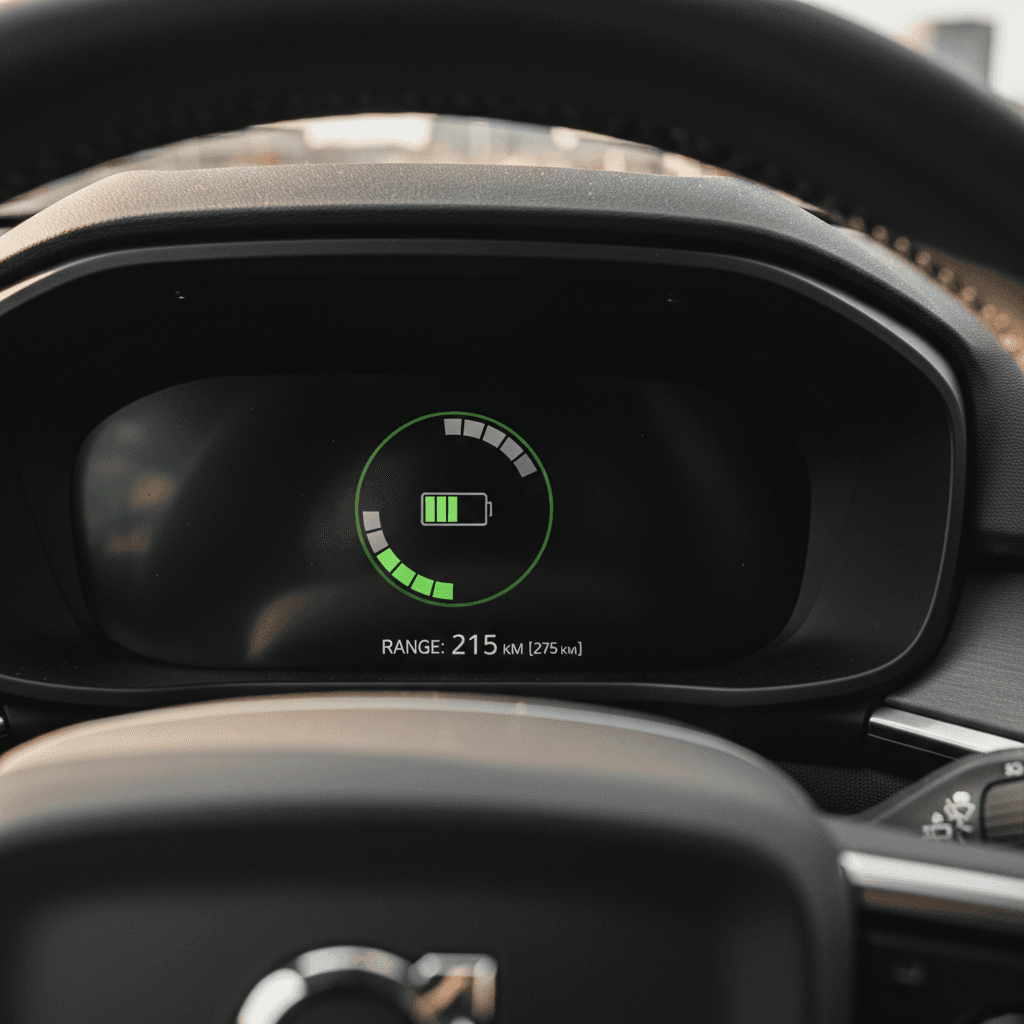
- Displayed range: With a known state of charge, does the estimate make sense for the model year?
- Service records: Any battery‑system warnings or repairs?
- Independent diagnostics: Tools or services that read the pack’s health, not just the dash.
- Warranty status: How many years and miles remain on the battery warranty?
Use Objective Battery Data
Volvo Battery Warranty and What It Really Covers
Battery warranties are your safety net against **abnormal degradation**. Volvo’s coverage for the C40 Recharge is similar to other premium EVs and typically includes:
- An **8‑year or similar time‑and‑mileage warranty** (consult the owner’s manual or Volvo documentation for your region).
- Protection against the battery falling below roughly **70% of its original capacity** within the warranty period, assuming proper use.
- Coverage for defects in materials and workmanship related to the battery pack and high‑voltage components, subject to terms and conditions.
Warranty Is Not a Wear Guarantee
Range Loss Calculator: C40 Recharge Examples
Let’s walk through how **per‑year battery degradation** feels in day‑to‑day range on a Volvo C40 Recharge. The exact numbers vary by wheel size, drivetrain, and conditions, so we’ll use simple, round figures to illustrate the impact.
Illustrative C40 Recharge Range vs. Degradation
Approximate real‑world range examples assuming a 225‑mile reference when new. These are sample scenarios, not guarantees.
| Scenario | Estimated Capacity | Approx. Usable Range | What It Feels Like |
|---|---|---|---|
| Brand‑new C40 Recharge | 100% | 225 mi | Full rated range under ideal conditions. |
| After 4 years, gentle use | ~92% | ~207 mi | Most trips feel the same; you might notice on the longest drives. |
| After 8 years, gentle use | ~86–90% | ~194–203 mi | You plan DC fast‑charge stops a bit closer together on road trips. |
| After 8 years, hard use | ~80–85% | ~180–191 mi | Still fine for daily use, but range‑sensitive drivers feel the squeeze. |
| Warranty‑threshold case | ~70% | ~158 mi | This is the level many OEMs treat as abnormally low within 8 years. |
Use this as a mental model; your numbers will depend on climate, driving style, and wheel/tire setup.
Why the Numbers Vary So Much Online
FAQ: Volvo C40 Recharge Battery Degradation
Frequently Asked Questions
Key Takeaways for C40 Recharge Owners and Shoppers
The Volvo C40 Recharge is designed so that **battery degradation per year** is a slow, predictable process, not a ticking time bomb. For most owners, you’re looking at a few percent in the early years and then around 1–2% per year with reasonable care. That still leaves plenty of usable range for commuting, errands, and even road‑trips with sensible charging stops.
If you’re already an owner, focus on **good charging habits**: favor Level 2 at home, avoid sitting at 100% for long periods, and protect the car from extreme heat when you can. If you’re shopping for a **used C40 Recharge**, make battery health part of your decision rather than an afterthought. Objective diagnostics, like the **Recharged Score battery health report** that comes with every EV sold on Recharged, can turn a vague worry into a clear, data‑driven decision. That’s how you get the advantages of an EV, without losing sleep over what’s happening inside the pack.