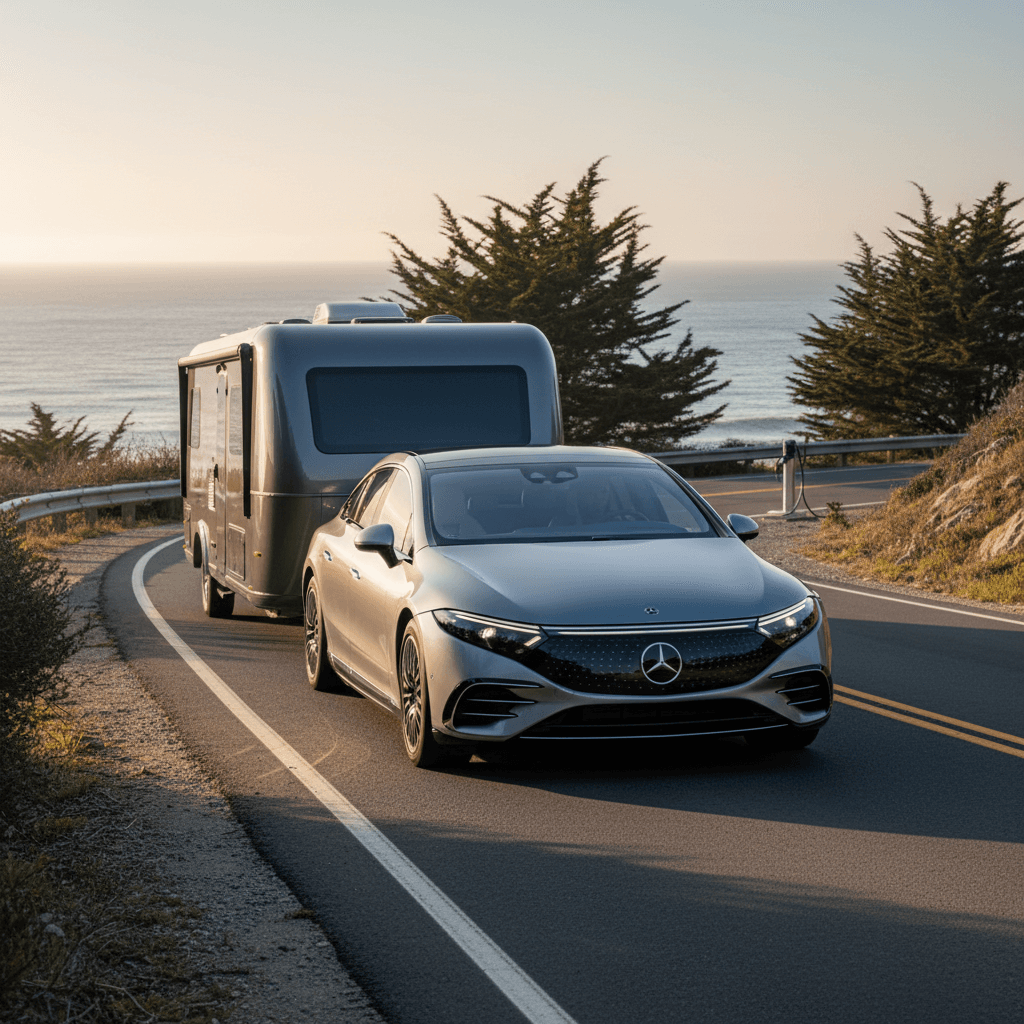
If you own, or are shopping for, a Mercedes EQS, you probably care about comfort and refinement first. But many EQS SUV shoppers also want to tow a small camper, utility trailer, or bikes. Understanding the real Mercedes EQS towing capacity and range loss is crucial so you don’t end up stressed on the side of the highway watching your remaining miles plummet.
Quick takeaway
Overview: EQS towing capacity and real-world range loss
- Only certain EQS configurations are rated to tow, and most ratings are in the light‑duty range (think small campers and utility trailers, not big fifth‑wheels).
- Aerodynamics matter more than weight for EV towing, boxy trailers hurt range far more than a low teardrop or bike rack.
- In practice, many EQS drivers see their usable highway range cut by about one‑third when towing at 65–70 mph, and closer to half with large, square campers.
- Smart route planning and charging strategy is the difference between a relaxing luxury‑EV road trip and an anxiety‑inducing one.
Luxury-ev reality check
EQS models and official towing capacity
Before you worry about range, you need to know whether your specific EQS is even rated to tow. Mercedes treats the EQS sedan and EQS SUV very differently here, and equipment like the factory tow package matters.
Approximate Mercedes EQS towing capacities by model
Always confirm your exact model’s tow rating in the owner’s manual and on the certification label, but this table gives you a realistic ballpark.
| Model | Drivetrain | Factory tow package? | Typical max tow rating* | Tongue weight |
|---|---|---|---|---|
| EQS 450+ sedan | RWD | Not generally offered | Not rated for towing | N/A |
| EQS 580 sedan | AWD | Varies by market | Often not rated | N/A |
| EQS 450+ SUV | RWD / AWD | Available | ≈ 3,500–4,000 lb | ≈ 10% of trailer weight |
| EQS 580 SUV | AWD | Available | ≈ 3,500–4,000 lb | ≈ 10% of trailer weight |
These are typical North American ratings for properly equipped models, not guarantees for every EQS on the road.
Check your specific VIN
The key takeaway: if towing matters, focus on the EQS SUV with a factory tow package. That combination gives you a legitimately useful light‑duty tow rating while preserving the quiet, refined driving experience that makes the EQS appealing in the first place.
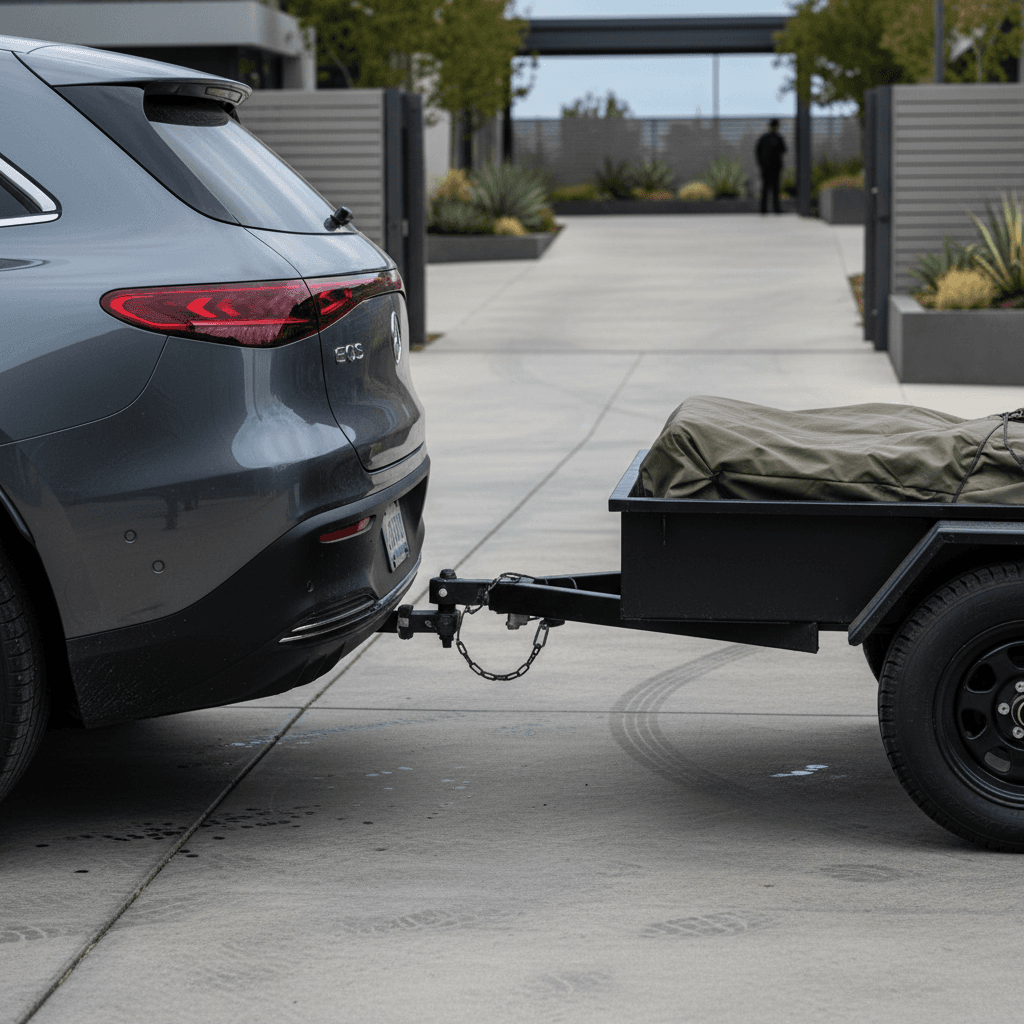
How much range do you lose when towing an EQS?
Official EPA range ratings don’t tell you anything about towing, so you have to work from real‑world EV physics and owner experience. For an EQS SUV with a healthy battery, you might see roughly 250–300 miles of highway range unladen, depending on wheel size, temperature, and speed. Bolt a trailer on the back, and that changes quickly.
Typical EQS SUV range loss while towing
So if your EQS SUV comfortably manages 260 miles at 70 mph without a trailer, you might be looking at something like 150–180 miles with a modest camper, and potentially as little as 130 miles with a big, boxy RV on a windy day. That’s not a flaw of the EQS; it’s the combination of aerodynamics, weight, and highway speed that punishes every EV when towing.
Plan for the worst case, not the best
5 key factors that change EQS range while towing
What really affects EQS towing range
Understanding these variables makes towing feel predictable instead of scary.
1. Aerodynamics of the trailer
Aerodynamic drag is the biggest enemy of EV efficiency at highway speeds.
- Low teardrop or pop‑up: relatively modest impact.
- Full‑height, flat‑front RV: huge hit to range.
2. Trailer weight & cargo
Weight still matters, especially on hills and during acceleration.
- Stay under your EQS’s rated tow capacity.
- Pack heavier items low and over the trailer axle.
3. Speed and driving style
Going from 60 to 75 mph can dramatically increase drag.
- Set cruise control a bit lower.
- Use Eco or Comfort modes for smoother power delivery.
4. Weather & temperature
Cold weather cuts range even without a trailer; towing compounds it.
- Heat or A/C uses additional energy.
- Headwinds are worse than crosswinds.
5. Terrain & elevation
Climbing long grades draws big power; regen only recovers some on the way down.
- Expect higher consumption in mountain regions.
- Never crest a pass with a low state of charge when towing.
6. Charging behavior
Frequent DC fast charges at higher states of charge are less efficient.
- Plan to arrive around 10–20% and leave around 70–80%.
- Shorter, more frequent stops usually save time.
Use the trailer as your speed governor
Trip planning and charging with a trailer
Towing with an EQS is less about brute strength and more about logistics. The car has the torque and chassis to handle light‑duty towing; your job is to make sure energy, charging access, and maneuvering with a trailer are all under control.
Step-by-step planning for an EQS towing trip
1. Confirm your tow rating & hitch
Verify in your manual that your EQS is rated to tow, confirm your maximum capacity, and make sure you’re using a proper hitch, ball mount, and wiring that match both car and trailer.
2. Estimate your ‘towing range’
Take your comfortable real‑world highway range without a trailer and mentally cut it by 35–40%. Use that number to choose your target charger spacing and state‑of‑charge (SoC) arrival buffer.
3. Choose charger locations with space
Favor larger highway fast‑charging sites, rest areas, and big‑box parking lots where you can pull through or back in without unhooking the trailer. Satellite view in map apps is your friend.
4. Build a conservative charging buffer
Aim to arrive at chargers with 15–25% SoC when possible, especially in unfamiliar or mountainous areas. That buffer covers wind, traffic, and detours without panic.
5. Precondition the battery for fast charging
When available in your EQS, use built‑in navigation to a DC fast charger so the battery can precondition on the way. That keeps charging speeds higher, which matters when you’re stopping more often.
6. Practice hitching, backing, and braking
Before a long trip, spend time in an empty parking lot learning how your EQS and trailer behave while backing up and braking. Smooth inputs help efficiency and keep the experience relaxing.
Charging station layout can make or break your day
Strategy A: Fewer, longer stops
This mirrors how many gas drivers tow, run down to a low fuel level, then refuel fully.
- Pros: Fewer interruptions; feels familiar.
- Cons: Higher SoC charging is slower; if a charger is offline, you have less buffer.
Strategy B: More, shorter stops
Use the EQS battery and DC fast chargers where they’re most efficient.
- Pros: Stay in the fast‑charging “sweet spot” (10–70%); more options if a station is busy.
- Cons: More frequent exits; requires a bit more planning.
Protecting EQS battery health when you tow
There’s a persistent myth that towing will “kill” an EV battery. The reality is more nuanced. Towing absolutely increases average power demand and pushes the thermal system harder, but modern packs, including the EQS’s, are engineered with significant cooling capacity and protective software. What matters is how you use that capability.
- Avoid repeatedly charging to 100% and then immediately towing at high speed, especially in hot weather.
- Use Eco or Comfort drive modes to smooth out acceleration instead of constantly dipping into maximum torque.
- Keep an eye on energy consumption and don’t be afraid to slow down in heavy headwinds or extreme heat.
- Whenever possible, let the car cool slightly between a long DC fast charge and an extended uphill towing climb.
How Recharged can help with battery health
Ready to find your next EV?
Browse VehiclesUsed Mercedes EQS: what towers should look for
Shopping used is where towing questions get especially important. You’re not just asking, “Can this EQS tow?” but “How will it tow now, after a few years of real‑world use?” Here’s how to stack the deck in your favor.
Checklist for a tow-friendly used EQS
These are the details experienced EV buyers pay attention to, especially if trailers and road trips are in the plan.
Verified battery health
Range loss from battery degradation stacks on top of towing loss.
- Look for an independent battery health report, not just a guess from the range meter.
- A healthier pack gives you more buffer when weather and trailers don’t cooperate.
Factory tow equipment
Ideally, you want an EQS SUV that left the factory with an approved tow package.
- Check for a proper hitch, wiring harness, and cooling provisions.
- Aftermarket hitches are useful for bike racks but may not carry a tow rating.
Clear service history
Review maintenance records for any warnings related to the high‑voltage system, cooling, or drivetrain.
- Well‑documented software updates and routine service are good signs.
Realistic range expectations
Take a long test drive at highway speeds to see real‑world consumption.
- Use that data to sanity‑check your expected towing range.
- Ask the seller how the car has been driven, frequent DC fast charging, heavy loads, and hot climates are all useful context.
Buying from a seller who understands EVs, and is transparent about the battery, is a huge advantage. That’s exactly why Recharged built its marketplace around verified battery health and fair pricing, not just shiny photos. If you plan to tow, having that data up front is the difference between a calculated compromise and a blind gamble.
FAQ: Mercedes EQS towing capacity and range loss
Frequently asked questions about EQS towing and range
Bottom line: Can a Mercedes EQS really tow?
Yes, within its design envelope, the Mercedes EQS SUV is a perfectly capable light‑duty tow vehicle. It has the torque, refinement, and chassis sophistication you’d expect from a flagship electric Mercedes. Where things get tricky is not power, but planning: you’ll lose 25–50% of your highway range with a trailer, so you need to think more like a pilot than a spur‑of‑the‑moment road‑tripper.
If you go in with realistic expectations, confirm your tow rating, and plan your charging with a healthy buffer, the EQS can comfortably handle bikes, small campers, and weekend‑warrior gear while still delivering that ultra‑quiet, effortless driving experience. And if you’re eyeing a used EQS as your next tow‑capable luxury EV, platforms like Recharged give you the battery data and expert support to decide whether an individual car truly fits your towing and range needs before you sign anything.