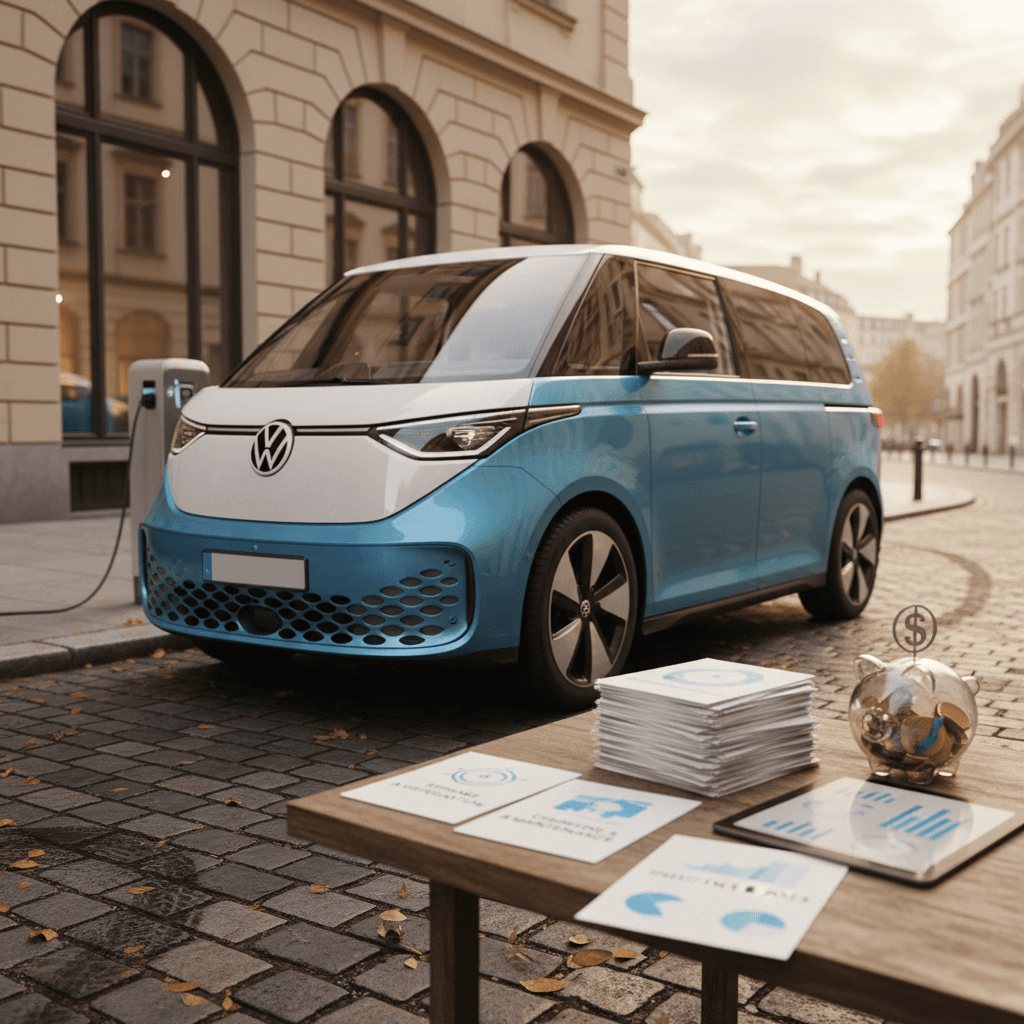
If you’re eyeing the retro‑cool Volkswagen ID. Buzz, the big question isn’t just “Can I afford the payment?” It’s “What’s the true cost of owning an ID. Buzz over 5 years, and how does it stack up against a gas minivan or SUV?” This guide walks through real‑world assumptions for a U.S. driver so you can see where the money actually goes: purchase, incentives, charging, maintenance, insurance, and depreciation. We’ll also look at how buying a used ID. Buzz from a marketplace like Recharged can shift the numbers in your favor.
Before we dive into the numbers
Why the Volkswagen ID. Buzz 5‑Year Cost Matters
The ID. Buzz is not just another EV. It’s a three‑row, people‑and‑gear hauler vying for the same role in your life as a gas Honda Odyssey, Kia Carnival, or three‑row SUV. That means total cost of ownership (TCO), not just MSRP, decides whether it makes sense for your family or business. Over five years you’ll feel the impact of fuel, depreciation, and maintenance far more than a few thousand dollars of sticker price difference.
Who needs a 5‑year ID. Buzz cost breakdown?
If you’re in one of these camps, the math really matters.
Family haulers
You’re replacing a gas minivan or three‑row SUV and want to know if the ID. Buzz will actually save money over school runs, road trips, and weekend sports.
Small business & fleets
You’re eyeing the ID. Buzz for shuttles, mobile services, or last‑mile delivery and need to project operating cost per mile vs. your current vans.
EV‑curious upgraders
You already own an EV sedan or crossover, like a Model Y or ID.4, and want to understand how a larger electric van changes your monthly outlay.
Purchase Price, Incentives, and Financing Assumptions
Because U.S. trims and pricing can vary by configuration and rollout timing, we’ll use round numbers that mirror a well‑equipped family ID. Buzz. Think of this as a realistic mainstream spec, not the absolute base or top‑shelf model.
Baseline purchase and financing assumptions
Working example for a new Volkswagen ID. Buzz in the U.S.
| Item | Assumption | Notes |
|---|---|---|
| MSRP before incentives | $58,000 | Representative of a well‑equipped ID. Buzz with larger battery and family‑friendly options. |
| Down payment | $5,800 (10%) | Many buyers roll in taxes and fees, but we’ll keep this simple. |
| Financing | 5.5% APR, 72 months | Typical rate for buyers with solid credit in 2025–2026. |
| Sales tax & fees | $4,000 (approx.) | Will vary widely by state; some states offer EV exemptions or reduced tax. |
| Federal tax credit | Up to $7,500, if eligible | Depends on battery sourcing, assembly, MSRP cap, and income. Treat this as a best‑case baseline. |
| Net “all‑in” price after credit | ≈ $54,500 | 58,000 + 4,000 tax/fees – 7,500 credit. Excludes interest on financing. |
You can tweak these inputs to match your own quote, down payment, and tax situation.
Watch the fine print on incentives
Electricity vs Gas: What It Really Costs to Drive an ID. Buzz
Fuel is where the ID. Buzz can claw back a lot of ground versus a gas van. We’ll assume a mixed use case: school runs, commuting, errands, and a handful of road trips each year.
5‑year driving profile assumptions
Estimating ID. Buzz electricity cost
With 12,000 miles per year at 2.7 miles per kWh, the ID. Buzz uses about 4,445 kWh annually.
- Home electricity rate (blended): $0.16 per kWh
- DC fast charging rate (blended): $0.40 per kWh
Using our 80/20 home vs fast‑charge split, your blended cost per kWh comes out around $0.21. That puts your annual electricity cost near $935 per year, or about $78 per month.
Comparing to a gas minivan
A similarly sized gas minivan or three‑row SUV that averages 22 mpg over the same 12,000 miles will burn about 545 gallons per year.
- At $3.75 per gallon (national‑level average), that’s ≈ $2,044 per year.
- That’s over double the ID. Buzz’s electricity cost at our assumptions.
Over five years, you’re looking at roughly $4,700 in electricity for the ID. Buzz vs. about $10,200 in gasoline for the minivan, a fuel savings on the order of $5,500.
Cut charging costs further with off‑peak rates
Maintenance, Repairs, and Tires Over 5 Years
One of the biggest advantages of a vehicle like the ID. Buzz is how little there is to service compared with a conventional van. No oil changes, no transmission flushes, no timing belts. That doesn’t mean zero cost, but it does mean fewer line items on your service invoices.
5‑year routine maintenance: ID. Buzz vs gas minivan
Approximate scheduled maintenance and wear items only, not collision damage or warranty repairs.
| Category (5 yr) | VW ID. Buzz (EV) | Gas minivan/SUV |
|---|---|---|
| Oil & filter changes | $0 | $600–$900 (8–10 services) |
| Transmission service | $0 | $300–$500 |
| Engine‑related tune‑ups | $0 | $400–$800 |
| Brake service | $300 | $700–$1,200 (pads/rotors wear faster on gas vans) |
| Coolant & fluids | $150 | $350 |
| Cabin air filter & minor items | $250 | $250 |
| Tires (1 full set) | $1,000 | $900–$1,000 |
| Estimated 5‑yr maintenance total | ≈ $1,700 | ≈ $3,500–$4,500 |
Actual service intervals and pricing vary by dealer, independent shop, and driving style.
Regenerative braking is your friend
Insurance, Registration, and Other Ownership Fees
Running an ID. Buzz for five years also means paying to insure it, register it, and possibly feed a few EV‑specific fees your state has tacked on to offset lost gas‑tax revenue. These line items are often overlooked in online calculators, but they’re very real on your bank statement.
Insurance
Insurance is highly personal, but EVs with higher MSRPs and lots of new tech can cost more to insure than mainstream gas vans. For a clean‑record driver with good credit:
- Estimated ID. Buzz premium: ~$1,900 per year
- Comparable gas minivan: ~$1,600 per year
That extra $300 per year adds up to about $1,500 over five years. Shopping multiple carriers and being smart about deductibles can narrow or erase that gap.
Registration and EV fees
Registration fees vary heavily by state. Some charge more for higher‑value vehicles; some add an annual EV surcharge instead of fuel tax.
- Baseline assumption: $300 per year in registration and EV fees for the ID. Buzz
- Over five years, that’s about $1,500.
That’s broadly similar to what you’d see on a higher‑trim gas minivan, but you may pay a bit more or less depending on your state’s EV policy and fee schedule.
Depreciation and 5‑Year Resale Value for the ID. Buzz
Depreciation, the value your vehicle loses as it ages, is usually the single biggest cost of ownership, and that’s especially true for new EVs. The ID. Buzz is a niche, high‑style electric people‑mover, and its long‑term behavior in the U.S. used market will depend on adoption, battery performance, and how much competition shows up from other automakers.
Key factors that drive ID. Buzz resale value
Why some ID. Buzz vans could hold value better than others.
Battery health
Vans with documented strong battery health will be more attractive on the used market. Platforms like Recharged quantify this with a Recharged Score so buyers see the data, not just the odometer.
Use case & wear
Light family use with intact interiors will outperform shuttles or work vans that rack up miles and cosmetic damage quickly.
Regional demand
Demand for quirky, practical EV vans is stronger in some coastal and urban markets. Where charging is mature and EV incentives are generous, resale often improves.
Illustrative 5‑year depreciation for a new ID. Buzz
This is a directional model, not an appraisal. Use it to understand structure, not as a resale guarantee.
| Year | Estimated value (% of original MSRP) | Dollar value (from $58,000) |
|---|---|---|
| New (Year 0) | 100% | $58,000 |
| After 1 year | 80% | $46,400 |
| After 3 years | 63% | $36,500 |
| After 5 years | 50% | $29,000 |
Real‑world resale will depend on mileage, condition, battery health, and broader EV market trends.
EV depreciation can be lumpy
5‑Year True Cost of Ownership: ID. Buzz vs Gas Minivan
Now let’s pull these threads together. We’ll compare a new Volkswagen ID. Buzz against a similarly priced gas minivan or three‑row SUV using our earlier assumptions. This is a directional, big‑picture look meant to answer: “What am I really spending over five years?”
Estimated 5‑year total cost of ownership
Illustrative comparison using U.S. averages and a 12,000‑mile‑per‑year driver.
| Cost category (5 yrs) | VW ID. Buzz (EV) | Gas minivan/SUV |
|---|---|---|
| Depreciation (value lost) | ≈ $29,000 | ≈ $24,000 |
| Fuel / electricity | ≈ $4,700 | ≈ $10,200 |
| Routine maintenance & tires | ≈ $1,700 | ≈ $4,000 |
| Insurance | ≈ $9,500 | ≈ $8,000 |
| Registration & EV fees | ≈ $1,500 | ≈ $1,500 |
| Estimated 5‑yr total | ≈ $46,400 | ≈ $47,700 |
| Effective cost per mile (60,000 mi) | ≈ $0.77 | ≈ $0.80 |
Purchase interest, taxes, and some smaller line items are rounded to keep the model readable.
What the math is really telling you
How Buying a Used Volkswagen ID. Buzz Changes the Math
Where this story gets more interesting is the used market. If early adopters take the biggest depreciation hit, a second‑owner buyer can step in at year 2–3 and enjoy much lower 5‑year costs, with most of the useful life and tech still intact.
Scenario: 3‑year‑old ID. Buzz, then keep for 5 years
- Original MSRP: $58,000
- Value at age 3 (from our model): ≈ $36,500
- Value at age 8 (five more years): assume ≈ 35% of original MSRP ≈ $20,300
That means you’d lose about $16,200 in depreciation over your five‑year ownership window versus $29,000 as the original buyer. You still pay for electricity, maintenance, insurance, and fees, but the single biggest cost, value loss, is dramatically lower.
Why buying used through Recharged helps
With a used ID. Buzz, the unknown is battery health. That’s where Recharged changes the equation:
- Every EV on the platform comes with a Recharged Score report that verifies battery health and capacity.
- Pricing is benchmarked to the broader used EV market to help you avoid overpaying.
- EV‑specialist advisors walk you through how previous fast‑charging, mileage, and climate may affect future range and value.
In short, buying used lets someone else absorb the steepest part of the depreciation curve, while Recharged’s diagnostics reduce the risk you’re inheriting a tired pack.
7 Ways to Lower Your ID. Buzz 5‑Year Ownership Cost
Practical tactics to bring your 5‑year costs down
1. Prioritize off‑peak home charging
Ask your utility about EV‑specific or time‑of‑use plans. Shifting most charging to overnight hours can trim your electricity cost per mile by 20–40%, especially if you avoid premium DC fast charging when it’s not truly necessary.
2. Right‑size your trim and options
Don’t pay for more ID. Buzz than you need. Higher‑spec audio, wheel packages, or cosmetic bundles rarely hold full value at resale. Put your money into range and safety features first; those are what used‑market buyers will pay for.
3. Keep fast charging in check
Occasional DC fast charging is fine, but living on a fast‑charge diet can accelerate battery wear. Over years, that can hit both usable range and resale value. For daily use, Level 2 at home or work remains the sweet spot.
4. Stay ahead on tires and alignment
The ID. Buzz is heavy and torquey, and that can chew through tires if alignment is off or pressures are ignored. Regular rotations, pressure checks, and timely alignments protect both your range and your wallet.
5. Shop insurance aggressively
Rates for new EVs vary widely between carriers. Get quotes from at least three companies, including ones that explicitly market EV‑friendly policies. Adjusting deductibles and bundling home/auto can materially trim annual premiums.
6. Document service and battery health
A clear paper trail for software updates, warranty visits, tire replacements, and battery health checks makes your ID. Buzz more attractive when you sell. Platforms like Recharged lean on documentation when evaluating trade‑ins and setting fair market prices.
7. Consider buying certified used
A low‑mileage ID. Buzz with verified battery health, inspected by EV‑savvy technicians, often delivers better value than a fresh build. At Recharged, every used EV includes a digital Recharged Score so you know exactly what you’re getting before you sign.
Volkswagen ID. Buzz 5‑Year Cost of Ownership: FAQ
Frequently asked questions about ID. Buzz ownership costs
Is the Volkswagen ID. Buzz Worth It Over 5 Years?
Viewed purely through the lens of the Volkswagen ID. Buzz true cost of ownership over 5 years, the electric van holds its own against mainstream gas minivans and three‑row SUVs. Higher upfront price and EV‑style depreciation are offset by cheaper energy, simpler maintenance, and the long‑term appeal of a distinctive, tech‑forward family or fleet vehicle.
Where the ID. Buzz really shines is in the used market. Let someone else take the steepest part of the depreciation curve, then step in with a verified‑healthy used ID. Buzz whose battery and pricing have been professionally evaluated. That’s exactly what Recharged is built for: every EV comes with a Recharged Score battery‑health report, transparent fair‑market pricing, financing options, trade‑in support, and, if you’re not local, nationwide delivery. If the ID. Buzz fits your lifestyle, the right purchase strategy can make it fit your budget too.