If you’ve been eyeing the retro-cool Volkswagen ID. Buzz and searching for a true Volkswagen ID. Buzz long term review 2026, you’re not alone. Early first-drive pieces were all wide smiles and nostalgia. But it’s only after months of kid-hauling, Costco runs, winter commutes, and highway road trips that you learn what this electric microbus is really like to live with, and whether it makes sense to buy one used as 2025 models start hitting the market.
Context: no 2026 model year, but plenty of 2025 vans
Why a Long-Term 2026 Review of the ID. Buzz Matters
On paper, the ID. Buzz is irresistible: three rows, tons of glass, a massive battery, and styling that turns every Whole Foods run into a mini car show. In reality, there are tradeoffs, especially around range, charging on today’s U.S. infrastructure, software polish, and overall value versus other big EVs like the Kia EV9, Hyundai Ioniq 7, or Rivian R1S.
This long-term 2026 look is built around thousands of miles of mixed driving, owner feedback, and test data from Recharged’s own VW ID. Buzz road trip review and 2024 ID. Buzz range testing. We’ll walk through how far it really goes, what it costs to run, where it shines as a family hauler, and what to watch for if you’re considering a used ID. Buzz.
Volkswagen ID. Buzz key long-term numbers (U.S. 2025 model)
Specs recap and what’s changed by 2026
Underneath the nostalgia, the ID. Buzz is a very modern EV built on Volkswagen’s MEB platform (shared with the ID.4 and Audi Q4 e‑tron). For 2025 U.S. vans, which are the de facto "2026" ID. Buzz for American buyers, the basics look like this:
- Rear- or all-wheel drive, depending on trim
- ~91 kWh battery pack (about 86 kWh usable)
- EPA-estimated range around 230–234 miles for rear-drive passenger models
- Up to 200 kW DC fast charging capability with battery preconditioning
- Three-row seating with sliding second row and fold-flat third row on U.S. long‑wheelbase models
- CCS DC fast charging inlet, with NACS adapters and future native NACS support in the pipeline
By early 2026, Volkswagen has already signaled that a refreshed 2027 model will target better real‑world range, updated pricing, and improved software. That matters because it puts downward pressure on 2025 Buzz pricing, and makes the long-term ownership story a little more buyer-friendly if you’re shopping used.
Used shopper tip
Real-world range and efficiency: what you actually get
If you only read the window sticker, you’d assume the ID. Buzz is a 230‑plus‑mile van. In day‑to‑day use, it’s more honest to think of it as a roughly 170–200 mile highway EV, with city and suburban driving stretching that closer to the official rating if you’re gentle.
ID. Buzz range in the real world
What we and owners typically see from the 91 kWh pack
City & suburban errand duty
Driven below 45 mph, with frequent regenerating stops, many owners see 3.0–3.5 mi/kWh. That translates to roughly 220–250 miles from 100% down to near empty, better than the EPA number.
Mixed driving & moderate highways
At 60–70 mph mixed with town driving, real-world efficiency falls into the 2.5–3.0 mi/kWh range. Plan on 180–210 miles of practical range before you’re nervously hunting chargers.
Fast U.S. interstates
At 75–80 mph, you’re pushing a bright yellow barn door through the air. Many drivers report closer to 2.0–2.4 mi/kWh, or roughly 150–180 miles of useful range between fast charges.
Cold weather trims those numbers further. Owners in northern climates routinely report winter highway legs in the 130–160‑mile range before they’re ready to stop and charge. The good news is that the Buzz’s big battery and strong DC fast charging make those shorter legs manageable, as long as you plan your route and don’t pretend it’s a 300‑mile cruiser.
Highway reality check
Charging experience at home and on the road
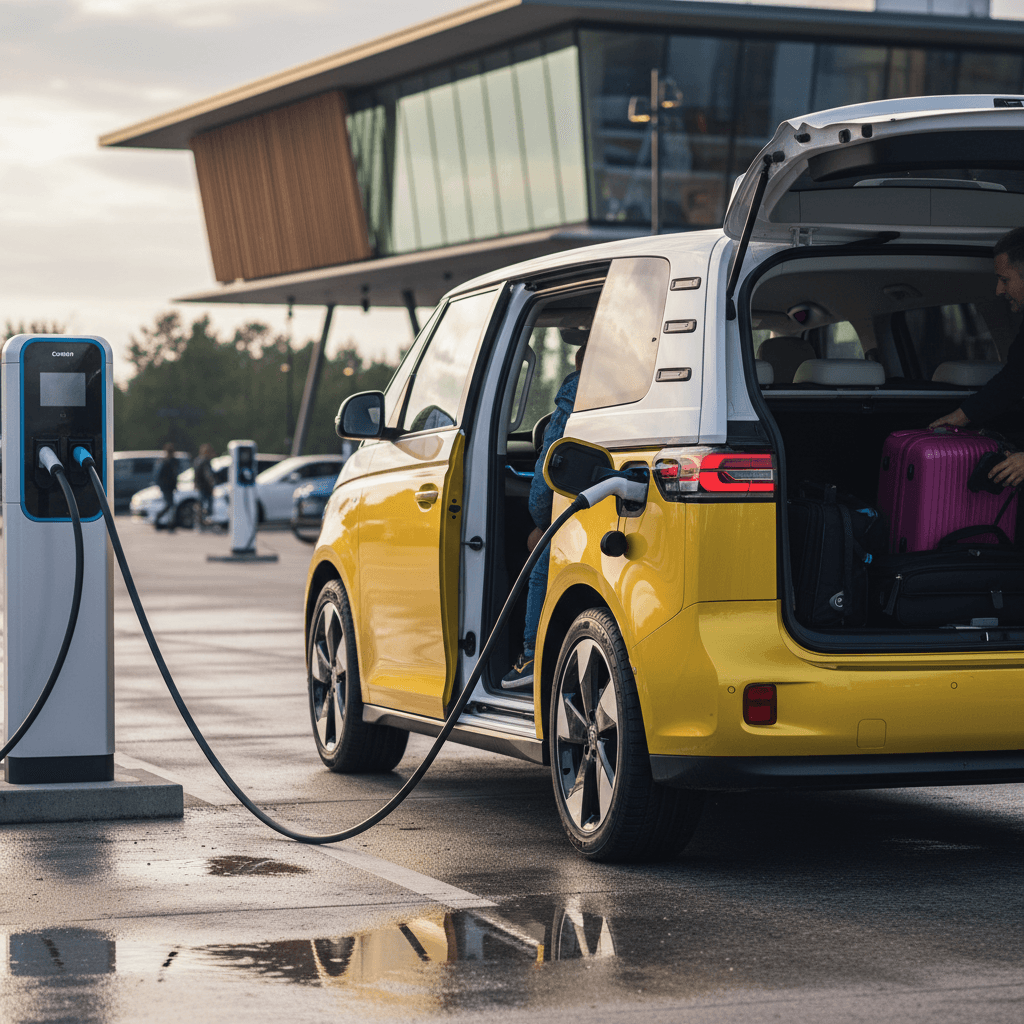
Living with an ID. Buzz in 2026 is much easier if you treat home charging as your "fuel station" and public charging as backup and road trip support. The 11 kW onboard AC charger makes overnight top‑ups painless if you have a 240‑volt Level 2 setup at home.
Home charging with Level 2
- Onboard AC charger: up to 11 kW on a 48‑amp Level 2 EVSE.
- Typical add: about 30–35 miles of range per hour of charging.
- Reality: Plug in at night, wake up to a full pack. No gas station runs, ever.
- Tip: If you’re shopping used, budget for a dedicated home charger if the previous owner didn’t include one.
DC fast charging on trips
- Peak rate: up to 200 kW on a strong 400‑V charger with battery preconditioning.
- Claimed 10–80%: around 25–30 minutes under ideal conditions.
- Real world: Expect 30–35 minutes when the pack is cold or the station is limited.
- Connector: CCS today; NACS adapters and, later, native NACS support expand options over the next few years.
Make friends with preconditioning
Compared with some rivals, the Buzz’s fast‑charge curve is good but not exceptional. It hits its promised peak on high‑power stations but tapers earlier than the best Korean systems. The difference isn’t night and day, but if you’re cross‑shopping an EV9 or Ioniq 7, know that those vehicles still have an edge in fast‑charging speed.
Comfort, practicality, and family duty
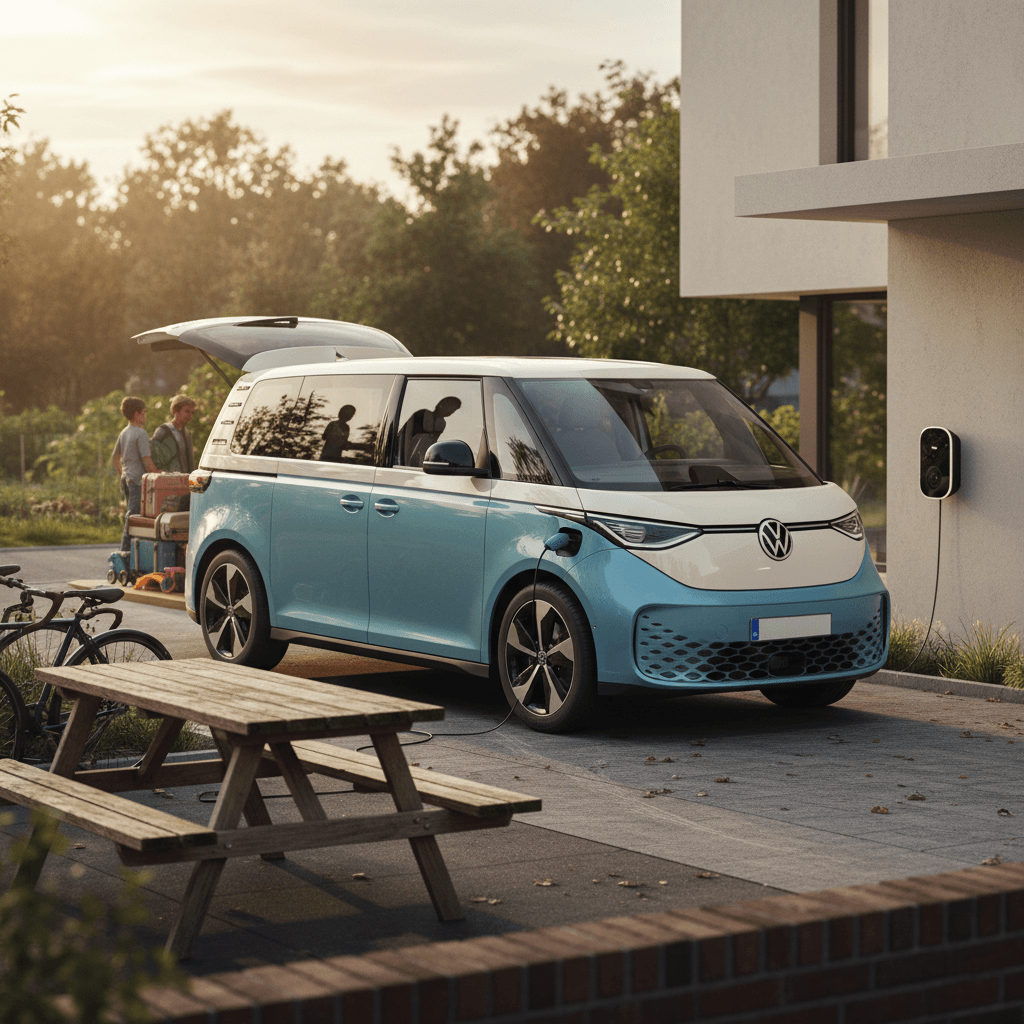
Where the ID. Buzz absolutely earns its spot in your driveway is as a rolling living room. The huge windows, upright driving position, and playful color palette make it feel like an event every time you climb in. Over months of use, that sense of occasion doesn’t fully fade the way it does in some crossovers.
Living with the ID. Buzz day to day
How the electric microbus handles real family life
Space & seating
The U.S. long‑wheelbase ID. Buzz offers three rows of adult‑friendly space. The middle row slides and reclines, the third row folds flat, and the tall roof makes loading car seats and kids much easier than in a low-slung SUV.
Cargo and versatility
With the third row up, you get usable but not cavernous cargo space, think grocery runs and a stroller. Drop the third row and the floor turns into a nearly flat, boxy cavern. For home‑improvement runs and camping trips, this is where the Buzz outshines most EV SUVs.
Ride, noise, and comfort
The ride is generally comfortable and quiet at city speeds, but you will hear wind and tire noise more than in a low, slippery SUV at highway pace. Long trips are still pleasant; just don’t expect S‑Class hush.
The attention factor is real
If you’re coming out of a traditional minivan like a Honda Odyssey or Toyota Sienna, you’ll notice two things immediately: less under‑floor trick packaging (no stow‑and‑go tricks here) and a much more open, lounge‑like cabin. The Buzz feels special in a way those do‑it‑all appliances rarely do, and that matters when you’re asking your family to embrace an EV.
Driving experience after thousands of miles
Point the ID. Buzz down a tight city street and it feels smaller than it looks. The wheels are pushed out to the corners, the steering is light, and the turning circle is taxi‑like. That’s a relief when you’re threading through school pickup chaos or tight parking garages.
- Power: Acceleration is brisk rather than explosive, plenty for merging and passing, especially with rear‑drive models. All‑wheel drive adds more muscle but doesn’t turn it into a drag racer.
- Handling: A nearly 6,000‑plus‑pound van will never feel tossable, but the low battery placement and quick steering keep it from feeling truckish.
- Braking: Regenerative braking is smooth and predictable. One‑pedal fans may wish for a bit more aggressiveness, but most drivers adapt quickly.
- Wind sensitivity: That big box profile can get pushed around in heavy crosswinds, something minivan and full‑size SUV owners will already be used to.
You don’t buy an ID. Buzz to carve canyons; you buy it because it makes every mundane drive feel like the start of a road trip.
Over time, what stands out most is how relaxed the Buzz encourages you to be. It’s happiest at 65 mph, not 80. It rewards smooth driving with better range and calmer passengers. If you lean into that personality, it’s a charming companion.
Software, tech, and the ownership quirks that show up later
Volkswagen’s early ID‑series infotainment was widely, and fairly, criticized for lag, confusing menus, and touch‑sensitive controls that seemed designed to annoy you at night. The ID. Buzz benefits from VW’s newer infotainment generation, but even by 2026, it still doesn’t feel as slick as Tesla, Hyundai/Kia, or even some GM systems.
Long-term quirks Buzz owners talk about
Occasional infotainment hiccups
Slow boot‑ups, Bluetooth glitches, and odd navigation reroutes still crop up. Over‑the‑air updates help, but don’t expect smartphone‑level polish just yet.
Driver assistance tuning
Adaptive cruise and lane keeping work well on clear highways but can ping‑pong more than you’d like on poorly marked roads. Get to know the systems, and don’t be shy about turning them down or off when they annoy you.
Range anxiety on windy days
Because the Buzz is tall and boxy, headwinds and crosswinds can noticeably dent range. Long‑term owners quickly learn to check weather along with chargers when planning trips.
Charging network roulette
The van itself charges well, but the CCS network still has patchy reliability in some regions. As more NACS options come online through 2026–2027, this should improve dramatically.
Software maturity over time
The silver lining: Volkswagen continues to roll out software updates. A used ID. Buzz in late 2026 will usually drive better and feel more polished than it did on day one, as long as updates have been applied.
Inspect software and update history on a used Buzz
Costs, depreciation, and shopping a used ID. Buzz
The ID. Buzz launched in the U.S. at a price that stung: well over $60,000 for many nicely equipped examples, especially once destination and dealer fees were added. Combined with modest range and fierce competition, that’s a big part of why sales have been limited, and why the 2026 model year was skipped. The upside is that depreciation has been sharper than initially expected.
ID. Buzz cost and value snapshot for 2026 shoppers
By 2026, many early U.S. ID. Buzz vans are coming off their first year of ownership or off short leases. That’s your chance to let someone else pay the steepest part of the curve and scoop up a van that’s barely broken in. As with any used EV, battery health and fast‑charge history matter more than odometer alone.
Checklist: evaluating a used Volkswagen ID. Buzz
1. Get objective battery health data
Ask for a third‑party battery report, not just a dashboard range guess. At Recharged, every vehicle comes with a <strong>Recharged Score</strong> that measures real battery state of health, charging history clues, and pack consistency.
2. Check for uneven tire wear
A heavy EV will chew through tires if alignment or suspension are off. Uneven wear can hint at curb strikes or chronic under‑inflation.
3. Inspect fast‑charge behavior
On your test drive, arrive at a DC fast charger around 10–30% state of charge. If the van takes unusually long to ramp up or never gets near triple‑digit kW on a strong charger, that’s a flag worth investigating.
4. Verify software and recall status
Have the seller show the software version, and confirm any recalls or service campaigns are complete. Up‑to‑date software can materially change range estimates, charging behavior, and driver‑assist performance.
5. Consider your use case honestly
If your life is mostly local errands, school runs, and the occasional weekend away, the Buzz fits beautifully. If you’re a 35,000‑mile‑a‑year highway warrior, you may be happier in something with 280–320 miles of real‑world range.
How Recharged can help
Who the Volkswagen ID. Buzz is really for
Buy the ID. Buzz if…
- You want a family EV that feels special every time you drive it.
- Your daily driving is mostly short to moderate local trips, with a handful of longer highway drives a year.
- You care more about space, style, and comfort than hitting 300 miles on a charge.
- You have (or can install) home Level 2 charging.
- You’re happy to slow down a bit on road trips and plan your charging stops.
You might skip it if…
- Your regular drives involve long, fast highway hauls with limited charger availability.
- You need maximum value per dollar and don’t care about style. A more conventional EV can give you more range or features for the same money.
- You’re extremely sensitive to software quirks and expect Tesla‑level polish.
- You can’t install home charging and would rely heavily on public chargers day‑to‑day.
Volkswagen ID. Buzz long-term FAQ
Frequently asked questions about long-term ID. Buzz ownership
Bottom line: our 2026 long-term verdict
After living with the Volkswagen ID. Buzz into 2026, the verdict is clear: this is not the rational spreadsheet winner of the three‑row EV world. It’s not the longest‑range choice, nor the quickest to fast‑charge, nor the cheapest. But it is one of the most charming, memorable, and genuinely useful electric family vehicles you can buy, especially if you snag one at a post‑depreciation price.
If your life fits its strengths, home charging, mostly local driving, a few well‑planned trips a year, the Buzz rewards you every single day with big windows, easy loading, and a cabin that makes kids and adults smile. If you’re shopping used in 2026, go in with open eyes about range, insist on real battery‑health data, and let someone else pay for that first big value drop.
And if you want a second pair of eyes as you compare vans, Recharged can help you line up options, understand each ID. Buzz’s Recharged Score, line up financing, and arrange delivery to your driveway. For the right driver, the electric bus isn’t just back, it’s finally ready for the long haul.