If you’re eyeing a Volkswagen ID. Buzz, you’re probably wondering more than just the sticker price. You want to know: how much does it cost to own a Volkswagen ID. Buzz per year, once you factor in charging, insurance, maintenance, and everything else that hits your bank account.
What this guide covers
Volkswagen ID. Buzz annual cost overview
Every household is different, but when you blend U.S. electricity prices, typical insurance premiums for a new electric minivan, and realistic driving habits, most owners will land in these broad ranges for a new ID. Buzz:
- Charging: roughly $550–$1,050 per year for 8,000–15,000 miles, depending on your kWh rate and how much you DC fast charge
- Insurance: typically $1,800–$2,800 per year for a new, well‑equipped ID. Buzz, varying by state, driving record, and coverage levels
- Maintenance and repairs: about $400–$800 per year averaged over the first 5–6 years, including tires and wear items (very little routine service)
- Registration, taxes, parking and misc.: usually $300–$900 per year, depending on where you live and whether your state adds EV road‑use fees
- Depreciation: for a brand‑new Buzz, expect something on the order of $4,500–$7,500 per year in the first few years, depending on how hard the minivan market softens
- Financing interest (if you borrow): anywhere from $1,000–$2,500 per year on a typical 5–6 year loan, highly sensitive to rate and down payment
Depreciation dwarfs running costs
Typical annual Volkswagen ID. Buzz ownership snapshot (new vehicle)
Add it all up and a realistic all‑in cost to own a new VW ID. Buzz can fall anywhere from about $9,000 to well over $13,000 per year, depending on how you buy, how far you drive, and local costs. The good news is that you have more control than you might think, especially if you’re willing to consider a used EV instead of brand‑new.
Charging: how much does it cost to power an ID. Buzz?
VW’s own data and independent testing put the ID. Buzz in the same ballpark as other big electric SUVs and vans. Expect combined efficiency in the range of 2.5–3.0 miles per kWh in mixed driving, with EPA ratings around 83 MPGe (roughly 2.5 mi/kWh) and some drivers seeing closer to 3.0 mi/kWh in real‑world use.
On the electricity side, residential power in the U.S. has climbed steadily. Recent federal and industry data put the average residential price in the mid‑ to high‑teens per kWh, with many states hovering around 17¢/kWh and high‑cost markets (California, the Northeast, Hawaii) significantly more expensive.
A simple way to estimate ID. Buzz charging cost
Estimated annual Volkswagen ID. Buzz charging costs
Home‑dominant charging, no rooftop solar. Assumes ~2.7 mi/kWh real‑world efficiency.
| Annual miles | kWh used (approx.) | 12¢/kWh | 17¢/kWh | 25¢/kWh |
|---|---|---|---|---|
| 8,000 | ≈ 2,965 kWh | $355 | $504 | $741 |
| 10,000 | ≈ 3,705 kWh | $445 | $630 | $926 |
| 12,000 | ≈ 4,445 kWh | $533 | $756 | $1,111 |
| 15,000 | ≈ 5,555 kWh | $667 | $944 | $1,389 |
Your actual cost will depend heavily on local electricity rates and how much you use public DC fast charging.
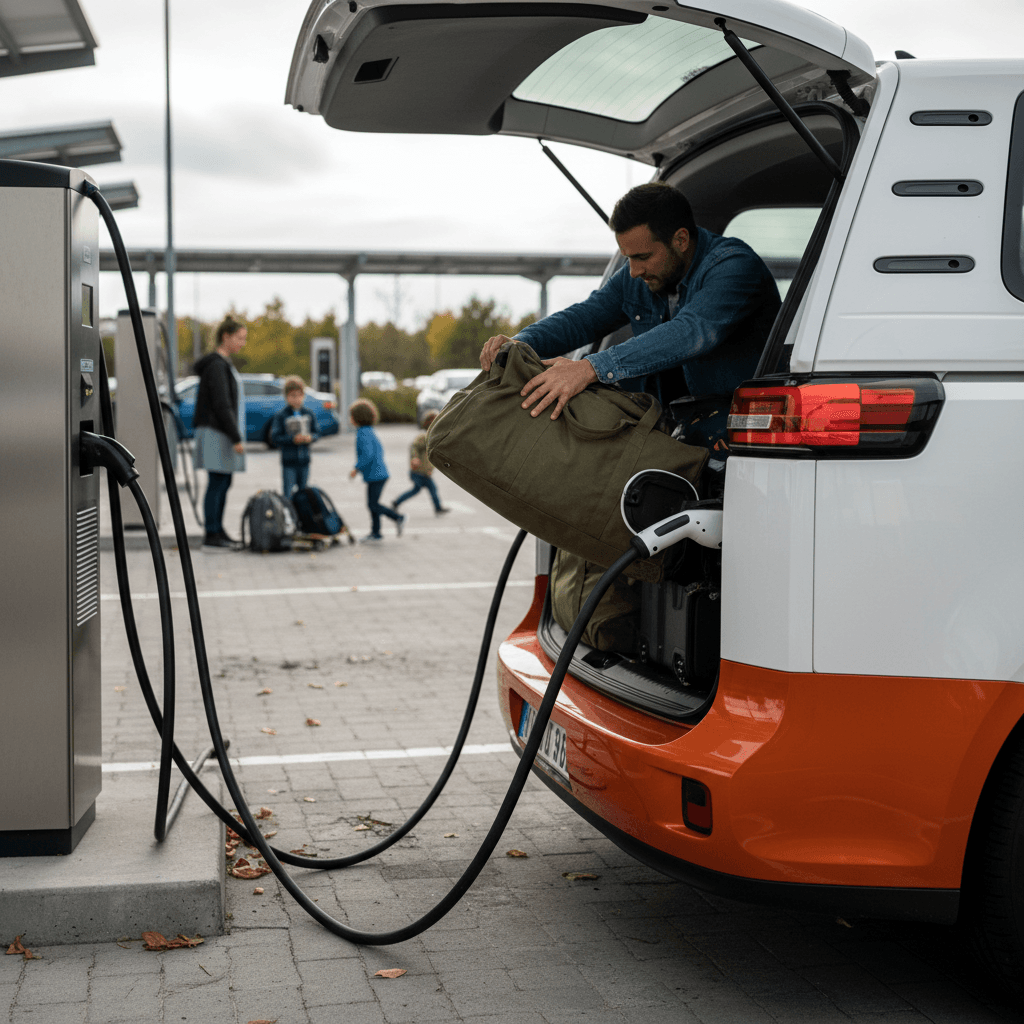
Frequent DC fast charging costs more
Insurance: what does it cost to insure an ID. Buzz?
The ID. Buzz is a large, high‑value electric minivan loaded with advanced electronics and safety tech. Insurers see that as a relatively expensive vehicle to repair, so premiums will generally sit above a compact crossover EV and closer to other three‑row family haulers.
Real‑world quotes owners report typically place the ID. Buzz’s premium roughly on par with or slightly above a mid‑size SUV or large pickup EV. In U.S. terms, that often means:
- Good driver, suburban area: around $1,800–$2,200 per year
- Urban, higher theft/collision risk or younger driver: $2,300–$3,000+ per year
- If it’s a third vehicle with older paid‑off cars on the policy, you may see a noticeable jump because the Buzz alone carries a much higher replacement cost than your existing vehicles
How to keep ID. Buzz insurance in check
Maintenance and repairs: EV van realities
Volkswagen built the ID. Buzz on the same MEB electric platform used by the ID.4, which has already racked up millions of real‑world miles. Like most EVs, there’s no engine oil, spark plugs, or timing belts to worry about, and brake wear is reduced thanks to regenerative braking. But you’re still moving a big, heavy van on fairly large tires, so maintenance isn’t zero.
Typical ID. Buzz maintenance items over time
Most of these are predictable and can be smoothed into an annual budget.
Battery & drivetrain
No scheduled battery service. Software updates and occasional diagnostics are the main items here. The high‑voltage battery is designed to last the life of the vehicle, and degradation is usually slow in the first 8–10 years.
Tires and alignment
A heavy EV minivan on large wheels will eat through tires faster than a compact sedan. Budget $900–$1,400 every 30,000–40,000 miles for quality tires plus alignment, which works out to a few hundred dollars per year for most owners.
Fluids, filters & misc.
Cabin air filters, brake fluid changes, wiper blades, and the occasional A/C service still apply. These are modest individually, but together they can average $150–$250 per year over time.
If you average everything out over the first six or seven years, most ID. Buzz owners will see annual maintenance and repair costs around $400–$800 per year, assuming nothing unusual fails and you keep up with tires and recommended inspections.
Out‑of‑warranty repairs can sting
Taxes, fees, parking and incidentals
Where you live has an outsized effect on this bucket. A new ID. Buzz will typically carry higher registration fees than a compact car because of its price and weight, and several states now levy extra EV fees in lieu of gas tax revenue.
- Registration and title: often $150–$400 per year, higher in states that base fees on vehicle value
- EV‑specific fees: some states add $100–$250 per year for electric vehicles
- Property or excise tax (if applicable): this can be a few hundred dollars per year, particularly in states that tax vehicle value annually
- Parking, tolls and charging network fees: highly variable, but many city‑center owners should budget a few hundred dollars a year if they regularly pay to park or use private chargers
Local policy can help or hurt
Depreciation and financing: the big hidden costs
Depreciation is where many ID. Buzz buyers get a surprise. Electric vehicles, and minivans, have both seen choppy resale values as the market has digested new models, shifting incentives, and changing interest rates. The cheerful retro styling helps the Buzz, but you’re still looking at a relatively expensive niche EV in a rapidly evolving segment.
Depreciation: value you never see
If you buy a new, well‑equipped ID. Buzz in the $60,000+ range and sell it five years later, it’s reasonable to expect you’ll have lost roughly half of the purchase price to depreciation, give or take. That’s on the order of $6,000–$7,000 per year during that period, even if your out‑of‑pocket running costs feel low.
Rapid improvements in range and charging speed on newer models, plus shifting EV incentives, can accelerate depreciation on early vehicles. Minivans also tend to peak in demand with family buyers and soften as they age.
Financing: the cost of money
Financing simply moves the pain from the showroom to your monthly budget. On a $60,000 purchase with a modest down payment and a 5–7% APR loan, you might pay $1,000–$2,500 per year in interest in the early years of the loan.
While interest expense declines as you pay down principal, it’s effectively another line item in your annual cost of ownership, one that rarely appears in “fuel vs. fuel” comparisons between EVs and gas vehicles.
Why used makes so much sense
Three real‑world ID. Buzz annual cost examples
To make all of this concrete, here are three simplified annual cost scenarios. These are ballpark illustrations, not quotes, but they’ll give you a realistic feel for where your own numbers might land.
Illustrative annual VW ID. Buzz ownership costs
All figures in U.S. dollars. Depreciation assumes a new vehicle unless noted.
| Cost category | Urban apartment driver (8,000 mi, more DC fast charging) | Suburban family commuter (12,000 mi, mostly home charging) | Used‑Buzz value buyer (10,000 mi, 3‑4 year‑old van) |
|---|---|---|---|
| Charging | $800 | $700 | $600 |
| Insurance | $2,600 | $2,100 | $1,900 |
| Maintenance & repairs | $500 | $600 | $700 |
| Taxes, fees & parking | $700 | $500 | $500 |
| Financing interest | $1,600 | $1,800 | $900 |
| Depreciation | $7,000 | $6,000 | $3,000 |
| Estimated annual total | ≈ $13,200 | ≈ $11,700 | ≈ $7,600 |
Your actual cost will vary with driving record, electricity rate, state taxes and how you buy the vehicle.
Compare to a comparable gas minivan
How buying a used ID. Buzz changes the math
By the time an ID. Buzz is three to five years old, the steepest part of the depreciation curve is typically behind it. That’s where a used example starts to look especially smart from a cost‑per‑year perspective, if, and only if, you know exactly what you’re buying.
Why a used ID. Buzz can be a sweet spot
The key is objective data on battery health, prior damage and pricing.
Less depreciation drag
Instead of losing $6,000–$7,000 per year on a brand‑new van, a used ID. Buzz might depreciate closer to $2,500–$3,500 per year over the same timeframe, depending on age and mileage. You still get the space and character without the steepest value loss.
Known history and battery health
Battery condition is the heart of any used EV purchase. At Recharged, every vehicle comes with a Recharged Score Report that includes verified battery health and pricing that reflects real‑world range, not just a brochure number. That transparency makes it much easier to predict your true annual costs.
Leaning toward used?
Ways to lower your VW ID. Buzz cost per year
Practical ways to cut ID. Buzz ownership costs
1. Optimize how and where you charge
If you can, install Level 2 home charging and use off‑peak time‑of‑use rates. Even a few cents difference per kWh can save you hundreds of dollars over 10,000+ miles.
2. Keep an eye on tire pressure and rotation
Correct tire pressures and regular rotations extend tire life on a heavy EV van. That’s the difference between replacing a full set every 25,000 miles versus 40,000+ miles.
3. Shop insurance like you shop the van
Get quotes from multiple insurers and ask specifically how they treat EVs and high‑tech vehicles. Bundling homeowners or renters insurance can also trim hundreds per year.
4. Consider total cost, not just payment
A lower monthly payment on a longer, higher‑rate loan can cost more in the long run. Run the numbers on interest paid, not just the monthly hit to your checking account.
5. Let someone else take the first‑owner hit
If your priority is lower annual cost, a lightly used ID. Buzz, especially one with an independent battery‑health report, can be a smarter play than the latest color or trim.
6. Use data, not guesses, for a used Buzz
Before you buy used, lean on tools like the Recharged Score, which pair battery diagnostics with market pricing so you aren’t overpaying for a van with hidden range loss.
How Recharged can help
Ready to find your next EV?
Browse VehiclesVolkswagen ID. Buzz ownership cost FAQ
Frequently asked questions about ID. Buzz annual costs
When you add everything together, owning a Volkswagen ID. Buzz isn’t inexpensive, but it can be a compelling package if you value space, character and the smooth, quiet feel of electric drive. Your annual cost will depend heavily on how you buy (new vs. used), how you charge, and how far you drive. If you want to tilt the math in your favor, let someone else shoulder the steepest early depreciation and focus on a used example with clear, data‑backed battery health, something Recharged was built to deliver.