If you drive an electric car in the Sunshine State, the Florida electric car charging network is finally starting to look like a real alternative to gas. The state now ranks near the top nationally for EV registrations and public charging locations, but coverage and reliability still vary wildly between South Beach, I‑95, and small Panhandle towns. This guide walks you through what Florida’s network actually looks like in 2026, which providers you’ll see most often, what you’ll pay, and how to plan stress‑free EV trips.
Florida is now a top‑three EV state
Why Florida’s electric car charging network matters in 2026
Florida is an edge‑case state for EVs: long, flat highway corridors, intense tourism, hurricanes, and millions of coastal residents who live in condos or rentals without easy home charging. A robust public charging network isn’t just a nice‑to‑have here, it’s the difference between an EV being your primary road‑trip car or a local commuter only.
- Florida has more than 250,000 registered EVs and plug‑in hybrids, with registrations growing each year.
- Tourism and rideshare activity concentrate charging demand in coastal metros and along I‑95, I‑4 and I‑75.
- Many Floridians can’t install home charging because of rental housing, HOAs, or limited parking, so they lean heavily on public networks.
- Hurricanes and evacuations make reliable highway fast charging, not just city chargers, especially important.
Think like a tourist, even if you’re local
How big is Florida’s EV charging network today?
Florida’s public EV charging footprint in early 2026
The growth story is real: Florida had roughly 1,600 public charging stations in 2021 and now has well over 4,000. But those averages hide big differences. Urban counties like Miami‑Dade and Orange sport dense clusters of Level 2 and DC fast sites, while many rural counties are still limping along with a handful of older Level 2 chargers that may or may not work when you pull in.
Don’t rely on old counts alone
Major public charging networks in Florida
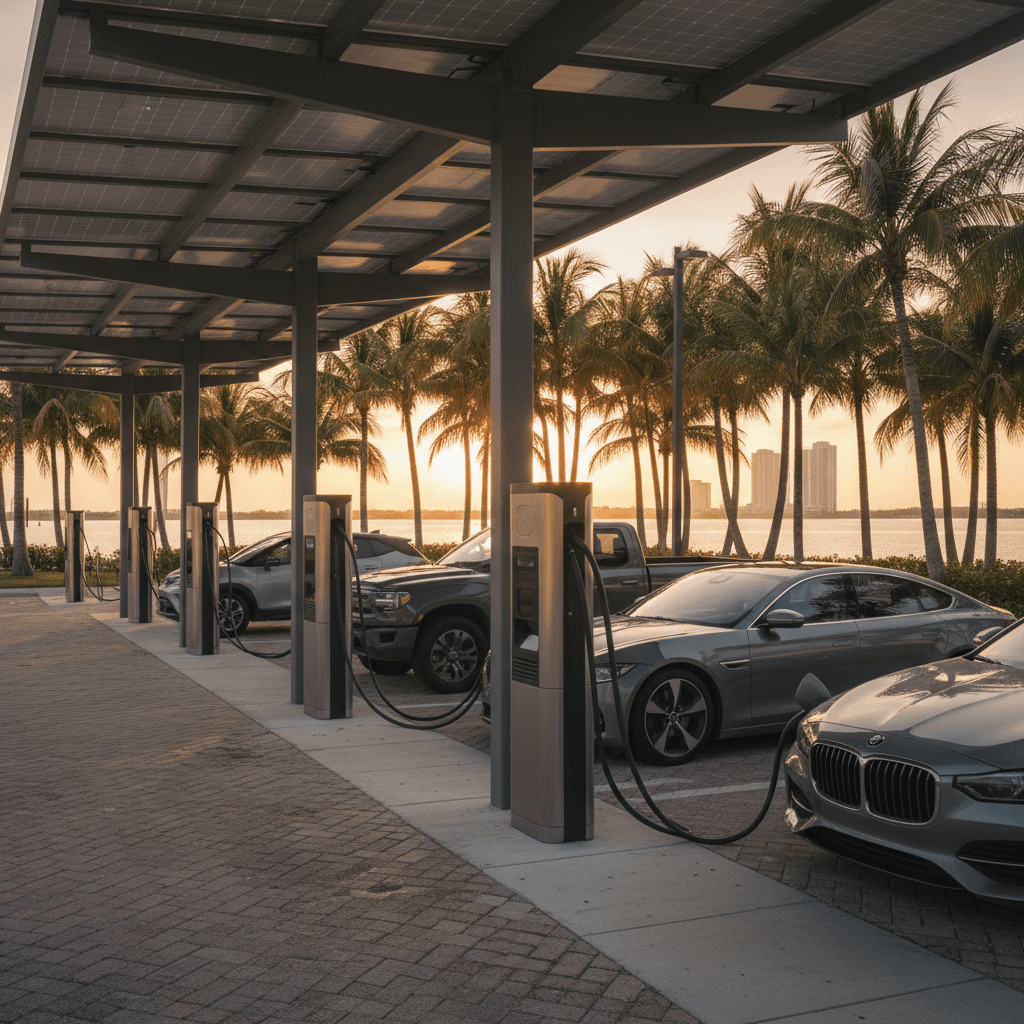
Florida’s electric car charging network isn’t one system, it’s a patchwork of utility‑run sites, national charging brands, big‑box retailers, and Tesla’s Supercharger footprint. You’ll see many logos, but a handful of networks dominate day‑to‑day life.
Who actually runs most chargers in Florida?
Know these names before you hit the road
Tesla Supercharger & Destination
Tesla still operates the largest and most reliable DC fast network in Florida, with dense coverage along I‑95, I‑75, the Turnpike and major metros. Many sites are now or soon will be accessible to non‑Tesla EVs using the NACS standard or adapters.
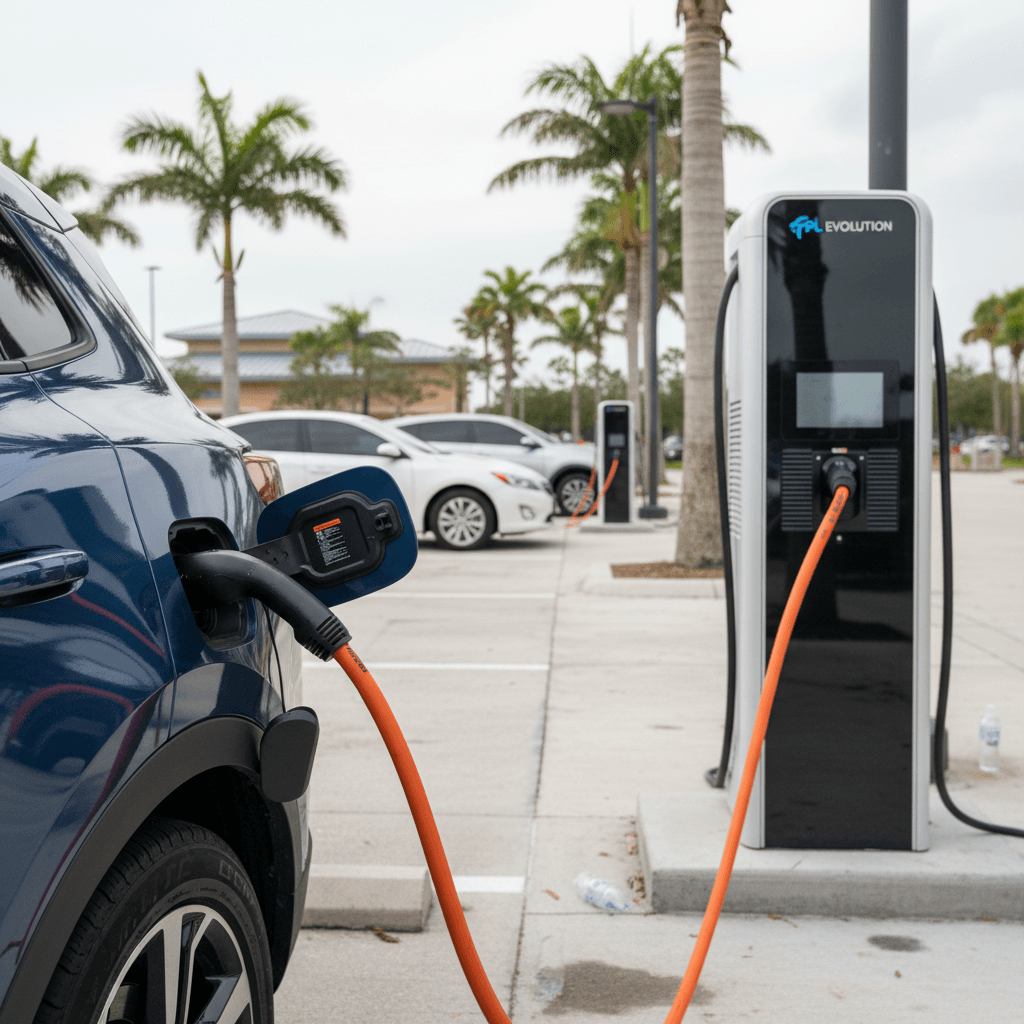
FPL EVolution
Florida Power & Light’s EVolution network focuses on DC fast chargers at highway exits, service plazas, city centers and parks within its service territory. It’s a backbone for long‑distance travel in much of eastern and southern Florida.
Electrify America & EVgo
These national networks anchor many highway stops and retail hubs with 150–350 kW chargers. Coverage is strongest around Orlando, Tampa Bay, South Florida and major interstates.
Retail & hospitality hosts
ChargePoint, Shell Recharge, Blink and others power thousands of Level 2 plugs at hotels, resorts, office parks and parking garages, critical for overnight and workplace charging.
GM/EVgo Pilot & truck stops
GM‑backed chargers at Pilot and Flying J locations are beginning to appear along regional routes like I‑75, giving non‑Tesla drivers more DC fast options at traditional travel plazas.
Big‑box & grocery programs
Walmart and other chains are rolling out their own 200–400 kW stations in store parking lots, including multiple locations in Florida, adding fast charging to everyday shopping trips.
You’ll need more than one app
Where chargers are concentrated across Florida
Florida’s charging network is thickest where people, tourists and freight all collide. If you stick to those regions, living with an EV can feel almost effortless. Once you venture into rural stretches, North Florida beach towns, or the interior between coasts, you’ll need a bit more planning.
Florida EV charging coverage by region
Where you’re most, and least, likely to find public chargers quickly
| Region | Coverage snapshot | Typical experience | Planning advice |
|---|---|---|---|
| Miami–Fort Lauderdale–Palm Beach | Very dense Level 2 and DC fast coverage | Multiple networks at malls, grocery stores, city garages and along I‑95 | Easy for daily life; still pre‑plan fast‑charge stops on holiday weekends. |
| Orlando–Kissimmee–Sanford | High density around attractions and toll roads | Theme parks, hotels and outlets offer abundant Level 2; several big DC fast hubs | Great for destination charging, watch out for queues during peak travel seasons. |
| Tampa Bay & I‑4 corridor | Strong but patchier than South Florida | Good mix of Level 2 and DC fast, especially near suburban retail centers and I‑4/I‑75 | Simple for locals; road‑trippers should map out specific plazas with multiple stalls. |
| Jacksonville & Northeast Florida | Moderate coverage focused on I‑95 and city core | Reliable DC fast at select highway exits plus Level 2 in downtown and beach areas | Plan ahead once you leave I‑95 or head toward smaller coastal communities. |
| Southwest Florida (Naples, Fort Myers, Sarasota) | Growing but uneven | Plenty of hotel and resort Level 2, fewer large DC fast hubs outside main interstates | Use destination charging heavily and don’t skip an opportunity to top up on I‑75. |
| Panhandle & rural interior | Sparse outside I‑10 and a few hubs | Scattered Level 2, limited DC fast, more single‑stall sites | Keep a large buffer, verify status in apps, and have a backup plan or slower charger. |
This overview focuses on public Level 2 and DC fast locations, not private workplace or home chargers.
Charging speeds and connector types you’ll see in Florida
Most Florida stations fall into three buckets: slow but everywhere, balanced daily drivers, and highway‑grade fast. Understanding what’s on‑screen when you pull into a lot will keep you from being surprised by a six‑hour charge when you were expecting 30 minutes.
Level 2: the workhorse
- Power: Typically 6–11 kW.
- Use case: Hotels, workplaces, parking garages, attractions.
- Speed: About 20–40 miles of range per hour, depending on your EV.
- Connectors: J1772 for most non‑Tesla EVs; Tesla wall connectors (NACS) at Tesla‑branded sites and many newer installs.
In metro Florida, Level 2 is often free or bundled into parking fees, making it ideal for overnight or all‑day top‑ups.
DC fast: road‑trip grade
- Power: Commonly 50–150 kW, with many newer sites at 200–350 kW.
- Use case: Highway travel, quick top‑ups between errands, rideshare and delivery fleets.
- Speed: Many EVs can go from 10% to 80% in 25–45 minutes.
- Connectors: CCS and NACS dominate; CHAdeMO is fading and mostly relevant for older Nissan LEAFs.
Expect to find DC fast chargers co‑located with gas stations, big‑box retail, travel plazas and FPL EVolution sites.
NACS is coming fast to Florida
What does EV charging cost in Florida?
Charging prices vary by network, site host and whether you pay by kWh, by the minute, or simply by paying to park. The good news is that Florida’s utility‑run DC fast network and competitive marketplace have kept costs in a predictable band, usually less than running a comparable gasoline car, especially if you can combine public fast charging with some home or workplace charging.
Typical public charging costs in Florida (2026 snapshot)
Approximate price ranges you’re likely to encounter at common charger types. Always check your app for current, location‑specific pricing.
| Charger type / operator | How you’re billed | Typical price range | Good for |
|---|---|---|---|
| FPL EVolution DC fast | Per kWh | Around $0.45/kWh at approved 2026 rates, plus taxes and fees | Highway fast charging when you need predictable, utility‑regulated pricing. |
| Private DC fast (Electrify America, EVgo, others) | Per kWh or per minute | Roughly $0.35–$0.60/kWh effective, depending on plan, demand and speed tier | Road trips and quick top‑ups near retail centers. |
| Level 2 at hotels & attractions | Often free, or bundled into parking | $0–$0.25/kWh equivalent; sometimes a flat parking fee instead | Overnight charging on vacation or during long visits. |
| Workplace & municipal Level 2 | Free, subsidized, or hourly parking rate | Ranges from free to a modest hourly fee | Regular commuting if you can’t charge at home. |
| Tesla Supercharger (non‑Tesla EVs) | Per kWh, with discounts via membership | Often competitive with other DC fast networks, especially with membership pricing | Fast, reliable long‑distance charging for NACS‑equipped or adapter‑equipped EVs. |
Prices shown are ballparks, not guarantees, some hosts offer free charging, others charge premiums in high‑demand areas.
Watch idle fees and time‑based rates
Planning a Florida EV road trip
The good news: you can now drive an EV from Key West to Pensacola using a mix of Superchargers, FPL EVolution and other DC fast networks. The bad news: you can’t just wing it the way you might in California. Florida’s charging corridors are improving fast, but they’re not fully built‑out or evenly spaced yet.
Step‑by‑step: planning a Florida EV road trip
1. Map your fast‑charging spine first
Before worrying about sightseeing stops, identify DC fast chargers along I‑95, I‑75, Florida’s Turnpike or I‑10 that match your connector type. Prioritize sites with multiple stalls and at least two different networks along your route.
2. Layer in Level 2 at destinations
Look for hotels and vacation rentals with reliable Level 2 charging so you can leave each morning near 100%. In places like Orlando or Miami, this can dramatically cut your need for highway fast charging.
3. Use multiple planning tools
Combine your car’s built‑in route planner with third‑party apps like PlugShare, A Better Routeplanner and network‑specific apps (Tesla, FPL EVolution, Electrify America) to cross‑check coverage and recent user reviews.
4. Add buffer for weather and traffic
High heat, heavy A/C use, strong headwinds and stop‑and‑go traffic can all eat into range. In rural stretches or the Panhandle, plan to arrive at chargers with 15–25% battery remaining, not single digits.
5. Avoid peak congestion when possible
Holiday weekends, cruise days, theme‑park peaks and hurricane‑season evacuations can all create charger lines. When you can, travel early in the morning or later at night for a smoother experience.
6. Pack a backup charging option
Consider carrying a portable Level 2/Level 1 EVSE and know where 120V outlets are at your lodging. In low‑infrastructure areas, even a slow backup can turn an inconvenience into a manageable delay.
Yes, you can road‑trip a used EV in Florida
Where Florida’s charging network still falls short
For all the progress, Florida’s electric car charging network still has some frustrating gaps. If you’re coming from a dense EV city like Los Angeles, Amsterdam or Vancouver, parts of Florida will feel behind the curve.
- Rural and small‑town coverage: Many inland counties and small Gulf or Atlantic beach towns still have few or no DC fast chargers, and the Level 2 options that exist may be single‑port sites.
- Uneven reliability between networks: Tesla and some utility‑backed sites generally score well on uptime, but drivers continue to report broken stalls or payment glitches on certain legacy networks.
- Policy headwinds: Florida has been slow to roll out some federal NEVI highway funding and has debated requirements for chargers in new developments, which can slow expansion in exactly the areas that need it most.
- Multi‑family housing challenges: Condo and apartment residents often depend entirely on public chargers, and many buildings still lack meaningful EV infrastructure.
Don’t ignore backup options in low‑coverage areas
How the network will grow next
Florida’s next wave of EV infrastructure will look different from the first. Instead of scattered one‑or‑two‑stall pilots, expect more consolidated plazas, more NACS connectors, and more build‑outs tied to national retail or automaker‑backed networks.
What to expect from Florida’s EV charging build‑out
Short term (2026–2027)
More DC fast hubs along I‑95, I‑75, I‑4 and the Turnpike funded by utilities, retailers and the first rounds of federal NEVI money.
Upgrades and expansions at existing sites, turning single‑stall locations into four‑plus‑stall plazas to reduce wait times.
Rapid adoption of NACS connectors alongside CCS, especially at new or renovated DC fast sites.
Medium term (2028–2030)
Better coverage in today’s weak spots, rural stretches, Panhandle beach towns and secondary state highways, as economics improve and early stations prove demand.
Increased role of big‑box retail, grocers and fleets as they build chargers to attract customers or power their own delivery vans and ride‑hail vehicles.
Higher‑power chargers (350–400 kW) becoming more common, especially along freight corridors and at travel plazas supporting electric pickups and SUVs.
Federal dollars will shape Florida’s map
What Florida’s charging network means if you’re buying a used EV
If you’re shopping for a used EV in Florida, the charging landscape should factor into which model you choose, where you live, and how you plan to use the car. The right pairing of battery health, connector type and local infrastructure can make ownership feel seamless. The wrong pairing can make every weekend trip feel like an experiment.
Questions to ask before you buy
- Where will I charge most often? Home, work, or public stations near your daily routes make a big difference.
- Is there reliable DC fast charging near my usual highways? Open your maps and check today, not in theory.
- What connector does this EV use? CCS, NACS, or CHAdeMO, and are quality adapters readily available?
- How healthy is the battery? A degraded pack means shorter realistic legs between Florida’s sometimes‑sparse fast chargers.
How Recharged can help
Every used EV sold through Recharged includes a Recharged Score Report with verified battery health diagnostics and transparent range estimates. Our EV specialists can walk you through how that specific car will behave on Florida routes you actually drive, whether that’s daily I‑4 commuting, Miami‑Orlando weekend runs, or Panhandle beach trips.
You can buy fully online, explore financing, or trade in your gas car and have a used EV delivered to your driveway, ready to plug into Florida’s growing charging network.
Florida EV charging network FAQ
Frequently asked questions about Florida’s electric car charging network
Key takeaways for Florida EV drivers
Florida’s electric car charging network has grown from a curiosity to a legitimate transportation backbone in just a few years. If you spend most of your time in the state’s major metros and along I‑95, I‑75, I‑4 or the Turnpike, an EV, new or used, can already fit seamlessly into everyday life. The farther you roam into today’s charging deserts, the more planning and buffer you’ll need, but the trend line is in your favor: more sites, more connectors and more competition arriving every year.
When you’re ready to move from research to ownership, pairing Florida’s maturing charging network with a used EV that has verified battery health and the right charging hardware makes all the difference. That’s exactly what Recharged was built for, transparent reports, fair pricing, EV‑savvy support and delivery to your driveway, so you can plug confidently into the Sunshine State’s growing web of chargers.