If you’re eyeing Volkswagen’s retro-electric van, you’re probably wondering what the Volkswagen ID. Buzz annual maintenance cost actually looks like in the real world. The short answer: it’s significantly lower than a comparable gas van, but it’s not zero, especially once you factor in tires, inspections, and long-term ownership.
Quick takeaway
Volkswagen ID. Buzz maintenance cost overview
ID. Buzz ownership cost snapshot (maintenance-focused)
Those figures aren’t official Volkswagen promises; they’re grounded in what we know about EV maintenance economics and what dealers and early ID. Buzz owners are reporting so far. The ID. Buzz uses the same basic MEB electric platform as the ID.4 SUV, so its long‑term service pattern should look very similar: fewer mechanical failures than a gas van, but higher-than-expected costs if you ignore tires, alignment, or software issues until something breaks.
How the ID. Buzz’s EV design changes maintenance
What you don’t service on an ID. Buzz
- No oil changes or oil filters
- No spark plugs, timing belts, or fuel injectors
- No traditional automatic transmission fluid or clutches
- Far fewer gaskets, hoses, and moving engine parts to fail
Cutting those items alone removes several hundred dollars per year that a gas-powered van owner would expect to spend, especially after the warranty period ends.
What you still maintain
- Tires and wheels (rotation, alignment, replacements)
- Brakes (pads, rotors, fluid – though pads usually last longer thanks to regen braking)
- Cabin air filter, wipers, washer fluid, bulbs
- Coolant for the battery and power electronics at long intervals
- Suspension components, steering, and HVAC just like any van
So while you’ll visit the service bay less often, you still need a plan, and a budget, for basic wear items.
Think in miles, not model years
Service intervals and what you’ll do each year
Volkswagen has not reinvented the wheel on intervals for the Buzz. U.S. dealers are generally quoting a 10,000‑mile or 1‑year rhythm, very similar to the ID.4 and other VW models: bring it in once a year for inspections and basic service, and tackle a few larger items at wider mileage milestones.
Typical VW ID. Buzz maintenance cadence (U.S. pattern)
Exact items vary by trim and build year, but this gives you a working roadmap for budgeting.
| Interval | Key items | What it usually costs at retail |
|---|---|---|
| Every 10,000 mi / 1 year | Multi‑point inspection, software checks, tire rotation, top-offs, cabin air filter as needed | ~$150–$250 |
| 20,000–30,000 mi | Repeat annual items; likely cabin filter; brake fluid check; alignment if tire wear suggests it | ~$200–$350 |
| 40,000–50,000 mi | More detailed inspection, possible brake fluid replacement, coolant check, key fob battery, etc. | ~$300–$500 |
| 60,000+ mi | Repeat of earlier services; potential suspension wear, more aggressive brake inspection | Highly variable, $400+ if parts needed |
Always confirm your specific service schedule in the owner’s manual or with your VW service advisor.
Dealer vs. independent shop pricing
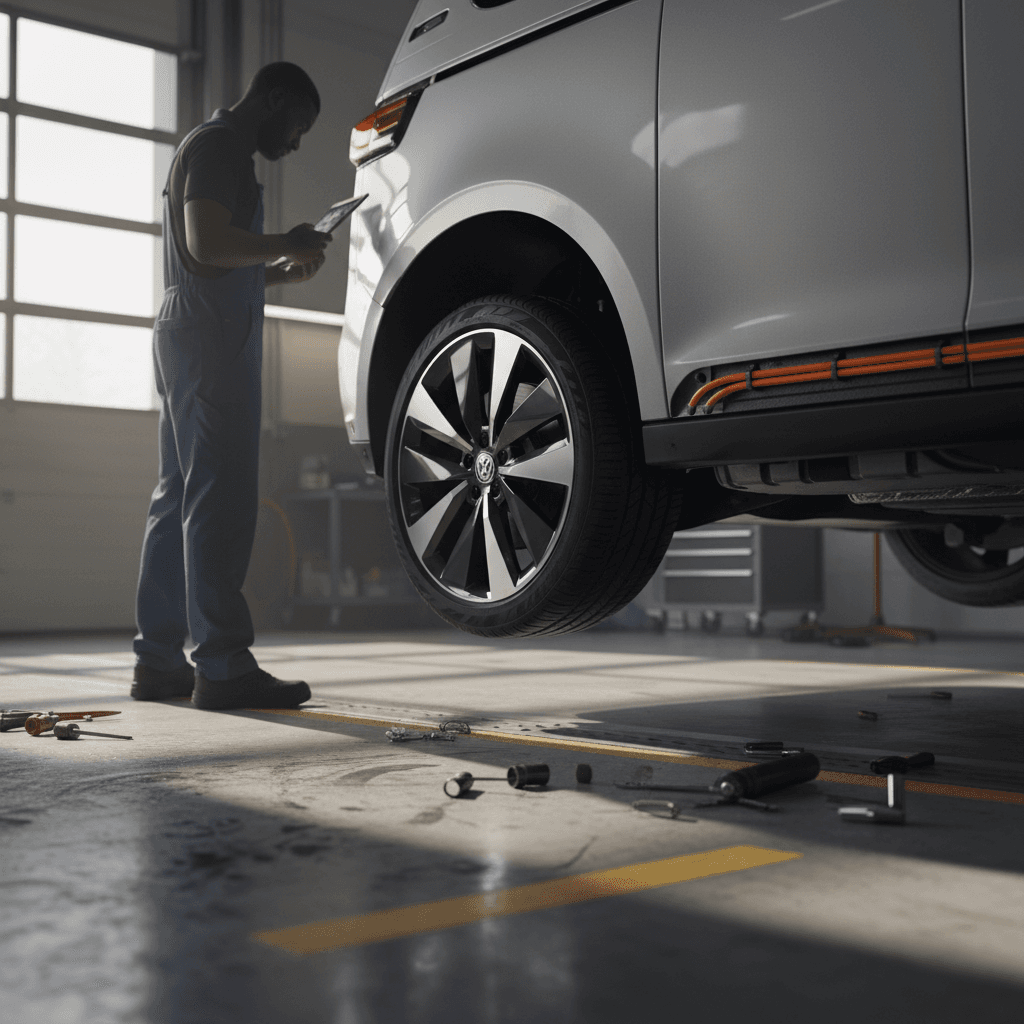
Estimated Volkswagen ID. Buzz annual maintenance cost
Because the ID. Buzz is still relatively new in the U.S., we don’t yet have a decade of hard repair data. But we can blend what we know about EVs generally with early Buzz service pricing and VW’s own maintenance program pricing to build a realistic estimate.
Annual maintenance cost scenarios for an ID. Buzz
Assuming 12,000–15,000 miles per year and no major accidents or abuse
Light‑use commuter / family van
Driving profile: Mostly suburban use, gentle driving, no towing, garage‑kept.
- 1 scheduled visit: ~$200
- Tire rotation/alignment as needed: ~$150
- Misc. items (wipers, bulbs): ~$50–$100
Estimated annual maintenance: $400–$550
Average mixed driving
Driving profile: Mix of city/highway, occasional road trips with a full van.
- 1 scheduled visit: ~$250
- Rotation + 4 tires every ~3 years: ~$250/yr averaged
- Alignment every 2 years averaged: ~$75/yr
Estimated annual maintenance: $700–$1,000
Heavy‑use commercial / road‑trip van
Driving profile: High miles, frequent highway runs, loaded with people or gear.
- 2+ visits per year: ~$400–$500
- Tires every ~2 years averaged: $350–$450/yr
- Brake service sooner than typical: $150+/yr averaged
Estimated annual maintenance: $900–$1,400
These estimates focus strictly on maintenance and minor repairs, not insurance, registration, or charging costs. They’re also averages: one quiet year might cost you only a couple of hundred dollars, while the year you need four new tires and a brake service will feel more expensive. What matters is the multi‑year average when you compare the ID. Buzz against a gas van or SUV.
Prepaid maintenance, warranty, and what’s already covered
Volkswagen leans hard on "Carefree Coverage" marketing for its newer EVs, and the ID. Buzz is no exception. The exact bundle depends on model year, but you can generally expect three layers that influence your out‑of‑pocket maintenance cost in the first few years:
- New‑vehicle limited warranty (typically 4 years / 50,000 miles) covering defects, not wear items.
- High‑voltage battery warranty (commonly 8 years / 100,000 miles against excessive capacity loss or defects).
- Complimentary scheduled maintenance on many recent VW models during the first 2 years, plus the option to buy VW Care prepaid maintenance plans that bundle factory-recommended services into a single upfront price.
- Roadside assistance during the early years, which can save you on towing or flat‑tire events.
Example VW prepaid maintenance pricing (ID family)
Recent VW Care price sheets for ID models give us a feel for how Volkswagen values those early services.
| Plan length | What it typically covers | Indicative plan price | Effective cost per year |
|---|---|---|---|
| 1–2 years | First factory services at 10k/20k miles | ~$400–$470 | ~$200/year |
| 3 years | Adds 30k‑mile service | ~$700–$800 | ~$230–$270/year |
| 4 years | Covers up to 40k‑mile service | ~$800–$850 | ~$200–$215/year |
Actual pricing varies by region and model year; check with your dealer for ID. Buzz–specific plans.
Where prepaid maintenance can make sense
If you’re buying used, ask whether the ID. Buzz you’re considering still has remaining complimentary maintenance or a transferrable prepaid plan. That can shift your effective annual maintenance cost down in the first year or two of ownership.
ID. Buzz vs. gas vans: maintenance cost comparison
The most useful comparison isn’t against other EVs, it’s against what you’d pay to keep a similarly sized gas van or three‑row SUV on the road. National data from consumer and industry studies consistently finds that purely electric vehicles spend about 30–40% less on maintenance and repairs over their lives than internal‑combustion vehicles, mostly because there’s no engine or conventional transmission to service.
Typical annual maintenance cost: ID. Buzz vs. gas van
Illustrative averages for a mainstream gas-powered family van/SUV versus a similarly used ID. Buzz over a 5‑year window.
| Vehicle type | Expected annual maintenance cost* | What drives that cost |
|---|---|---|
| Volkswagen ID. Buzz (EV) | ~$700–$1,000 | Tires, alignment, brake checks, fluid changes at long intervals, minor repairs |
| Gas minivan / 3‑row SUV | ~$1,000–$1,400 | All of the above plus oil changes, transmission service, engine repairs, exhaust and emissions work |
Real costs will vary, but this is the pattern most owners will see if they keep up with scheduled service.
The spread grows as the vehicles age. Once you’re past the basic warranty window, major engine or transmission repairs on a gas van can easily wipe out several years’ worth of the ID. Buzz’s maintenance advantage in a single visit. That’s where EVs, including the Buzz, really shine on the cost side if you’re planning to hold a vehicle for 8–10 years.
Big-ticket items: tires, brakes, battery, and software
When ID. Buzz owners talk about "surprise" costs, they’re usually not talking about oil changes, they’re talking about tires, brakes, and the rare but scary prospect of a battery issue. Here’s how to think about the big stuff.
Major maintenance cost drivers on an ID. Buzz
Tires and alignment
The Buzz is heavy and torquey, and it wears tires faster than a compact hatchback.
- A quality set of EV‑rated tires: $900–$1,200 installed
- Realistic replacement interval: every 25k–40k miles depending on driving style
- Plan on an alignment every 20k–30k miles or anytime you notice uneven wear
Brakes and suspension
Regenerative braking helps pads last longer, but you still need regular checks.
- Brake fluid replacement every few years: ~$150–$250
- Pad/rotor replacement (when needed): often less frequent than gas vans
- Heavier EV mass can age bushings, ball joints, and shocks faster on rough roads.
High-voltage battery and cooling
Catastrophic battery failures are rare and usually covered during the warranty window, but this is the single most expensive component in the vehicle.
- Battery defect coverage typically: 8 yrs / 100,000 mi
- Out‑of‑warranty pack replacement (if ever needed): high four to low five figures
- Battery coolant service: at long intervals, low annualized cost when budgeted over many years
Software and electronics
Most updates are done over the air or during scheduled service. The real risk is intermittent gremlins that require diagnostic time.
- Diagnostic time out of warranty: often $150+ per visit
- Module replacement costs vary widely, but they’re far less common than brake or tire work.
Don’t skip basic inspections
How buying a used ID. Buzz changes your maintenance picture
If you’re reading this with an eye toward a used ID. Buzz rather than a factory‑fresh one, your annual maintenance cost question is a little different. You’re not just asking, "What does it cost each year?" but also, "What am I walking into on day one?"
Questions that change your cost curve
- How many miles are already on the odometer? A 40k‑mile van is a very different bet than an 8k‑mile demo unit.
- Has every scheduled service been done on time? Gaps in history are red flags.
- What’s left on the battery and bumper‑to‑bumper warranty? That’s your safety net for expensive surprises.
- Are tires and brakes fresh, or nearing end of life? This can swing your first‑year cost by more than $1,000.
How Recharged can help you model costs
Every used EV listed on Recharged comes with a Recharged Score Report that includes verified battery health, tire condition, and a scan of diagnostic trouble codes.
That lets you see, before you buy:
- Whether the pack is holding capacity as expected
- Whether previous owners kept up with service
- Whether you’re likely to need tires, brakes, or suspension work in the first 12 months
You can then bake those needs into your personal estimate of the ID. Buzz’s annual maintenance cost instead of guessing.
Used ID. Buzz checklist
7 ways to keep ID. Buzz maintenance costs low
Practical tactics to shrink your annual maintenance bill
1. Rotate and check tires religiously
Tire wear is the #1 hidden cost on heavy EVs. Rotate every 5,000–7,500 miles, check pressures monthly, and get an alignment at the first sign of uneven wear.
2. Use scheduled maintenance as a diagnostic moment
Don’t treat the annual visit as a box‑check. Ask your advisor specifically about remaining brake life, suspension wear, and software updates that address known issues.
3. Keep regen braking on and drive smoothly
Aggressive acceleration and late braking chew through tires and pads. Let regenerative braking do the work and you’ll extend both tire and brake life.
4. Shop service, not just location
A VW dealer is a good choice for complex EV work and warranty campaigns, but for routine rotations, alignments, and wipers, a reputable independent shop can be cheaper without sacrificing quality.
5. Consider prepaid maintenance if the math works
Price out individual services and compare them to VW’s prepaid maintenance plans. If the plan costs less than doing the same work a la carte, and you plan to keep the van, it can be a smart hedge against inflation.
6. Protect the battery with sane charging habits
Frequent DC fast charging and always parking at 100% can accelerate degradation. Keeping daily charging in the 20–80% window reduces long‑term battery stress and the chance of expensive issues later.
7. Use a pre‑purchase inspection for private‑party deals
If you’re not buying through a marketplace like Recharged that already checks the vehicle, pay for an EV‑savvy inspection. The $200–$300 you spend can save you from buying into someone else’s deferred maintenance.
Volkswagen ID. Buzz maintenance cost FAQ
Frequently asked questions about ID. Buzz maintenance costs
Bottom line: Is the ID. Buzz cheap to maintain?
Viewed strictly through the maintenance lens, the Volkswagen ID. Buzz is a solid play. You dodge oil changes, timing belts, and most engine‑related failures, and your biggest recurring expense becomes tires and alignment rather than chasing leaks or misfires. Budget around $700–$1,000 per year for a typical ownership pattern and you’ll be prepared for almost everything routine ownership throws at you.
Where you really win is in the long game. Compared with a gas van you keep for 8–10 years, the Buzz’s simpler drivetrain, fewer moving parts, and strong battery warranty tilt the odds toward fewer big repair bills. If you’re shopping used, pairing that with a Recharged vehicle that has verified battery health, a clean service history, and transparent pricing makes it a lot easier to see the true annual maintenance cost before you commit, so the only surprise is how much you’re enjoying the van, not what you’re paying to keep it running.