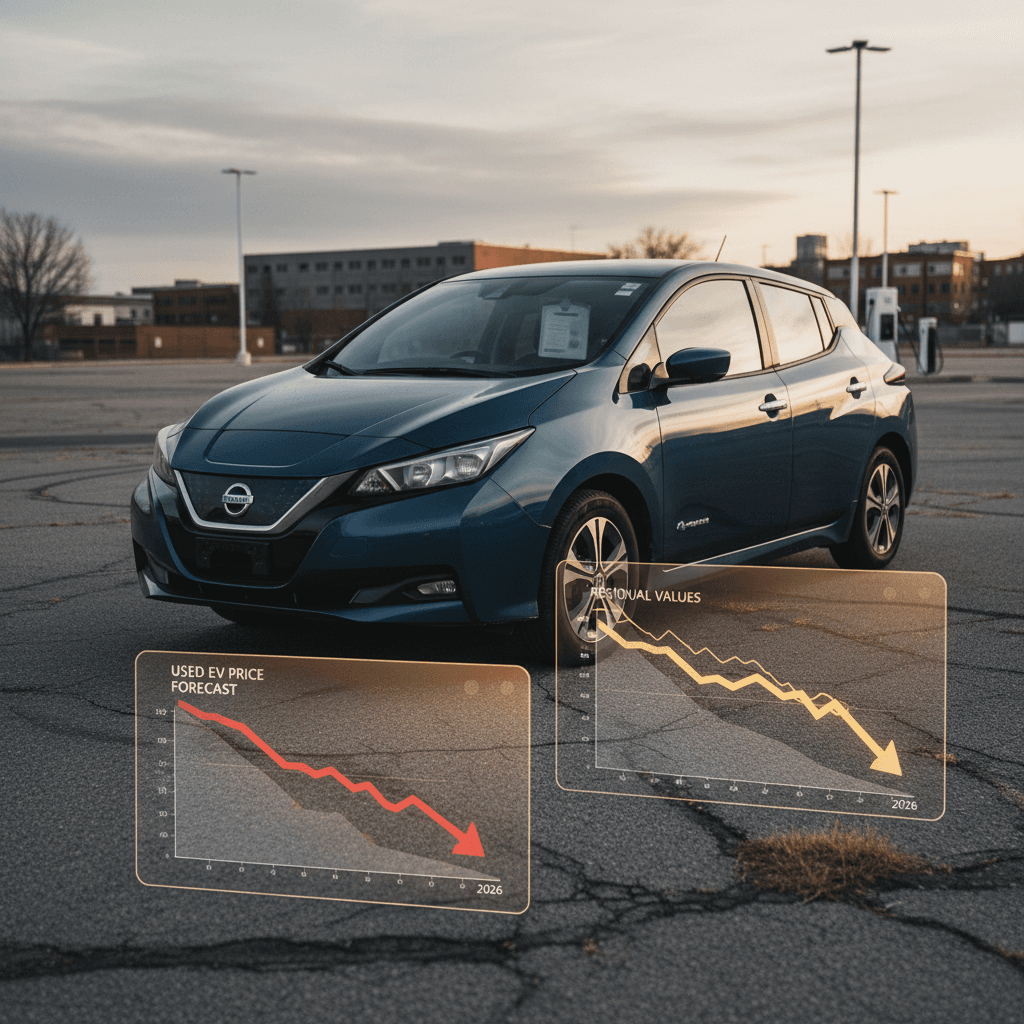
If you’ve watched used electric vehicle prices over the last couple of years, you’ve seen something we almost never witness in the car world: a genuine crash. Used EV prices have fallen more than 30% in some cases, and shoppers are wondering whether the used EV price forecast for 2026 means more bargains ahead, or a risk if you buy now.
Why this matters now
Why used EV prices crashed so hard
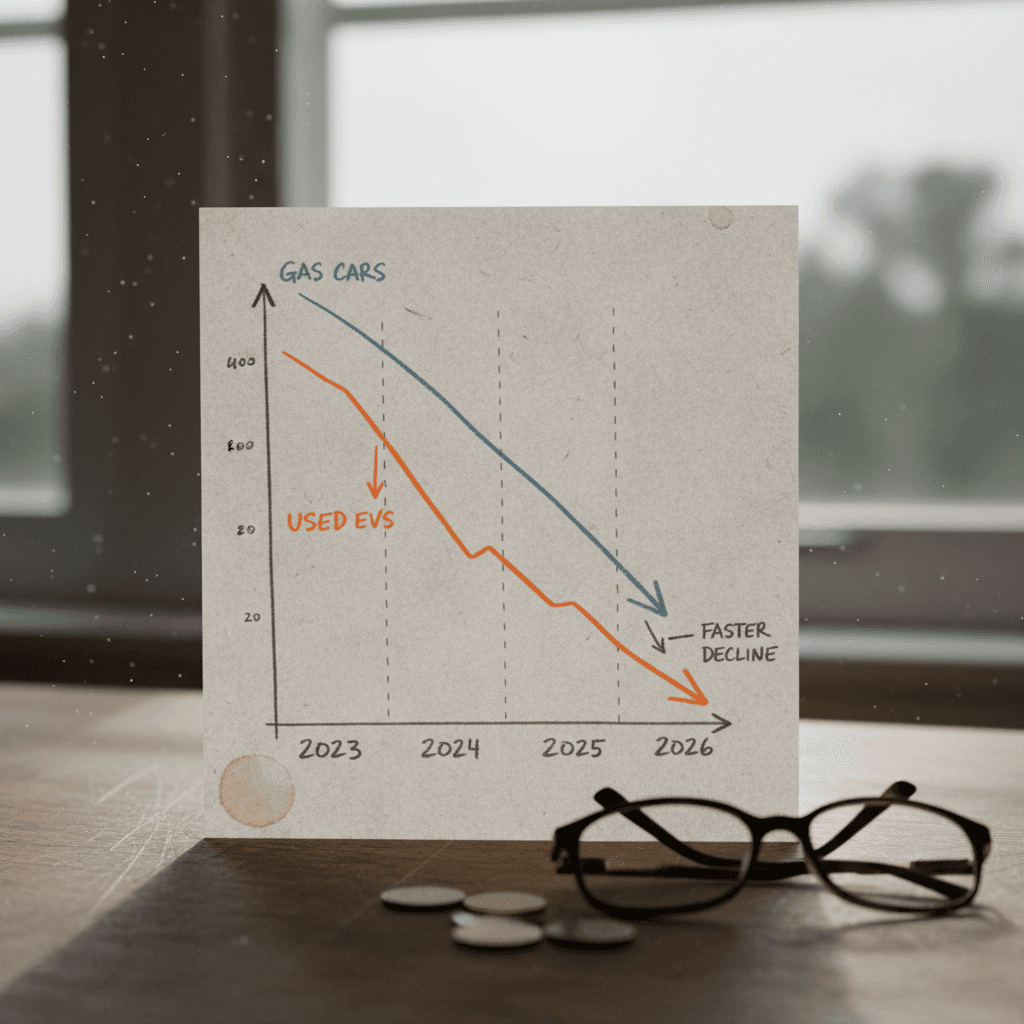
Used EVs haven’t just gotten cheaper, they’ve gotten cheaper fast. Analysis of the U.S. market showed average used EV prices dropping roughly 30–35% year-over-year through late 2023 and early 2024, while the typical used car price fell only about 5%. In other words, EVs took the elevator down while gasoline cars strolled down the stairs.
How fast used EV prices fell
Several forces collided to smack used EV values at once:
- New EV price cuts: Aggressive discounting and MSRP cuts, especially from Tesla, pulled the floor out from under used values overnight.
- Tax credits shifted demand: When shoppers could get up to $7,500 off a new EV at the point of sale, many skipped the used lot altogether.
- Technology moved quickly: Longer-range batteries, faster charging, and better driver-assist tech in newer models made 2–4-year-old EVs feel dated faster than equivalent gas cars.
- Early-adopter overhang: Many first-wave EVs had quirky styling, shorter range, or slow charging. When buyers moved on, those cars piled up in the used market.
Price cuts ripple backwards
Where used EV prices stand heading into 2026
By late 2025, the freefall had slowed, but the gap between EVs and gas cars remained stark. Prices for many used EVs, especially Teslas and luxury models, stabilized at much lower levels than just two years prior. In practical terms, that means a three-year-old EV that might have fetched $40,000 in 2022 could now be trading in the low $30,000s, or even high $20,000s, depending on mileage and battery health.
Used EVs in early 2026
- Prices well below their 2022 peaks, often by five figures.
- Plenty of 200–300 mile EVs under $30,000, some under $20,000.
- Slow sellers in some regions, creating room for negotiation.
Used gas cars in early 2026
- Prices down modestly from pandemic highs, but still comparatively strong.
- Popular hybrids often gaining value year-over-year.
- Faster to sell than EVs in many markets, especially SUVs and trucks.
A buyer’s market for the right EVs
Used EV price forecast for 2026
So where do we go from here? The headline: used EV prices in 2026 are likely to stay soft overall, but the brutal, across-the-board price collapses are behind us. Instead, expect a split market where the best, most usable EVs level out while weaker models keep drifting down.
Our 2026 used EV price outlook
What we expect across major segments (U.S. market)
Mainstream EVs (Nissan Ariya, Hyundai Ioniq 5, VW ID.4)
Forecast: Mild additional declines, then stabilization.
- Many already corrected 20–30% from peaks.
- Expect low- to mid-single-digit price drops in 2026.
- Strong range & modern tech support long-term demand.
Older & short-range EVs (2016–2020 Leafs, early Bolts)
Forecast: Continued gradual erosion.
- Limited range & slower charging cap appeal.
- More competition from newer budget EVs and PHEVs.
- Prices could slide another 10–15% over 2026.
Desirable long-range & performance EVs (Model 3/Y, Taycan)
Forecast: Bumpy but resilient.
- Hit hard already by earlier price cuts.
- Good range and performance keep a floor under values.
- Expect mostly sideways movement with pockets of strength.
A forecast, not a promise
Winners and losers: which used EVs will hold value best?
As the market matures, used EV values are starting to behave less like a single category and more like what they really are: a mix of excellent, decent, and not-so-great cars. In 2026, depreciation will be heavily influenced by range, charging speed, and brand reputation.
2026 used EV value outlook by segment
Big-picture view of which types of used EVs are positioned to hold value, and which aren’t.
| Segment | Typical Age in 2026 | Value Trend | Why |
|---|---|---|---|
| Modern long-range crossovers (Ioniq 5/6, Ariya, Mustang Mach-E, ID.4) | 2–4 years | Stabilizing or modest declines | Good range (250+ miles), DC fast charging, family-friendly body styles. |
| Affordable commuter EVs (Bolt EUV, Kona Electric, ID.4 base trims) | 3–6 years | Strong demand at lower prices | Appealing to budget buyers and commuters looking to ditch gas. |
| Luxury performance EVs (Porsche Taycan, Audi e-tron GT) | 2–5 years | Volatile but with a floor | High MSRPs mean big dollar drops, but enthusiast demand keeps them from collapsing entirely. |
| Early short-range EVs (older Leaf, i3, first-gen Soul EV) | 6–10+ years | Ongoing slide | Short range and slower charging make them second or third cars for most households. |
| Large electric pickups (F-150 Lightning, early Rivian R1T) | 2–4 years | Softening | High new prices, niche use cases, and rapid improvements in newer trucks pressure used values. |
Exact models differ, but these patterns are already forming in the U.S. used market.
Follow the miles and the plug
How 2026 EV lease returns will reshape the used market
There’s another wave headed for the used EV beach: off-lease returns. Industry analysts expect EV lease returns to spike sharply in 2026, with well over 200,000 electric vehicles coming back from leases, more than double prior years and a much larger share of all off-lease vehicles than we’ve seen before.
Why 2026 lease returns matter
Most of these off-lease EVs are exactly what used buyers love: 2–4 years old, moderate mileage, and usually with complete service histories. But that surge in supply also puts gentle downward pressure on prices, especially for mainstream crossovers and sedans. Expect more choice on used lots, and more need to compare trims and battery options carefully.
Why lease buyouts are less attractive now
What this pricing outlook means if you’re buying a used EV
From a buyer’s perspective, 2026 is shaping up as one of the most attractive windows we’ve ever seen for used EVs. You’re getting the benefit of earlier price drops, plus a wave of fresh off-lease vehicles, without taking quite as much risk as the folks who bought at the top of the market.
Buyer playbook: how to shop used EVs in 2026
1. Target the sweet-spot years
Look for EVs roughly 2–5 years old. They’ve already absorbed the steepest portion of depreciation, but still offer modern range and tech.
2. Prioritize battery health documentation
Demand objective data on battery condition. At Recharged, every car comes with a <strong>Recharged Score Report</strong> that includes verified battery health, so you’re not buying blind.
3. Check charging compatibility for your life
If you rely on road trips or public charging, make sure the EV supports the fast-charging networks you’ll actually use, and confirm NACS adapter options where relevant.
4. Compare total cost, not just price
Factor in insurance, home charging installation, electricity vs. fuel, and any remaining warranties. A slightly pricier EV can still be cheaper to own than a gas car.
5. Use the price dip to upgrade trims
Because prices are softer, you can often step into a better-equipped trim, larger battery, upgraded audio, all-wheel drive, for what a base model cost a couple of years ago.
6. Work with EV-specialist retailers
Dealers who live and breathe EVs can explain degradation, range in your climate, and charging options. Recharged’s EV specialists are available end-to-end, fully online or at our Richmond, VA Experience Center.
Why buying in 2026 can be smart
What this pricing outlook means if you’re selling or trading in
On the selling side, soft prices aren’t exactly a cause for celebration, but they don’t have to be a disaster either. The key is understanding where your EV sits in the market and how to present it so it stands out.
If you’re trading in
- Get offers from EV-savvy buyers, not just general dealers.
- Time your trade before a wave of similar off-lease models hits the market.
- Use your battery health report as a selling point, strong health can justify a better number.
If you’re selling privately
- List detailed charging info: connector type, adapter status, and typical range at your driving style.
- Highlight remaining warranty coverage on the battery and drive unit.
- Price realistically based on recent comparable sales, not what the car was worth in 2022.
Leverage transparent valuation tools
Battery health: the new backbone of used EV value
In a soft pricing environment, the difference between a great deal and a regret isn’t the color, the wheels, or even the brand. It’s the battery. Real-world data from fleets and analytics companies shows that modern EV batteries are generally holding up better than early skeptics predicted, with only a small percentage needing full pack replacements within the first 8–10 years.
- A healthy battery can support better pricing and a faster sale, even in a crowded market.
- Cars with visible degradation, especially if it’s not documented or explained, will be the ones that need big discounts to move.
- Transparent, third-party battery reports give buyers confidence and help sellers argue against lowball offers.
How Recharged handles battery uncertainty
Used EV price forecast 2026: FAQ
Frequently asked questions about used EV prices in 2026
Bottom line: is 2026 a good year for used EVs?
If you bought an EV at the top of the market, the story on paper isn’t pretty. But if you’re entering the used EV market in 2026, this is one of the most favorable landscapes you’re ever likely to see. Prices have reset, batteries are proving more durable than expected, and a wave of lease returns is giving shoppers a buffet of late-model choices.
The smart move isn’t trying to outguess every twist in the market, it’s using today’s conditions to your advantage. Focus on verified battery health, realistic range for your lifestyle, and a price that reflects the new normal, not 2022 fantasies. That’s the philosophy behind Recharged: transparent battery diagnostics, fair market pricing, expert EV guidance, and financing and trade-in options built for this new EV reality.
If you’re ready to see what that looks like in real cars, explore used EVs on Recharged, get a Recharged Score Report, and let an EV specialist walk you through the numbers. In a market where prices move fast, the right information is still the most valuable feature you can buy.