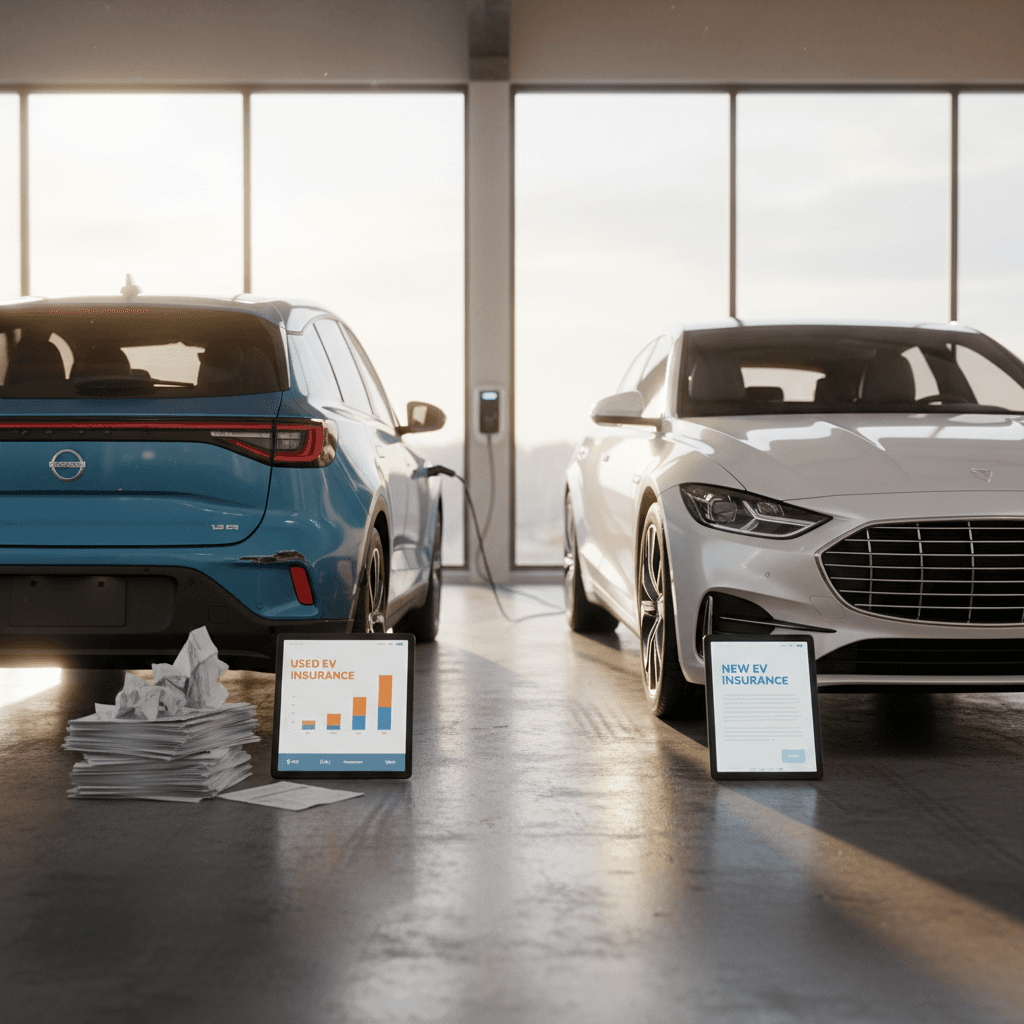
If you’re comparing a **used EV** to a **brand‑new electric car**, you’ve probably noticed one big wildcard in the budget: insurance. EV insurance is often higher than for comparable gas cars, and the picture gets more complicated when you ask, “How does *used EV insurance vs new EV insurance* really stack up?”
Quick takeaway
Used EV Insurance vs New EV Insurance: The Short Version
- **New EVs** typically carry the *highest* premiums because of their higher sticker prices, expensive batteries and cutting‑edge tech that can be costly to repair.
- **Used EVs** often cost *less* to insure than their new counterparts, especially once they’re a few model years old and have dropped in value.
- Compared with gas cars, **both new and used EVs** can still run 10–20% (and in some studies closer to 40–50%) more to insure because of repair and battery costs.
- Insurers are still learning how EVs age, so **rates vary widely by brand, model and state**. Two similar‑looking EVs can produce very different quotes.
- Your choice of **coverage (especially collision/comprehensive), deductibles and mileage** can change the used‑vs‑new comparison far more than most drivers realize.
Practical next step
First, Why Are EVs Often More Expensive to Insure Than Gas Cars?
To understand **used EV insurance vs new EV insurance**, you first need to know why EVs in general often carry higher premiums than gas vehicles. Insurers price policies based on what they might have to pay out, and with EVs, that potential payout can be higher for several reasons:
Core reasons EVs can cost more to insure
These apply to both used and new electric vehicles, but they hit new EVs hardest.
Expensive batteries
Complex technology
Limited repair networks
On the flip side, EVs also have advantages: fewer moving parts, less routine maintenance and strong crash‑test performance. Some studies even show **lower claim frequency** for certain EV trims compared with their gas equivalents, which is one reason rates can vary so much from model to model.
Don’t generalize from one EV
How Vehicle Age Changes EV Insurance Costs
Age matters in insurance because it changes the **value of the vehicle**, the **data insurers have**, and the **way you choose to insure it**. Here’s how that plays out for **used vs new EV insurance**.
How age affects EV insurance: new vs used
Broad trends you’ll see when you compare quotes on similarly equipped electric vehicles.
| Factor | New EV (0–3 years) | Used EV (4–8+ years) |
|---|---|---|
| Vehicle value | Highest; full MSRP or close to it | Lower; depreciation already priced in |
| Collision & comprehensive cost | Highest, to cover full replacement or major repairs | Often lower because the insurer’s maximum payout is smaller |
| Repair expectations | Insurers may assume expensive, OEM‑only parts and limited repair options | More data on real‑world repair patterns, plus some parts may be more available |
| Battery warranty status | Typically within full factory battery warranty | May be nearing the end of battery warranty, affect coverage decisions |
| Data history | Less historical claim data, more conservative pricing | More claim data by model year; insurers can adjust rates to reality |
| Coverage choices | Most owners carry high limits and full coverage | Owners sometimes raise deductibles or drop certain coverage as the car ages |
Actual premiums will vary by driver profile, location, insurer and specific EV model.
For many drivers, this adds up to a simple pattern: **a two‑ or three‑year‑old EV often hits a sweet spot for insurance.** It still has modern safety tech and some battery warranty remaining, but its depreciated value generally pulls premiums down compared with a fresh‑off‑the‑lot model.
Why New EV Insurance Is Often Higher
When insurers look at a brand‑new EV, several risk factors line up in a way that tends to **push premiums upward**, especially in the first few model years.
- **Higher sticker price:** A $60,000 electric SUV simply costs more to replace than a $28,000 used hatchback. Collision and comprehensive coverage are priced on that worst‑case replacement cost.
- **Fresh, unproven tech:** All‑new platforms, larger battery packs and new software suites mean **more uncertainty** for insurers. Until they see real‑world claim data, they often price cautiously.
- **Repair complexity and parts availability:** New body styles, sensor packages and battery designs can make repairs more specialized, and **parts may be back‑ordered or dealer‑only**.
- **Higher‑performance trims:** Many new EVs offer very quick acceleration. For some insurers, that correlates with **higher claim severity**, and some performance‑oriented models are priced accordingly.
- **Financing and lender requirements:** If you finance or lease a new EV, your lender will generally require **full coverage with specific deductibles** and may encourage or require gap coverage, all of which can raise your total insurance bill.
Watch the total package
When Used EV Insurance Is Cheaper, And When It Isn’t
Used EVs have a natural cost advantage: **lower market value**. That usually means you can insure them for less than their new counterparts, especially if you choose higher deductibles or adjust coverage as the car ages. But there are also situations where a used EV’s insurance bill doesn’t fall as much as buyers expect.
When used EV insurance is typically lower
- Mid‑priced models, a few years old: A three‑year‑old compact EV that has dropped $10,000–$15,000 in value often carries substantially lower collision and comp premiums than the same car brand‑new.
- Good safety ratings and ADAS: A used EV that retains strong crash‑test scores and driver‑assistance tech may qualify for discounts similar to a new car.
- Battery health is documented: When you can show that the battery is healthy and charging correctly, insurers may be more comfortable with repair vs total‑loss decisions.
- Moderate performance versions: Non‑performance trims (smaller wheels, less power) are often cheaper to insure than high‑output variants, even when both are used.
When used EV insurance doesn’t drop much
- High‑end luxury EVs: A used $85,000 luxury EV that’s now worth $55,000 is still a very expensive car to repair or replace. Premiums may remain steep.
- Models with poor repair histories: If claims data show that certain EVs are often totaled after relatively minor damage, insurers bake that into their rates regardless of age.
- Older EVs with limited parts availability: Some first‑generation EVs have scarce body parts or specialty components, which can keep repair costs (and premiums) elevated.
- Very high miles or salvage/flood history: History issues can spook insurers or push your coverage options into non‑standard markets with higher prices.
Where used EVs shine
Coverage Strategies: Used EV vs New EV
Coverage choices can tilt the used‑vs‑new equation more than most shoppers realize. Here’s how drivers commonly configure insurance for each, and where you have room to maneuver.
Typical coverage approaches for new vs used EVs
Use this as a starting point, then tailor it to your risk tolerance and budget.
New EV coverage playbook
- Full coverage (liability + collision + comprehensive) is almost always required by lenders and lessors.
- Lower deductibles (e.g., $500) so you’re not writing a huge check if something happens soon after purchase.
- Gap coverage or new car replacement to protect against rapid depreciation in the first years.
- Higher limits for property damage and bodily injury to protect your finances if the worst happens.
Used EV coverage playbook
- Still carry **full coverage** while the car retains significant value, especially if you can’t easily self‑fund a replacement.
- Consider **raising deductibles** (e.g., from $500 to $1,000) to drop your premium if the car is paid off and worth less.
- Revisit whether **gap coverage** is still needed as the loan balance drops below the car’s market value.
- Maintain strong liability limits; vehicle age doesn’t change your potential exposure in a major crash.
Adjust as the EV ages
Realistic Cost Scenarios: Used vs New EV Insurance
Every driver profile is different, but walking through realistic examples can clarify how **used EV insurance vs new EV insurance** might look in practice. Imagine a U.S. driver with a clean record, average annual mileage and solid but not ultra‑high coverage limits.
Illustrative insurance scenarios: used vs new EV
Not quotes, just directional examples to show how vehicle value and configuration can affect premiums.
| Scenario | Vehicle | Approx. vehicle value | Relative annual premium |
|---|---|---|---|
| A: New compact EV | 2026 compact EV, new, well‑equipped | $42,000 | Highest (baseline 100%) |
| B: 3‑year‑old same model | 2023 compact EV, similar trim, used | $26,000 | Often 15–25% lower than Scenario A |
| C: Used mainstream EV | 2019–2020 mainstream EV hatchback | $17,000 | Often 25–35% lower than Scenario A |
| D: Used luxury EV | 2021 luxury EV, performance trim | $55,000 used | Can rival or exceed Scenario A despite being used |
Assumes the same driver, location and coverage limits; amounts are for comparison only.
The take‑home: **“Used” doesn’t automatically mean “cheap to insure.”** What matters most is the combination of value, brand/model repair data, safety tech and how you choose to structure coverage.
How to Lower Insurance Costs on a Used EV
If you’re leaning toward a pre‑owned EV, the good news is that you have several levers to pull to bring premiums into a comfortable range, without cutting coverage so deeply that you put yourself at risk.
Checklist: Make a used EV cheaper to insure
1. Start with the right car
Choose a used EV with a solid safety record, moderate performance, and widely available parts. Mainstream models with good crash‑test scores and standard driver‑assist features often rate better than niche or ultra‑luxury EVs.
2. Verify battery health and history
Ask for documentation of **battery health, charging habits and accident history**. At Recharged, every vehicle includes a Recharged Score Report with verified battery diagnostics and history checks, which can give both you and your insurer confidence in the car’s condition.
3. Get quotes before you buy
Compare at least three insurers using the **specific VINs** of the used EVs you’re considering. Small differences, like wheel size, trim level or built‑in safety packages, can move your premium more than you’d expect.
4. Optimize deductibles, not just limits
Raising your collision and comprehensive deductibles from, say, $500 to $1,000 can noticeably lower your premium on a used EV whose value has already dropped. Just be sure you have the cash saved if you need to file a claim.
5. Ask about EV and telematics discounts
Some insurers offer **green‑vehicle discounts**, EV‑specific programs, or usage‑based telematics plans that reward low‑mileage and smooth driving. These can help offset the baseline cost of insuring an electric car.
6. Bundle and clean up the basics
Standard moves still matter: bundle auto and home, keep your credit in good shape where allowed, and add an approved driver‑monitoring app if you’re comfortable. With EVs, stacking small discounts can make a surprisingly big difference.
Mileage matters more than you think
How Recharged Helps You Make Smarter EV Insurance Decisions
Insurance shouldn’t be an afterthought when you’re shopping for an electric car, especially if you’re weighing a **used EV against a new one**. Recharged is built around the idea that EV ownership should be **simple, transparent and financially predictable**.
- **Recharged Score battery health report:** Every used EV listed on Recharged includes a detailed Recharged Score Report with verified battery health and diagnostics. That insight helps you understand how the car has been treated, and can support a more accurate discussion with your insurer.
- **Fair, data‑driven pricing:** Because vehicles are priced in line with fair market values, you’re not overpaying upfront. A realistic purchase price usually means a more realistic **insured value**, which helps keep premiums in check.
- **EV‑specialist guidance:** Recharged’s EV specialists can help you think through **coverage needs, warranty overlap and total cost of ownership**, so you’re not just comparing purchase prices but also monthly insurance and charging costs.
- **Flexible buying options:** Whether you finance, trade in or sell your current car through Recharged, you can structure your deal, and your coverage, to hit a target monthly number that works for you.
- **Nationwide, digital‑first experience:** You can compare used EVs, review battery reports and run insurance quotes from home, or visit the Recharged Experience Center in Richmond, VA if you prefer a hands‑on walkthrough.
Putting it together
Ready to find your next EV?
Browse VehiclesFrequently Asked Questions: Used EV vs New EV Insurance
Your questions, answered
Bottom Line: Choosing Between Used and New EVs With Insurance in Mind
When you zoom out, the pattern is clear: **used EV insurance vs new EV insurance usually tilts in favor of the used car**, thanks to depreciation and more flexible coverage choices. But EVs aren’t a one‑size‑fits‑all story. Brand, model, battery design, safety tech and your own driving profile can swing premiums significantly in either direction.
If you want the environmental and driving benefits of an electric car without straining your budget, a carefully chosen **used EV with documented battery health** can be a smart play. Pair that with thoughtful insurance choices, right‑sized coverage, realistic deductibles, and discounts you can actually qualify for, and you can keep monthly ownership costs in check.
Recharged exists to make that process easier. With verified battery diagnostics, fair pricing, expert EV support and flexible buying and selling options, you can focus on the right questions: *Does this EV fit my life, and what will it really cost me each month, including insurance?* When you answer those clearly, the used‑versus‑new decision usually makes itself.