If you’re trying to decide between an electric vehicle and a gasoline car, **residual value**, what the car is worth down the road, can feel like the tiebreaker. Over the last few years, headlines have swung from “EVs hold value amazingly well” to “EVs are crashing in price.” So what’s actually happening with **EV residual value vs gas cars** in 2026, and how should it shape your buying or selling decision?
Depreciation sets the tone
Why EV residual value vs gas cars matters now
Residual value is the percentage of a vehicle’s original price it’s expected to retain after a certain time or mileage, commonly three or five years. It affects you in three big ways:
- **Lease payments**: Higher residual value usually means lower monthly payments, because the lender expects the car to be worth more at lease-end.
- **Equity when you sell or trade**: A car that holds value better leaves you with more cash or trade-in credit when you move on.
- **Total cost of ownership (TCO)**: Even if an EV saves you money on fuel and maintenance, heavy depreciation can offset those gains if you buy new and sell early.
The catch is that **residual value is not uniform across all EVs or all gas cars**. Some EVs, especially well-known models with strong demand, do surprisingly well. Others take a steeper hit than almost any gas vehicle. To make sense of it, you need to understand how depreciation works in the first place.
How vehicle depreciation really works
Every vehicle follows a broadly similar depreciation curve: **fast early losses that slow over time**. You typically see the biggest value drop in the first three years, then a gentler decline later. The curve shape is similar for EVs and gas cars, but the **steepness** can be very different.
What drives gas car depreciation
- Age and mileage: Wear and tear, out-of-warranty risk.
- Fuel economy: Thirsty vehicles lose appeal when gas prices rise.
- Brand & segment: Trucks and SUVs usually hold value better than luxury sedans.
- Market cycles: Recessions, supply shortages, and incentives all move prices.
What adds on for EVs
- Battery uncertainty: Fear of expensive battery replacement weighs on resale.
- Rapid tech change: Newer EVs often have more range and faster charging, making older ones feel obsolete more quickly.
- Policy swings: Federal and state incentives can suddenly shift demand between new and used EVs.
- Charging access: Models that struggle with fast charging or connector compatibility may suffer.
Think in percentages, not just dollars
Current data: EV vs gas depreciation in 2025–2026
Five-year depreciation: EVs vs gas cars
Recent large-scale analyses of the U.S. used-car market show that **EVs, on average, depreciate more than any other vehicle type** over a five‑year period. While a typical vehicle loses around **45–46%** of its value after five years, EVs are now averaging **close to 59%** loss over the same window.
Zoom in and you’ll see big spreads between individual models:
Illustrative 5‑year depreciation examples
These examples highlight how differently specific EVs and gas vehicles can perform. Numbers are rounded from recent market analyses and should be viewed as directional, not precise quotes for any individual car.
| Vehicle type & example | Approx. 5‑yr depreciation | Approx. 5‑yr residual value | Notes |
|---|---|---|---|
| Mass-market EV hatchback (e.g., older Nissan Leaf) | ~64% | ~36% | Shorter range, older tech, and fading incentives push prices down. |
| Mainstream compact EV crossover (e.g., newer Tesla Model Y, Hyundai Ioniq 5) | ~55–60% | ~40–45% | Stronger demand, but still hit harder than many comparable gas SUVs. |
| Mainstream gas compact SUV | ~45% | ~55% | Benefit from broad demand and no battery concerns. |
| Hybrid SUV | ~40–41% | ~59–60% | Hybrids combine efficiency with low range anxiety, supporting value. |
| Full-size pickup (gas) | ~40% | ~60% | Trucks remain some of the strongest residual-value performers. |
Always check live market data for the exact model, year, and mileage you’re considering.
Averages can mislead
Why many EVs depreciate faster than gas cars
Four structural reasons EVs often lag gas cars on residual value
These forces have been especially strong in the 2022–2025 market cycle.
1. Upfront incentives cut into used prices
2. Rapid tech and range improvements
3. Battery replacement fears
4. Off‑lease waves and price cuts
“Between incentives that effectively lower an EV’s price before it’s even purchased and concerns about battery replacement costs, used electric vehicles have always suffered higher depreciation than equivalent gasoline cars.”
When EV residual value can rival or beat gas cars
Despite the scary averages, **not all EVs are depreciation disasters**. Residual value is model‑specific and timing‑specific. Under the right conditions, some EVs can **match or even beat** comparable gas cars on value retention.
Situations where EVs can be resale standouts
Look for these patterns if you want an EV that holds its value better.
High-demand nameplates
Right-size range and charging
Clean histories & healthy batteries
Used EV sweet spot
Battery health: the hidden X‑factor in EV residual value
For gas vehicles, used‑car shoppers worry about engines and transmissions. For EVs, **battery health is the single most important mechanical variable**. Two EVs of the same model year and mileage can have very different market values if one pack has degraded significantly more than the other.
- Most modern EVs lose around **2–3% of battery capacity per year** under typical use, though climate and fast‑charging habits matter.
- A pack that’s still at **90–95% of original capacity** is usually a non‑issue for resale; one that’s down near **75–80%** will see meaningful value hits.
- Because a replacement pack can easily cost **$8,000–$20,000+**, buyers and lenders are increasingly demanding **objective battery health data**, not just a dashboard guess.
Why third‑party diagnostics matter
Residual value vs total cost of ownership: what actually saves you money
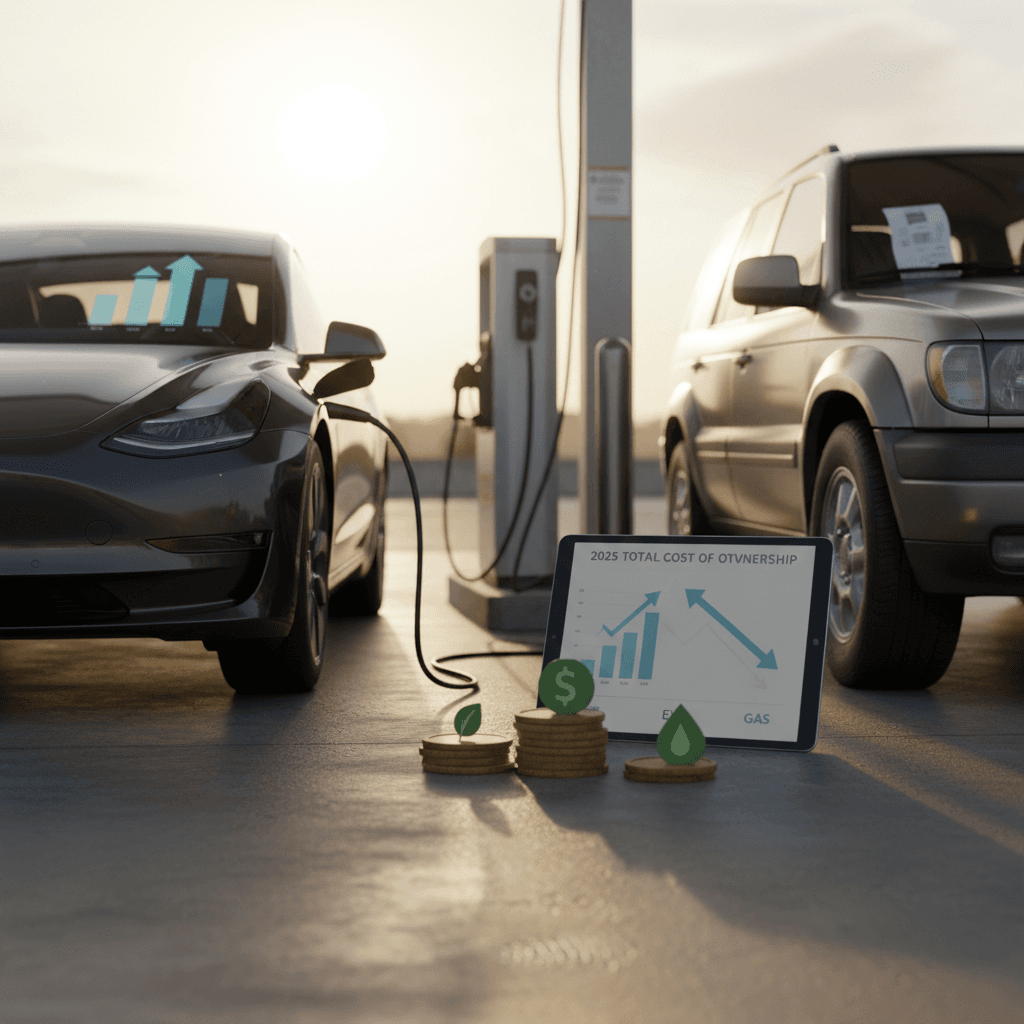
It’s tempting to fixate on one metric, “EVs depreciate more than gas cars, therefore they’re worse financially.” In reality, you should weigh **residual value inside the broader total cost of ownership (TCO)** picture over the years you plan to keep the car.
Key TCO ingredients for a gas car
- Fuel: Gasoline costs vary, but over 5 years it’s typically one of your top expenses.
- Maintenance: Oil changes, spark plugs, exhaust systems, and more add up, especially beyond 60,000 miles.
- Depreciation: Often 40–50% over 5 years for mainstream models.
Key TCO ingredients for an EV
- Electricity: On home charging, it often equates to paying around $1–$2 per gallon of gas equivalent.
- Maintenance: Fewer wear items, no oil changes, fewer moving parts, so routine upkeep tends to be lower.
- Depreciation: Can be closer to 55–60% over 5 years on average, but varies widely by model.
Run the full 5‑year math
Used EV vs used gas car: which is the smarter buy today?
Because new EV depreciation has been relatively steep, **used EVs have quietly become some of the best value buys in the market**. In many segments, you can now get a late‑model EV for a price similar to, or even lower than, an equivalent gas car, despite the EV having cost much more when new.
Used EV vs used gas car: how they stack up
Assuming similar size, age, and equipment
Used EV advantages
- Lower purchase price vs original MSRP: Early depreciation is your friend as a buyer.
- Cheaper “fuel” and less routine maintenance: Especially if you can install home Level 2 charging.
- Quieter, smoother drive: Instant torque and fewer vibrations.
- Future‑proofing: Access to growing fast‑charging networks, especially as more brands adopt NACS.
Used gas car advantages
- More predictable resale: Decades of data mean you can estimate future value more confidently.
- Fast refueling anywhere: No trip planning around chargers, especially in rural areas.
- Lower purchase price in some segments: Particularly for older economy cars where EV alternatives are scarce.
- Less tech obsolescence concern: A 7‑year‑old gas car doesn’t feel as “obsolete” as a 7‑year‑old EV with half the range.
Where used EVs often win outright
Selling strategies: how to maximize your EV’s resale value
If you already own an EV, you can’t change market cycles, but you can control how attractive your car looks to the next buyer. These moves can materially improve your **residual value vs similar EVs** when it’s time to sell or trade in.
Checklist: Boosting your EV’s residual value
1. Time your sale around 3–6 years
For many EVs, **3–6 years of age** is a sweet spot where depreciation has slowed from the early plunge, but battery and tech still feel current. Waiting until the battery warranty is nearly over can spook buyers and lenders.
2. Document battery health
Get a **formal battery health report** before you sell. At Recharged, every car includes a Recharged Score battery diagnostic; even if you sell elsewhere, being able to show strong state of health can support a higher price.
3. Highlight charging flexibility
If your EV has access to multiple charging networks or adapters (for example, NACS and CCS), call that out. Easier charging translates directly into broader appeal and better residual value.
4. Keep software and service up to date
Maintain **software updates** and keep records of any warranty or recall work. For buyers, a well‑maintained EV signals that the previous owner was careful with both the battery and the rest of the car.
5. Avoid abusive charging habits
Long term, try to limit **frequent 100% fast charges** and avoid chronic deep discharges. Buyers are getting savvier about how charging behavior affects degradation, and inspection tools can surface past abuse.
6. Consider multiple exit options
Compare **trade‑in offers, instant online bids, and consignment**. Market sentiment toward EVs swings quickly; a specialist EV marketplace like Recharged can sometimes beat generic dealer bids by marketing battery health and low running costs explicitly.
How Recharged fits in
FAQ: EV residual value vs gas cars
Frequently asked questions
Bottom line: how to use residual value to your advantage
Residual value is where the economics of EVs and gas cars get honest. On average, **EVs still depreciate faster than gas cars**, largely because of incentives, rapid tech turnover, and lingering battery fears. But that doesn’t mean EVs are a bad financial move, it means you need to be **deliberate** about what you buy, when you buy it, and how you sell it.
If you’re shopping used, today’s market often lets you pick up a **3–5‑year‑old EV at a deep discount** relative to its original price, then enjoy low running costs, especially with verified battery health and convenient charging. If you already own an EV, timing your exit and presenting clear battery data can materially boost your **residual value vs similar cars**.
Either way, you don’t have to navigate this alone. Recharged’s combination of **battery‑health‑driven pricing, transparent Recharged Score reports, EV‑specialist support, financing, trade‑ins, instant offers, and consignment options** is designed to turn a confusing residual‑value landscape into a set of clear decisions. Focus on the total economics, insist on real battery data, and you can make residual value work for you, whether you end up in an EV, a gas car, or somewhere in between.