If you’re shopping for a used electric car, the **first** question you should be asking isn’t range or 0–60. It’s this: does the EV warranty transfer to a second owner? Because in the EV world, that warranty, especially the battery coverage, is the financial airbag behind every drive.
Quick answer
How EV warranties work for second owners
An EV doesn’t have pistons or timing chains; its beating heart is a battery pack that can cost as much as a starter home’s down payment. That’s why manufacturers wrap new EVs in multiple overlapping warranties, some of which transfer with the car and some of which don’t.
- Bumper-to-bumper ("basic vehicle") warranty: Covers most components and electronics for a set number of years/miles. Often transferable, but shorter than battery coverage.
- Powertrain warranty: For gas cars this covers engine and transmission and often does not fully transfer. For EVs it’s sometimes replaced or overshadowed by EV‑specific coverage.
- EV battery and electric drive warranty: Covers the high‑voltage battery and related components, usually for 8–10 years and 100,000+ miles. This is the most important warranty for a used EV buyer.
- Corrosion / emissions / roadside: Side‑band warranties that may or may not transfer, and are less critical for your long‑term cost picture.
Key principle
What parts of an EV warranty usually transfer?
Typical EV warranty transfer rules (big picture)
Always check the actual booklet for the specific car, but here’s how it usually breaks down.
High‑voltage battery
Usually transfers in full to later owners for the remaining years/miles.
Example: An 8‑year/100,000‑mile battery warranty started in 2022 typically still protects a 2026 buyer until 2030 or 100,000 miles, whichever comes first.
Electric drive components
Motors, inverters, on‑board chargers and related EV hardware are often bundled with the battery warranty.
These components typically transfer along with the battery coverage.
Bumper‑to‑bumper & extras
Basic vehicle coverage (often 3–5 years/36–60k miles) nearly always transfers, but you’ll usually be buying a car partway through that clock.
Perks like roadside assistance or free charging may be first‑owner only.
Where things get tricky is the fine print around powertrain and "lifetime" claims. Some legacy warranty templates were written for gas cars and bolt EV language on top. So you’ll find situations where the 10‑year powertrain warranty doesn’t transfer, but the 10‑year EV system warranty does, creating a lot of confused salespeople and even more confused buyers.
Don’t rely on the salesperson
Brand examples: Tesla, Hyundai, and others
Let’s get specific. Here’s how warranty transfer typically looks on some of the most common EVs on the U.S. used market as of early 2026. Always confirm the details for the exact model year and trim you’re considering, because small changes happen quietly from year to year.
Typical EV warranty transfer patterns by brand (U.S., recent model years)
High‑level patterns for popular EV brands. This is a guide, not a substitute for reading the exact warranty booklet for the VIN in front of you.
| Brand | Battery & EV system warranty | Does it transfer?* | Basic / bumper‑to‑bumper | Special notes |
|---|---|---|---|---|
| Tesla | 8 years with 100k–150k mile limit depending on model, with 70% capacity retention | Yes, remaining term transfers to subsequent owners | 4 years / 50,000 miles basic; remainder transfers | Used Teslas sold by Tesla often add a 1‑year/10k‑mile CPO warranty on top of remaining basic coverage. |
| Hyundai (Ioniq 5, Kona EV, etc.) | 10 years / 100,000 miles on EV system and high‑voltage battery | Yes, for EVs this coverage is generally transferable to later owners | 5 years / 60,000 miles New Vehicle Limited, transferable | Traditional 10‑year powertrain warranty language for gas cars doesn’t apply the same way to EVs; EV components are covered under the EV‑specific warranty. |
| Kia (EV6, Niro EV) | Similar to Hyundai: 10 years / 100,000 miles on EV components and battery | Typically transferable for EVs | 5 years / 60,000 miles basic, typically transferable | As with Hyundai, older web pages sometimes confuse ICE and EV coverage, always verify in the EV warranty booklet. |
| Nissan (Leaf, Ariya) | Earlier Leafs: 8 years / 100,000 miles against excessive capacity loss; newer Ariya has similar or better coverage | Generally transferable for remaining term | 3 years / 36,000 miles basic, 5 years / 60,000 miles powertrain | Watch early Leaf model years for shorter or more limited degradation protection. |
| Volkswagen (ID.4) | 8 years / 100,000 miles on high‑voltage battery | Transfers for remaining term | 4 years / 50,000 miles basic, transferable | Emissions and corrosion coverage add extra protections depending on state. |
| Ford (Mach‑E, F‑150 Lightning) | 8 years / 100,000 miles on battery and electric drivetrain components | Transfers for remaining term | 3 years / 36,000 miles bumper‑to‑bumper | Some Mach‑E years had separate coverage for different battery sizes; check the booklet. |
| GM (Bolt, Lyriq) | 8 years / 100,000 miles on EV battery and components for most modern EVs | Transfers for remaining term | 3 years / 36,000 miles basic | Bolt battery recall replacements generally carry fresh warranty coverage, but confirm in writing. |
Examples are representative; coverage can vary by model year, state, and whether the car was bought new or used from the manufacturer.
Asterisks matter
Tesla: everything rides on the transfer
Teslas are relatively simple on paper: a 4‑year/50,000‑mile basic warranty plus an 8‑year battery and drive unit warranty with varying mileage caps by model. When ownership is properly transferred in Tesla’s system, the remainder of both coverages follows the car.
Buy a 3‑year‑old Model 3 with 30,000 miles, and you might have roughly 1 year/20,000 miles of basic coverage plus 5 more years of battery/drive coverage left, assuming the odometer and in‑service dates are accurate.
Hyundai & Kia: EV coverage better than the brochure implies
Hyundai’s famous “10‑year/100,000‑mile powertrain warranty” for gas cars historically stuck to original owners. But for EVs like the Ioniq 5 and Kona Electric, the separate Hybrid/EV system warranty (10 years/100k) is typically transferable to subsequent owners, including the high‑voltage battery.
That means a used Ioniq 5 buyer may get nearly a decade of factory battery coverage from the original in‑service date, even if the generic website small print suggests otherwise.
How many owners do EV warranties cover?
You might assume warranties only cover the second owner and then evaporate. In reality, most EV warranty booklets use language like “transferable to subsequent owners,” not “second owner only.” In practice, that means third and fourth owners can still benefit as long as the calendar and odometer haven’t run out.
Why this matters on the used EV market
Good news for later buyers
Certified pre-owned vs regular used EV warranty
Certified pre‑owned (CPO) sounds like a golden ticket, and sometimes it is. But with EVs, the value of a CPO badge depends heavily on the brand and how generous the original EV warranty already is.
CPO vs non‑CPO: what actually changes for a used EV
Think in terms of added time, added miles, and inspection depth, not just the word “certified.”
Certified pre‑owned from the automaker
- Usually adds extra bumper‑to‑bumper coverage (e.g., Tesla’s 1‑year/10,000‑mile CPO warranty after the basic ends).
- Requires an inspection checklist and may include reconditioning standards.
- Rarely extends the high‑voltage battery warranty beyond the original term, it was already long.
Regular used (dealer or private sale)
- You still inherit whatever factory coverage remains by time and mileage, as long as the brand allows transfer (most do for EV components).
- No extra bumper‑to‑bumper years unless the seller includes a third‑party plan.
- Inspection quality depends entirely on the seller, there’s no universal standard.
When CPO is worth paying for
How to check warranty status before you buy
Whether you’re standing in a dealer lot or scrolling through listings at home, you should never treat warranty coverage as an educated guess. Here’s a simple process you can follow for any EV, whether you buy from a private seller, a franchise dealer, or a marketplace like Recharged.
Step‑by‑step: confirming a used EV’s warranty
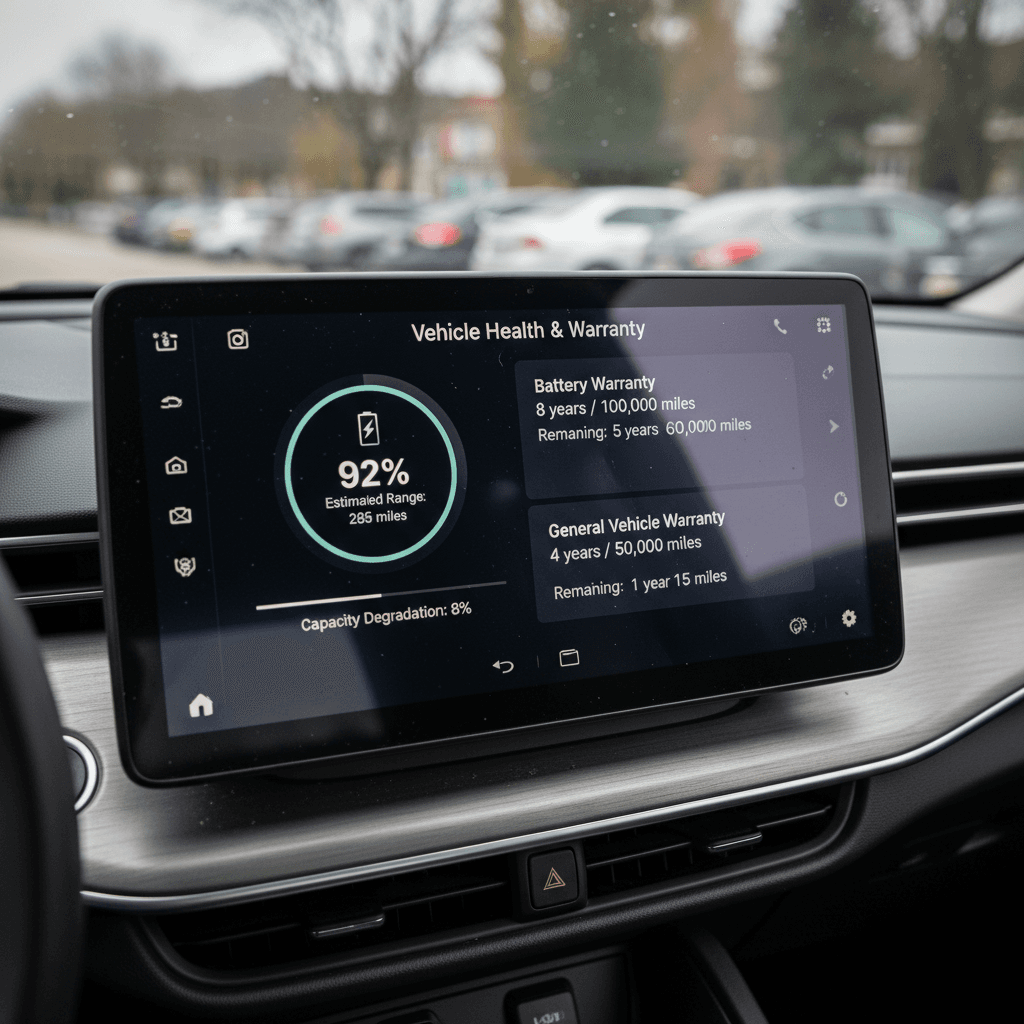
1. Get the full VIN and in‑service date
Ask the seller for the VIN and the original in‑service date (the day the first owner took delivery). Most warranty clocks start from that date, not the model year.
2. Download the official warranty booklet
Go to the manufacturer’s U.S. website, find the warranty section, and download the PDF for that exact model year. Search for terms like <strong>“transferable”</strong>, <strong>“subsequent owners”</strong>, and <strong>“battery”</strong>.
3. Call the manufacturer with the VIN
Most brands’ customer care lines can tell you, based on the VIN, the in‑service date and what factory coverage remains. Take notes: who you spoke with, date, and what they confirmed.
4. Verify mileage against the odometer
Factory warranties are usually “years <em>or</em> miles, whichever comes first.” Make sure the odometer reading matches the story the seller is telling, including service receipts and Carfax/AutoCheck history.
5. Look for exclusions and transfer rules
Scan the fine print for modifiers like “original owner only,” “CPO only,” or conditions that void coverage (improper modifications, commercial use, salvage title).
6. Get it in writing on the sales paperwork
When possible, have the remaining warranty coverage clearly stated on your buyer’s order or purchase agreement. It reduces finger‑pointing later.
Common pitfalls that can kill your coverage
Automakers are reasonably generous about battery warranties; they are far less generous when an owner gives them an excuse to walk away. You don’t need to live in fear, but you do need to know which landmines to avoid.
- Salvage or rebuilt title: Many manufacturers void most or all factory warranties once the car is declared a total loss, even if it’s later repaired.
- Unauthorized modifications: DIY battery repairs, non‑approved high‑voltage work, or aggressive tuning of power electronics can void coverage on the affected systems.
- Commercial or high‑duty use: Rideshare, delivery, or fleet duty can reduce warranty periods or fall under separate commercial terms.
- Missing software updates: Ignoring critical software or recall campaigns, especially those aimed at protecting the battery, can haunt you if there’s a later failure.
- Abuse and neglect: Documented overheating, ignoring repeated system warnings, or extreme misuse can give a manufacturer grounds to deny a claim.
Odometer tampering and data mismatch
How Recharged handles warranty and battery health
You can do all this detective work yourself, or you can let someone obsessive do it for you. At Recharged, our entire business is built around making the used EV question, “Is this thing actually healthy?” feel boringly easy.
What you get when you buy a used EV through Recharged
Warranties are only half the story; verified battery health is the other half.
Recharged Score report
Every vehicle on Recharged comes with a Recharged Score, a detailed, technician‑backed report that includes:
- Measured battery health and capacity
- Charging history insights when available
- Estimated remaining useful life vs. peers
Verified warranty & title status
We dig into each car’s history and documentation to confirm:
- Remaining factory EV and battery warranty
- Title status (no salvage surprises)
- Open recalls and key software campaigns
Modern, low‑friction buying experience
Recharged offers financing, trade‑ins, instant offers or consignment, and nationwide delivery, all wrapped in a digital‑first process. Prefer to touch metal first? Visit our Experience Center in Richmond, VA.
Why this matters more than a CPO badge
FAQ: EV warranties and second owners
Frequently asked questions about EV warranties for second owners
Bottom line on EV warranties for second owners
A used EV without clear warranty information is like a house with a locked basement: maybe everything’s fine, but you’d be crazy to sign before you look. The good news is that, in the EV era, factory battery and EV‑system warranties usually do transfer to second and later owners, and they often last 8 to 10 years from the original sale date.
Your job is to replace wishful thinking with paperwork: confirm the in‑service date, read the actual warranty booklet, verify mileage and title status, and get the remaining coverage documented at sale. Or hand the homework to someone who lives for this stuff. When you buy through Recharged, every car comes with a Recharged Score report, verified battery health, and clearly explained warranty status, so you can focus on the fun question instead: which used EV do you actually want to live with?