If you’re shopping for used electric cars in Maryland in 2026, you’re hitting the market at an inflection point. The big federal used EV tax credit ended in late 2025, Maryland’s own incentive landscape is shifting, and used EV prices have finally come down after the pandemic bubble. The upside: if you know how incentives, charging costs, and battery health work in 2026, you can get a lot of car for the money.
Context: 2026 is a transition year
Why used electric cars in Maryland are compelling in 2026
Maryland consistently ranks among the leading EV states by market share and policy support. The Chesapeake Bay region, I‑95 corridor, and dense suburbs around Baltimore and D.C. make short‑to‑medium commutes the norm, which plays to electric vehicles’ strengths. At the same time, new EV prices have climbed with higher interest rates, pushing more buyers to look seriously at the used market.
Maryland EV landscape heading into 2026
The real story in 2026 isn’t just sticker price. It’s that fuel and maintenance savings stack up year after year, while more used EVs hit the market as leases expire and early adopters trade up. If you’re willing to understand incentives and battery health, Maryland is one of the better places in the U.S. to daily‑drive a used EV.
What changed for used EV incentives in 2026?
For most of 2024 and 2025, the headline for budget‑minded shoppers was the federal Used Clean Vehicle Tax Credit, worth up to $4,000 on qualifying used EVs under $25,000. That credit ended for vehicles delivered after September 30, 2025, which means that in calendar‑year 2026, you can’t claim it on newly purchased used EVs, no matter what state you live in.
Don’t assume you still get the federal used EV credit
Maryland’s own incentives have also evolved. The state’s EV excise tax credit of up to $3,000 is targeted at new zero‑emission vehicles and has been constrained by annual funding caps that have run out quickly in past fiscal years. For used buyers in 2026, your financial levers are different: you’re mostly optimizing on purchase price, electricity rates, and long‑term battery health rather than a single big tax windfall.
Maryland-specific EV incentives and rebates in 2026
Even with the federal used EV credit gone, Maryland still offers a mix of incentives that affect the total cost of owning a used electric car in 2026. Some are state‑level, others come from utilities or local governments. Not all of them are as visible as a rebate on the window sticker, but together they can shift your math significantly.
Key incentives Maryland EV shoppers should know in 2026
These programs change, but the patterns are clear
Maryland EV excise tax credit
Maryland offers an excise tax credit of up to $3,000 for qualifying new zero‑emission electric and fuel‑cell vehicles purchased and titled between July 1, 2023 and June 30, 2027, subject to price caps and annual funding limits.
While this doesn’t apply directly to used vehicles, it matters because it supports new EV sales today, which become tomorrow’s used inventory.
Home charger rebate
The state and utilities have repeatedly funded programs that rebate up to 50% of EV charger and installation costs, often capped around $700 for residential Level 2 equipment.
These are typically available whether your car is new or used, what matters is that you’re installing a qualifying charger at a Maryland home.
Time‑of‑use (TOU) charging rates
All major Maryland utilities now offer off‑peak EV charging rates. If you plug in overnight, your electricity cost per kWh can drop dramatically.
For a used EV driver, TOU rates can be the difference between saving a little and saving a lot versus gasoline.
Always check current program details
How incentives affect a used EV purchase in 2026
Where the money does, and doesn’t, show up when you buy used.
| Cost component | New EV buyer | Used EV buyer in 2026 | What to do as a used buyer |
|---|---|---|---|
| Vehicle purchase price | May get state excise tax credit (if funds available) | No direct state vehicle tax credit | Focus on negotiating a lower price and comparing total cost of ownership. |
| Federal tax credits | No federal new EV credit after Sep 30, 2025 | No federal used EV credit after Sep 30, 2025 | Ignore out‑of‑date credit claims; run the numbers without them. |
| Home charger & install | May qualify for EVSE rebate | Also may qualify for EVSE rebate | Plan a Level 2 install into your overall budget. |
| Fuel (electricity) costs | Low with TOU rates | Low with TOU rates | Set up off‑peak charging as soon as you bring the car home. |
Exact amounts and eligibility depend on program rules in effect when you apply.
Typical prices for used electric cars in Maryland
After a wild couple of years, used EV pricing has started behaving more like the rest of the used car market. The exact numbers will vary by mileage, trim, and battery health, but in Maryland’s 2026 market you’re likely to see the following ballparks from reputable dealers for mainstream used EVs:
- Early‑generation Nissan LEAF, 2016–2019, shorter‑range: often in the $10,000–$16,000 range, with the lowest prices attached to cars showing noticeable degradation.
- Chevrolet Bolt EV/Bolt EUV, especially 2019–2023 models: commonly in the mid‑teens to low‑$20,000s, depending on mileage and whether the pack has been replaced under recall.
- Tesla Model 3 (Standard/Long Range) from the late‑2010s and early‑2020s: frequently in the mid‑$20,000s to low‑$30,000s from franchise dealers, with rear‑wheel‑drive cars typically cheaper than dual‑motor trims.
- Hyundai Kona Electric, Kia Niro EV, and similar compact crossovers: often priced like Bolts, but with a bit of a premium for brand and feature set if they have a clean history and good range.
Used EVs vs used hybrids vs used gas
Best used electric car models for Maryland driving
Maryland’s mix of stop‑and‑go Beltway traffic, winter slush, and weekend road trips to the mountains or the beach means your used EV choice should balance range, charging speed, and practicality. Here are some of the standout models for 2026 shoppers.
Used EV models that make sense in Maryland
Think in terms of use cases, not just badges
Chevrolet Bolt EV / Bolt EUV
Why it works: Compact footprint for city parking, 200+ miles of rated range on many trims, and widespread availability thanks to strong past sales.
- Great for Baltimore and D.C. commuters.
- Post‑recall packs can actually be stronger than original units.
- DC fast‑charging is adequate for occasional road trips, not record‑setting.
Tesla Model 3
Why it works: Dense Supercharger coverage along I‑95, efficient at highway speeds, and a strong owner community in Maryland.
- Excellent for frequent Baltimore–D.C. or Baltimore–Philly drives.
- Software features and Autopilot matter if you spend time in traffic.
- Be extra careful about prior accident history and alignment.
Hyundai Kona Electric / Kia Niro EV
Why it works: Subcompact crossovers with practical cargo space and real‑world ranges that hold up well for mixed driving.
- Good choice if you routinely head to western Maryland or the Eastern Shore.
- Decent highway efficiency and a comfortable ride.
- Check that DC fast‑charging behavior matches original specs.
Nissan LEAF (later years)
Why it works: For short commutes and in‑town use, later‑generation LEAFs can be inexpensive entry points into EV ownership.
- Best as a second car or for sub‑50‑mile days.
- Battery degradation is the make‑or‑break factor, get data, not guesses.
- CHAdeMO DC fast‑charging is a dead end; treat them as mainly Level 2 cars.
Watch out for orphaned fast‑charging standards
Battery health and range: what to look for in a used EV
Battery health is the single most important variable when you’re buying a used EV in 2026. Two cars that look identical on a dealer lot can have very different usable range and long‑term value depending on how their packs have aged, how they were charged, and whether they’ve seen extreme heat or frequent fast‑charging.
How to evaluate battery health
- Ask for a battery health report: Some dealers can pull OEM diagnostics, but many still can’t or won’t.
- Look at displayed range at high state of charge: A nearly full battery on a test drive should show reasonable projected range.
- Compare to original EPA rating: A healthy pack typically retains the majority of its rated range after 4–6 years, not half.
- Check for recall history: Bolt EVs, for example, may have had packs replaced under recall, often a plus.
Why third‑party diagnostics matter
Traditional used‑car processes weren’t built for batteries that cost five figures to replace. A visual inspection won’t tell you if you’ve lost 15% or 30% of capacity.
At Recharged, every vehicle comes with a Recharged Score battery health report, using dedicated diagnostics rather than guesswork. That lets you compare two Model 3s, or a Bolt and a Kona, on more than just miles and model year.
Avoid buying a mystery battery
Charging a used EV in Maryland: home, public, and costs
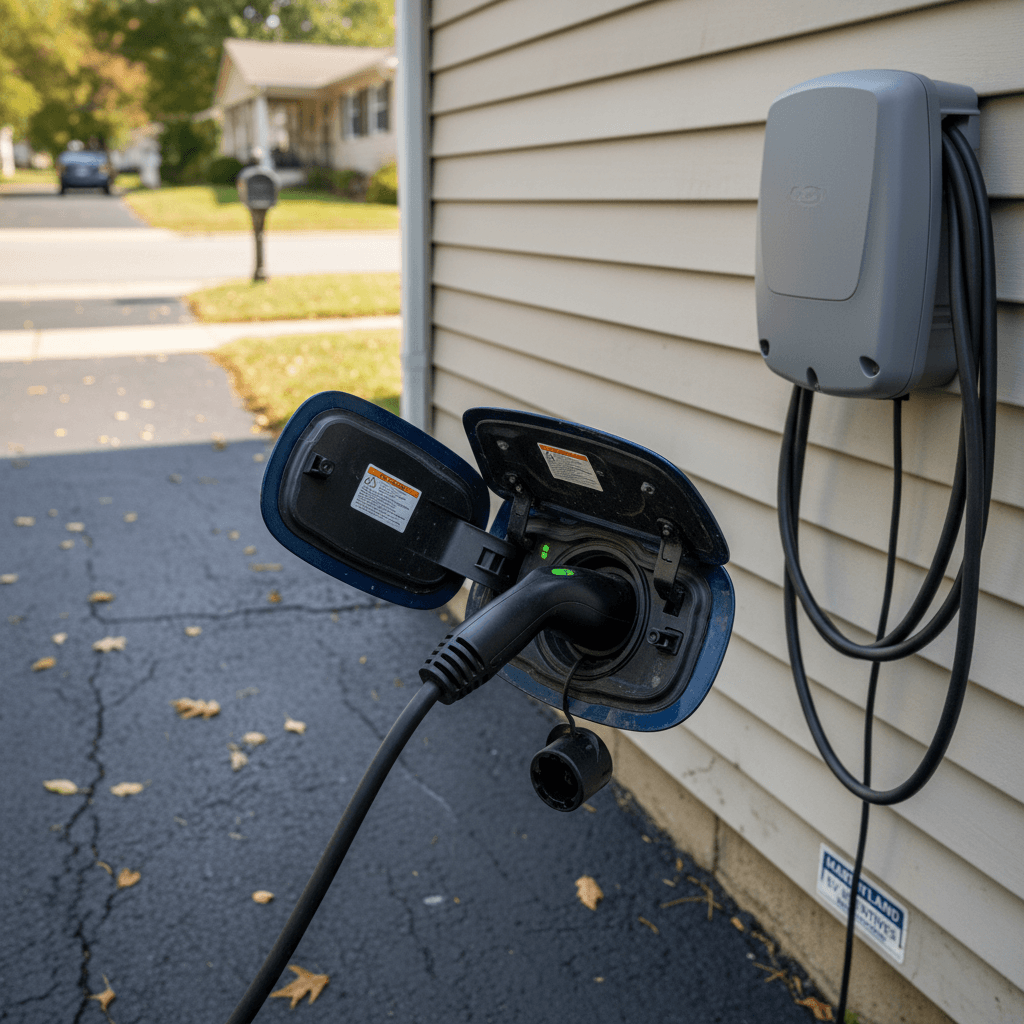
Charging is where Maryland quietly makes used EV ownership work. Between relatively dense public infrastructure, state‑supported home charger rebates, and widespread time‑of‑use rates, you can keep your running costs low even without a big tax credit on the hood.
Your main charging strategies in Maryland
Most households mix and match these three
Level 2 at home
Best for: Homeowners or renters with dedicated parking.
- 240‑volt circuit in your garage or driveway.
- Refills most daily driving overnight.
- Often eligible for state or utility rebates on hardware and install.
Workplace & public Level 2
Best for: People without home charging or with longer commutes.
- Office chargers, parking garages, retail destinations.
- Slower than DC fast‑charging, but easier on the battery.
- Some locations still offer free or discounted charging.
DC fast‑charging on corridors
Best for: Road trips and irregular long days.
- Tesla Superchargers (for Teslas and, increasingly, non‑Teslas) plus networks like Electrify America.
- Plan around I‑95, I‑70, and major US‑routes.
- Use occasionally, don’t build your life around it if you can help it.
Estimate your “fuel” savings
Where to buy used electric cars in Maryland (and how Recharged fits in)
Maryland shoppers in 2026 have more options than ever for finding used electric cars: franchise dealers, independent lots, online marketplaces, and private sellers. The challenge isn’t scarcity anymore, it’s sorting the solid EVs from the ones with hidden compromises and getting straight answers on battery health, pricing, and charging.
Traditional options
- Franchise dealers: Often have off‑lease EVs from the brands they sell. Warranty options can be decent, but battery diagnostics are hit‑or‑miss.
- Independent used lots: Increasingly carry EVs, but staff may not be EV‑specialists. You’ll need to bring your own homework.
- Private sellers: Can offer lower prices, but it’s on you to validate battery health, charging behavior, and title history.
The Recharged approach
Recharged was built specifically around used electric vehicles, not gas cars with a charger bolted on. Every vehicle on the platform includes:
- A Recharged Score Report with verified battery health and range estimates.
- Transparent, fair‑market pricing grounded in current EV resale data.
- Financing, trade‑in options, and nationwide delivery, including to Maryland addresses.
- EV‑specialist support that can talk you through home charging, incentives, and real‑world range.
If you prefer to touch and feel a car first, Recharged also operates an Experience Center in Richmond, VA, within a reasonable drive for many Maryland buyers.
Why buyers use Recharged for Maryland purchases
Ready to find your next EV?
Browse VehiclesChecklist: buying a used electric car in Maryland in 2026
Step‑by‑step used EV buying checklist
1. Define your real‑world range needs
Map your weekly driving: daily commute, weekend errands, and regular trips to places like Ocean City or Deep Creek. Decide the minimum comfortable range you need with a 20–30% buffer for winter and degradation.
2. Set a total‑cost budget, not just a price cap
Look at your current gas spend, insurance, and maintenance. Use that to inform a monthly budget that includes payment, electricity, and a bit of margin for tires and routine service.
3. Shortlist models that fit Maryland driving
For most drivers, compact crossovers and sedans with at least 200 miles of EPA‑rated range are the sweet spot. Put cars like the Bolt EV/EUV, Model 3, Kona Electric, and Niro EV on your list before niche options.
4. Demand evidence of battery health
Ask for a formal battery report, not just a screenshot of a range estimate. If you’re buying through Recharged, review the Recharged Score closely and compare it across vehicles.
5. Plan your charging setup before you buy
Confirm whether you can install a Level 2 charger at home, what it will cost, and which rebates or TOU rates you can use. If home charging isn’t possible, verify reliable options near work or along your usual routes.
6. Verify incentives and fees line‑by‑line
Don’t let outdated promises of a federal used EV credit slip into your decision‑making. Ask the dealer to walk through every tax, fee, and doc charge. For Maryland‑specific incentives, grab current documentation from official state or utility sites.
7. Test‑drive with range and charging in mind
On your test drive, pay attention to efficiency (mi/kWh), charging port location, and how intuitive the charging and trip‑planning interfaces feel. These will matter every week you own the car.
FAQs: used electric cars in Maryland, 2026 edition
Frequently asked questions about used EVs in Maryland (2026)
Bottom line: is a used electric car in Maryland worth it in 2026?
In 2026, the used EV story in Maryland looks different than it did in 2024 or 2025. The headline federal used EV tax credit is gone, state incentives are more about charging infrastructure and electricity rates than about slashing sticker prices, and the pool of available vehicles is deeper and more varied. That means the advantage goes to shoppers who understand range, charging, and battery health, not just rebates.
If you do the homework, or let a specialist platform like Recharged do a lot of it for you, a used EV can still be one of the smartest ways to get reliable, efficient transportation in Maryland. Focus on models whose range matches your real life, insist on hard data about the battery, and make sure your home or workplace charging plan is nailed down before you sign. Get those pieces right, and a used electric car in Maryland in 2026 is not just viable; it’s a quietly compelling upgrade over most gas alternatives.