If you’re thinking long term, the **total cost of ownership EV vs gas over 10 years** is the question that really matters. Sticker prices and monthly payments grab your attention, but it’s fuel, maintenance, insurance, and resale value that quietly decide which car drains, or grows, your bank account over a decade.
The short answer
Why look at 10-year total cost of ownership?
Most ownership calculators stop at five years. That’s helpful, but many people keep cars longer than that, and **EV advantages compound with time**. Fuel savings and lower maintenance grow every year, while a lot of the EV “penalties”, higher purchase price and faster early depreciation, hit you in the first few years and then flatten out.
- Will lower charging and maintenance really offset a higher purchase price?
- How much should I worry about a battery replacement in year 8 or 10?
- Does buying a used EV instead of new tilt the 10-year math in my favor?
Think in cost per year, not just monthly payment
How we compare EV vs gas over 10 years
To make this concrete, we’ll build a simple, realistic 10‑year scenario based on 2025 U.S. conditions. We’ll compare a mainstream compact/crossover EV to a similarly sized gas model, assuming 12,000 miles per year and typical financing.
- Purchase price and financing (including interest)
- Fuel vs electricity costs
- Maintenance and repairs
- Insurance, registration, and fees
- Depreciation and resale value
- Battery life and the risk of a replacement
Your numbers will vary
10-year EV vs gas: big picture numbers
10-year total cost example: EV vs gas
Let’s build a simple comparison using round numbers. These aren’t tied to a single specific model, but they’re in line with what you’ll see shopping mainstream compact crossovers and sedans in 2025–2026.
Illustrative 10-year cost of ownership: EV vs gas (120,000 miles)
Assumes U.S. averages in 2025–2026: gas at about $3.10/gal, home electricity around 18¢/kWh, 12,000 miles per year, and mostly home charging.
| Cost category | Example EV | Example gas car | Notes |
|---|---|---|---|
| Purchase price + interest | $38,000 | $30,000 | New EVs often cost ~$8,000 more up front than similar gas models, even after dealer discounts. |
| Energy (fuel/electricity) | $7,000 | $16,000 | Home charging at ~3–4¢/mile vs ~8–12¢/mile for gas, over 120,000 miles. |
| Maintenance & repairs | $5,000 | $9,000 | Fewer moving parts mean fewer big repairs for EVs; both need tires and occasional brakes. |
| Insurance (10 years) | $16,000 | $14,000 | EVs can run 10–20% higher to insure, though this gap is narrowing. |
| Taxes, registration, fees | $4,000 | $3,500 | Many states add EV registration surcharges but some offer HOV or toll perks. |
| Depreciation (loss of value) | $18,000 | $13,000 | EVs can depreciate faster early on; used prices have been catching up as demand grows. |
| Possible battery work (out of warranty) | $2,000 | $0 | Most owners won’t replace a full pack in 10 years, but we’ll budget a small cushion for peace of mind. |
| Estimated 10‑year total | $90,000 | $85,500 | In this scenario the EV is slightly more expensive overall, but that can flip fast with higher gas prices or lower EV purchase price. |
These numbers are directional, not a quote. Use them to understand how each cost bucket behaves over 10 years.
Depending on the models you compare, local incentives, and whether you buy new or used, that $4,500 gap can easily swing the other way. Buy a **used EV that’s already taken its big depreciation hit**, and you often get 10‑year costs that are lower than or very close to a similar gas car, with less day‑to‑day hassle.
Where EVs usually win over 10 years
Fuel vs electricity costs over a decade
Fuel is where EVs earn their keep. In 2025, the average U.S. gas price is hovering around the low $3 per gallon mark, while typical residential electricity lands in the high‑teens cents per kWh. That puts a **home‑charged EV at roughly 3–4¢ per mile**, versus **8–12¢ per mile for a gas car** of similar size and performance.
Example EV fuel cost
- Efficiency: ~3.5 miles per kWh
- Electricity: $0.18/kWh at home
- Cost per mile: about 5¢ (being conservative)
- 120,000 miles in 10 years: ≈ $6,000
Public fast charging can be 2–3x home rates. Occasional road trips won’t break the bank, but relying on fast charging every day will.
Example gas car fuel cost
- Efficiency: ~30 mpg combined
- Gas price: $3.10/gal average
- Cost per mile: about 10–11¢
- 120,000 miles in 10 years: ≈ $12,000–$13,000
If gas jumps back above $4, the 10‑year fuel bill climbs quickly, while electricity tends to move more slowly.
Home charging is the secret weapon
Maintenance and repairs: where EVs pull ahead
A gas engine is a mechanical opera: pistons, valves, exhaust, emissions systems, timing chains, fluids everywhere. An EV powertrain is quiet by comparison, motor, inverter, single‑speed gearbox. That simplicity shows up in your **maintenance line item over 10 years**.
EV vs gas: 10-year maintenance reality check
Same tires and wipers, very different under the hood.
No oil, fewer fluids
Fewer big failures
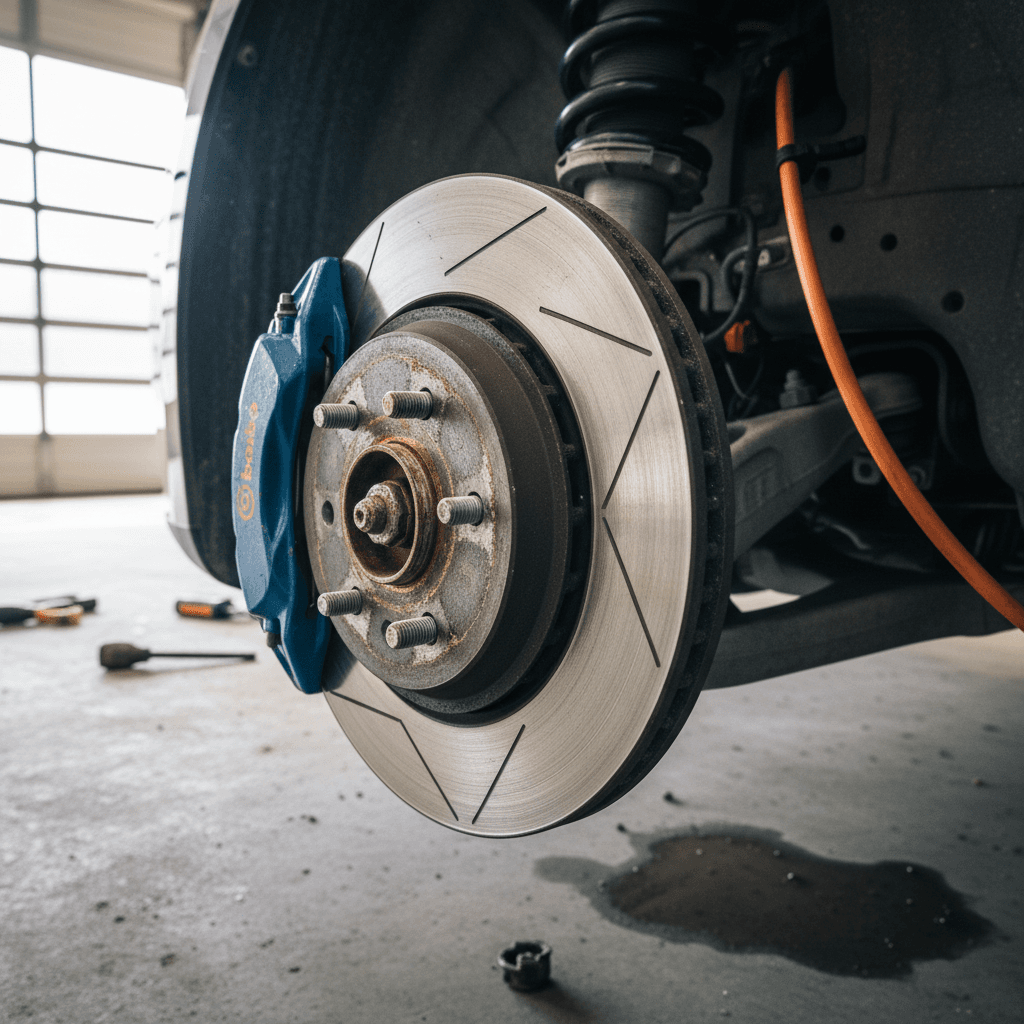
Brakes last longer
Real‑world estimates put **EV maintenance and repair costs roughly 35–50% lower than comparable gas vehicles** over time. In our 10‑year example budget, we penciled in $5,000 for the EV vs $9,000 for the gas car to cover scheduled service and the occasional repair.
Don’t forget tires
Insurance, taxes, and fees
This is the part most people skip in their back‑of‑the‑napkin math. New EVs often carry **higher insurance premiums** than gas cars, thanks to expensive battery packs, advanced driver‑assistance systems, and still‑maturing repair networks. Some states also add **extra registration fees for EVs** to make up for lost gas‑tax revenue.
- Expect many EVs to cost about 10–20% more to insure than comparable gas cars, especially when new.
- Some states charge annual EV fees that can add a few hundred dollars a year, but you may also gain perks like HOV lane access or reduced tolls.
- Used EVs that have dropped in value can narrow or erase the insurance gap, because you’re no longer insuring a $50,000 car.
Insurance gap vs fuel savings
Depreciation and resale value
Depreciation, the silent killer. For both EVs and gas cars, it’s usually the **single biggest cost** of ownership over 10 years. The wrinkle is that **EVs often depreciate faster in the early years**, especially when new technology and pricing changes hit the market.
Gas cars: the predictable curve
- Steady, well‑understood used market.
- 10‑year‑old, 120,000‑mile gas car often retains a modest but reliable resale value.
- Depreciation slows after year 5 as the car approaches the end of its “prime.”
EVs: fast early drop, then flattening
- New EV prices and incentives can cause sharp resale swings in the first 3–5 years.
- Once an EV’s past the steep part of the curve, values often stabilize.
- Battery health becomes the main driver of resale value at years 8–10.
Why used EVs often win the 10-year game
Battery life and replacement risk
This is the elephant in the room for 10‑year planning. Modern EV batteries generally age slowly, single‑digit percentage loss over many years, and most packs carry **8‑ to 10‑year warranties** that cover excessive degradation. Still, it’s reasonable to worry about a big bill in year 9 or 10.
What a 10-year owner should know about EV batteries
Separating myths from real‑world risk.
Degradation is gradual
Warranty safety net
Full replacements are rare
In our 10‑year example we added a small $2,000 “battery buffer” for potential out‑of‑warranty work. You might never spend that, but it keeps your math honest. For many buyers, especially those shopping used EVs, it’s smarter to **pay less up front for a car with a documented healthy pack** than to stress over a hypothetical replacement that may never come.
Avoid the unknown‑history EV
Used EV vs new EV vs gas: smarter 10-year strategies
A 10‑year horizon doesn’t have to mean buying new and keeping the car for exactly 10 calendar years. You have options, and some are much friendlier to your wallet than others.
Three realistic 10-year ownership paths
1) Buy new gas, keep 10 years
Lower purchase price and easier financing up front.
Predictable maintenance schedule but higher fuel and service costs as the car ages.
Depreciation is steady; at 10 years you still have a car that’s worth something, but not much.
2) Buy new EV, keep 10 years
Higher sticker price and insurance for the first few years.
Energy and maintenance savings kick in immediately and accumulate every year you drive.
Battery warranty covers most of your 10‑year window; resale at year 10 strongly depends on remaining range.
3) Buy 3–5‑year‑old used EV, keep 7–10 years
Someone else already paid for the biggest depreciation drop.
You get lower purchase price, but still capture most fuel and maintenance savings.
Battery health and past charging behavior matter, this is where verified diagnostics like the Recharged Score shine.
Why path #3 is so attractive right now
How Recharged helps you run the numbers
If you’re trying to compare **10‑year total cost of ownership EV vs gas**, the hardest part is trusting the assumptions, especially around battery health and fair pricing on a used EV. That’s exactly what Recharged was built to fix.
Making 10-year planning simpler with Recharged
Data, diagnostics, and support, baked into every used EV we sell.
Recharged Score Report
Fair, data‑driven pricing
Financing & trade‑in support
Ready to find your next EV?
Browse VehiclesYou can shop and buy entirely online, or visit our Experience Center in Richmond, VA if you’d rather walk around the cars and talk with an EV specialist in person. Either way, we’ll help you think beyond the sticker price and into year 10.
FAQ: 10-year EV vs gas ownership costs
Frequently asked questions about 10-year EV vs gas costs
Bottom line: should you bet 10 years on an EV?
If you’re thinking in 10‑year terms, an EV is no longer a science experiment, it’s a very practical way to get your transportation costs under control. The **total cost of ownership EV vs gas over 10 years** tilts in favor of electric for many drivers, especially those with home charging and a normal or high annual mileage. Lower fuel and maintenance costs keep paying you back year after year, while better batteries and strong warranties ease the big‑ticket worries.
The key is to buy smart: focus on **battery health, fair pricing, and your real‑world driving pattern**. That’s exactly what we built Recharged for. If you’re ready to see how a used EV would look in your life over the next decade, start browsing vehicles, or talk with an EV specialist who lives and breathes this stuff all day long.