Buying a used electric car is a little like adopting a retired racehorse: the drivetrain might be serene and silent, but you absolutely need to know how hard it’s been run. The usual used-car routine, kick the tires, sniff the dipstick, doesn’t cut it. There are specific things to check before buying a used EV that will make or break your ownership experience.
Big picture
Why used EVs need a different checklist
Modern EV batteries have aged far better than the early doomers predicted. Recent long-term testing of popular models shows many packs still above 90% of original capacity after well over 100,000 miles. But degradation is uneven: a gently driven highway commuter can be healthier at 120,000 miles than a rideshare car with half the mileage that’s been fast-charged to within an inch of its life.
Battery health baselines for used EVs (2024–2026 data)
If that sounds like a lot of homework, it is, unless you buy from a platform that does the battery diagnostics and pricing analysis for you. Every EV on Recharged comes with a Recharged Score battery health report, so you can see capacity, projected range, and a fair market price before you ever click “Buy.”
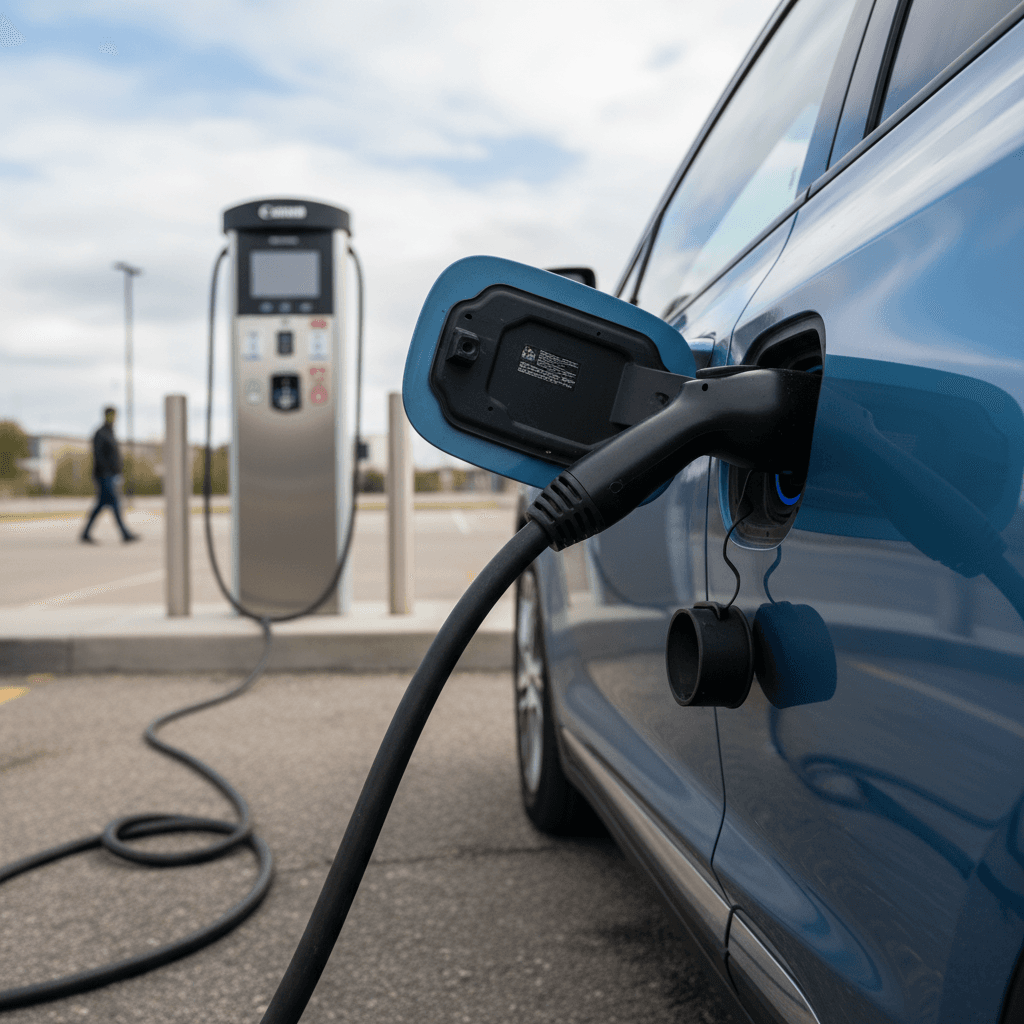
1. Verify battery health (SoH) and degradation
This is the hill to die on. The high-voltage battery is the most expensive component in the car, and its State of Health (SoH), how much capacity remains versus new, dictates range, value, and resale.
How to check used EV battery health
Start with SoH, then look at how it got there
1. Get a formal SoH report
Ask the seller for a printout or PDF from a dealer or EV specialist. Many brands can generate an SoH report from their service tools.
If they won’t, consider that a serious red flag.
2. Use built-in or app tools
Some EVs show battery health in the infotainment system or companion app. Others can be read via OBD-II and apps like Leaf Spy (Nissan Leaf) or model-specific tools.
3. Interpret the number
- 85–100%: Excellent
- 80–84%: Good, priced right
- 75–79%: Borderline, negotiate hard
- <75%: Usually walk away unless it’s very cheap and you accept short range.
If you can’t see SoH, you don’t know the car
2. Check remaining battery warranty and in-service date
In the U.S., federal rules require automakers to warranty EV batteries for at least 8 years or 100,000 miles. Many offer more. The nuance is where shoppers slip: the clock starts at the car’s in-service date, the day it was first sold, not the model year.
Typical EV battery warranty terms (U.S.)
Always verify exact terms for the year and trim you’re considering.
| Brand examples | Typical term* | Capacity guarantee? | Transferable? |
|---|---|---|---|
| Tesla, Hyundai, Kia | 8 yrs / 100k–120k mi | Often 70%+ | Usually yes |
| GM, Ford, VW | 8 yrs / 100k mi | Often 60–70% | Usually yes |
| Older models (e.g., early Leaf) | 5–8 yrs / 60k–100k mi | Sometimes none | Varies |
Use this as a rough guide, not gospel; brands and trims vary.
Your move: decode the dates
3. Confirm real-world range for your driving
EPA range numbers are like dating profiles: aspirational. For a used EV, you care about actual miles on your actual roads. Battery aging, wheel size, climate, and driving style can easily turn an original 250‑mile car into a 180‑mile one.
At the seller or dealership
- Note the current SoC (state of charge) and estimated range.
- Drive a mixed loop (city + highway) for at least 20–30 miles.
- Compare miles driven vs. miles lost from the estimate. Big mismatches suggest degradation or inaccurate calibration.
Using data and tools
- Look up original EPA range for the exact trim.
- Apply the SoH percentage. A pack at 85% health on a 300‑mile car should roughly deliver 255 miles in ideal conditions.
- Remember winter and highway speeds can shave another 15–30%.
Commuter reality check
4. Review charging history and habits
Two identical EVs, same year and mileage, can have wildly different batteries depending on how they were charged. Repeated DC fast charging to 100%, or sitting at full charge in summer heat, ages cells faster than gentle Level 2 home charging in the 20–80% band.
- Ask how often the car was DC fast charged vs. home or workplace Level 2.
- Be extra cautious with ex‑rideshare or delivery vehicles; they often live on fast chargers and high duty cycles.
- Scan service records for battery-related warnings, thermal issues, or repeated fast-charging faults.
- If you can, pull logs via OEM tools or third-party services that summarize charging behavior.
Fast charging isn’t evil, but patterns matter
5. Make sure it fits your charging setup
Before you fall in love with a used EV, marry it to your electrical panel. You want to know not just that you can charge it, but how fast, where, and at what cost.
Charging compatibility checklist
Match the car to the way you actually live
Home charging
- Do you have a garage, driveway, or only street parking?
- Is there already a 240V circuit (dryer, range) you can use?
- Check your panel capacity; a 40A Level 2 circuit may require an electrician.
Public charging
- What connector does the car use for DC fast charging (CCS, NACS, CHAdeMO)?
- Which networks are dense near you, Electrify America, Tesla Supercharger, others?
- Does the car have a healthy fast‑charge curve, or is it notoriously slow?
Included equipment
- Does it come with a portable Level 1/2 cord?
- Is the charge port and cable latch clean and undamaged?
- Any home charging equipment included in the sale?
Think in miles per hour, not kilowatts
6. Inspect the high-voltage system and 12V battery
There are two electrical systems to care about. The big, scary one, the high‑voltage pack, runs the motor. The humble 12V battery runs everything else and is the gatekeeper that allows the HV system to even wake up.
- Have a professional visually inspect high‑voltage cabling and connectors for damage, corrosion, or amateur repairs.
- Confirm there are no active HV system warnings on the dash (turtle modes, reduced power, etc.).
- Test the 12V battery; a weak one can trigger bizarre electronic gremlins or leave an EV “dead” even with a full traction battery.
- Ensure any 12V replacement was done with the correct type and, for some models, properly registered in software.
Don’t ignore the 12V
7. Look for thermal management and climate impact
Batteries hate extremes, hot Phoenix parking lots and subzero Minnesota winters. EVs with robust liquid thermal management generally age far better than those with passive air cooling, especially older designs.
- Research whether the model uses liquid cooling, air cooling, or none at all.
- Be extra cautious with early EVs known for rapid degradation in hot climates.
- Check service history for battery coolant changes or thermal system repairs.
- Ask where the car has lived; life in a temperate climate is a quiet gift to battery longevity.
8. Dig into software updates and infotainment
EVs are rolling computers with a car attached. Software controls charging behavior, thermal management, driver-assistance systems, even the instrument cluster font. On a used EV, outdated software is both a safety issue and a resale problem.
Core software & firmware
- Ask if the car receives over‑the‑air (OTA) updates or requires dealer visits.
- Check that critical firmware updates, especially for battery management and safety systems, have been applied.
- Verify that the infotainment system and maps still receive updates; some older systems age out.
Connected services
- Confirm that the companion app works with second owners.
- Check remote preconditioning, charge scheduling, and route‑planning features.
- Find out if any subscriptions are expiring that you’d want to renew.
Why Recharged cares about software
9. Run the full vehicle history and title checks
A bent EV is still a bent car. Your inspection may be battery‑centric, but you still need the greatest hits: title status, accidents, flood damage, odometer consistency, and ownership history.
Vehicle history checklist for used EVs
Confirm clean, non-salvage title
Salvage or rebuilt titles can void high‑voltage battery warranties and make future service difficult or impossible at some dealers.
Check for flood or fire damage
High‑voltage systems and water are a bad cocktail. Walk away from anything with flood branding or suspicious auction history.
Review accident and airbag history
Serious front or underbody damage can affect battery enclosures, high‑voltage wiring, or cooling lines, even if repairs "look" good.
Look at ownership patterns
Ex‑fleet, rental, or rideshare cars may have harder usage and more fast charging than privately owned vehicles.
10. Check brakes, tires, and suspension
EVs may sip electrons, but they devour tires and bushings. Extra weight and instant torque mean more stress on rubber and suspension than a comparable gas car.
- Inspect tire tread depth and age; EV‑specific tires are often pricier and may have acoustic foam inserts.
- Check for uneven wear that hints at alignment or suspension issues.
- Test brake feel; surface corrosion on rotors is common but should clean up with use. Pulsation or grinding is not normal.
- Listen over bumps for clunks and squeaks, heavy battery packs punish cheap bushings and shocks.
Budget for fresh rubber
11. Verify recalls and EV-specific service campaigns
EVs, like all modern cars, collect recalls and technical service bulletins as engineers learn from the real world. Some are minor software tweaks; others involve battery fire risk, charge limits, or HV contactor failures.
- Run the VIN through the manufacturer’s recall lookup and NHTSA’s database.
- Ask for documentation that all open recalls have been completed, especially battery or charging related.
- Look for “customer satisfaction” campaigns that may not be mandatory but are still important updates.
- Factor any incomplete, serious recall work into your willingness to proceed.
12. Test-drive it like an EV owner, not a gas-car shopper
A proper used EV test drive is a rolling diagnostic. With no engine noise, the car has nowhere to hide its sins.
How to test-drive a used EV
Start with a cold car
Turn it on from cold. Listen for clunks, fan noise, or error messages. Check the initial estimated range against SoC.
Play with regen levels
Cycle through regenerative braking modes. The transition from accel to regen should be smooth, with no grinding or shudder.
Highway and city loop
Take it up to highway speed, then through low-speed city streets. Note wind noise, suspension behavior, and how quickly range ticks down.
Charge-port and cable check
If possible, plug into a Level 2 or DC fast charger. Confirm the car initiates charge cleanly, reports reasonable speeds, and doesn’t throw errors.
13. Understand charging standards and adapters
The North American charging landscape is in the middle of a messy but necessary standardization. Most legacy EVs use CCS for DC fast charging and J1772 for AC; newer ones increasingly adopt NACS (Tesla’s connector) as standard. Adapters are bridging the gap, but you want to know what you’re buying into.
Common North American charging standards
Make sure you and the car speak the same plug language
J1772 (AC)
AC Level 1 & 2 standard on most non‑Tesla EVs built before the NACS transition. Works at home and slower public stations.
CCS (DC fast)
Combined Charging System for DC fast charging on most non‑Tesla EVs. Widely deployed today, but slowly giving way to NACS.
NACS (Tesla)
Tesla’s connector, now the North American Charging Standard. Grants access to much of the Supercharger network, often via adapters on older cars.
Don’t assume the adapter is included
14. Run the numbers on total cost, not just price
Used EV pricing in 2026 is… volatile. Depreciation has been steep on some models, generous on others. Battery health, warranty status, and charging performance can swing fair value by thousands of dollars between two nearly identical cars.
Costs to factor in
- Purchase price vs. battery SoH and remaining warranty.
- Home charging installation (panel upgrade, wiring, hardware).
- Insurance, some EVs rate higher than equivalent gas cars.
- Expected tire replacement and potential suspension work.
- Any paid connectivity or software subscriptions you care about.
Where Recharged helps
- Every car gets a Recharged Score with verified battery health and fair market pricing.
- Financing options built for used EV values and depreciation curves.
- Trade‑in and consignment options if you’re coming out of a gas car or older EV.
15. Consider a specialist EV inspection, or let Recharged handle it
If you’re buying privately or from a general used-car lot, assume they know less about the high‑voltage system than you do after reading this article. A third‑party EV specialist inspection is money well spent, especially on higher-value cars.
- Look for inspectors or mobile mechanics who specifically advertise EV expertise, not just generic pre‑purchase inspections.
- Expect to pay roughly what you’d pay for a high-end mechanical inspection; in return you get battery diagnostics, HV system checks, and an honest report.
- If you’re near Richmond, VA, you can visit the Recharged Experience Center for hands-on help and expert guidance.
How Recharged simplifies all of this
Ready to find your next EV?
Browse VehiclesUsed EV checklist: quick summary
15 things to check before buying a used EV
1. Battery State of Health (SoH)
Get a documented SoH percentage from a dealer, EV specialist, or trusted marketplace like Recharged.
2. Remaining battery warranty
Confirm term, mileage, in‑service date, and whether coverage transfers to you.
3. Real-world range
Test-drive and compare actual miles driven vs. range lost; sanity-check against SoH and original EPA range.
4. Charging history
Ask how often the car was DC fast charged, and whether it lived on road trips or home Level 2.
5. Charging fit
Verify home charging options, public networks near you, and included charging equipment.
6. High-voltage system & 12V battery
Check for HV warnings, visible damage, and a healthy, correctly specified 12V battery.
7. Thermal management & climate
Understand the car’s cooling system and where it has lived climate-wise.
8. Software & connectivity
Confirm critical updates are installed and that connected services work for second owners.
9. Vehicle history & title
Run full history reports; avoid flood, fire, and salvage titles unless you know exactly what you’re doing.
10. Brakes, tires, suspension
Inspect brake feel, tire wear, and suspension noise, EVs are hard on rubber and bushings.
11. Recalls & service campaigns
Use the VIN to check for and verify completion of recalls, especially battery or charging related.
12. EV-focused test drive
Evaluate regen, NVH, range behavior, and charge-port function, not just acceleration.
13. Charging standard & adapters
Know whether it’s CCS, J1772, NACS, or older CHAdeMO, and which adapters are included.
14. Total cost of ownership
Factor installation, tires, insurance, and potential battery risk into the deal, not just sticker price.
15. Inspection or Recharged Score
Either hire an EV specialist to inspect the car or buy a vehicle that already has a verified battery health and condition report.
The punchline: a used EV can be a spectacular bargain, quiet, quick, cheap to run, if you’re ruthless about the battery and clear‑eyed about charging and warranty. Skip those checks and you’re buying a mystery box that happens to have a steering wheel. Whether you take this checklist to a private sale, an auction listing, or decide to let Recharged do the hard, high‑voltage homework for you, the right car is the one whose battery story you actually understand.