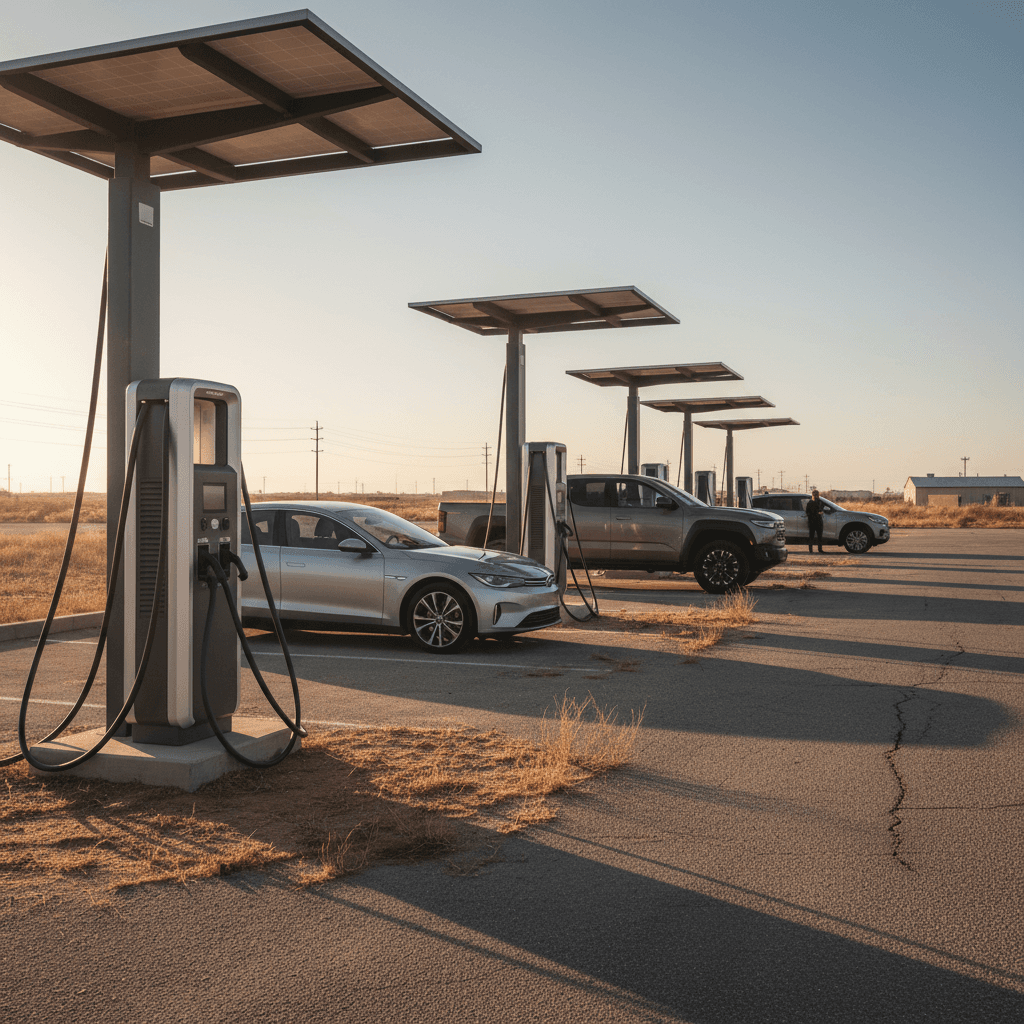
If you live in Texas, odds are you’ve seen more EVs slipping into H‑E‑B lots and Buc‑ee’s travel centers every month. The Texas electric car charging network has exploded in the last few years, but it doesn’t feel evenly spread when you’re staring at a low battery on US‑277 in West Texas. This guide walks you through what the network really looks like today, how to work with its gaps, and what it means if you’re considering a new or used EV.
Texas is quietly a top‑tier charging state
Texas EV charging at a glance
Texas EV and charging numbers, right now
Those headline numbers sound huge, and on paper, they are. But if you zoom in, you see the real story: dense clusters of chargers in Dallas–Fort Worth, Houston, Austin, and San Antonio, then long, thin stretches of highway where you’ll plan your stops with care. That’s where good route planning, the right car, and a bit of local knowledge make all the difference.
Coverage ≠ convenience
How big is the Texas electric car charging network today?
As of late 2025, data from federal and state sources show Texas with roughly 3,700–4,300 public charging stations and over 11,000 charging ports. Depending on whose math you follow, that works out to somewhere between 16 and 34 EVs per public port, slightly behind the national average, but not by much.
- Level 2 stations (great for 1–3 hour stops while you work, shop, or sleep) make up the majority of locations.
- DC fast charging (the highway heroes) accounts for several thousand high‑power ports across the state.
- Tesla’s Supercharger network blankets key interstates like I‑10 and I‑35, with more sites opening access to non‑Tesla EVs through Magic Dock or NACS ports.
- New NEVI‑funded highway sites are coming online, Texas has 14 in operation, dozens under construction, and hundreds more in the pipeline.
On the flip side, Texas has hundreds of thousands of EVs on the road and climbing. Public charging is keeping up on paper, but not every driver experiences that growth the same way, especially if you live in a smaller city, drive a non‑Tesla, or don’t have a garage to fall back on.
Who actually runs all these chargers in Texas?
Major players in the Texas electric car charging network
You’ll see a mix of national brands and local utilities when you pull up to a plug.
Tesla Supercharger & Destination
Best for: Tesla drivers, and growing access for non‑Tesla EVs.
- Excellent coverage on I‑10, I‑35, I‑45, and major metro areas.
- Some sites support non‑Teslas via Magic Dock or NACS ports.
- Access and pricing handled through the Tesla app or in‑car navigation.
Public fast‑charge networks
Electrify America, EVgo, Francis Energy, and others.
- DC fast charging at Buc‑ee’s, Walmart, H‑E‑B, truck stops, and urban hubs.
- Support CCS (and increasingly NACS) plugs.
- Good options for non‑Tesla EVs on long trips.
Utilities & city programs
Austin Energy, CPS Energy (San Antonio), Oncor, and co‑ops.
- Dense Level 2 networks in city cores and workplaces.
- Some offer memberships or subscription pricing for cheaper charging.
- Often paired with time‑of‑use rates or home‑charging rebates.
Layered on top of that are NEVI‑funded sites, federal dollars funneled through the Texas Department of Transportation (TxDOT) to create a backbone of highway chargers no more than about 50 miles apart on key routes. Some of these new stations live at familiar truck stops or travel centers; others are stand‑alone plazas carved out by the side of interstates.
Follow the money to find the future
Where Texas EV chargers are, and where they aren’t
Places where charging feels almost normal
- Dallas–Fort Worth, Houston, Austin, San Antonio have hundreds of public stations each, including fast chargers and dense Level 2 networks.
- Major suburbs along I‑35, I‑45, and I‑10 often have multiple options at big box stores, malls, and workplaces.
- Popular destinations, Hill Country towns, Gulf Coast beaches, college towns, now usually have at least one DC fast option nearby.
Places you still have to think like a trucker
- West Texas, the Panhandle, and border regions can still mean 80–120 miles between fast chargers.
- Smaller towns may only have a handful of Level 2 plugs at hotels or dealerships.
- You’ll want a solid plan (and maybe a backup) before you point the nose into ranch country with 15% left.
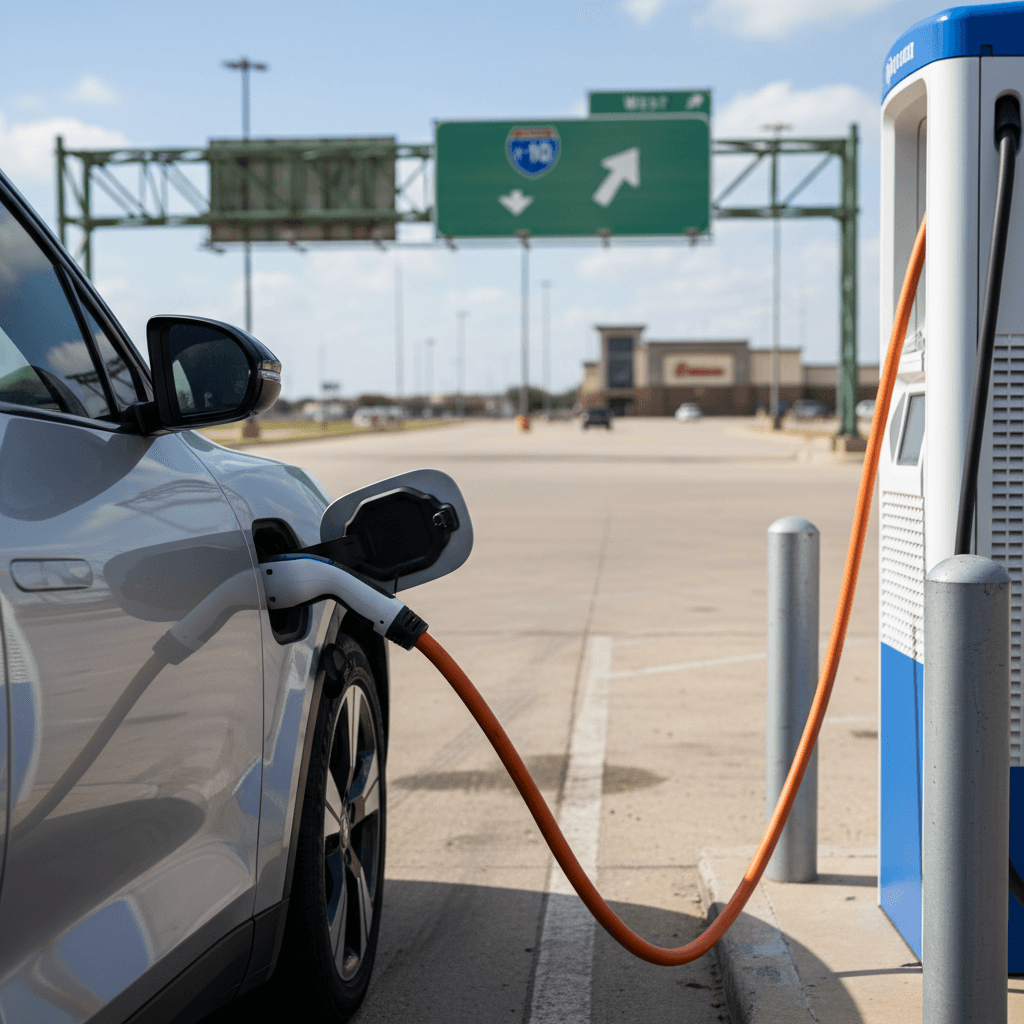
App maps can lie
Highway corridors and road trip routes
For long‑haul Texans, the I‑35 warriors and I‑10 cowboys, the question is simple: can I get from here to there without spending my vacation at a broken charger? Today, for most popular routes, the answer is yes if you plan, and very much yes if you drive a Tesla.
Key Texas highway corridors for EV drivers
These routes already have reasonably strong coverage from a mix of Tesla, NEVI, and private networks. Always confirm details in an app before you roll.
| Route | Typical use | Charging outlook | Driver notes |
|---|---|---|---|
| I‑35 (Dallas–Austin–San Antonio) | In‑state business, college runs, weekend trips | Dense mix of Superchargers and public DC fast chargers; getting better every quarter. | Easiest corridor in Texas for any EV. Traffic is your biggest problem, not chargers. |
| I‑10 (Houston–San Antonio–El Paso) | Cross‑state and cross‑country trips | Good coverage between metros; longer gaps toward West Texas but rapidly improving with NEVI sites. | Non‑Tesla drivers should map stops carefully west of San Antonio. Chargers are there, just farther apart. |
| I‑45 (Houston–Dallas) | Major metro connector | Solid fast‑charge coverage at travel centers and in both metros. | One of the simpler runs in an EV, but still check for congestion on holiday weekends. |
| I‑20 / I‑30 (DFW to West Texas) | Oil patch, Panhandle, and beyond | Growing but still sparser network outside DFW and Midland/Odessa. | Think in terms of "next reliable stop," not "I’ll grab something whenever I’m low." |
| US‑59 / I‑69 (Houston to East Texas) | Piney Woods, small cities | Improving mix of Level 2 and DC fast in larger towns; patchy in between. | Factor in slower Level 2 stops if you’re in an older or shorter‑range EV. |
Coverage can change quickly, this table is a planning starting point, not a guarantee.
Test your road‑trip route in software first
How fast will my EV charge in Texas?
Texas doesn’t change physics. What matters is the type of charger you plug into and what your car can accept. Here’s how the Texas Department of Transportation breaks it down, with some real‑world color added.
Charging levels you’ll actually see in Texas
Level 1 – 120V outlets
You’ll mostly see this at home or in tiny motels that say, “Sure, you can plug into the wall.” Expect roughly 3–5 miles of range per hour, enough for very light daily driving or an overnight top‑off, not road‑trip duty.
Level 2 – 240V public and home stations
This is the workhorse of Texas cities. At 15–30 miles of range per hour, it’s perfect for parking while you sleep, work, or shop. In apartments or office garages, Level 2 often makes the difference between an EV being easy or impossible.
DC fast charging – 50–150 kW
You’ll meet these at many Buc‑ee’s, Walmarts, H‑E‑Bs, and NEVI sites. Think 150–250 miles of range per hour under good conditions. Great for getting across the state in a day if you’re willing to stop every 90–150 miles.
High‑power DC fast – 250–350 kW
Tesla V3/V4 Superchargers and the newer big third‑party cabinets live here. Only cars that can accept this much power will see the full benefit, but even older EVs will charge as fast as they can handle.
Your car, not Texas, sets the ceiling
What does public charging cost in Texas?
Public charging prices in Texas jump around more than gasoline. Networks price by the kilowatt‑hour, by the minute, or with hybrid models that change by time of day and power level. Recent analyses put average public fast‑charging costs around the low‑to‑mid‑$0.50 per kWh range, a bit higher than the national average, with Level 2 typically cheaper.
- In many Texas metros, DC fast charging can run roughly $0.45–$0.60 per kWh, sometimes more at peak hours.
- Level 2 public charging may be free (sponsored by a city or employer) or around $0.20–$0.35 per kWh.
- Some utilities and city programs offer membership plans that dramatically cut costs if you use their network often.
- Tesla Supercharger pricing varies by site and time of day; the app will show you current rates before you plug in.
Road‑trip math in plain English
Best apps and tools for finding Texas chargers
Apps every Texas EV driver should carry
You don’t need them all, but you do want redundancy.
Network‑agnostic maps
- PlugShare, Chargeway, A Better Routeplanner
- Show nearly every public charger, regardless of brand.
- Include user photos, check‑ins, and reliability notes.
Tesla app & in‑car nav
- Essential for Tesla owners; increasingly useful for non‑Teslas at Magic Dock/NACS sites.
- Shows real‑time stall availability and estimated charge times.
- Great at planning weather‑aware road‑trip routes.
Utility & city apps
- Austin Energy, CPS Energy, and others run local networks.
- Apps or RFID cards may unlock cheaper member rates.
- Ideal for commuters who charge in the same area every day.
Let your car do some of the work
Planning a Texas road trip in a used EV
Here’s where battery size, efficiency, and health matter. A 6‑year‑old Chevy Bolt and a nearly new Hyundai IONIQ 5 will both cross Texas, but they’ll do it very differently. You don’t need a brand‑new EV to enjoy the state; you just need to match the car to your kind of driving and be honest about your tolerance for stops.
5 steps to a low‑stress Texas EV road trip
1. Start with honest range
Base your planning on the <strong>real</strong> highway range of your EV, often 20–30% lower than the EPA number at 75 mph with A/C blasting. Recharged’s <strong>Score Report</strong> gives you verified battery health so you’re not guessing.
2. Anchor your stops to strong sites
Aim for chargers at busy travel centers, major truck stops, or Tesla Superchargers rather than lone plugs behind small motels. Busy sites tend to be better maintained and easier to get help at if something’s wrong.
3. Treat 10–20% as your red zone
In open country, avoid dipping below 10–15% unless your next stop is a sure thing. Wind, hills, and detours eat range quickly in Texas, especially in winter or triple‑digit heat.
4. Charge just enough, then move
On DC fast chargers, it’s usually faster to add 20–50% and keep going than to sit there grinding from 80% to 100%. Your charge curve slows dramatically as the battery fills.
5. Have at least one Plan B
For any critical highway leg, identify a backup charger and know which app or RFID card you’ll need to activate it. Screenshots and a printed note are cheap insurance if your cell signal drops.
How Recharged fits into your Texas plans
Ready to find your next EV?
Browse VehiclesHome vs. public charging in Texas
Most Texans who say “charging is easy” have one thing in common: they plug in at home. The public Texas electric car charging network makes road trips and apartment life possible, but cheap, predictable overnight charging is still the golden ticket for comfort.
When home charging wins
- You have a garage or driveway and access to a 240V circuit.
- Your utility offers off‑peak or EV‑specific rates after 10 p.m., when Texas wind power is plentiful.
- You mostly drive under 150 miles per day and only need fast charging for road trips.
Charging from 10 p.m. to 6 a.m. is ideal for both your battery and the Texas grid, according to TxDOT’s own guidance.
When public charging carries the load
- You live in an apartment or condo without a dedicated plug.
- Your daily commute takes you past reliable Level 2 or DC fast chargers.
- Your employer, school, or city runs a robust local network.
In this world, station reliability, pricing, and parking rules matter as much as the EV you drive.
Safety and infrastructure protection
Texas EV policy, the grid, and what’s coming next
Texas is an energy state to its core, and that shows up in the way it’s building out charging. On one hand, there’s a $400‑plus‑million plan to lace the interstates with chargers every 50 miles and eventually reach all 254 counties. On the other, there are extra EV registration fees and political tug‑of‑war around federal funding. If you’re just trying to drive to grandma’s, it can feel like background noise, but it shapes where chargers land.
- Phase 1 of TxDOT’s plan targets interstate corridors with fast chargers roughly every 50 miles, no more than a mile from exits.
- Phase 2 pushes deeper into rural counties and smaller metros, filling in the “Swiss cheese” holes between big cities.
- The grid operator, ERCOT, currently has enough capacity to support projected EV growth through the decade, especially if drivers lean on off‑peak night charging.
- Cities like Austin have aggressive climate and charging targets that could add tens of thousands of Level 2 ports over the next 10–15 years.
Why 10 p.m. to 6 a.m. matters in Texas
FAQ: Texas electric car charging network
Common questions about Texas EV charging
Bottom line: Is Texas ready for your EV?
Texas isn’t a charging utopia yet, but it’s no longer the Wild West, either. The Texas electric car charging network has matured into a workable, even comfortable system for most drivers who live near major metros and plan their long trips with a bit of care. Highway corridors are filling in, grocery and travel centers are quietly adding plugs, and NEVI‑funded sites are stitching together the long, lonely stretches.
The question isn’t whether Texas has enough chargers in the abstract, it’s whether there are enough chargers for the way you drive. That comes down to your routes, your ability to charge at home or work, and the real‑world range of the EV you choose. If you’re shopping the used market, Recharged can help you answer those questions up front with battery‑health diagnostics, fair pricing, nationwide delivery, and EV‑savvy support from your first test drive to your first West Texas road trip.