If you’re shopping for a Tesla Model Y, or already own one, highway range is what really matters on road trips. EPA numbers look great on paper, but steady 65–75 mph driving is where the truth comes out. In this guide, we’ll break down the Tesla Model Y real-world range on the highway by trim, speed, and conditions, and show you what to expect from both new and used Model Ys.
Quick takeaway
Why real-world highway range matters more than EPA numbers
EPA range ratings are useful for comparing EVs, but they’re based on standardized test cycles that mix city and highway driving under controlled conditions. Real-world highway trips look very different: you’re often driving 65–80 mph for hours, maybe with bikes on the back, a full family on board, and temperatures far from ideal. That’s when the gap between paper range and real range really shows up.
- EPA ratings assume a mix of city and highway speeds, with gentle acceleration.
- Highway-only driving at 70–75 mph uses more energy than the EPA test cycle.
- Headwinds, hills, cold weather, and big wheels can easily remove 15–30% of usable range.
- On a road trip, what matters most is how many miles you can drive between fast charges, not the absolute maximum if you hypermile.
Reality check on EPA numbers
Tesla Model Y EPA vs real-world highway range
Let’s start with the 2024–2025 era Model Y trims most U.S. buyers are considering, and how their EPA range translates into realistic highway range at moderate speeds in mild weather.
Recent Tesla Model Y EPA combined range (2024–2025)
Highway range is always lower than the combined EPA rating. At a steady 70 mph, independent tests of the Model Y Long Range have seen roughly 220–260 miles per charge on the highway, around 70–85% of the EPA rating, depending on wheels, temperature, and elevation changes.
Highway vs. EPA in one sentence
Model Y real-world highway range by trim and speed
Below are realistic one-way highway range estimates for a healthy-battery Model Y at 65–75 mph, starting from 100% and stopping at 5–10% remaining. These aren’t lab numbers, they’re planning tools to avoid range anxiety.
Approximate Tesla Model Y real-world highway range by trim
Estimates assume a relatively new battery, no roof box, normal cargo, fairly flat terrain, and temperatures around 60–75°F.
| Trim & wheels | EPA combined range* | 65 mph (ideal) | 70 mph (typical) | 75 mph (faster flow) |
|---|---|---|---|---|
| RWD, 19" wheels | ≈320–357 mi | 260–290 mi | 235–265 mi | 210–240 mi |
| Long Range AWD, 19" | ≈310–327 mi | 250–280 mi | 225–255 mi | 200–230 mi |
| Long Range AWD, 20" | ≈292–318 mi | 235–265 mi | 210–240 mi | 190–220 mi |
| Performance, 21" | ≈279–308 mi | 220–245 mi | 195–225 mi | 175–205 mi |
These are planning ranges, not guarantees. Your exact results will vary with conditions and driving style.
How to use these numbers
Example: Long Range AWD, 70 mph
Let’s say you have a Long Range AWD Model Y on 19-inch wheels. EPA range is around 310 miles. At 70 mph in good weather, a realistic highway leg from 100% down to 10% is about 220–240 miles.
Most drivers won’t start at 100% or run to 10% on every leg, so in practice they’ll plan closer to 180–210 miles between stops.
Example: Performance, 75 mph
With a Model Y Performance on 21-inch wheels, EPA range is roughly 280–300 miles. Hold 75 mph with some hills and you’re more likely to see 170–200 miles from 100% down to roughly 10%.
If you like to drive fast, build in extra margin and plan for 150–180 mile legs between chargers.
7 key factors that reduce Model Y range on the highway
Two Model Y owners can see completely different highway range on the same trim. Here are the biggest reasons why, and how much they can matter.
What really eats into Model Y highway range
Some of these you can’t control, but several you can.
1. Speed
Aerodynamic drag rises quickly with speed. Going from 65 to 75 mph can cost you 10–20% of your range all by itself.
2. Temperature
Cold-soaked batteries and cabin heating in winter can cut range by 20–30%. Very hot weather with max A/C also trims efficiency, but usually less dramatically.
3. Headwinds & hills
Strong headwinds and long climbs mean the car has to work much harder. A windy, hilly day can feel like you added another 5–15 mph to your cruising speed.
4. Wheel & tire setup
Bigger, stickier wheels (20" or 21") look great and improve handling, but they can cost 5–10% range vs. the base 19-inch aero wheels.
5. Roof racks & cargo
A loaded roof box or bikes on a hitch rack increase drag and can easily remove 10–25% of range at highway speeds.
6. Weight & passengers
Four adults, luggage, and gear add weight. The impact isn’t huge on flat ground, but it shows up more in hilly areas and when accelerating.
7. Driving from 100% to 0%
How used Model Y battery health affects highway range
If you’re considering a used Tesla Model Y, the big question is: how much range do you lose with age and miles? The good news from real-world fleet data is that modern Tesla packs generally hold up well, especially for the first 100,000 miles or so.
Large rideshare fleets that track battery state of health have reported Tesla Model Y packs averaging around 94% of original capacity after years of hard, high-mileage use. That implies maybe a 3–8% capacity loss for a typical privately owned Model Y in its first several years, assuming normal usage and charging habits.
What battery degradation means for highway range
Approximate impact of battery health on a Model Y Long Range AWD originally rated around 310–325 miles EPA.
| Estimated battery health | EPA-equivalent capacity | Typical 70 mph highway range (mild weather) |
|---|---|---|
| 100% (new) | ≈310–325 mi | ≈225–255 mi |
| 95% (lightly used) | ≈295–310 mi | ≈215–245 mi |
| 90% (higher mileage) | ≈280–295 mi | ≈205–235 mi |
These are illustrative examples; an individual car should always be assessed on its own data.
Why battery reports matter on used EVs
Ready to find your next EV?
Browse VehiclesPlanning a road trip: how far you can really go per stop
On a real highway trip, you almost never run from 100% down to 0%. It’s slower for charging and more stressful to drive. The most efficient road-trip pattern in a Model Y is usually charging between about 10–15% and 60–80%, depending on how dense Superchargers are along your route.
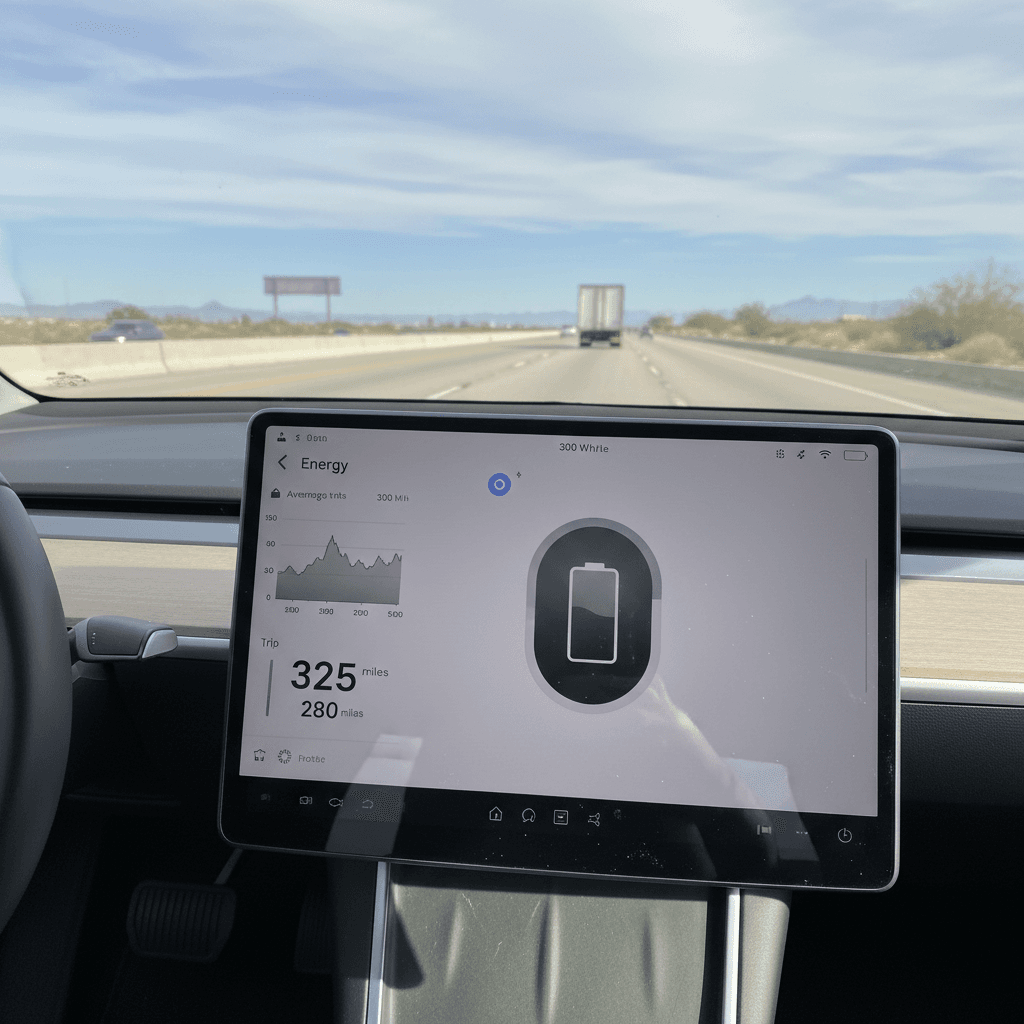
Typical Supercharger leg in a Long Range Model Y
- Start a leg at 70–80% charge.
- Drive 170–210 miles at 65–75 mph.
- Arrive at the next Supercharger with 10–20% remaining.
- Charge back to ~70–80% in about 15–25 minutes, depending on stall speed and how busy it is.
You’re rarely limited by maximum possible range. You’re usually limited by how often you want to stop, how much you value a larger buffer, and how busy the network is.
Shorter legs in winter or sparse areas
- In cold weather (below ~25°F) or in areas with big gaps between fast chargers, plan legs around 120–170 miles instead.
- Use the Tesla navigation’s trip planner to see expected arrival % and adjust speed if your buffer dips below 10–15%.
- Precondition the battery before fast charging to keep charge speeds high.
Use Tesla’s trip planner, but sanity-check it
Practical ways to improve your Model Y’s highway range
You can’t change physics, but you can tilt things in your favor. Here are practical adjustments that make a noticeable difference in how far your Model Y will go between charges.
Highway range optimization checklist
1. Keep speeds in the 65–70 mph band when possible
Every 5 mph above ~65 mph takes a bigger bite out of range than the previous 5 mph. If you’re tight on energy, slowing from 75 to 68 mph can easily save 10–15% range without adding much time on a long leg.
2. Use Chill Mode and smooth inputs
Aggressive acceleration and late braking don’t hurt as much as speed itself on the highway, but a smoother style still helps. Chill Mode can make it easier to drive efficiently, especially if multiple drivers use the car.
3. Precondition in winter
Use the app or scheduled departure so the battery and cabin are preheated while plugged in. A warm pack is more efficient and charges faster when you reach a Supercharger.
4. Choose smaller wheels if range is a priority
If you’re spec’ing a new Model Y or shopping used, 19-inch wheels are your friend. They’re less flashy than 20"/21" setups, but they can be worth 5–10% more real-world highway range.
5. Pack smart and manage aerodynamics
Remove roof boxes or bike racks when you don’t need them, and consider a hitch rack over a roof rack if you carry bikes regularly. Anything that sticks into the airflow will hurt range at 70–75 mph.
6. Let the nav route you through chargers
Starting a highway day at 100% isn’t always best. Often, it’s faster overall to leave around 80–90%, drive 150–200 miles, then take a short, high-speed charge break on the way.
Don’t hypermile yourself into unsafe territory
Should you worry about Model Y highway range?
For most drivers, the answer is no, as long as you understand the difference between EPA ratings and real-world highway range. A Tesla Model Y Long Range or RWD has more than enough highway range to handle typical U.S. road trips with comfortable charging stops every 150–220 miles. Even the Performance model, with its lower efficiency, is still very road-trip capable if you plan conservatively.
Where owners get into trouble is assuming the EPA number is what they’ll see at 75 mph, in the cold, with a roof box. If you plan using the more conservative numbers in this article, the Model Y is one of the least stressful EVs to road-trip today, especially with access to Tesla’s dense Supercharger network and accurate in-car route planning.
Shopping used? Range is where Recharged shines
Tesla Model Y real-world highway range FAQ
Frequently asked questions about Model Y highway range
Understanding the Tesla Model Y’s real-world highway range, not just the EPA number on the spec sheet, turns road trips from stressful guesswork into simple planning. Use the conservative estimates in this guide, lean on Tesla’s trip planner for live adjustments, and you’ll find the Model Y is one of the easiest EVs to live with on long drives. And if you’re considering a used Model Y, make sure you’re seeing verified battery health data, Recharged’s Score report and EV-focused support are built precisely to answer the question, “How far will this car really go for me?”