If you’ve lived your life on a first-name basis with oil-change stickers, the phrase EV service can feel like a riddle. No oil, no spark plugs, no timing belts, so what are you actually servicing on an electric car, how often do you need to go in, and what does it really cost, especially if you’re shopping for a used EV?
The short story
How EV service differs from gas-car maintenance
What disappears with an EV
- No oil changes, there’s no engine oil to replace.
- No spark plugs, fuel filters, timing belts, or exhaust system.
- Far fewer fluids: no transmission fluid in most EVs, and no engine coolant in the traditional sense.
- Fewer moving parts overall, which usually means fewer failure points.
What you still service
- Tires and wheels, EV weight and instant torque are tough on rubber.
- Brakes, pads and rotors still matter, even with regenerative braking.
- Suspension and steering, same ball joints and bushings as any car.
- Cabin filters, wiper blades, and brake fluid.
- Battery and thermal system checks to keep everything cool and safe.
EVs vs gas cars: maintenance at a glance
For most owners, the biggest mindset shift is this: EV service is less about fixing an engine and more about keeping the car safe, efficient, and software‑up to date. That means far fewer quick lube visits and more focus on tires, alignment, and the cooling systems that protect your battery and electronics.
What does EV service actually include?
Look for EV-specific checklists
Typical EV service intervals and checklists
Every brand has its own schedule, but most mainstream EVs in 2025 follow a simple rhythm: an inspection roughly once a year or every 10,000–15,000 miles, with a few bigger items every few years. Here’s a general pattern you’ll see in many owner’s manuals.
Common EV service intervals (generalized)
Always confirm the exact schedule in your owner’s manual, but this gives you a realistic starting point.
| Interval | Typical items | What it means for you |
|---|---|---|
| Every 6,000–7,500 miles | Tire rotation; quick brake and suspension check | Keeps wear even and catches alignment issues early, especially important on heavy EVs. |
| Every 10,000–15,000 miles or 12 months | Full inspection, software/diagnostics, tire rotation, fluid checks | Think of this as your EV’s “annual physical,” even if almost nothing gets replaced. |
| Every 2–3 years | Brake fluid test or replacement; cabin filter change | Moisture in brake fluid can corrode components; filters keep HVAC clean and efficient. |
| Every 5–10 years (varies widely) | Battery coolant or thermal-system service on some models | Done less often but vital to long battery life. Many EVs go 100,000 miles+ before this. |
| Any time steering feels off or tires wear oddly | Alignment and suspension inspection | Misalignment will chew through expensive EV tires in a hurry, don’t wait. |
Service timing will vary by automaker and climate; this table is for planning, not a replacement for your official schedule.
Watch for mileage, not just years
What does EV service cost in 2025?
The good news: routine EV service is usually pretty gentle on your wallet. The less‑great news: accident repairs and specialized electronic work can still sting, especially on luxury brands. Thinking in averages, not edge cases, helps you build a realistic budget.
- Many owners of mainstream EVs (think Hyundai Ioniq 5, Chevy Equinox EV, Kia EV6) see roughly $150–$300 per year in scheduled maintenance when averaged over several years, mainly inspections, tire rotations, and occasional fluid or filter changes.
- Comparable gas cars routinely land in the $700–$1,500 per year range once you factor in oil changes, spark plugs, timing belts, and transmission service.
- Luxury EVs can be a different story: specialized parts and fewer qualified shops can push repair bills well into four figures for collision or complex electronics work.
- Tires are the wild card. Replacing a full set of 19–21 inch EV tires can run $800–$1,400, and heavy, powerful EVs can burn through them faster than a compact gas sedan.
Total cost vs service bills
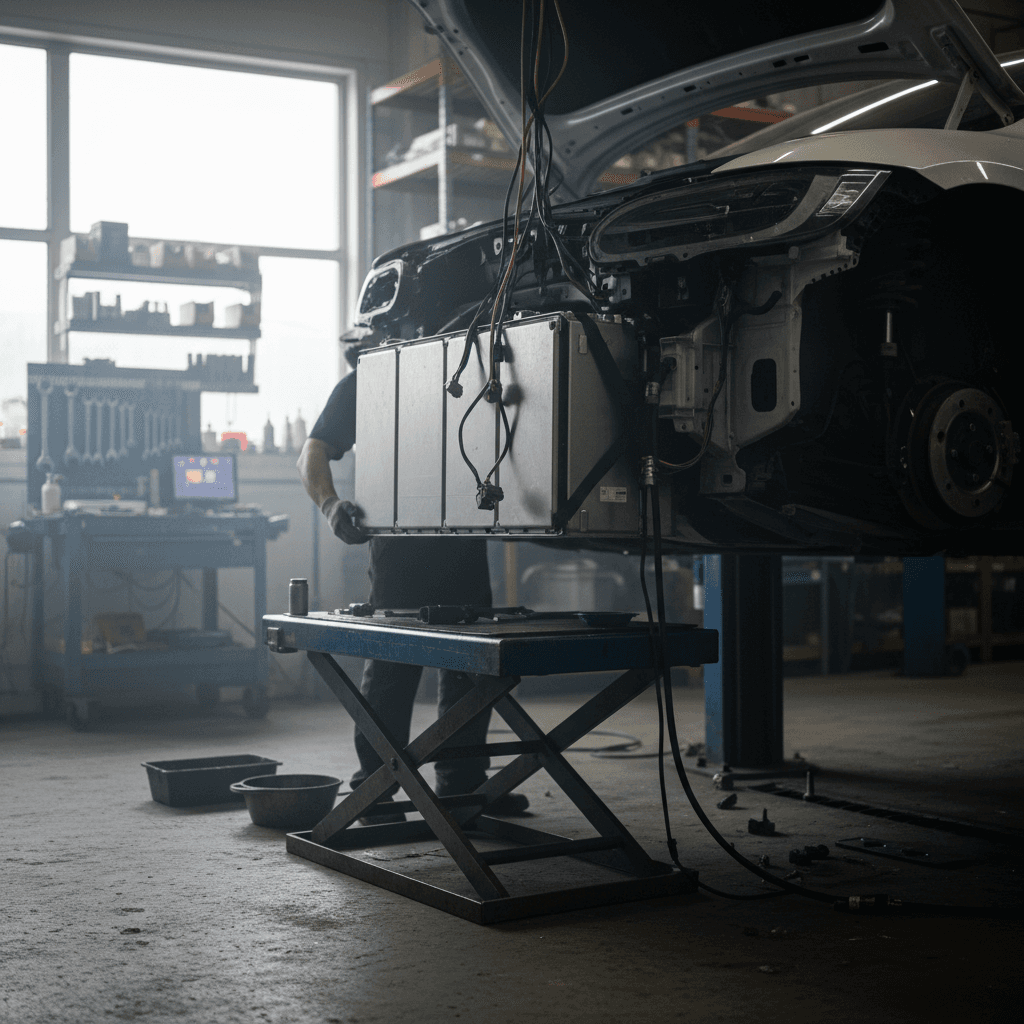
Battery health checks and high-voltage diagnostics
The battery pack is the heart of your EV, and the part everyone worries about. The reality in 2025: most modern EVs lose only a small percentage of range each year, and catastrophic pack failures are rare. Still, you want to keep a close eye on battery health, especially when you’re buying used.
What a good EV battery check includes
This is where EV service really differs from a traditional tune‑up.
State-of-health review
Modern EVs can report an estimated state of health for the battery: essentially how much capacity remains versus new. Some brands expose this in the dash; others require a scan tool or a specialist report like the Recharged Score.
Thermal system inspection
Technicians inspect coolant levels, pumps, valves, and fans that keep the battery and power electronics in their comfort zone. Overheating is the enemy of battery life.
Error-code scan
Even if there’s no warning light, a high‑voltage system scan can surface intermittent faults in contactors, sensors, or charging hardware before they become breakdowns.
Safety checks
Shops also inspect orange high‑voltage cables, connectors, and pack housings for damage or corrosion, especially important on older or high‑mileage EVs and cars from snow‑belt states.
How Recharged helps here
Ready to find your next EV?
Browse VehiclesEV brakes, tires, and suspension: the real wear items
If you talk to EV techs, you’ll hear the same story: the service bay action is at the corners of the car. That’s where the weight of the battery and the punch of instant torque show up over time.
Corner-to-corner: what to watch
Monitor tire wear patterns
Feathering or one‑sided wear usually points to misalignment or worn suspension parts. On heavy EVs, catching this early can save you hundreds on premature tire replacement.
Budget for quality tires
Low‑rolling‑resistance EV tires help you keep range, noise, and ride comfort where they should be. Cheaper replacements can feel louder and cut into efficiency.
Don’t ignore brake service
Regenerative braking dramatically reduces pad wear, but <strong>brake fluid still ages</strong>, and calipers can seize if they never get hot. Periodic cleaning and fluid changes are cheap insurance.
Listen for suspension noises
Clunks over bumps or extra play in the steering wheel are signs that bushings, ball joints, or tie rods are ready for attention, EV or not.
Don’t skip tire rotations
Where to service your EV: dealer vs independent vs mobile
In the early days of EVs, the dealership was often your only option. In 2025, the landscape is broader: more franchised dealers are EV‑capable, independent shops are investing in training, and mobile providers can handle many basics in your driveway.
Franchised dealer
- Best choice for warranty repairs, recalls, and complex diagnostics.
- Techs have direct access to factory training and proprietary tools.
- Downside: labor rates are often higher, and appointments can book out weeks in EV‑dense regions.
Independent EV specialist
- Great for out‑of‑warranty maintenance, tires, brakes, and many repairs.
- Often more flexible on scheduling and pricing.
- Look for shops that advertise high‑voltage certification and have a track record with your specific brand.
Mobile & on‑site service
- Ideal for software updates, basic inspections, wipers, and some warranty work (especially with brands that offer factory mobile techs).
- Saves you a trip to the shop, but limited to lower‑risk work.
- Still emerging; availability depends heavily on where you live.
Ask this before you book
Buying used: reading service history and planning maintenance
A used EV with a clean Carfax and shiny paint isn’t the full story. The service record tells you how the car has really been living. Has it seen regular inspections? Were any battery or charging issues addressed promptly? This matters as much as the odometer reading.
How to “read” a used EV’s service story
Whether you’re buying from a neighbor, a dealer, or an online marketplace, these are the clues to look for.
Consistent annual visits
Look for yearly inspection or service entries, even if they’re light on parts. That means someone was checking tires, brakes, and software regularly.
Charging and battery notes
Any mention of “HV battery check,” “thermal service,” or “charge system diagnosis” is worth reading closely. You want to see issues resolved, not repeated.
Recall and campaign completion
Most EVs have seen software or hardware campaigns for charging behavior, drive units, or safety systems. A complete history shows recalls handled promptly.
Independent health reports
Third‑party reports, like the Recharged Score, add a second opinion on battery health and diagnostics so you aren’t relying solely on seller claims.
Why many buyers like starting with Recharged
What you can (and shouldn’t) DIY on an EV
If you’re handy, you might be wondering how much of EV service you can tackle yourself. The answer: more than nothing, less than a full tune‑up. Anything involving the orange high‑voltage cabling belongs to trained professionals, but there’s still room for owner tinkering.
DIY smart, not reckless
Safe DIY tasks
You can confidently handle <strong>wiper blades, washer fluid, 12‑volt battery checks, tire pressure adjustments, and sometimes cabin air filters</strong> if access is straightforward and you’re comfortable with basic tools.
“Maybe” DIY tasks
Tire rotations or brake pad swaps are possible for experienced home mechanics with proper jacks, torque specs, and safety stands, but EV weight raises the stakes. When in doubt, pay a pro.
Never DIY high-voltage systems
Anything touching the <strong>orange cables, battery pack, inverters, or onboard charger</strong> is strictly off‑limits without high‑voltage training and protective gear.
When to call a pro immediately
Warning lights related to <strong>battery, charging, or drive system</strong>, burning smells, severe overheating, or crash damage near the battery pack are all reasons to stop driving and get the car inspected professionally.
Respect the orange cables
EV service FAQ
Common questions about EV service
Key takeaways: building a simple EV service plan
The beauty of EV ownership is that service becomes predictable. Instead of chasing oil changes and surprise engine repairs, you’re mostly budgeting for tires, periodic inspections, and the occasional fluid or filter. Treat your EV kindly, rotate the tires on time, schedule that yearly checkup, and pay attention to alignment, and it will likely reward you with lower maintenance costs and less time in the shop than a comparable gas car.
If you’re stepping into a used EV, that service story matters even more. This is where Recharged can make your life easier: from a transparent Recharged Score battery report to expert guidance on what service you’ll actually need in the next few years, you get a clear picture before you sign anything. That way, your first EV, or your next one, feels less like an experiment and more like a smart, well‑planned move.