
You bought a Tesla Model X for the drama: the falcon‑wing doors, the warp‑speed launches, the smug sense of being ten minutes ahead of the rest of traffic and ten years ahead of the climate. Now you’re staring at trade‑in quotes that feel…punitive. If you’re trying to decode your Tesla Model X trade in value in 2025, you’re not imagining it: this is one of the most volatile, fastest‑depreciating luxury EVs on the road.
The short version
Why Model X trade‑in values feel all over the map
If you’ve plugged your VIN into three different appraisal tools and gotten three radically different numbers, welcome to the Tesla Model X experience. This SUV sits at the toxic intersection of high original MSRP, rapid technology turnover, and a used‑EV market that has cooled dramatically in the last two years.
Model X value reality check in 2025 (US market)
Luxury EVs were bid to the moon during the 2021–2022 frenzy. As rates rose and new competition arrived, gravity did what gravity does. The Model X’s five‑year depreciation now routinely cracks 60%, and that’s before you factor in individual variables like Autopilot options or a tired battery pack.
How much is a Tesla Model X worth today?
Let’s put some ballpark numbers around Model X value so you can sanity‑check the offers you’re seeing. These are rough U.S. retail and trade‑in ranges for clean, accident‑free examples with average mileage and no major issues, as of early 2025. Your local market, options, and battery health can move the needle thousands of dollars either way.
Approximate Tesla Model X values by model year (early 2025)
These are illustrative ranges based on mainstream pricing guides and marketplace data. Trade‑in values skew to the lower end; private‑party sales skew higher.
| Model year | Original MSRP range* | Typical dealer retail | Typical trade‑in range |
|---|---|---|---|
| 2024–2025 | $95,000–$110,000+ | $80,000–$95,000 | $65,000–$80,000 |
| 2022–2023 (refresh) | $100,000–$125,000+ | $60,000–$75,000 | $45,000–$60,000 |
| 2019–2021 | $90,000–$110,000+ | $38,000–$55,000 | $28,000–$40,000 |
| 2016–2018 (early builds) | $80,000–$110,000+ | $25,000–$38,000 | $18,000–$28,000 |
Use this table as a directional guide, not a quote. Always pair it with a real‑time appraisal and a battery‑health report.
About those ranges
To get an initial baseline, it’s worth running your VIN through a couple of mainstream pricing tools and then checking live listings for similar Model Xs within 250 miles of your ZIP. You’re looking for the pattern, not the single highest outlier.
What actually drives your Model X trade‑in value
Six big levers that move Model X trade‑in value
You can’t control all of them, but knowing which ones matter keeps you from leaving money on the table.
1. Model year & tech generation
2. Mileage & usage profile
3. Battery health & charging history
4. Accident, repair, and title history
5. Spec & options
6. Market timing & region
Think like a buyer
Tesla vs dealers vs EV marketplaces: who pays what?
You have three broad options when you’re trading out of a Model X: Tesla’s own trade‑in program, a conventional dealer (Tesla or non‑Tesla), or a more modern EV‑specialist marketplace like Recharged. Each sees your car through a slightly different lens.
Tesla trade‑in
- Ultra‑convenient if you’re ordering another Tesla.
- Single online quote, simple paperwork.
- Value is often conservative; Tesla is not in the business of overpaying for its own used inventory.
Good for: maximizing convenience, minimizing effort. Less good for: squeezing every last dollar out of a high‑spec Model X.
Traditional dealers
- Non‑Tesla stores may wholesale your X rather than retail it.
- Many lack the tools to evaluate battery health, so they price in extra risk.
- Offers can be especially low on older, high‑mileage, or quirky spec cars.
Good for: bundling into a deal when you’re switching brands. Less good for: specialty EV expertise.
EV marketplaces like Recharged
- Built specifically around EVs, including Teslas.
- Use battery‑health diagnostics (like the Recharged Score) to prove your pack’s condition to buyers.
- Offer flexible paths: instant offer, trade‑in, or consignment where you share in the upside.
Good for: owners who want transparent pricing, expert guidance, and nationwide buyer reach without selling the car themselves.
Where Recharged fits in
Ready to find your next EV?
Browse VehiclesBattery health: the silent deal‑breaker in Model X trade‑ins
Battery degradation is the part of your Model X’s value that the online estimators mostly hand‑wave away. On paper, Tesla’s 8‑year/100,000‑mile (or more, depending on pack) battery warranty looks reassuring. In practice, a pack that’s lost 18% of its real‑world range is a harder retail sale than one that’s only down 7%, even if both are technically "within spec."
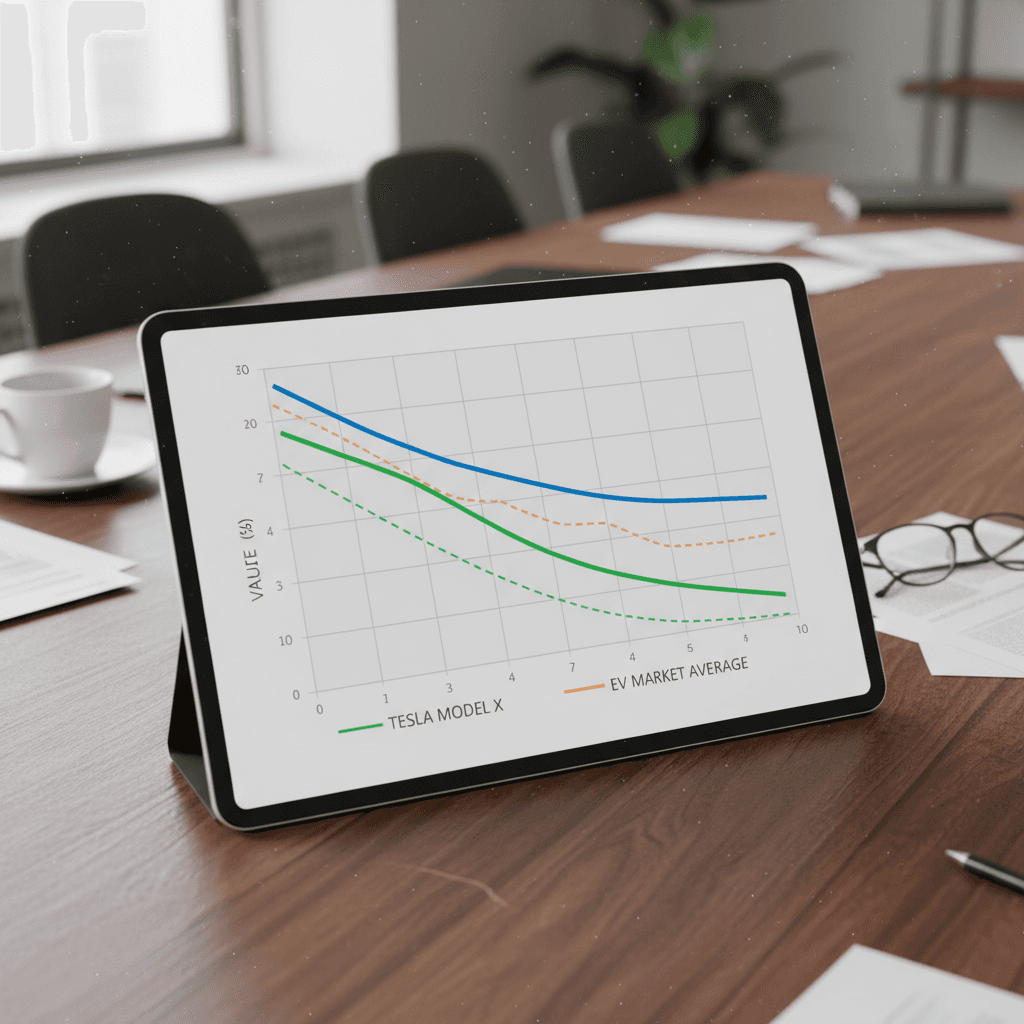
- Most buyers fixate on usable range today, not the number printed on the original window sticker.
- Heavy DC fast‑charging and frequent 100% top‑offs can accelerate degradation.
- A well‑cared‑for Model X that still delivers close to its original range can justify a meaningfully higher trade‑in value.
- Dealers who can’t accurately measure your battery health will assume the worst, and price accordingly.
What a battery‑health report does for you
Step‑by‑step: how to get a strong Model X trade‑in offer
Pre‑trade‑in checklist for Tesla Model X owners
1. Gather your paperwork and digital history
Pull your registration, title (or payoff info), service invoices, tire receipts, and any body‑shop paperwork. In your Tesla app, grab screenshots of service visits and the current battery‑health/charge screen showing typical range at 80–90%.
2. Get a realistic value baseline
Use 2–3 trusted sources: a major pricing guide, live listings for comparable Model Xs near you, and at least one EV‑specialist marketplace quote. Average them mentally. Ignore the single outlier that flatters you the most.
3. Clean and de‑Tesla‑clutter the car
A quick detail, vacuum, and de‑personalization (no stickers, no random cords everywhere) will not turn a $35k car into a $45k car, but it can nudge you to the top of whatever condition band you’re in.
4. Fix cheap, obvious defects
Burned‑out bulbs, a dangling undertray, curbed but repairable wheels, missing key cards, these are the $150 annoyances that give appraisers an excuse to be aggressive. Fix the low‑hanging fruit; skip major cosmetic surgery.
5. Get battery health documented
If you’re trading through Recharged, our Recharged Score evaluation will do this for you. Otherwise, consider a third‑party EV inspection that can document range and pack behavior. Bring that report when you shop offers.
6. Collect multiple offers and play them off each other
There is no moral obligation to accept the first number someone texts you. Get an instant offer, a Tesla quote, and if you have the patience, a consignment estimate from Recharged. Then compare net proceeds, not just sticker numbers.
When to trade in your Model X for the best value
Timing is a dark art, but there are some patterns in how the Model X sheds value. The steepest part of the curve is usually in the first 3–5 years, then depreciation slows, but so does buyer enthusiasm for older, out‑of‑warranty luxury EVs.
Trade‑in timing strategies by owner type
Daily‑driver owners (6–10 years of use)
Aim to trade just before your battery and drivetrain warranty expires, especially if mileage is already high.
If you’re approaching 90,000–100,000 miles, get ahead of the market’s fear of six‑figure odometers.
Watch for big Tesla price cuts on new Models, these can instantly re‑price your used SUV downward. Selling before a major cut can save you thousands.
Tech‑chaser owners (3–5 years of use)
You’re paying for the latest hardware and software, accept that you’ll also eat the sharpest depreciation.
Trading around years 3–4 can capture most of the "new Tesla" experience without having to live through steep battery degradation.
Consider consignment through Recharged if your spec is special (Performance, rare color, low miles); retail buyers will often pay more than an algorithm.
Low‑mileage, second‑car owners
If you drive your Model X sparingly, your best move may be to hold until the market normalizes a bit.
Keep the battery happy: avoid long‑term 100% sitting in hot climates, and don’t fast‑charge just for the thrill of it.
When you do sell, lean hard on documentation, your low use is an asset, but only if buyers believe it.
Seasonality still matters
Common Model X trade‑in mistakes to avoid
- Chasing the unicorn number. That one offer that’s $7,000 higher than everyone else? Read the fine print. Many of those numbers shrink after inspection, or come with fees and conditions that wipe out the advantage.
- Ignoring battery health. If you don’t know your pack’s actual condition, the buyer will assume it’s worse than it is. That assumption lands directly in your offer.
- Rolling negative equity blindly. If you owe more on your Model X than it’s worth, some dealers will happily bury the difference in a new loan. You’ll feel it later, when you’re upside‑down again.
- Trading in before fixing title or lien issues. A missing payoff letter or unresolved lien can derail an otherwise smooth deal and limit your options, especially with out‑of‑state buyers.
- Underestimating private‑sale effort. Yes, you might net more selling privately, but factor in time, test drives, scams, financing headaches, and out‑of‑state paperwork before you write off a solid trade‑in or consignment offer.
Don’t fake the condition report
Is trading in your Tesla Model X actually worth it?
When a trade‑in makes sense
- You’re switching into another EV and value time more than chasing every last dollar.
- Your Model X has quirks, minor cosmetic issues, an accident history, that will spook private buyers.
- You want the tax advantage in states where trade‑in value reduces the taxable amount on your next purchase.
- You’d rather have professionals handle payoff, paperwork, and transport, especially across state lines.
When you might do better selling differently
- You own a low‑mileage, late‑model, clean‑history X with desirable options and colors.
- You’re comfortable waiting a few weeks while the right buyer appears.
- You’re interested in a consignment model where an EV specialist handles marketing, test drives, and financing, and you share in the upside over a guaranteed floor price.
- You don’t need the proceeds immediately to fund your next car.
The Model X is a victim of its own ambition: an expensive, rapidly evolving electric spaceship in a market that is suddenly spoiled for choice. That makes your Tesla Model X trade in value more fragile than you might like, but not unknowable, and not unmanageable. With a clear view of how depreciation, battery health, and selling channel interact, you can choose the path that fits your priorities: maximum convenience, maximum cash, or a smart compromise through an EV‑focused marketplace like Recharged.