If you’re looking at a Tesla Model 3 and wondering how far it can go with a trailer or bike rack hanging off the back, you’re not alone. The Tesla Model 3 towing capacity and range story is a mix of hard limits, regional quirks, and very real range penalties that catch a lot of new EV owners off guard.
Key takeaway up front
Can a Tesla Model 3 tow at all?
The first thing to understand is that not every Tesla Model 3 is approved to tow, and Tesla has changed its stance over time.
Earlier North American Model 3s
- 2017–2023 U.S. & Canada: Tesla did not offer a factory tow package.
- The owner’s manual for these cars explicitly states that Model 3 does not currently support towing and warns that towing can cause damage and may void the warranty if you use non‑approved components.
- Many owners still installed aftermarket hitches for bike racks or light towing, but this lives in a warranty gray area.
Europe & Asia‑Pacific
- Tesla has long offered a factory tow package for Model 3 in markets like Europe and parts of Asia‑Pacific.
- Those cars are fully rated for towing, with published capacities and a built‑in Trailer/Tow Mode in software.
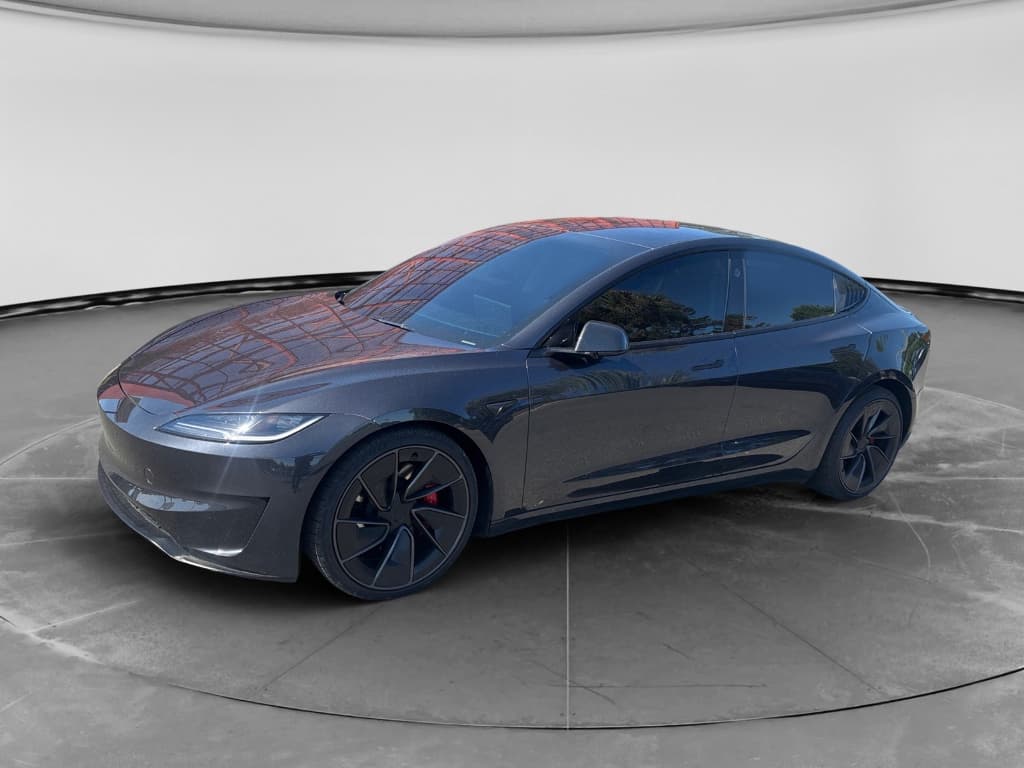
- In mid‑2025, Tesla began offering a factory tow package for the refreshed Model 3 in North America as well, aligning capabilities more closely with Europe.
Warranty nuance
Tesla Model 3 towing capacity by region and trim
Official towing capacity depends on both where the car was sold and whether it has the Tesla‑approved tow package. Here’s how to think about it.
Model 3 factory towing capacities (global overview)
Approximate official limits for factory‑equipped tow‑package cars. Always confirm in the owner’s manual and on the hitch label for your specific VIN.
| Market / spec | Tow package | Max trailer w/ brakes | Max trailer w/o brakes | Max tongue weight |
|---|---|---|---|---|
| Europe / many APAC markets | Factory option available on most trims | 1,000 kg (≈2,205 lbs) | 750 kg (≈1,650 lbs) | 100 kg (≈220 lbs) |
| 2024+ "Highland" Model 3 with tow package (Europe/APAC/NA) | Factory option | ≈1,000 kg (≈2,205 lbs) typical | ≈750 kg (≈1,650 lbs) typical | ≈100 kg (≈220 lbs) typical |
| Earlier North America Model 3 (no Tesla tow package) | Not offered from factory | 0 (not approved) | 0 (not approved) | 0 (not approved) |
Without the factory tow package, Tesla generally specifies that the Model 3 is not approved for towing.
Tongue weight matters
When you shop used, the important distinction isn’t so much RWD vs Long Range vs Performance, it’s whether the car was delivered with a Tesla‑approved hitch and Tow/Trailer Mode. That’s what gives you a clean, documented towing capacity. Recharged’s inspection process notes factory options and can help you confirm whether a used Model 3 you’re considering is truly tow‑ready.
How towing affects Tesla Model 3 range
ICE owners are used to seeing fuel economy tank when towing; EVs behave the same way, just more visibly. With a Model 3 you’re watching the watt‑hours per mile jump in real time on the screen.
Main drivers of range loss when towing
Why the same trailer can cost you 25% or 60% range depending on how you use it
Aerodynamic drag
With EVs, aero matters more than weight at highway speed. A tall, boxy camper can double your drag, slashing range even if it’s fairly light.
Speed
Going from 60 mph to 75 mph massively increases drag. The same rig that costs you ~30% range at 60 mph can cost 50%+ at 75 mph.
Terrain & weather
Hills, headwinds, cold temps, and rain all raise consumption. Climbing with a trailer is particularly energy‑intensive, even with regen on the way down.
A 2024 Model 3 Long Range AWD is rated around 340+ miles EPA on the standard wheels, but independent real‑world testing has found closer to 440 km / 273 miles under mixed driving conditions even without a trailer. Add a trailer and you’re layering range loss on top of the usual real‑world shortfall.
Rule‑of‑thumb for EV towing
Real‑world range examples when towing
Because Tesla doesn’t publish official "with trailer" range, owners end up building their own mental model. Here are simplified examples to help you think about it. These are not promises, just planning baselines.
Illustrative consumption scenarios for a Long Range Model 3
Approximate usable range vs. trailer type (Long Range Model 3)
Very rough planning numbers assuming ~75 kWh usable battery, starting around 90% and arriving at chargers with 10% remaining. Real‑world results will vary.
| Scenario | Assumed consumption | Usable energy window | Estimated range between fast charges |
|---|---|---|---|
| Solo highway driving, mild weather | 250 Wh/mi | ≈60 kWh (90% to 10%) | ≈240 miles |
| Low teardrop / aero cargo trailer at 60–65 mph | 350 Wh/mi | ≈60 kWh | ≈170 miles |
| Same trailer at 70–75 mph | 400 Wh/mi | ≈60 kWh | ≈150 miles |
| Small, tall box trailer or mini‑camper at 60–65 mph | 450 Wh/mi | ≈60 kWh | ≈130 miles |
| Boxy trailer at 70–75 mph, bad weather | 500+ Wh/mi | ≈60 kWh | ≈120 miles or less |
Think of this as a sanity check, not a guarantee. Always build in extra buffer.
Don’t plan to "use the full pack"
Trip planning and charging strategy with a trailer
The Model 3’s software does a decent job adjusting energy estimates when you activate Tow/Trailer Mode on factory‑equipped cars, but you still need to think more conservatively than you would driving solo.
Planning a towing road trip in a Model 3
1. Start with half‑range planning
Take your solo‑driving highway range and cut it roughly in half for your initial plan. If your Model 3 typically does 240 miles between chargers solo, start by planning 110–130‑mile legs when towing.
2. Use energy graphs, not just %
On the touchscreen, monitor <strong>Wh/mi and trip energy graphs</strong> during your first 30–50 miles. If you’re trending worse than expected, shorten your next charging leg right away.
3. Prefer bigger, better‑spaced chargers
When towing, it’s more stressful to detour for a back‑road DC fast charger. Stick to major Supercharger corridors or large third‑party sites with multiple stalls so you have redundancy.
4. Consider trailer maneuvering at chargers
Many Superchargers and CCS sites aren’t set up for pull‑through charging. Be ready to <strong>unhitch</strong> or choose locations with perimeter stalls and extra space.
5. Slow down when needed
If your energy use is worse than planned, dropping from 75 mph to 60–65 mph can claw back a surprising amount of range and save you an extra charging stop.
6. Respect weather and elevation
Heading into strong headwinds, freezing temps, or long climbs? Treat your plan as optimistic and trim another 10–15% off your expected range until you see how the car behaves.
Use software to your advantage
What you can safely tow with a Model 3
Even where it’s legal and factory‑approved, the Model 3 is still a compact sedan with a relatively low tongue‑weight rating. Think of it as a light‑duty tow vehicle for smaller loads, not a stand‑in for a midsize pickup.
Common Model 3‑friendly loads
Assuming factory tow package and typical 1,000 kg / 2,200‑lb rating
Bike racks & cargo carriers
Perfect use case. A hitch‑mounted bike rack or small cargo tray is well within the vertical load limit and has minor impact on range if it stays tucked in the slipstream.
Teardrop & micro campers
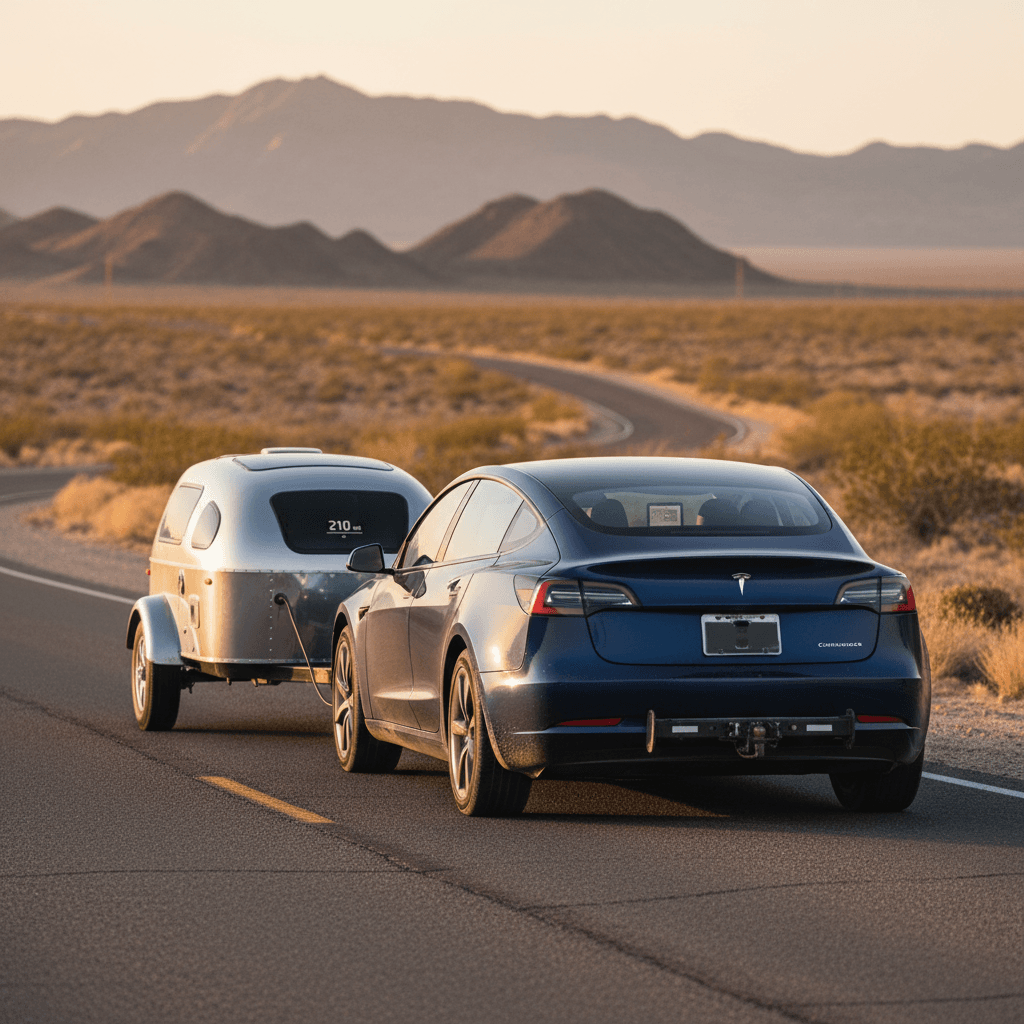
Many teardrop trailers and minimalist campers come in under 1,500–2,000 lbs loaded and sit low in the airflow. Great for EV "glamping" if you’re realistic about range.
Small utility trailers
Light single‑axle utility trailers (yard waste, home‑improvement runs) are fine, but loading them tall with furniture, appliances, or building materials will hit your aero and range hard.
Stay inside the weakest limit
Protecting your battery and drivetrain while towing
Towing in a Model 3 isn’t just about not exceeding the hitch rating. You’re also managing battery temperatures, motor loads, and braking systems that were sized for a relatively light sedan.
- Avoid repeated full‑throttle launches with a trailer attached; high current plus extra mass equals extra heat in the battery and motors.
- Watch battery temperature and power‑limit indicators on long climbs. If the car starts to reduce power, back off your speed to give the cooling system some headroom.
- Use the trailer’s own brakes where possible. Relying solely on regenerative and friction braking in the car is asking a relatively small system to do a truck’s job.
- Keep tire pressures at the upper end of the recommended range when towing to reduce heat and improve stability, but never exceed max sidewall pressure.
- Don’t tow at or near maximum capacity in extreme heat or cold for long distances if you can avoid it; both temperature extremes stress the pack.
Think like an engineer, not a spec sheet
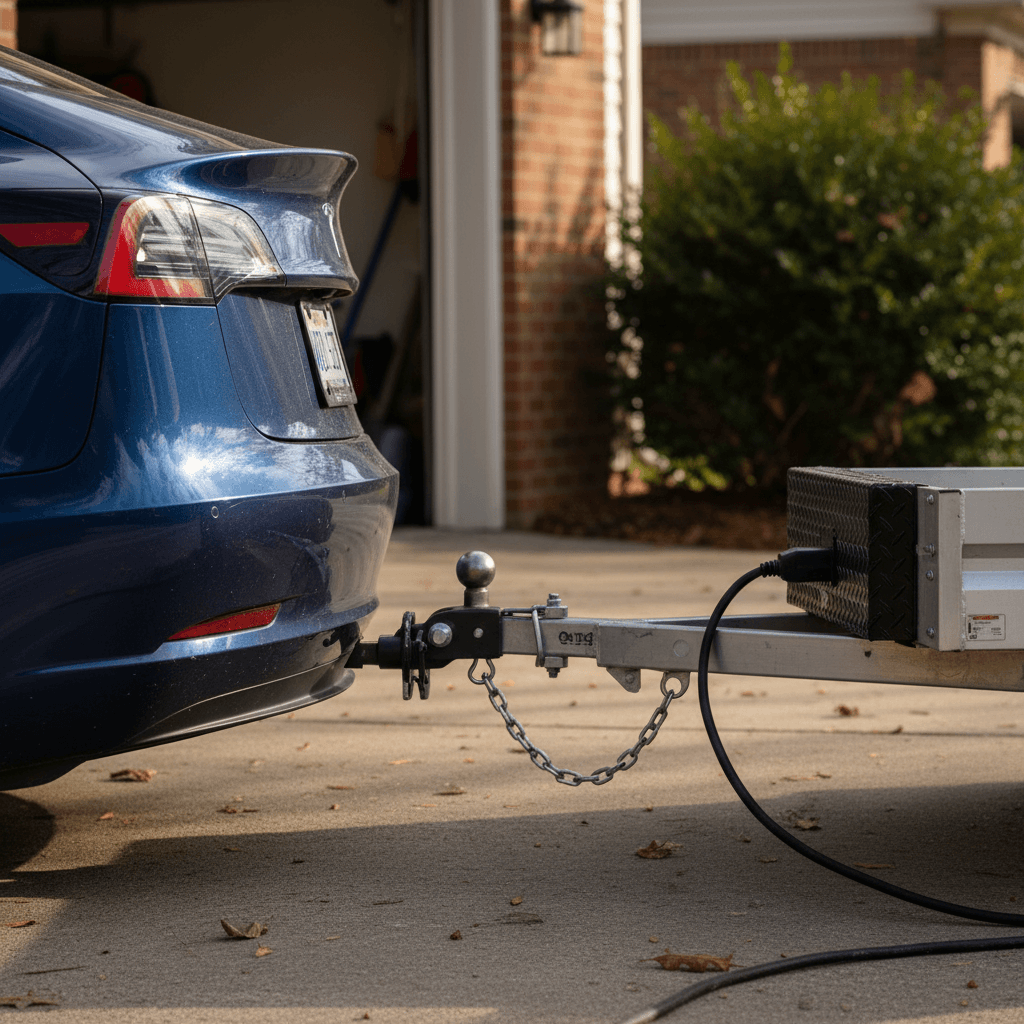
Buying a used Tesla Model 3 that has towed
If you’re shopping for a used Model 3, especially one with an obvious hitch, it’s worth asking a few extra questions. Towing done thoughtfully is no big deal; towing at or beyond the limits for years on end is another story.
Used Model 3 towing checklist
Confirm factory tow package vs. aftermarket
Look for evidence of a <strong>Tesla‑installed hitch</strong> and Tow/Trailer Mode in the software menus. Aftermarket hitches aren’t automatically bad, but they signal that the car may have been used outside Tesla’s official towing envelope.
Ask what was towed and how often
Light bike racks on weekends are a different story than a nearly max‑weight camper dragged across mountain passes every summer. Ask for specifics and, if possible, photos.
Inspect for rear‑end wear and damage
Check the rear bumper, mounting points, underbody, and wiring for damage, rust, or sketchy DIY repairs. Excess flex or corrosion near the hitch is a red flag.
Review service history for drivetrain issues
Frequent alerts related to <strong>inverter, drive unit, or battery cooling</strong> could suggest the car was stressed, towing or not. A clean history is ideal.
Check recent range and battery health
On a test drive, look at consumption and estimated range at a given state of charge. On Recharged vehicles, the <strong>Recharged Score Report</strong> includes independent battery‑health diagnostics so you’re not guessing.
Verify tire and brake condition
Towing adds load to both tires and brakes. Uneven tire wear or prematurely worn pads and rotors can hint at hard use, even if the seller downplays it.
How Recharged helps here
Frequently asked questions: Model 3 towing & range
Model 3 towing & range FAQ
Is the Tesla Model 3 a good tow vehicle?
Used thoughtfully, a Tesla Model 3 can be a surprisingly capable light‑duty tow vehicle, especially for bike racks, cargo carriers, and small, aero‑friendly trailers. But it’s still a highly efficient sedan first and a tow rig a distant second. If you work within the published weight limits, plan for 30–50% range loss on trips, and give the battery and brakes some mechanical sympathy, it can unlock a lot of flexibility without undermining what makes the Model 3 great day to day.
If you’re shopping for a used Tesla Model 3 and towing is on your wish list, it pays to be picky. Look for a car with the right tow hardware, clean history, and strong battery diagnostics. On Recharged, every vehicle comes with a Recharged Score Report, transparent pricing, and EV‑specialist support to help you understand exactly what a specific Model 3 can (and shouldn’t) be asked to do, hitched up or not.