If you’re considering a Tesla Model 3, especially a used one, it’s natural to worry about battery degradation per year. Range is the lifeblood of any EV, and you don’t want to discover after buying that your "long‑range" sedan doesn’t go nearly as far as advertised.
Quick takeaways
How fast do Tesla Model 3 batteries degrade?
Let’s start with the question you really care about: how much range does a Tesla Model 3 lose per year? No two cars are identical, but thousands of owner‑reported data points and fleet analyses paint a broadly consistent picture.
Typical Tesla Model 3 battery degradation pattern
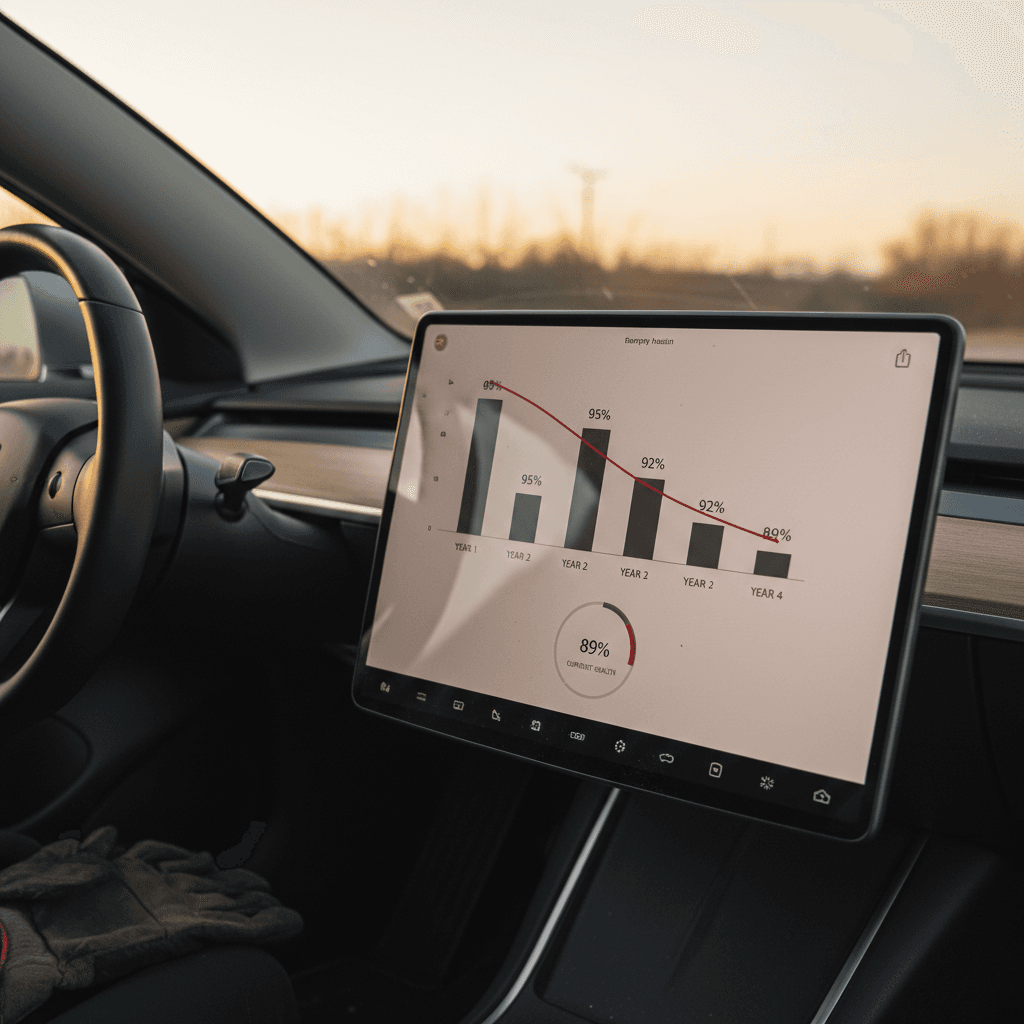
Put simply, Tesla Model 3 battery degradation per year is not a straight line. You’ll usually see a bigger hit early on, then a long, slow glide afterward. Over a decade of typical driving, that’s often far less scary than most shoppers imagine.
These are patterns, not promises
Why the first year of degradation looks worse than it is
If you graph Model 3 battery degradation per year, the curve usually isn’t straight, it’s steeper at the beginning, then flattens out. That’s largely because of how lithium‑ion chemistry works.
Phase 1: The early drop (0–2 years)
- Initial settling: Lithium‑ion cells often lose a few percent of capacity as they "form" in real‑world use.
- Software calibration: The car’s battery management system is learning your pack; range estimates can swing as it refines its model.
- Frequent fast charging: Many new owners test every Supercharger on the map, which can accelerate early wear if done constantly.
Phase 2: The plateau (3+ years)
- Slower chemical aging: After the early drop, the battery’s loss rate tends to stabilize at a much lower annual percentage.
- Habit patterns: Owners settle into predictable charging routines, often home Level 2, which is gentler on the pack.
- Software refinements: Over‑the‑air updates may tweak how the car protects the battery at high and low states of charge.
Don’t overreact to the first few percent
Real‑world Model 3 battery life and mileage expectations
So what does this mean for how long a Tesla Model 3 battery will last? Again, every car is different, but when you aggregate owner data, some rough benchmarks emerge that are useful for shoppers and owners alike.
Rough real‑world Model 3 battery benchmarks
These are generalized, illustrative ranges for many Model 3s in typical use, not hard limits.
| Odometer | Typical Capacity Remaining | What It Feels Like in Daily Use |
|---|---|---|
| 50,000 miles | ~92–96% | You’ll rarely notice; a few less miles than day one. |
| 100,000 miles | ~88–93% | Range difference shows on paper but is manageable in daily driving. |
| 150,000 miles | ~85–90% | Road‑trippers may plan an extra brief stop; daily commuting is still easy. |
| 200,000 miles | ~80–88% | Usable for most drivers; long‑distance travel takes more planning. |
| 250,000+ miles | Varies widely | Some packs will still be road‑trip ready; others may be best for shorter‑range duties. |
Approximate capacity retention at major mileage milestones for a well‑cared‑for Tesla Model 3.
Why these ranges are wide
Factors that speed up or slow down degradation
Tesla’s pack design and thermal management give the Model 3 an advantage over many early‑generation EVs, but it’s not magic. Certain habits will reliably push your battery degradation per year up or down.
Key factors that affect Model 3 battery degradation per year
Most owners have more control over battery health than they realize.
Heat & climate
High ambient temperatures accelerate chemical aging.
- Parking in direct sun for long periods is harder on the pack.
- Garage parking and shade help, especially in hot states.
Charging style
How you charge matters just as much as how often.
- Frequent DC fast charging heats the pack more than Level 2.
- Gentle nightly Level 2 or Level 1 charging is kinder over time.
State of charge window
Living at the extremes is tougher on cells.
- Regularly charging to 100% and leaving it full speeds wear.
- Running down to near 0% frequently does the same.
Driving style
High sustained power draws add stress.
- Constant high‑speed runs and aggressive acceleration add heat.
- Smoother driving and moderate speeds are gentler.
Cold weather
Cold doesn’t usually cause permanent degradation by itself.
- Range temporarily drops in winter due to chemistry and cabin heating.
- Long‑term capacity usually rebounds when temperatures rise.
Software & maintenance
Keeping the car updated and functioning smoothly helps.
- Over‑the‑air updates can tweak how the pack is managed.
- Fixing charging hardware issues promptly avoids abnormal stress.
The worst‑case habits
Model 3 battery warranty and when to worry
When you’re evaluating Tesla Model 3 battery degradation per year, the real question is: at what point should you be concerned enough to bring Tesla, or a seller, into the conversation?
Tesla Model 3 battery & drive unit warranty overview
Exact terms vary slightly by configuration and model year; always verify with the specific VIN and Tesla’s current documents.
| Configuration | Typical Warranty Term* | Capacity Guarantee |
|---|---|---|
| Standard / RWD | 8 years or 100,000–120,000 miles | At least 70% battery capacity remaining within warranty limits |
| Long Range / Performance | 8 years or 120,000–150,000 miles | At least 70% battery capacity remaining within warranty limits |
Most Model 3 variants are covered for 8 years, with a mileage cap and minimum capacity guarantee.
What the 70% guarantee really means
From a practical standpoint, you should pay closer attention if a car is approaching the end of its 8‑year window or is already showing significantly more degradation than peers with similar age and mileage. That’s where a detailed health report becomes invaluable, especially for a used Model 3.
How to check battery health on a used Model 3
If you’re shopping used, the biggest mistake you can make is relying on the odometer alone. Two Model 3s with 60,000 miles can have very different battery stories depending on how they were driven and charged.
Practical steps to assess a used Model 3 battery
1. Ask for the latest software‑reported range
Have the seller show you the car’s estimated range at 100% (or project it from the 90% value). Compare that to the original EPA rating for that trim to get a rough sense of capacity loss.
2. Check typical daily charge limit
Look at where the charge slider is set. A prior owner who kept daily charging around 70–80% likely treated the pack more gently than one who lived at 100%.
3. Review charging history, if possible
Ask how often the car was Supercharged vs. charged at home. Occasional fast charging is fine; heavy reliance on DC fast charging for local driving can accelerate wear.
4. Look at climate history
A car that spent its life in a temperate region and lived in a garage is generally a safer bet than one that lived in extreme heat and sat outside constantly.
5. Take a thorough test drive
Watch how quickly the projected range drops during your drive. Sudden, dramatic drops may indicate calibration issues, or, more rarely, a pack problem.
6. Get a third‑party or marketplace battery report
Specialized diagnostics, like the <strong>Recharged Score battery health report</strong>, use scan data and modeling to estimate state of health more accurately than eyeballing the dash.
How Recharged simplifies used Model 3 shopping
Ready to find your next EV?
Browse VehiclesTips to reduce Tesla Model 3 battery degradation per year
You can’t stop battery aging, but you can meaningfully influence how fast it happens. The good news: the most effective strategies are simple habits, not complicated rituals.
- Use a conservative daily charge limit. For everyday driving, set your charge limit in the 60–80% range unless you truly need more for a particular trip.
- Reserve 100% charges for road trips. It’s fine to go to 100% occasionally, just time it so you start driving soon after reaching full, instead of letting the car sit for hours at 100%.
- Avoid arriving at 0% whenever possible. Try to keep your pack above ~10% in normal use; emergency deep discharges now and then won’t kill it, but they shouldn’t be routine.
- Favor Level 2 over constant fast charging. Superchargers are terrific tools, but using them for daily local charging will increase battery stress compared with a home or workplace Level 2 charger.
- Keep the car cool when you can. Garage parking, shade, and using cabin overheat protection help protect the pack from sustained high temperatures.
- Stay current on software updates. Tesla routinely refines thermal management and charging behavior; staying up to date lets you benefit from those optimizations.
Think in decades, not weeks
Should battery degradation stop you from buying a used Model 3?
For many shoppers, fear of the unknown around battery degradation per year is the single biggest barrier to buying a used Tesla Model 3. That’s understandable, replacing a pack is expensive. But when you look at real‑world data and factor in Tesla’s warranty, the story is less scary than the headlines.
Why degradation is less scary than it sounds
- Slow long‑term decline: After the initial drop, many Model 3 packs lose capacity gradually, often around ~1% per year in typical use.
- Large starting range: Even after 10–15% degradation, most trims still offer plenty of real‑world range for daily commuting and moderate road trips.
- Strong thermal management: Tesla’s active cooling and heating systems help the pack age more gracefully than many early EVs.
When you should be cautious
- Unusually high degradation vs. peers: If one car is clearly an outlier compared with similar age/mileage vehicles, dig deeper.
- Warranty almost or fully expired: You’ll want extra confidence in the pack’s health if you’re beyond Tesla’s coverage.
- Lack of transparency: If a seller won’t share range estimates, charging history, or allow a battery health report, that’s a red flag.
A smarter way to shop used EVs
Tesla Model 3 battery degradation FAQ
Frequently asked questions about Model 3 battery degradation
When you look past the anxiety and focus on data, Tesla Model 3 battery degradation per year turns out to be far more manageable than most shoppers fear. A thoughtfully used Model 3 with documented battery health can deliver years of reliable, efficient driving, at a significant discount to new. And with tools like the Recharged Score Report, you don’t have to guess whether a specific car’s pack is aging gracefully or headed for trouble, you can see it clearly before you buy.