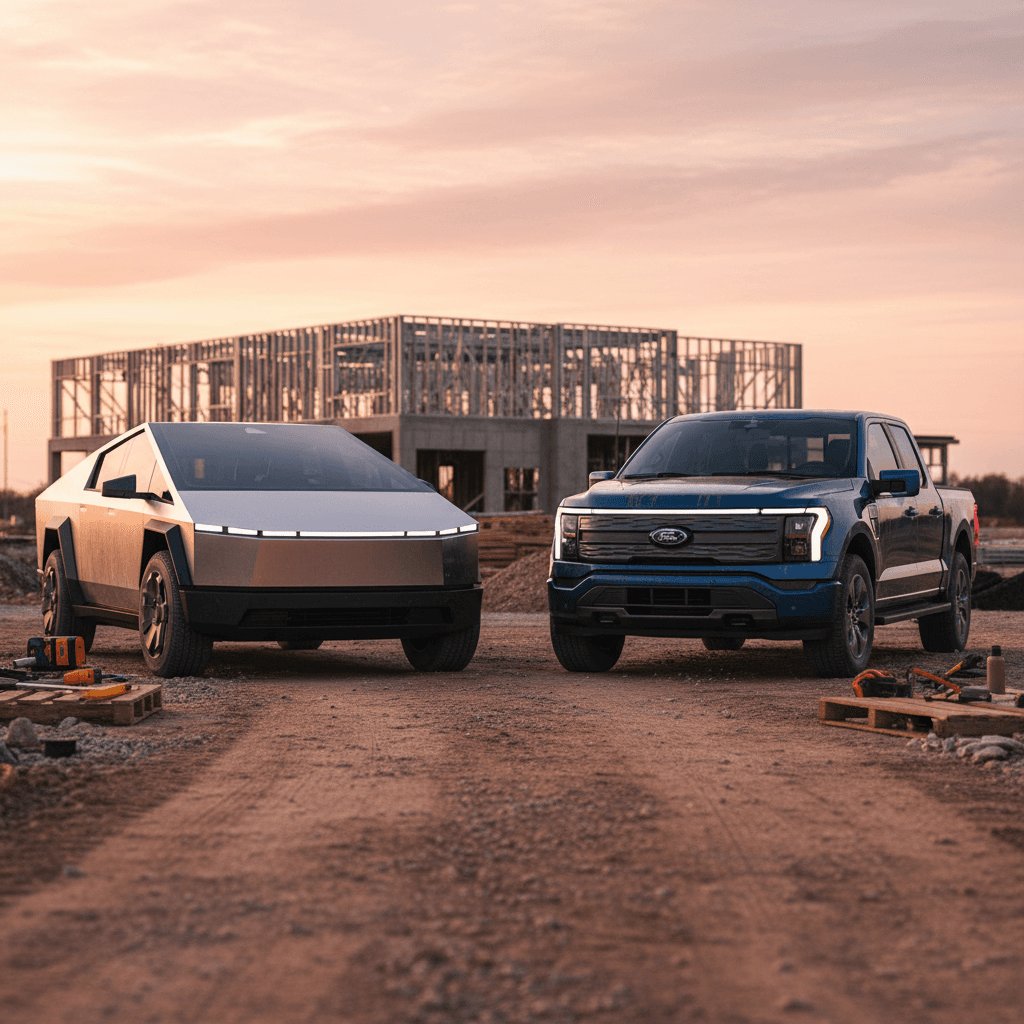
You’re standing at the crossroads of two very different Americas. On one side: the Tesla Cybertruck, a stainless-steel science project with outrageous acceleration and a built-in internet comment section wherever you park. On the other: the Ford F‑150 family, gas, hybrid, and the electric F‑150 Lightning, the default answer to “I need a truck.” If you’re asking “Tesla Cybertruck vs Ford F-150, which should you buy?”, this guide is going to walk you through the decision like a brutally honest friend who also reads spec sheets for fun.
Quick take
Cybertruck vs F‑150: who this guide is for
Before you get lost in range charts, be clear on what you’re trying to do. This Cybertruck vs F‑150 comparison is written for three kinds of shoppers:
- You want an electric truck and you’re torn between Cybertruck and F‑150 Lightning.
- You’re a truck first, EV second person, wondering if a gas or hybrid F‑150 is a better bet than going full Cybertruck.
- You mostly want a wild weekend toy that can still haul plywood or tow a boat without drama.
We’ll talk about performance, towing, range, bed usability, tech, costs, and the stuff you only notice after six months of living with a truck. Then we’ll give straight recommendations by use case so you’re not guessing.
Lineup at a glance: Cybertruck vs F‑150 family
Cybertruck vs Ford F‑150: lineup snapshot (U.S., 2026)
Big-picture view of how the Tesla Cybertruck and Ford F‑150 families are positioned.
| Truck | Powertrain | Ballpark new price* | Role / vibe |
|---|---|---|---|
| Tesla Cybertruck Dual Motor AWD | Full battery electric | Upper-$70Ks+ | Performance EV toy meets lifestyle truck |
| Tesla Cybertruck Cyberbeast | High-output tri‑motor EV | Into six figures | Crazy-fast halo truck, overkill for most |
| Ford F‑150 gas | V6 / V8 gas | From mid-$40Ks | Workhorse, fleets, long-haul towing |
| Ford F‑150 PowerBoost hybrid | Gas‑electric hybrid | High-$50Ks+ | Great daily driver, decent tow, mini power plant |
| Ford F‑150 Lightning | Full battery electric | High-$60Ks+ | Electric work + family truck, mature package |
Exact pricing and specs vary by trim and options; always confirm on the build tool or window sticker.
Reality check on availability
Performance, towing and payload
Spec highlights (approximate, popular trims)
Straight-line speed: unnecessary, delightful, addictive
The Cybertruck, especially in Cyberbeast form, is absurdly quick. You are piloting a stainless-steel Dorito that can humiliate sports cars at stoplights. The F‑150 Lightning is also very quick by truck standards, think mid‑4‑second 0–60 in some trims, but the Tesla is playing a different game. Gas and hybrid F‑150s feel downright traditional: plenty quick for daily duty, but not a party trick.
Do you actually need this much power?
Towing: numbers vs reality
Cybertruck towing
- Rated up to around 11,000 lb in many trims.
- Instant EV torque makes launching a trailer easy.
- Range drops hard at highway speeds with big loads, think half your empty range or worse with a tall camper.
- Integrated bed outlets and onboard power are excellent for work sites and campsites.
F‑150 towing (gas, hybrid, Lightning)
- Gas and hybrid F‑150s can crest 12,000 lb with the right engine and tow package.
- F‑150 Lightning tops out near 10,000 lb, but also sees heavy range loss while towing.
- Gas and hybrid trucks handle very long-distance towing better because you can refuel in minutes almost anywhere.
If you tow long distances, read this twice
Payload and bed dimensions
The Cybertruck’s composite bed is about 6 by 4 feet with the tailgate closed, more like an F‑150’s 5.5‑foot bed than a long box. Payload on many Cybertruck trims lands around 2,000–2,500 lb, which is right in line with a properly optioned F‑150 or F‑150 Lightning. In other words: both can handle Home Depot runs, landscaping, motorcycles, and most job‑site uses. The differences are in shape, access, and cleverness, which we’ll get to in the usability section.
Range, MPG and what it feels like to road trip
Energy use, translated into road‑trip reality
How far you can go, and how stressful it feels, is more important than abstract kWh numbers.
Cybertruck range
High‑capacity battery, EPA‑rated in the ballpark of mid‑300 miles in some trims, less in performance versions.
On a fast highway run, plan around 60–70% of the sticker number; add a trailer and it gets spicy.
F‑150 Lightning range
Depending on battery and year, expect roughly 240–320 miles EPA when new.
Similar story: sustained 75 mph or towing will chop that down sharply.
Gas / hybrid F‑150 range
Tank plus decent mpg means well over 400 miles between stops for many configurations.
Crucially, refueling is five minutes, in every small town in America.
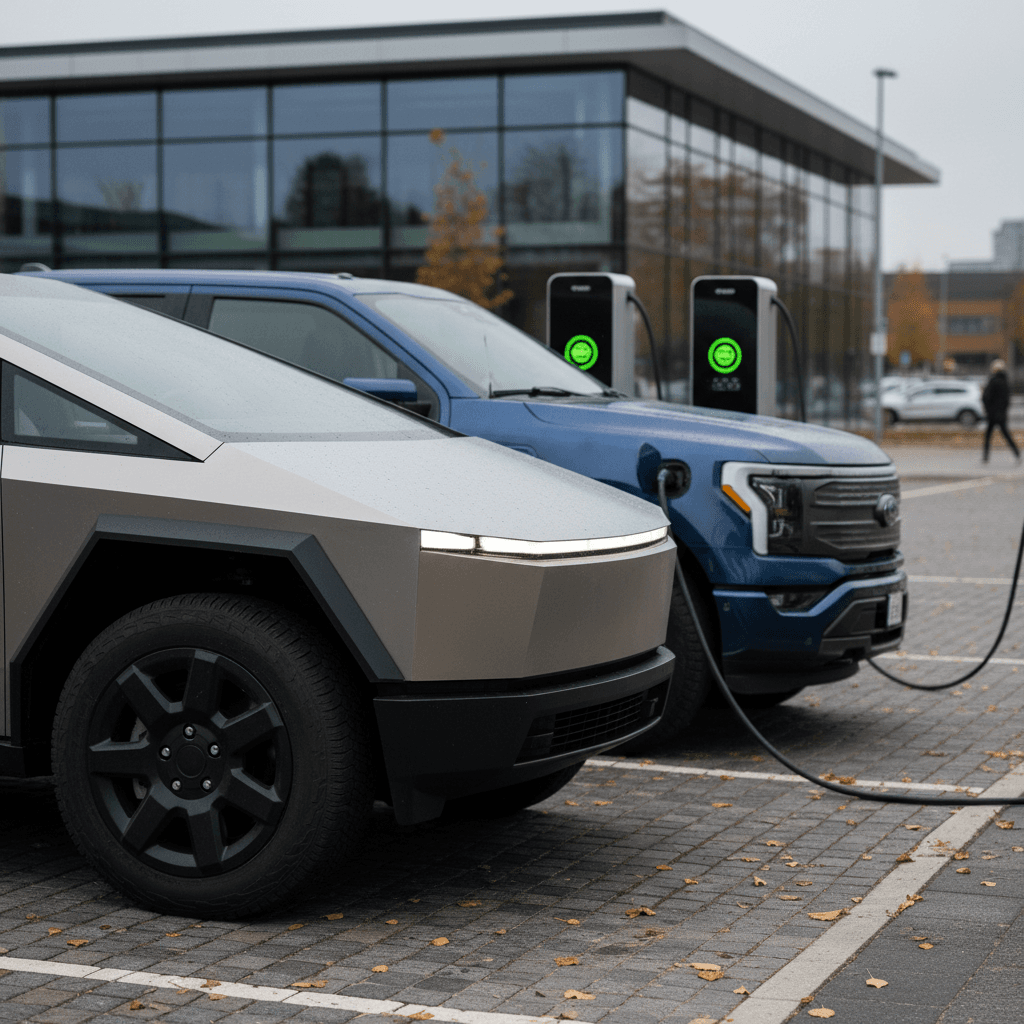
From the driver’s seat, the big difference is not what the window sticker says; it’s how confident you feel leaving the metro area. Cybertruck has the huge advantage of seamless access to Tesla’s Supercharger network, which is still the gold standard for fast charging reliability. F‑150 Lightning owners are increasingly tapping into that network too as Ford and other automakers adopt Tesla’s NACS plug, but in 2026 it still involves adapters and a patchwork of non‑Tesla networks when you leave major corridors.
Urban vs rural reality
Bed utility, interior and day-to-day livability
The beds: spaceship tub vs known quantity
Cybertruck bed
- Around 6' x 4' with the tailgate closed.
- Standard power tonneau (on many trims) and lockable vault feel concept‑car cool.
- High, straight sides and sloped roof make it less friendly for awkward, tall cargo.
- Great tie‑downs and integrated power make it camping‑trip catnip.
F‑150 bed
- Multiple lengths, more conventional walls and wheel wells.
- Pro Power Onboard (hybrid and Lightning) turns the truck into a rolling generator.
- Enormous aftermarket: caps, ladder racks, bed drawers, you name it.
- Easier to load ATVs, contractors’ racks, and random Home Depot geometry.
Cabins and comfort
Sit in a Cybertruck and it feels like a brutalist lounge: big glass, sharp angles, giant center screen, almost no physical controls. It’s dramatic and surprisingly spacious, but also polarizing; some people love the futurism, others miss normal knobs. The F‑150 gives you a truck interior you already understand, with physical buttons for things you use with gloves on, solid materials, and in higher trims, genuine luxury. Lightning and hybrid models add big touchscreens and software without throwing out the manual controls.
Family duty and commuting
Tech, charging and ownership experience
Software and driver assistance
Tesla still leads on the feeling of software cohesiveness. The Cybertruck inherits the clean UI, over‑the‑air updates and robust app experience: preconditioning, remote climate, easy charging payments, rich trip planning. Ford has dramatically improved its SYNC software and BlueCruise hands‑free driving, but it’s more traditional: more menus, fewer over‑the‑air surprises, more like a modern truck than a rolling smartphone.
Charging experience
- Cybertruck: You’re fully in the Tesla ecosystem, plug in at Superchargers, the truck and charger talk to each other, your payment is handled automatically. Home charging is straightforward Level 2 at 240V.
- F‑150 Lightning: Today you’re juggling Ford’s app and third‑party fast‑charging networks, but access to Tesla Superchargers via NACS is rolling out. It’s good and getting better, just not quite as seamless yet.
- Gas / hybrid F‑150: The tech story is about Pro Power Onboard (huge advantage if you need 120/240V power in the field), but “charging” is gas stations and maybe a Level 2 charger if you go hybrid and plug‑in options expand in future.
Home charging is the real game changer
Cost of ownership: new vs used
Sticker prices move around with incentives, trims and dealer markups, but the broad strokes are clear: Cybertruck and F‑150 Lightning live in the expensive half of the truck market, especially new. Gas and hybrid F‑150s span a wider price range and are abundant on the used market. The wildcard is operating cost: electricity is generally cheaper per mile than gas, and EVs have fewer routine maintenance items.
Key cost questions to ask yourself
1. How many miles do you drive per year?
High‑milers (15,000+ a year) stand to save more in fuel with Cybertruck or Lightning, especially if you can charge at home on low electric rates.
2. Do you keep vehicles a long time?
If you buy and hold for 8–10+ years, the higher upfront cost of an EV truck may pencil out in fuel and maintenance savings. If you swap every 3 years, depreciation hits harder.
3. What’s your electricity vs gas price?
In some regions, expensive electricity and cheap gas narrow the EV advantage. In others, especially where you can time‑shift charging to off‑peak hours, EV fueling is a steal.
4. Are you open to buying used?
A used F‑150 Lightning or future used Cybertruck can compress the price gap dramatically versus a new gas truck. At Recharged, every used EV we list includes a <strong>Recharged Score</strong> with verified battery health so you’re not guessing about degradation.
Insurance and repairs
Which should you buy? Recommendations by use case
Cybertruck vs F‑150: best pick by lifestyle
No truck is perfect. Here’s where each shines, and where it doesn’t.
Adventure / lifestyle, light towing
Best: Tesla Cybertruck or F‑150 Lightning.
- You value drama, design and acceleration as much as utility.
- Towing is mostly boats, small campers, utility trailers within a few hundred miles.
- You can install home charging and live near good fast‑charging networks.
If you want the wildest experience and can live with the quirks, Cybertruck. If you want something that still looks like a truck, Lightning.
Work truck, heavy towing, rural use
Best: Gas or hybrid F‑150.
- Frequent towing near max capacity, often over long distances.
- Job sites in rural areas where fast chargers are a rumor.
- You care more about uptime than software updates.
A well‑spec’d F‑150 with a max tow package is still the default answer here.
Family hauler that sometimes works
Best: F‑150 hybrid or Lightning.
- School runs, weekend trips, a couple of big tows a year.
- Need comfortable rear seats and normal controls.
- Appreciate the hybrid’s or Lightning’s onboard power for tailgates and blackouts.
The Cybertruck’s styling and visibility are not everyone’s idea of kid‑taxi serenity.
Tech toy / early adopter
Best: Tesla Cybertruck (especially higher trims).
- You love being the first to own weird, delightful hardware.
- Your tolerance for software updates, experimental features and quizzical stares is high.
- This is not your only vehicle; you can pivot to something conventional when needed.
If you tick these boxes, no F‑150 variant will scratch the same itch.
Be honest about your 5% use case
How Recharged can help you shop smarter
If you’re leaning toward an electric truck, Cybertruck now or a used F‑150 Lightning, the used market is where the numbers often start to make sense. That’s where Recharged comes in. We’re a retailer and marketplace built around used EVs, with tools specifically designed to answer the questions that keep shoppers up at night.
- Every vehicle we list comes with a Recharged Score Report so you can see verified battery health, projected range, and fair‑market pricing at a glance.
- You can trade in your current vehicle, get an instant offer or use consignment, and we’ll handle the logistics.
- Our team of EV specialists can help you compare a used Lightning against, say, keeping your gas F‑150 and adding a smaller EV commuter, so you’re making a whole‑garage decision, not a vacuum decision.
- Nationwide delivery and a fully digital experience mean you can shop for the right truck from your couch, not just whatever happens to be on the local lot.
- If you’re near Richmond, VA, you can visit our Experience Center, drive different EVs, and talk through options with a human who speaks both truck and kilowatts.
Whether you end up in a Cybertruck, an F‑150 Lightning, or a conventional F‑150 that keeps your towing simple for a few more years, the key is understanding how the truck fits the way you actually live. Our job at Recharged is to make that decision transparent instead of tribal.
FAQ: Tesla Cybertruck vs Ford F‑150
Common questions about Cybertruck vs F‑150
Bottom line: Cybertruck or F‑150?
If you want a truck that is also a rolling conversation starter, that can out‑drag sports cars and turn every grocery run into a mini auto show, the Tesla Cybertruck is in a class of one. It’s brilliant, flawed, and utterly unserious about blending in. If you want a truck that quietly does truck things, haul, tow, commute, carry a family, plug in tools, and slides easily into the existing infrastructure of dealers, parts, and job sites, the Ford F‑150 family, especially the hybrid and Lightning, remains the default choice for very good reasons.
Your smartest move is to start with brutal honesty: how often do you really tow, where do you actually drive, and how long will you keep this truck? Then match the tool to the job, not the marketing. If that leads you to a used electric truck, Recharged can help you compare options with hard data on battery health and ownership costs, so your next truck isn’t just the loudest thing on social media, it’s the right thing in your driveway.