If you’re shopping for a used Hyundai IONIQ 5 or already own one, you’ve probably heard about recalls, especially around sudden loss of power. This Hyundai IONIQ 5 recalls list pulls the major campaigns into one place, explains what each one means in plain English, and shows you how to quickly check any IONIQ 5 by VIN before you buy or drive.
Quick takeaway
Overview: How many Hyundai IONIQ 5 recalls are there?
Because the Hyundai IONIQ 5 is still a relatively new model (U.S. sales started with the 2022 model year), its recall history is still evolving. As of early 2026, U.S. owners can expect to see at least one of the following on their vehicle’s record:
- A major safety recall related to the Integrated Charging Control Unit (ICCU) and 12‑volt system that can lead to reduced or complete loss of power while driving (covering many 2022–2024 IONIQ 5s).
- A newer recall campaign affecting certain 2025–2026 vehicles where the digital instrument cluster in the steering column can go blank due to a software error, hiding speed and warning lights.
- Several service campaigns and technical service bulletins (TSBs) that are not always labeled as “safety recalls” but still matter for reliability and charging behavior.
Model-year note
Major Hyundai IONIQ 5 safety recalls, by issue
Let’s start with the big stuff, the recalls that directly affect drive power and your ability to see critical safety information while you’re behind the wheel.
ICCU & loss-of-power recall (NHTSA 24V-204 and related actions)
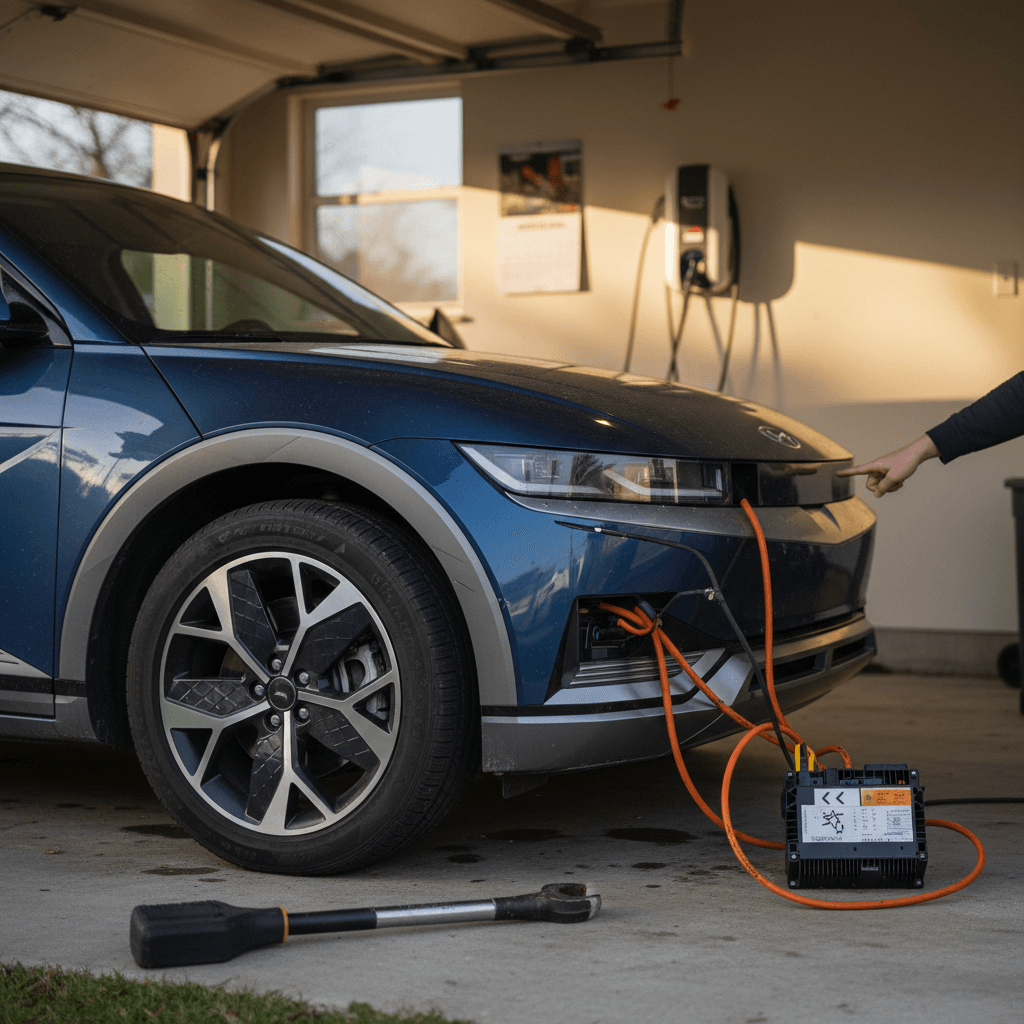
The most widely discussed Hyundai IONIQ 5 recall centers on the Integrated Charging Control Unit (ICCU). This component manages charging and converts high-voltage battery power down to charge the small 12‑volt battery that runs the car’s computers, safety systems, and accessories. When it doesn’t behave, you can end up with warning lights, limp-home mode, or a complete loss of motive power.
Key facts about the IONIQ 5 ICCU recall
In 2023, U.S. safety regulators opened an investigation into 2022 IONIQ 5 models after owners reported sudden loss of power and “turtle mode” on the highway. That work ultimately led Hyundai to file a formal safety recall (identified by NHTSA as 24V-204 for Hyundai) covering 2022–2024 IONIQ 5 along with some IONIQ 6 and Genesis EVs.
What the ICCU recall looks like from the driver’s seat
Common symptoms that led to the safety campaign
Sudden power limit
The car may suddenly limit power and speed, often dropping to 20–30 mph and refusing to accelerate, Hyundai’s version of limp-home mode.
Multiple warnings
Drivers report seeing messages like “Check EV system” or “Stop vehicle and check power supply”, sometimes accompanied by warning chimes.
Eventual shutdown
If the 12‑volt battery can’t be charged, the IONIQ 5 can eventually lose all motive power, increasing the risk of a crash if it happens in traffic.
The recall remedy isn’t just a quick software tweak. Dealers are instructed to inspect the ICCU and its high‑voltage fuse, update software to reduce electrical stress and heat, and replace the ICCU and fuse if necessary. If your car already had a previous ICCU-related service campaign, Hyundai still wants it reinspected under this newer, formal recall.
What you should do
Instrument cluster display software recall (2025–2026 vehicles)
A separate, newer recall affects the digital instrument cluster, the screen inside the steering column that shows your speed, warning lights, and key EV status information. On certain 2025–2026 Hyundai models, including the IONIQ 5, a software bug can cause this display to go blank or fail to show critical data.
What’s the risk?
Driving without a working speedometer or warning lamps clearly isn’t ideal. If the cluster goes dark, you may not see ABS, airbag, high-voltage system, or low tire-pressure warnings in time to react.
That’s why this campaign is treated as a safety issue: it can hide other problems instead of causing its own.
How it’s fixed
Hyundai’s remedy is a software update for the display module. Depending on your specific vehicle, that may be done:
- Over the air (OTA) through Hyundai’s connected services, or
- At a dealership service visit, where technicians reflash the cluster software.
Again, there is no cost to owners.

Good news for 2025–2026 buyers
Other campaigns, service actions, and TSBs affecting the IONIQ 5
In addition to formal recalls, Hyundai has issued several service campaigns and technical service bulletins (TSBs) for the IONIQ 5. These don’t always show up in the same way as safety recalls, but they’re still worth asking about:
- Earlier ICCU/12‑volt charging software campaigns that predated the full 24V‑204 recall, aimed at reducing stress on the unit.
- Charging behavior and thermal management updates that adjust how cooling pumps and fans run while fast charging.
- Assorted infotainment and connectivity software updates, especially for early 2022 builds.
Ask for a full campaign history
Hyundai IONIQ 5 recalls list by model year
Here’s a high-level look at how the major IONIQ 5 recall activity breaks down by model year in the U.S. This isn’t an exhaustive list of every technical bulletin, but it hits the campaigns most shoppers ask about.
Hyundai IONIQ 5 recalls by model year (U.S.)
Always verify details for a specific VIN, but this table gives you a quick sense of which model years see which major recall themes.
| Model year | Key recall / campaign themes | Typical remedies | Notes |
|---|---|---|---|
| 2022 | ICCU / 12‑volt charging system recall for possible loss of motive power; earlier ICCU software campaigns; various software updates | ICCU inspection, software update, and possible ICCU + fuse replacement; other software flashes | This is the most heavily investigated year because it was first to market. |
| 2023 | ICCU recall expansion; ICCU software campaigns; charging and thermal management updates | Same ICCU inspection/replacement process; updated cooling and charging logic | Some mid‑cycle software improvements were rolled into 2023 builds. |
| 2024 | ICCU recall coverage continues; incremental software and charging updates | Software plus hardware replacement as needed | Later 2024 builds may already have improved parts from the factory. |
| 2025 | Instrument-cluster display software recall; continuing software refinements | Cluster software reflashed over the air or at the dealer | Watch for documentation that both cluster and power‑train software are current. |
| 2026 (early) | Instrument-cluster software recall applies to certain early builds; ongoing software updates | Display software update; other updates as issued | Recall picture is still evolving for the newest model year. |
Summary of the most significant safety-related recalls and campaigns affecting the Hyundai IONIQ 5 by model year.
Don’t rely on model year alone
How to check if a specific Hyundai IONIQ 5 has open recalls
Fortunately, checking recall status on a Hyundai IONIQ 5 is straightforward, and you don’t need to guess or rely only on what a seller tells you.
Step-by-step: run a Hyundai IONIQ 5 recall check
1. Find the full 17‑character VIN
You’ll see it on the lower driver’s side windshield, the driver’s door jamb sticker, your registration, or insurance card. For a used IONIQ 5 listing, ask the seller to share it if it isn’t already visible in photos.
2. Use the official NHTSA recall lookup
Go to the National Highway Traffic Safety Administration’s online recall tool, enter the VIN, and confirm that there are <strong>no unrepaired recalls</strong>. This pulls from the same database dealers use.
3. Cross-check with Hyundai’s recall site or app
Hyundai also offers a brand-specific recall lookup. Enter the VIN there as well, this can reveal brand campaigns or service actions that might not show up as formal NHTSA recalls yet.
4. Call or visit a Hyundai dealer
Ask the service department to print a <strong>campaign and recall history</strong> by VIN. This shows which recalls are open and which have already been completed, plus software campaigns.
5. Save documentation
If you’re buying or selling, keep copies of recall completion receipts and campaign summaries. They help prove that safety work was done on time and correctly.
How Recharged does it
Is it safe to drive an IONIQ 5 with an open recall?
This is where you have to balance convenience with risk. Not all recalls are equally urgent, but with the IONIQ 5, at least one campaign, the ICCU/12‑volt issue, can directly affect whether the car keeps moving after a warning light appears.
Higher-priority issues
- ICCU / loss-of-power recall: Because this can lead to rapid power reduction or complete shutdown, you should treat it as a high-priority safety item. Schedule the repair as soon as possible and avoid long highway trips until it’s done.
- Anything that mentions fire, stalling, or steering/braking: Even if not common on the IONIQ 5, these are always high on the priority list.
Lower-priority issues
- Display-only bugs: Problems with non-safety screens or minor graphics glitches are usually lower priority, as long as critical info (speed, warning lights) still works.
- Cosmetic or trim items: Some campaigns address squeaks, rattles, seals, or small durability problems that don’t change how the EV drives.
When in doubt, ask the service adviser
Buying a used Hyundai IONIQ 5: recall and safety checklist
A recall doesn’t automatically make a car a bad buy, especially when the manufacturer has a robust fix in place. But you do want to know the whole story before you commit to a used IONIQ 5, particularly a 2022 or 2023 model.
Used IONIQ 5 recall & safety questions to ask
Has every recall on this VIN been completed?
Ask for documentation that the ICCU recall, cluster software recall, and any other safety campaigns have been performed. A clean NHTSA VIN check plus dealer paperwork is ideal.
Were ICCU repairs hardware or just software?
If the previous owner had ICCU work done, find out whether the unit was <strong>replaced</strong> or only reprogrammed. A replacement under the later recall can be more reassuring than an early software-only fix.
Any history of “turtle mode” or shutdowns?
Ask the seller whether they’ve ever seen power-loss warnings, limp-home behavior, or sudden shutdown, even if the car was later “fixed.” Request related service records.
Do warning lights behave normally at startup?
During a test drive, make sure all cluster lights illuminate briefly at startup and then go out. A blank or glitchy cluster, especially on a 2025–2026 car, deserves follow-up questions.
Is there a recent health check or battery report?
For EVs, a <strong>battery health report</strong> adds context. At Recharged, this shows up as part of the Recharged Score, which includes high-voltage battery diagnostics and charging system checks.
Paper trail matters
Do Hyundai IONIQ 5 recalls hurt resale value or battery health?
Automakers hate recalls; shoppers don’t love hearing about them either. But the reality is that nearly every modern EV has seen at least one significant safety recall, from premium brands to mainstream crossovers.
How recalls usually affect a used IONIQ 5
Think of them as part of the car’s story, not the whole story.
Short-term perception hit
When a big recall first hits the news, like the ICCU loss-of-power campaign, buyers may hesitate. Prices can soften temporarily if supply is high and headlines are loud.
Long-term neutral if fixed
Once the remedy is widely in place, a documented repair generally stops being a major value drag. Shoppers care more about whether the work was done than whether a recall ever existed.
Battery health is separate
The ICCU recall targets charging control hardware and software, not the main high-voltage battery chemistry. A separate battery health report is still the best way to judge long‑term range and performance.
For a used‑car shopper, the key is to separate emotional reaction (“this car was recalled!”) from factual evaluation (“this car had a known issue that’s now fixed with updated parts and software”). That’s exactly what tools like the Recharged Score are built to do, pull safety campaigns, battery diagnostics, and pricing into one transparent picture.
How Recharged handles recalls on used IONIQ 5s
Because Recharged focuses on used EVs, including the Hyundai IONIQ 5, recalls are part of the daily routine. The goal is simple: make sure you don’t have to decode a stack of service bulletins on your own.
- VIN-level checks: For every IONIQ 5 we list, we run recall and campaign checks using official data sources, so we know which actions are open or already completed.
- Dealer coordination: When possible, we coordinate with Hyundai dealers to complete open safety recalls before the vehicle is delivered to a new owner.
- Recharged Score Report: Each vehicle comes with a digital report covering battery health, charging performance, and safety status, so you can see how recall history fits into the bigger picture.
- EV-specialist support: If you’re unsure what a particular recall code or line item means, our EV specialists can walk you through it in plain language.
Thinking about a used IONIQ 5?
Hyundai IONIQ 5 recall FAQ
Frequently asked questions about Hyundai IONIQ 5 recalls
Recalls are part of life with any modern vehicle, and EVs like the Hyundai IONIQ 5 are no exception. The upside is that high-profile issues, especially those involving power loss or critical displays, tend to get serious engineering attention and robust fixes. If you use the tools available, insist on documentation, and lean on resources like the Recharged Score, you can shop or drive an IONIQ 5 with a clear, confident view of its safety story.