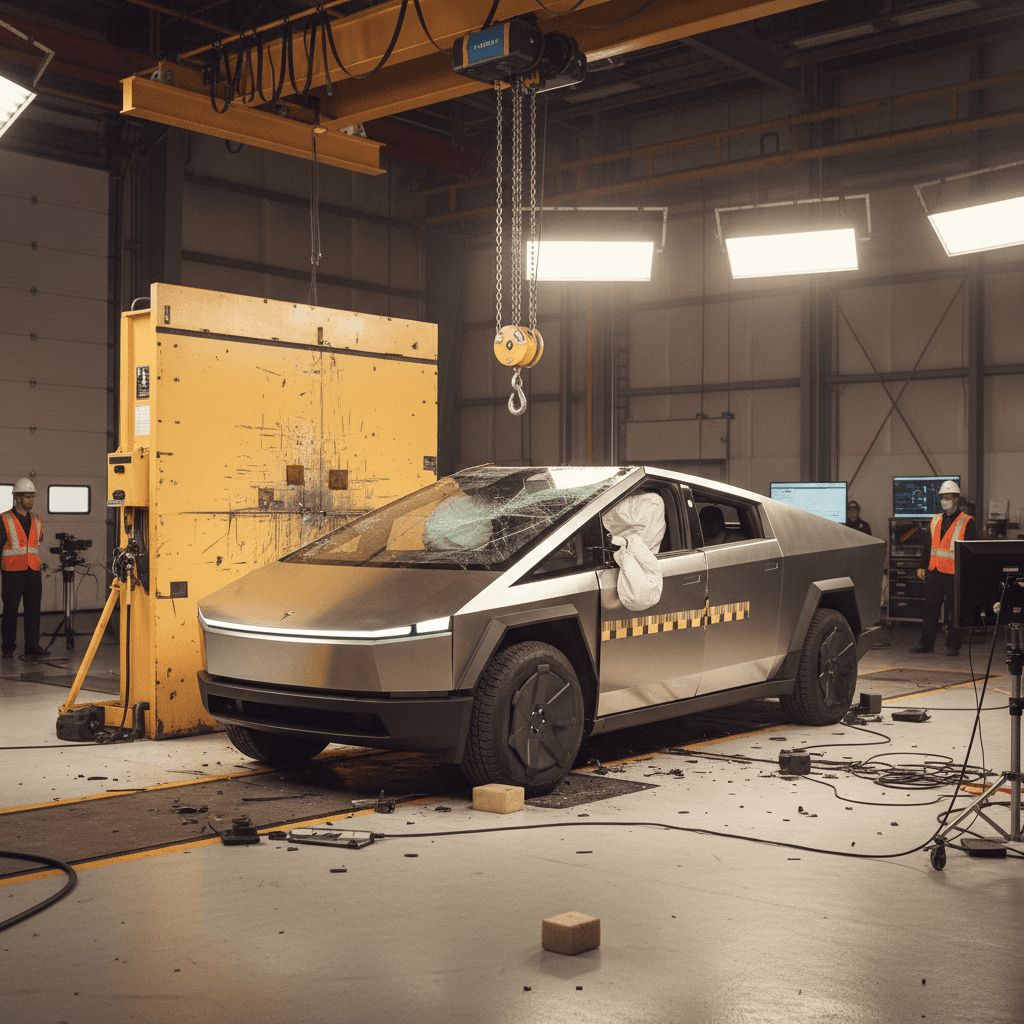
Searches for “Tesla Cybertruck safety rating crash test” have exploded now that the truck has finally gone through independent crash testing. Between the stainless‑steel “exoskeleton,” viral crash photos, and a wall of hot takes on social media, it’s hard to know what’s signal and what’s noise. This guide walks through the actual IIHS and NHTSA results, how the Cybertruck compares to other electric pickups, and what it all means if you’re thinking about buying one, especially on the used market.
Key takeaway
Tesla Cybertruck safety at a glance
Cybertruck crash-test snapshot (2025)
When you strip away the memes, the Tesla Cybertruck is a large, very heavy electric pickup that now carries top-tier crash-test scores for occupants. The nuance is in the details: which build dates are covered by which ratings, what the stainless‑steel body really does, and how its sheer mass and angular design affect everyone else on the road.
Official Tesla Cybertruck safety ratings for 2025
Two U.S. organizations define the safety story for most shoppers:
- IIHS (Insurance Institute for Highway Safety) – independent crash tests and safety-technology evaluations. Their awards, Top Safety Pick and Top Safety Pick+, are widely used by insurers and fleet buyers.
- NHTSA (National Highway Traffic Safety Administration) – government agency that runs frontal, side, and rollover tests and publishes the 5‑star ratings you see on window stickers.
Cybertruck safety ratings by organization
What the official test programs actually say
IIHS: Top Safety Pick+ (2025)
The 2025 Tesla Cybertruck crew cab earns Top Safety Pick+, IIHS’s highest award, for trucks built after April 2025.
- Crashworthiness (front & side): Good across the board.
- Updated moderate overlap and side tests: Good for driver and solid rear-passenger protection.
- Headlights & pedestrian AEB: rated Good.
- Seat-belt reminders: Marginal; LATCH child-seat system: Acceptable.
NHTSA: 5-star overall
NHTSA gives the Cybertruck a 5‑star overall safety rating, its best score, putting it in the top tier of pickups for occupant protection.
- Frontal crash: 5 stars.
- Side crash: 5 stars.
- Rollover resistance: competitive with other heavy EV pickups.
That said, NHTSA’s star system doesn’t directly measure how much damage a 6,600‑pound wedge does to other vehicles or pedestrians.
Build-date matters
How the Cybertruck actually performed in crash tests
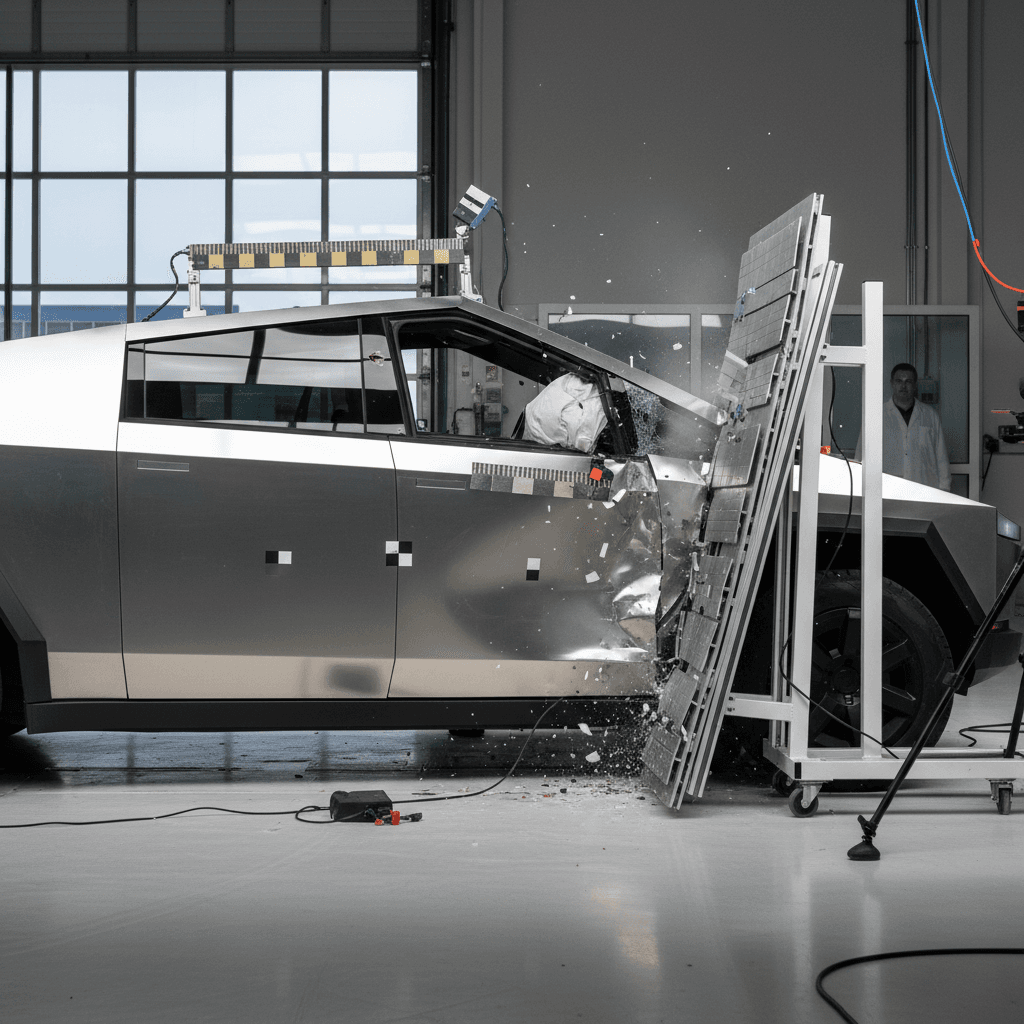
To understand what the ratings mean in real life, it helps to look at the specific IIHS crash tests for the Cybertruck, all of which were performed on a 2025 crew-cab 4WD model.
IIHS crash-test results for 2025 Tesla Cybertruck
Ratings here refer to 2025–26 Cybertruck crew cabs built after April 2025.
| Test / area | Rating | Notes |
|---|---|---|
| Small overlap front (driver) | Good | Structure, safety cage, and all injury measures rated Good. |
| Small overlap front (passenger) | Good | Matching Good ratings across head/neck, chest, hips, and legs. |
| Moderate overlap front (updated) | Good | Good for driver; rear passenger chest load Acceptable but still strong overall protection. |
| Side impact (updated) | Good | Strong structure; driver torso load Acceptable, all other measures Good. |
| Head restraints & seats | Good | Good whiplash protection in rear impacts. |
| Headlights | Good | Standard LED lightbar and beams meet IIHS’s latest criteria. |
| Front crash prevention – pedestrian (day & night) | Good | Avoided collisions in most test scenarios at 12–37 mph. |
| Seat-belt reminders | Marginal | Audible alerts are shorter and less persistent than IIHS prefers. |
| LATCH child-seat anchors | Acceptable | Usable but not as intuitive or accessible as the best designs. |
IIHS uses a 4‑step scale: Good, Acceptable, Marginal, Poor.
In plain English: once you’re in a post–April 2025 Cybertruck, you’re in one of the best‑performing trucks IIHS has ever tested for crash protection, especially up front. The weaker spots are secondary: seat-belt reminder behavior and the fine details of child-seat anchor usability.
How to check your truck’s build date
Does the stainless-steel exoskeleton make the Cybertruck safer?
Tesla has marketed the Cybertruck’s cold‑rolled stainless‑steel skin and triangular exoskeleton as a revolution in durability and safety. The reality is more complicated, and it’s worth separating occupant protection from everybody‑else protection.
Pros for people inside the truck
- Very stiff structure: The Cybertruck’s crash results show strong preservation of the safety cage in small and moderate overlap front tests. Limited intrusion means less space for your legs and feet to be crushed.
- High mass: At more than 6,600 pounds, the Cybertruck has physics on its side in two‑vehicle crashes. All else being equal, the heavier vehicle tends to protect its own occupants better.
- Battery inboard and low: Like other modern EVs, the battery pack is mounted low in the frame, improving rollover resistance and keeping heavy components away from common impact zones.
Tradeoffs for other road users
- Less energy absorption by the outer shell: Stainless-steel body panels are harder for another vehicle’s crumple zone to “push into,” which can transfer more energy into whatever the Cybertruck hits.
- Blunt, high front profile: Compared with a conventional pickup nose, the Cybertruck’s tall, unyielding front can be more punishing to pedestrians, cyclists, or people in lower cars.
- Repair and compatibility concerns: Deformed stainless panels and unique structure can be costly to repair, and some body shops are still climbing the learning curve.
A vehicle can simultaneously be very good at protecting its own occupants and quite bad for the people it hits. The Cybertruck lands squarely in that tension.
Safety isn’t just about stars
Pedestrian and other road‑user safety concerns
On paper, the Cybertruck ticks many of the active‑safety boxes that help drivers avoid crashes in the first place: automatic emergency braking with pedestrian detection, lane-keeping support, blind‑spot monitoring, and good headlights. But for vulnerable road users, its form factor and mass still raise legitimate questions.
Cybertruck and people outside the cab
Where the test data ends and open questions begin
Pedestrian AEB
In IIHS testing, the Cybertruck’s pedestrian automatic emergency braking system performed well, avoiding or mitigating collisions in both day and night scenarios across child and adult dummies.
That’s the good news: the truck is reasonably good at dodging trouble at typical urban speeds when the system is active and the driver is attentive.
Blunt, tall front end
Like other large pickups, the Cybertruck presents a tall, flat front to the world. For pedestrians or cyclists, being struck higher on the torso and head is generally worse than being hit lower on the legs.
Because of its unusual geometry and steel shell, there’s concern that when crashes do occur, injury severity could be higher than with more deformable designs.
System vs. structure
Modern active‑safety systems reduce crash frequency, but they’re not perfect. When they fail, or are switched off, the underlying vehicle physics takes over.
The Cybertruck’s combination of high mass, stiff shell, and aggressive shape is where the safety equation becomes more lopsided for everyone outside the cabin.
Why you see conflicting narratives online
Cybertruck vs other electric pickup truck safety ratings
If you’re cross‑shopping electric pickups, crash safety is one of the clearest ways to separate the sheet‑metal theater from the substance. As of late 2025, most major EV trucks have been through either IIHS, NHTSA, or both test programs.
How the Cybertruck stacks up to other electric pickups
High-level comparison of safety ratings for popular battery‑electric pickups as of the 2025 model year.
| Model (2025) | Primary test body | Top award / overall rating | Notable safety notes |
|---|---|---|---|
| Tesla Cybertruck (crew cab) | IIHS & NHTSA | IIHS Top Safety Pick+; NHTSA 5‑star overall | Outstanding occupant protection; Marginal seat-belt reminders; concerns about mass and pedestrian impact profile. |
| Ford F‑150 Lightning | IIHS & NHTSA | Strong ratings, often Top Safety Pick or Pick+ depending on configuration | Conventional aluminum body with well‑understood crumple zones; robust Ford Co‑Pilot360 suite. |
| Rivian R1T | IIHS | Top Safety Pick (not Plus) after updates | Excellent structure; mixed results in some updated tests, especially around rear occupants in certain years. |
| GMC Hummer EV pickup | NHTSA (partial) | High star ratings where tested | Extremely heavy; impressive occupant scores but similar external‑risk concerns as Cybertruck. |
| Chevrolet Silverado EV (where tested) | IIHS (ongoing) | Varies by cab and trim | Traditional truck form factor with modern crash engineering; more data emerging each year. |
Always verify the specific model year and build date you’re shopping, ratings can change after structural updates.
The headline is that the Cybertruck is now at the top of the class for lab‑measured occupant safety, even compared with well‑engineered rivals like the F‑150 Lightning and Rivian R1T. Where it differs most is in design philosophy: a radical exterior that prioritizes durability and visual drama over the softer, more forgiving shapes of its competitors.
Real‑world issues: recalls, quality problems, and risk
Crash‑test ratings tell you how a vehicle behaves in controlled, perfectly executed collisions. The everyday ownership reality of the Cybertruck has been noisier: multiple recalls, high‑profile quality problems, and fast‑moving over‑the‑air software changes.
- Hardware recalls: Early Cybertrucks have faced recalls for issues like accelerator pedals, windshield wipers, exterior trim, and other hardware that can directly or indirectly affect safety if they fail at speed.
- Build‑quality complaints: Owners have reported cracked windshields, panel alignment problems, and corrosion‑like spotting on the stainless finish. While not all of these are crash‑critical, they speak to manufacturing variance in the earliest builds.
- Software & driver-assistance: Tesla’s driver‑assistance systems (Autopilot, Full Self‑Driving) continue to evolve quickly and remain under regulatory scrutiny. Regardless of marketing, you should treat them as assist features, not autonomy, and keep your hands and attention in the loop.
Crash ratings assume a properly maintained truck
What this means if you’re considering a used Cybertruck
On the used market, the Cybertruck is already showing steep depreciation relative to its launch hype. That’s painful for early adopters, but it opens the door for buyers who want cutting‑edge EV truck performance and safety ratings at a substantial discount, if they shop carefully.
By mid‑2025, auction data and appraisal tools were showing used Cybertruck prices falling by tens of thousands of dollars from their 2024 peaks, with some trucks trading below the price of a new build with similar hardware. For you, that means two things:
- You can often find a lightly used Cybertruck for much less than its original transaction price, especially early Foundation Series trucks and high‑spec Cyberbeast trims.
- You absolutely cannot assume uniform quality or identical safety characteristics across the fleet; build date, recall status, and battery health all matter.
Where Recharged fits in
Ready to find your next EV?
Browse VehiclesChecklist: how to safely shop for a used Cybertruck
Safety-first shopping for a used Cybertruck
1. Confirm build date and configuration
Verify the <strong>build month and year</strong> on the door jamb. For IIHS Top Safety Pick+ assumptions, prioritize trucks built <strong>after April 2025</strong>. Confirm whether you’re looking at an AWD or Cyberbeast, and whether it’s a limited Foundation Series truck.
2. Run a recall and software-update check
Use the VIN on Tesla’s recall lookup and confirm all <strong>hardware recalls</strong> have been performed. Ask the seller to show the in‑car software screen so you can see that it’s on a current, supported firmware version.
3. Inspect glass, panels, and suspension
Look closely for <strong>windshield cracks, misaligned panels, odd gaps, or corrosion spots</strong> on the stainless body. On a test drive, listen for suspension clunks or steering vibration that might indicate curb hits or previous collisions.
4. Ask for battery-health data
Range is safety when you’re planning towing or road‑trip legs. A <strong>Recharged Score battery report</strong> or equivalent scan can reveal degradation, imbalance, or previous fast‑charging abuse that might affect performance and reliability.
5. Verify tires and brakes are up to spec
Because the Cybertruck is so heavy, <strong>tire load rating and brake condition</strong> are critical. Uneven wear, budget tires, or warped rotors are all reasons to pause and renegotiate, or walk away.
6. Understand how you’ll use it
If most of your driving is in dense urban areas with lots of pedestrians or cyclists, be honest about whether a huge, stiff‑front pickup is the right choice. Sometimes a safer move for everyone is a smaller EV with more forgiving crash geometry.
FAQ: Tesla Cybertruck safety rating & crash tests
Frequently asked questions
Bottom line: is the Tesla Cybertruck safe?
If all you care about is what happens inside the cabin in a standardized crash, the 2025+ Tesla Cybertruck is one of the safest pickups on sale. IIHS and NHTSA data both point to a truck that preserves survival space, controls crash forces well, and layers on modern active‑safety tech to help you avoid the crash in the first place.
But safety is more than a star rating. The Cybertruck’s stainless‑steel exoskeleton and sheer mass tilt the equation toward its own occupants and away from everyone outside the cab. Combine that with early‑run quality issues, multiple recalls, and fast‑moving software changes, and you get a vehicle that demands informed, eyes‑open ownership, especially on the used market.
If you decide the Cybertruck fits your needs and risk tolerance, treat build date verification, recall completion, and a deep battery/systems inspection as table stakes. And if you’d rather have expert backup, Recharged can help you source, evaluate, finance, and trade in EVs with transparent battery‑health data and fair‑market pricing, so you’re not relying on hype to make a six‑figure safety decision.