If you’re looking at a Subaru Solterra and wondering how much it can tow, and how far it can go while doing it, you’re not alone. Subaru markets the Solterra as an adventure-ready electric SUV, but the fine print on towing capacity and range can be confusing, especially with different ratings overseas and big updates coming for the 2026 model year.
Key takeaway
Subaru Solterra towing and range: quick overview
Subaru Solterra towing & range fast facts
For U.S. shoppers, the headline is this: Subaru does not recommend towing with the current U.S.-spec Solterra, and you won’t find an official tow rating in the owner’s manual or window sticker. Third‑party spec sites list overseas ratings around 1,650 pounds (750 kg), which gives us a good idea of what the platform can physically handle, but it’s not a green light to ignore Subaru’s guidance in the States.
Does the Subaru Solterra have an official towing capacity?
Here’s where things get tricky. In the U.S., most mainstream spec sheets and buyer’s guides either list the Solterra’s maximum towing capacity as “Not recommended” or leave it blank altogether. That lines up with what you’ll see if you dig into Subaru’s U.S. marketing materials for the 2023–2025 Solterra: adventure-focused imagery, yes, tow ratings, no.
United States
- No factory tow package or hitch from Subaru.
- Most guides list towing as “not recommended”.
- No official SAE tow rating published for 2023–2025 models.
Other markets (example: Australia & Europe)
- Factory tow rating around 750 kg (≈1,650 lb) braked and unbraked.
- Aftermarket hitches and small‑trailer towing are more common.
- Same basic dual‑motor AWD platform as the U.S. car.
Numbers vary slightly by market and trim, but the pattern is consistent: overseas Solterras can tow modestly, while Subaru of America plays it safe.
Warranty and liability warning
Subaru Solterra towing capacity by market and model year
Even without a U.S. tow rating, it’s useful to understand what the Solterra platform is doing globally. That helps you set realistic expectations if you’re planning to haul bikes, a small utility trailer, or a very light camper.
Subaru Solterra towing capacity snapshot
Approximate tow ratings by region and generation. Always verify against your specific VIN and local regulations.
| Model years / region | Drivetrain | Official tow rating | Comments |
|---|---|---|---|
| 2023–2025 Solterra (U.S.) | Dual‑motor AWD | No rating / not recommended | No factory tow package; most guides advise against towing. |
| 2023–2025 Solterra (Europe/Australia, typical) | Dual‑motor AWD | ≈750 kg (≈1,650 lb) braked & unbraked | Suitable for small box trailer or very light camper. |
| 2026 Solterra (estimated, early info) | Dual‑motor AWD | TBD (market‑specific) | Larger battery and more power; tow ratings not yet widely published. |
Subaru of America does not currently publish a tow rating for the 2023–2025 Solterra; overseas ratings are shown for context, not as advice to exceed U.S. guidance.
Why the same EV can have different tow ratings
Subaru Solterra range by model year
Whether you tow or not, understanding the Subaru Solterra’s range is step one. Subaru and independent testers have now published several sets of numbers, and the 2026 update is a big step forward.
Subaru Solterra EPA-estimated range by generation (U.S.)
Exact numbers vary slightly by trim and wheel size, but these ballparks are what most owners see on the window sticker.
2023 Solterra
- Premium (18-inch wheels): about 228 miles EPA.
- Limited/Touring (20-inch): about 222 miles EPA.
- 72.8 kWh battery, dual‑motor AWD.
2024–2025 Solterra
- Incremental software and hardware tweaks; range remains in the low‑220s to high‑220s.
- Real‑world owners typically report 180–210 miles at highway speeds in mild weather.
2026 Solterra (updated)
- Larger ~74–75 kWh battery and efficiency upgrades.
- Subaru estimates up to ≈285–288 miles of range.
- Faster DC fast charging (10–80% in roughly half an hour).
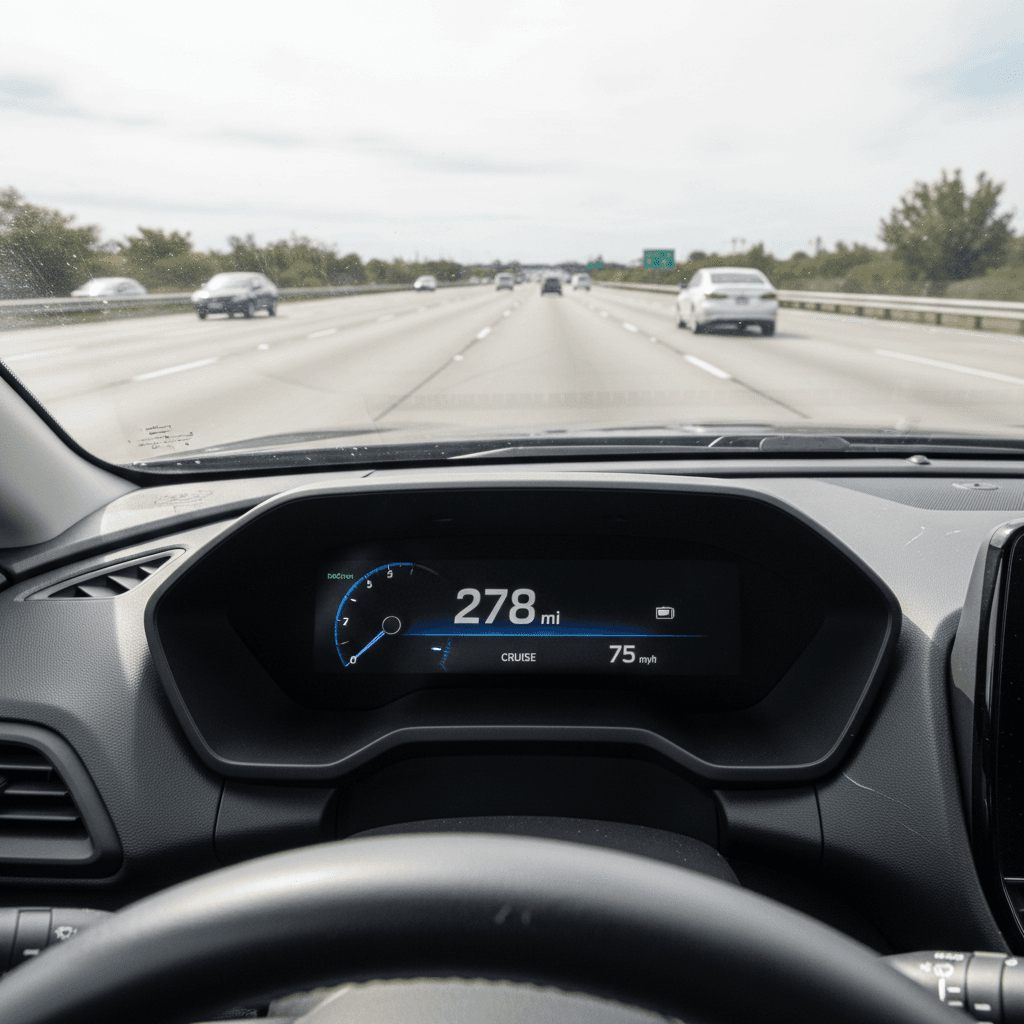
As with any EV, those are lab‑cycle estimates. Cold weather, high speeds, and elevation gain can easily knock 20% or more off the sticker numbers even without a trailer. Add a big, unaerodynamic camper and the hit gets even steeper.
How towing affects Subaru Solterra range in the real world
We don’t yet have a huge sample of Solterra‑specific tow data in North America because Subaru doesn’t encourage it. But we do have years of experience from other dual‑motor compact EV crossovers with similar batteries and range. The pattern is consistent: towing is range‑expensive.
- A light, low trailer (small utility trailer with bikes or a kayak) can trim range by roughly 20–30% at highway speeds.
- A taller or heavier trailer (small camping trailer near 1,500–1,800 lb) can cut effective range by 30–50%, especially above 65 mph.
- Hills, headwinds, cold temperatures, and roof‑mounted gear stack on top of trailer penalties.
Example: early Solterra (≈225‑mile EPA)
Let’s say you own a 2023–2025 Solterra with a 222–228‑mile EPA rating.
- No trailer, calm weather, 70 mph: you might realistically see 170–190 miles.
- Small, low utility trailer: that could drop to 130–150 miles.
- Small boxy camper near 1,500 lb: now you’re potentially in the 110–140‑mile window between charges.
Example: 2026 Solterra (≈288‑mile estimate)
The updated 2026 Solterra gives you more headroom.
- No trailer at 70 mph: many drivers may see 210–230 miles in good conditions.
- Light trailer: think 160–190 miles.
- Small camper: you may still be refueling every 140–170 miles.
These are directional examples, not promises. Real‑world results depend heavily on driving style, terrain, and weather.
Plan around your shortest leg, not your best day
Payload, rooftop tents, and gear: what the Solterra can carry
Even if you never hook up a trailer, the Solterra’s payload and roof ratings matter for road trips and overlanding. Subaru leans into this more openly than it does towing.
Solterra cargo & roof capability highlights
Exact numbers vary slightly by trim and model year, but these figures are representative for 2024 U.S. models.
Interior cargo
- Roughly mid‑20s cubic feet of cargo space behind the rear seats.
- More than 55 cubic feet with the second row folded.
- No front trunk; space is focused in the cabin and rear cargo area.
Roof and rooftop tents
- Roof rails plus crossbars allow up to roughly 176 lb of dynamic load while driving.
- Static (parked) rating can support a rooftop tent plus occupants, commonly quoted around 700 lb total, including tent and gear.
- Payload and roof loads still count against overall GVWR, so don’t ignore what’s inside the cabin.
Don’t ignore payload when you skip a trailer
Charging a Solterra while towing: planning and practicality
The other half of the towing capacity and range question is charging logistics. Even with the more efficient 2026 Solterra, you’ll be visiting fast chargers more often when you’re hauling.
Key charging realities when towing with a Solterra
1. You’ll probably unhook to DC fast charge
Most public fast chargers back into narrow spaces. With a trailer attached, you may block drive lanes or other stalls. Plan extra time to disconnect and reconnect your trailer at busy sites.
2. Aim for 10–70%, not 0–100%
DC fast charging slows dramatically above ~70–80% state of charge. On road trips, it’s usually faster overall to do more frequent, shorter sessions than to wait for a full battery.
3. Learn your high‑speed efficiency
Before a big trip, do a few highway runs at your planned towing speed without a trailer. That gives you a baseline to estimate how much range you’ll sacrifice when you hitch up.
4. Factor in charger spacing
On some routes, fast chargers may be 80–120 miles apart. If towing cuts your comfortable range to 130–150 miles, that’s still workable, but you lose flexibility if a station is down or crowded.
5. Mind cold‑weather charging
The Solterra’s cold‑weather optimization has improved, especially on the 2026 model, but winter still slows both range and charging speed. Precondition the battery when you can and keep departure SOC higher than you would in summer.
Is the Subaru Solterra a good tow vehicle? Use cases that work
If you’re picturing a big travel trailer and cross‑country towing, the honest answer is: the Solterra is not the ideal tool, especially in U.S. spec. But there are scenarios where a Solterra can be a smart partner for light towing or adventure gear, particularly in markets where Subaru publishes a modest tow rating.
Where the Solterra makes sense, and where it doesn’t
Think in terms of size, weight, and how far you need to go between charges.
Great fit: light weekend duty
- Small utility trailer with bikes, kayaks, or landscaping gear.
- Short, familiar routes with plenty of charging nearby.
- Occasional trips rather than every‑week towing.
Maybe: micro‑campers
- Very small, aerodynamic camper under ~1,500–1,650 lb where tow‑rating is allowed.
- Trips with flexible timing and lots of route planning.
- Acceptance that you’ll stop every 120–160 miles to fast charge.
Poor fit: big trailers
- Anything approaching mid‑size or large travel trailers.
- Heavy boats, car haulers, or tall enclosed trailers.
- Remote routes with sparse DC fast‑charging coverage.
When the Solterra shines
Tips to maximize your Solterra’s range when towing
If you decide to tow, where it’s legally and manufacturer‑approved, your driving habits matter as much as the spec sheet. These techniques can mean the difference between a stressful leg and a relaxed one.
Driver-tested ways to stretch Solterra range with a trailer
1. Slow down 5–10 mph
Aerodynamic drag rises quickly with speed. Dropping from 70 to 60–65 mph can claw back a surprising amount of range, especially with a taller trailer.
2. Use Eco or Normal instead of Power
Later Solterras offer multiple drive modes. When towing, resist the temptation to live in Power mode; smoother acceleration in Eco or Normal keeps energy use in check.
3. Manage regen with the paddles
On newer Solterras, paddle shifters adjust regenerative braking. In hilly areas, stronger regen can feed energy back into the pack and reduce brake wear, just don’t rely on it as a substitute for proper trailer brakes where required.
4. Pack light and low
Every pound and every square foot of frontal area costs you range. Keep heavy items low in the trailer, avoid roof boxes if you’re towing, and leave non‑essentials at home.
5. Precondition smartly
Preheating or precooling the cabin while plugged in lets you start with a full battery and reduces HVAC loads for the first stretch of your drive.
6. Use real‑time energy screens
Keep an eye on the Solterra’s consumption readouts. If you see usage spike because of headwinds or grades, shorten your target distance to the next charger.
Buying a used Solterra for towing and road trips: what to check
If you’re shopping used, the question isn’t just “What’s the Subaru Solterra towing capacity and range on paper?” It’s “What can this specific Solterra comfortably do today?” Battery health, tire choice, and prior use all matter, especially if you plan to load the car up with gear or tow in a market where that’s allowed.
1. Battery health and real-world range
- Look for documentation of charging habits and any battery service.
- On a test drive, reset the trip computer and compare projected range to the original EPA figure.
- Ask how often the previous owner DC fast‑charged; constant 0–100% fast charging can accelerate degradation.
2. Evidence of towing or heavy loads
- Check for aftermarket hitches, wiring, or scuffs around the rear bumper.
- Inspect brakes and tires for uneven or accelerated wear that might hint at heavy use.
- Listen for suspension clunks over bumps, especially in loaded test drives.
How Recharged can help
If you’re cross‑shopping, you may want to look at other used EVs that are explicitly tow‑rated in the U.S., for example, some versions of the Hyundai Ioniq 5, Kia EV6, or Volkswagen ID.4. A Solterra can still be a great choice if you value Subaru’s AWD character and mostly carry gear rather than tow it.
Subaru Solterra towing capacity and range: FAQ
Frequently asked questions about Subaru Solterra towing & range
Bottom line: how to think about Solterra towing and range
If you’re drawn to the Subaru Solterra for its all‑weather grip, quiet cabin, and electric efficiency, you’re in the sweet spot of what this EV SUV does best. Its official towing capacity and range story is more nuanced: early U.S. models aren’t rated to tow at all, while overseas versions and the updated 2026 model show that the hardware can handle modest loads, but with a sizeable range penalty whenever you hitch up.
In practice, the Solterra is a terrific companion for skis, bikes, rooftop tents, and cargo packed inside the cabin, and only a “maybe” for small trailers in regions where Subaru endorses towing. If your life revolves around campers and boats, you’ll likely be happier in an EV that’s explicitly tow‑rated. If you mostly want a capable all‑weather electric SUV with enough range for daily driving and carefully planned road trips, a well‑chosen new or used Solterra, especially with verified battery health from a Recharged Score Report, can be a smart addition to your driveway.