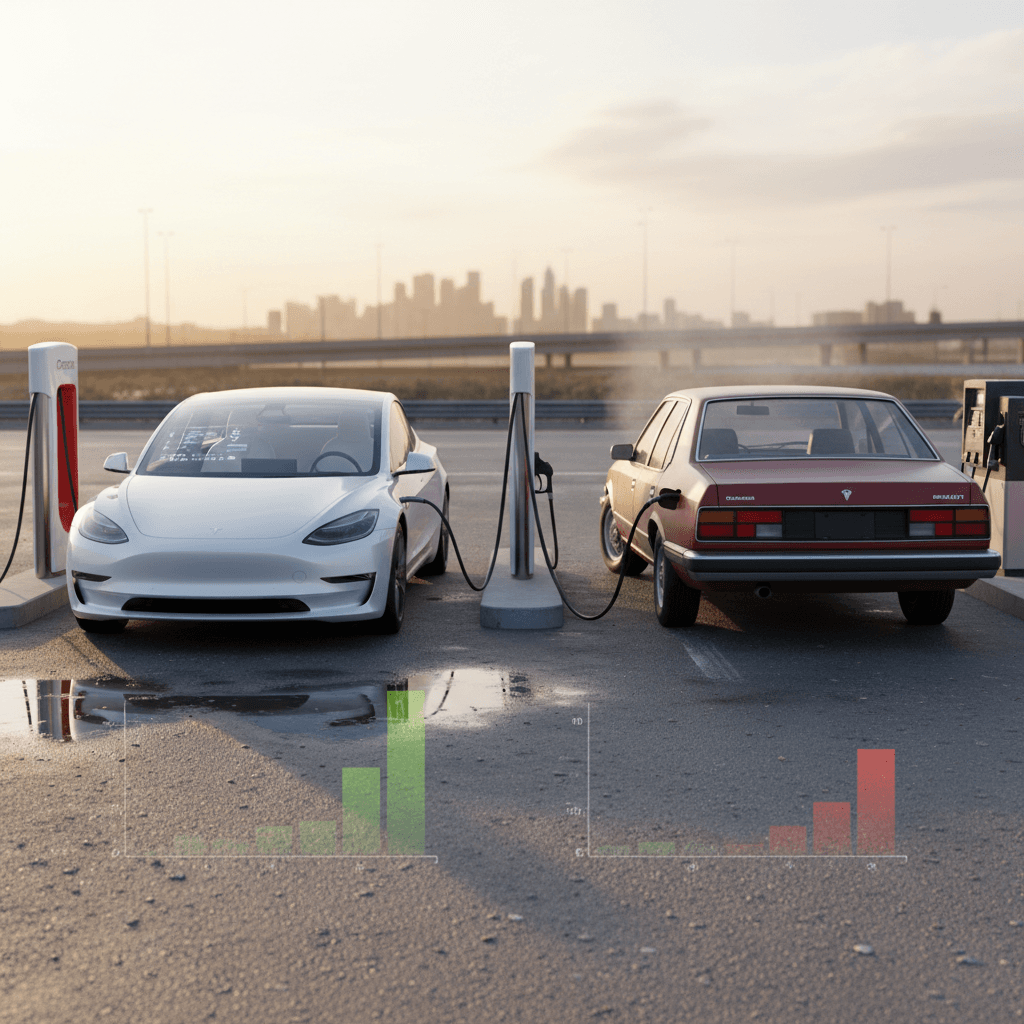
If you’re comparing a Tesla to a gasoline car, the first question is usually simple: what’s the cost per mile vs gas? With gas still hovering near $3 a gallon nationally in late 2025 and electricity bills edging higher in many states, the old “EVs are always cheaper” line isn’t enough. You need numbers, not hype.
Quick takeaway
Why Tesla cost per mile vs gas matters now
A few years ago, high gas prices and relatively cheap electricity made the Tesla vs gas cost per mile story almost one‑sided. Today, the picture is more nuanced. Gas prices have eased off their 2022 highs, while average U.S. residential electricity rates have climbed into the mid‑teens (cents per kWh) and higher in coastal states. That makes it even more important to run the numbers based on today’s conditions where you live, not national averages from 2021.
What energy costs look like in 2025
Those averages mask big regional spread: California drivers often pay over 30¢/kWh at home, while some Midwest states sit closer to 12–14¢. Gas can swing from the mid‑$2s in Oklahoma to the mid‑$4s in Hawaii. The good news: once you understand the basic math, you can plug in your own local prices and see your personal cost per mile story.
Baseline prices: what electricity and gas cost in 2025
Electricity: cents per kWh
Recent federal and industry data puts the average U.S. residential electricity rate in 2025 around 17¢ per kWh, with a typical range from about 12–14¢ in lower‑cost states to 30–40¢ in higher‑cost regions like California and parts of New England.
- Low‑cost states: roughly 12–14¢/kWh
- National average: about 17¢/kWh
- High‑cost states: 30¢+/kWh
You’ll find your exact rate on your utility bill under “$/kWh” or “cents per kWh.”
Gasoline: dollars per gallon
U.S. gasoline prices have cooled off from 2022. Government and industry forecasts point to an average around $3.10 per gallon in 2025, with seasonal bumps in summer and dips in winter.
- Low‑price states: high‑$2 range
- National average: about $3.10/gal
- High‑price states: $4–$4.50/gal
Your closest reality check is the price on the pump in your daily driving area.
Use your own numbers
How to calculate Tesla cost per mile (step by step)
Whether you’re looking at a new or used Tesla, the cost per mile math always comes down to three inputs: efficiency (Wh per mile), electricity price (per kWh), and how and where you charge.
DIY Tesla cost-per-mile formula
1. Find your Tesla’s efficiency
Look up your car’s average energy use in watt‑hours per mile (Wh/mi). Many Model 3 and Model Y owners see <strong>240–280 Wh/mi</strong> in mixed driving. You can find it in the car’s Energy screen or Tesla app.
2. Convert Wh to kWh per mile
Divide Wh/mi by 1,000. For example, 260 Wh/mi = <strong>0.26 kWh per mile</strong>.
3. Multiply by your electricity price
Cost per mile = kWh per mile × price per kWh. If you pay 17¢/kWh and use 0.26 kWh/mi, your cost is 0.26 × $0.17 = <strong>$0.044 per mile</strong>.
4. Adjust for charging losses
Home charging typically adds <strong>5–15% losses</strong> between the wall and the battery. Multiply your kWh per mile by about 1.1 for a realistic figure unless your car’s trip data already accounts for it.
5. Compare to a gas car
Gas cost per mile = gas price per gallon ÷ mpg. At $3.10/gal and 27 mpg, that’s about <strong>$0.115 per mile</strong>.
Rules of thumb
Real-world examples: Model 3 & Model Y vs gas cars
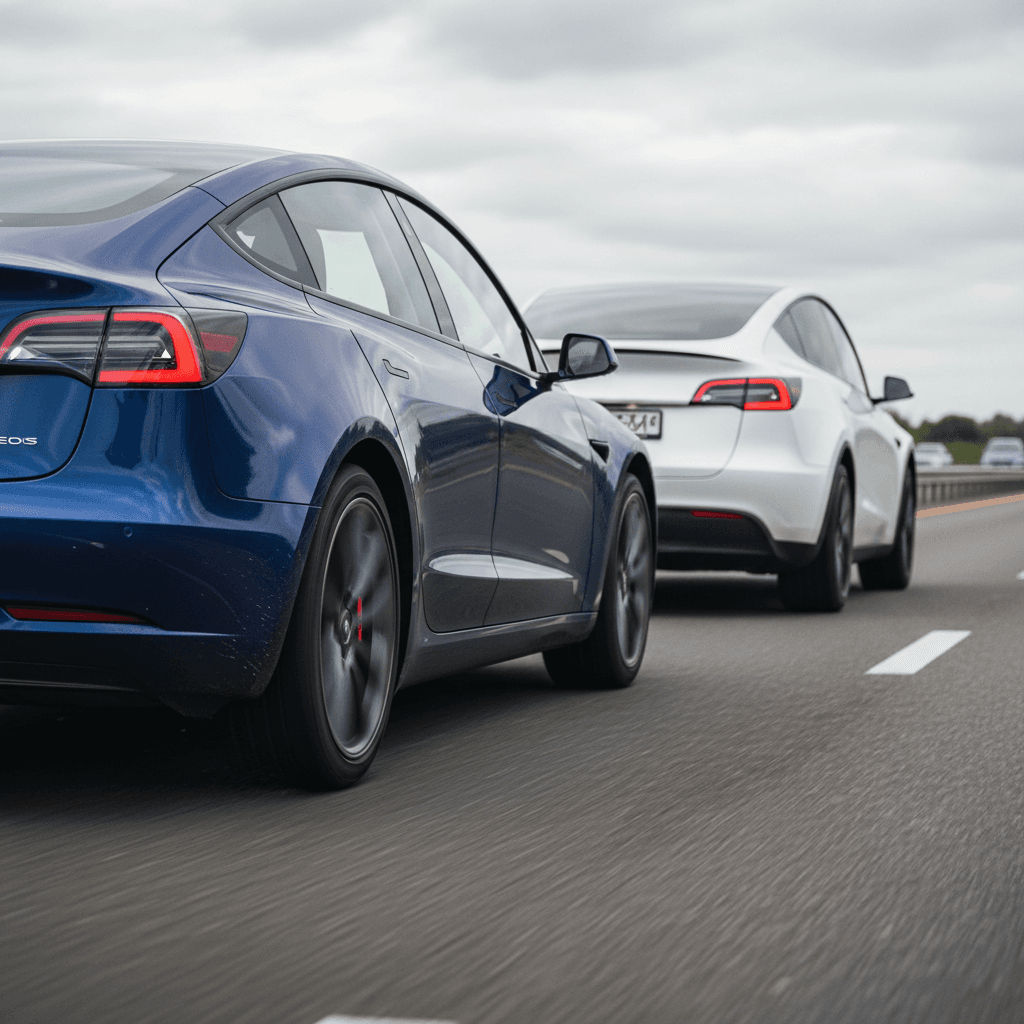
Let’s plug in some realistic 2025 assumptions for popular Tesla models and common gas car benchmarks. These aren’t lab numbers; they’re grounded in everyday mixed driving with reasonable highway speeds and normal weather.
Scenario 1: Average-cost state, home charging
Assumptions: electricity 17¢/kWh, gas $3.10/gal, 10% charging losses for EVs.
| Vehicle | Type | Efficiency | Energy price assumption | Estimated fuel cost per mile |
|---|---|---|---|---|
| Tesla Model 3 RWD | EV | 250 Wh/mi (0.25 kWh/mi) | 17¢/kWh | ≈ $0.05/mi |
| Tesla Model Y Long Range | EV | 280 Wh/mi (0.28 kWh/mi) | 17¢/kWh | ≈ $0.05–$0.06/mi |
| Efficient hybrid (50 mpg) | Gas | 50 mpg | $3.10/gal | ≈ $0.06/mi |
| Typical sedan/crossover (27 mpg) | Gas | 27 mpg | $3.10/gal | ≈ $0.11–$0.12/mi |
| Larger SUV or truck (18 mpg) | Gas | 18 mpg | $3.10/gal | ≈ $0.17/mi |
Home charging is where Tesla cost per mile shines, even with today’s higher power rates.
In an average‑cost state, a Model 3 or Model Y charged at home looks a lot like a high‑mpg hybrid on fuel cost per mile and significantly undercuts most crossovers and SUVs. That’s before you factor in maintenance differences and tax credits.
Scenario 2: High-electricity, high-gas state (think California)
Assumptions: electricity 32¢/kWh, gas $4.40/gal, 10% charging losses.
| Vehicle | Type | Efficiency | Energy price assumption | Estimated fuel cost per mile |
|---|---|---|---|---|
| Tesla Model 3 RWD | EV | 250 Wh/mi (0.25 kWh/mi) | 32¢/kWh | ≈ $0.09/mi |
| Tesla Model Y Long Range | EV | 280 Wh/mi (0.28 kWh/mi) | 32¢/kWh | ≈ $0.09–$0.10/mi |
| Efficient hybrid (50 mpg) | Gas | 50 mpg | $4.40/gal | ≈ $0.09/mi |
| Typical sedan/crossover (27 mpg) | Gas | 27 mpg | $4.40/gal | ≈ $0.16/mi |
| Larger SUV or truck (18 mpg) | Gas | 18 mpg | $4.40/gal | ≈ $0.24/mi |
Even with expensive power, high pump prices keep Tesla cost per mile very competitive.
Here, home‑charged Teslas and an efficient hybrid are effectively tied on fuel cost per mile, but Teslas are still dramatically cheaper to operate than low‑20s‑mpg vehicles. In markets where used Teslas are priced competitively, that math can be compelling for commuters putting 12,000–15,000 miles a year on the odometer.
Scenario 3: Supercharging-heavy road-trip use
Assumptions: Supercharger price 40¢/kWh (varies widely), gas $3.10/gal.
| Vehicle | Type | Efficiency | Energy price assumption | Estimated fuel cost per mile |
|---|---|---|---|---|
| Tesla Model 3 RWD | EV | 260 Wh/mi (0.26 kWh/mi) | 40¢/kWh | ≈ $0.10–$0.11/mi |
| Tesla Model Y Long Range | EV | 300 Wh/mi (0.30 kWh/mi) | 40¢/kWh | ≈ $0.12/mi |
| Typical sedan/crossover (27 mpg) | Gas | 27 mpg | $3.10/gal | ≈ $0.11–$0.12/mi |
| Larger SUV or truck (18 mpg) | Gas | 18 mpg | $3.10/gal | ≈ $0.17/mi |
Fast charging on the road narrows Tesla’s cost advantage, but it usually doesn’t erase it.
Road-trip reality check
City vs highway and winter vs summer
Gas cars and Teslas behave differently as conditions change. That matters if you’re trying to predict your real‑world cost per mile vs gas in city traffic, at 80 mph, or in a January cold snap.
How driving conditions change Tesla vs gas cost per mile
Same route, different season and speed can move your numbers more than you’d think.
City traffic
Tesla: Regenerative braking recovers energy as you slow down, so stop‑and‑go driving often improves efficiency vs highway.
Gas: Idling and constant acceleration/braking usually hurt mpg, so your cost per mile rises.
High-speed highway
Tesla: Aerodynamic drag ramps up quickly above 70 mph, pushing Wh/mi higher; cost per mile increases.
Gas: MPG also drops at high speeds, but many drivers underestimate how much. Both powertrains get more expensive per mile.
Cold weather
Tesla: Cabin and battery heating can boost energy use by 20–40% on short trips, especially without preconditioning.
Gas: Engines are less efficient cold, but the hit is usually smaller percentage‑wise than in an EV.
Winter EV cost tip
Home charging, Supercharging, and free charging
Your Tesla cost per mile vs gas is ultimately a story about where your electrons come from. The same car can look incredibly cheap per mile for one driver and just “okay” for another depending on the charging mix.
1. Home charging (biggest savings)
Charging overnight on a Level 2 charger is usually the lowest-cost option, especially if your utility offers off‑peak rates. Many owners land near the low end of that $0.04–$0.07 per mile range this way.
2. Workplace or free charging
Some employers, apartments, and retail centers offer low-cost or free Level 2 charging. If you tap into that regularly, your effective cost per mile can drop even further, occasionally close to zero for daily commuting.
3. Supercharging and third-party DC fast charging
Fast charging is about convenience and time. At around $0.35–$0.55/kWh in many markets, it can push your Tesla’s cost per mile into hybrid‑like territory. Great for road trips, less ideal as your only fuel source.
Don’t ignore installation costs
Beyond fuel: maintenance and total cost of ownership
Fuel is the headline, but the full Tesla vs gas story includes maintenance, repairs, and long‑term battery health. A Tesla’s cost per mile advantage at the pump can be offset, or amplified, by what happens in the service bay over 5–10 years.
Typical maintenance differences: Tesla vs gas
Patterns will vary by driver, but some trends are clear.
Where Teslas tend to save you money
- No oil changes or spark plugs.
- Fewer moving parts in the drivetrain.
- Regenerative braking reduces brake wear.
- Fewer emissions and fuel-system components to fail.
Over 100,000 miles, many owners see lower routine maintenance costs than a comparable gas vehicle.
Where costs can still bite
- Tires can wear faster on heavier, high‑torque EVs.
- Out‑of‑warranty electronics or suspension repairs can be pricey.
- Battery degradation affects range and resale value.
This is where doing your homework on a used Tesla’s battery health really pays off.
Why battery health matters for cost per mile
Used Tesla shopping: how Recharged makes the math safer
If you’re shopping the used Tesla market, the theoretical cost per mile is only half the picture. You also need to know what shape the battery is in, whether the price is fair, and what you’ll likely spend over the next several years. That’s where Recharged is built to help.
How Recharged supports smarter Tesla cost-per-mile decisions
We focus on the parts of used EV ownership that drive your real long-term costs.
Verified battery health
Fair-market pricing & financing
Expert EV support & delivery
Ready to find your next EV?
Browse VehiclesIf you already own a gas car and you’re running the numbers on a Tesla, you can use Recharged listings as real‑world examples: compare monthly payment, estimated charging costs, and your current fuel and maintenance spend. That gets you from theory to your actual budget much faster.
FAQ: Tesla cost per mile vs gas
Frequently asked questions
Bottom line: Is a Tesla cheaper per mile than gas?
When you cut through the noise, a simple pattern emerges: for drivers who can charge at home at reasonable electricity rates, Teslas are usually significantly cheaper per mile than comparable gas cars. In an average‑cost state with home charging, you’re often looking at roughly half the fuel cost per mile versus a typical gasoline crossover or sedan, and comparable running costs to an efficient hybrid.
That advantage shrinks if your local power rates are sky‑high, you rely heavily on Superchargers, or you compare against the most frugal hybrids. It grows if gas prices spike again, if you access cheap off‑peak or workplace charging, or if you’re replacing a thirsty SUV or truck.
If you’re trying to decide whether a Tesla, new or used, makes sense for you, start with your local electricity rate, your real mpg, and your annual miles. Then layer in maintenance, insurance, and financing. And if you’re exploring the used EV market, Recharged can help you see the full picture with battery health reports, fair-market pricing, trade‑in options, and EV‑specialist support so your next car isn’t just cheaper to fuel, it’s smarter to own.