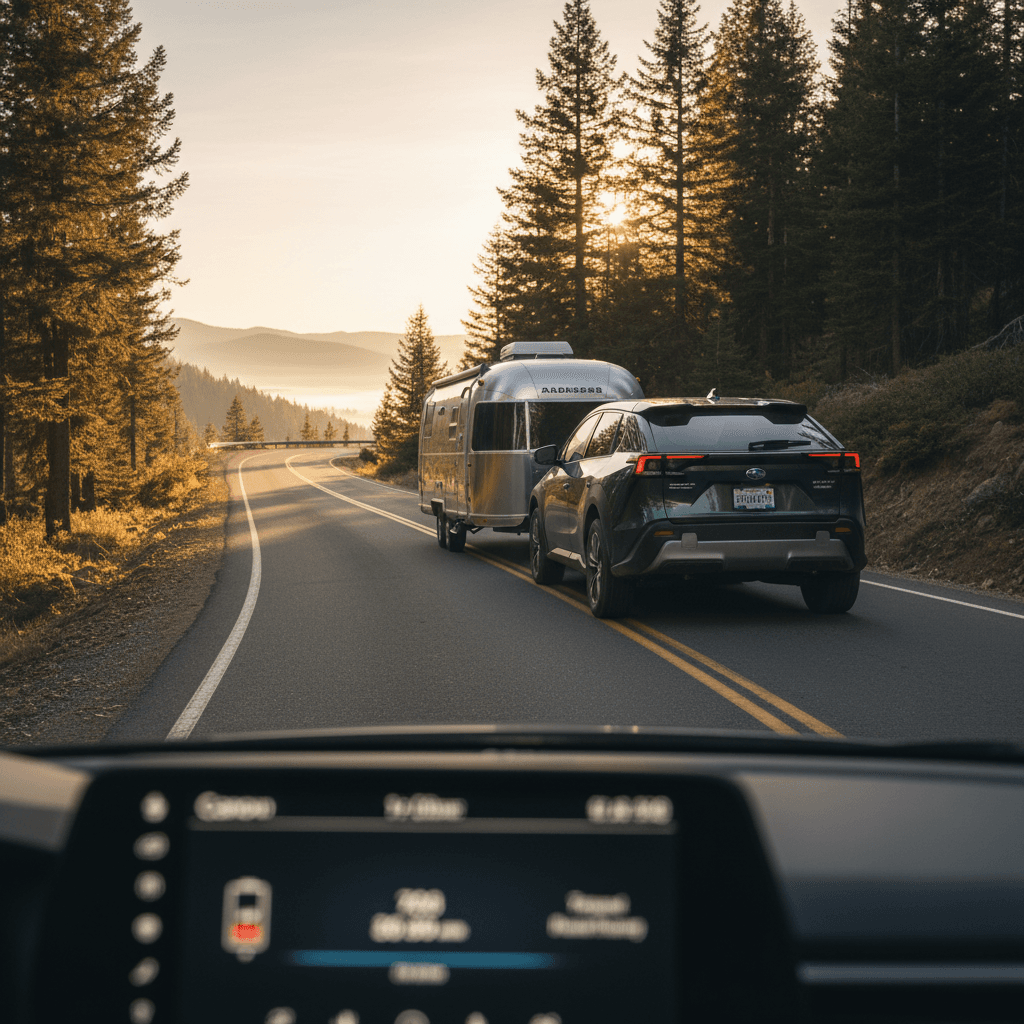
If you live an outdoorsy life, odds are you’re wondering about Subaru Solterra towing capacity and range loss. Can you pull a small trailer? What about a pair of e‑bikes on a hitch rack? And how far will you really get on a charge once you start hauling gear? With the Solterra, the answer is more complicated than just a single tow rating on a spec sheet.
Big picture
Subaru Solterra towing at a glance
Solterra towing & range: quick stats
Important disclaimer
Official towing ratings by market and model year
The first thing to understand is that Subaru sells effectively the same Solterra with different towing rules depending on where you live.
Subaru Solterra towing guidance by region (high level)
How Subaru positions Solterra towing in North America vs. other markets. Always confirm in your own owner’s manual for your exact model year.
| Market / Region | Model years | Official trailer tow rating | Typical guidance in manual |
|---|---|---|---|
| U.S. & Canada | 2023–2026 | 0 lbs (no trailer rating) | "Subaru does not recommend towing a trailer" and hitches, if fitted, are for accessories like bike racks. |
| Europe / some overseas markets | Similar model years | Often 750–1,500 kg braked (approx.) | Many overseas specs list modest tow ratings comparable to Toyota bZ4X. |
| All markets | All years | Tongue / hitch loads vary | Accessory brochures and manuals differentiate between a light “activity” mount and a true tow hitch, if offered. |
Subaru’s official towing guidance can differ by market, even when the underlying hardware is similar.
In North America, the 2023–2026 Solterra owner’s manuals emphasize that the vehicle isn’t designed for trailer towing, even as Subaru offers an “activity mount” style hitch for bikes in newer brochures. That’s Subaru being conservative about liability, braking margins, thermal loads on the motors and battery, and the extra risk that comes with bolting a heavy trailer to a relatively short‑range EV.
What about the Toyota bZ4X twin?
Aftermarket hitches & what they can really handle
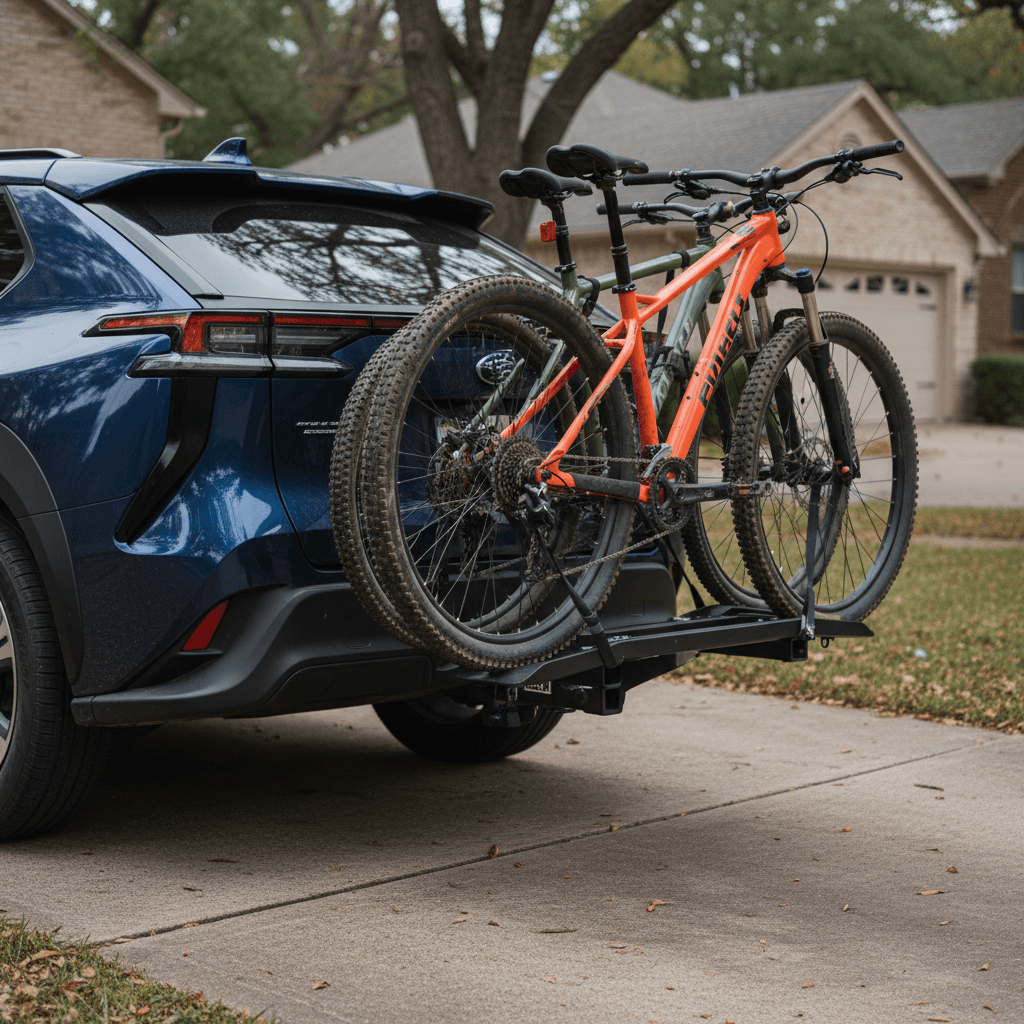
Walk around any Solterra meet‑up and you’ll spot plenty of aftermarket hitches, mostly wearing bike racks, cargo trays, or the occasional light utility trailer. The hardware itself is not the bottleneck: several hitch manufacturers sell Class 2 or Class 3 receiver hitches for 2023–2025 Solterras rated around 2,000 pounds of trailer weight and 200–300 pounds of tongue weight when installed on a suitable vehicle.
Hitch rating ≠ vehicle rating
Common Solterra hitch uses (and what they mean for range)
How owners are actually using hitches day to day
1. Bike racks
2. Cargo trays
3. Light utility trailers
Check the fine print
How towing affects Subaru Solterra range
Even if you never hook up a trailer, it’s useful to understand how extra load and drag change an EV’s energy use. The Solterra’s EPA range, roughly 222–228 miles for early North American models, and closer to the high‑200s for updated 2026 versions, assumes a lightly loaded vehicle at moderate speeds. Start hanging things off the back, and that picture changes quickly.
- Weight hurts you most when accelerating and climbing. Every pound in the trailer has to be hauled up to speed and up hills.
- Aerodynamics matter every second at highway speeds. A tall trailer, a pair of bikes standing in the wind, or a big cargo box can cost more range than the weight alone.
- Rolling resistance rises with load. Heavier trailers and larger wheels eat a little more energy each mile.
- Climate control is the quiet thief. Running heat or A/C to keep the cabin comfy on a towing day piles onto the load the battery is already carrying.
Across many EVs, not just the Solterra, drivers commonly see 20–40% range loss with light trailers and 40–60% or more with big, boxy campers. The Solterra’s relatively modest battery (about 72.8 kWh usable in early years) and mid‑pack efficiency mean you notice that penalty sooner than you might in a 300‑mile crossover.
Think in miles per kWh
Real‑world towing scenarios and range loss
Let’s walk through some realistic scenarios Solterra owners talk about, many of them towing despite Subaru’s official “no”, and what kind of range loss you might expect based on broader EV towing data.
Illustrative Solterra towing & hauling scenarios
Approximate range impacts based on wider EV towing tests and physics, not Subaru‑approved towing data. Your results will vary with weather, speed, terrain, and how much you’re willing to slow down.
| Use case | Load example | Driving conditions | Estimated range impact | What it might feel like |
|---|---|---|---|---|
| Hitch bike rack, 2 analog bikes | ~80–100 lbs total on rear rack | Mostly city / suburban, 40–55 mph | ~5–10% less range | You might hardly notice, especially below highway speeds. |
| Hitch bike rack, 2 heavy e‑bikes | ~120–150 lbs plus rack | Mixed driving, some highway at 65–70 mph | ~10–20% less range | Extra weight plus more drag can shave 20–40 miles off a full charge. |
| Small open utility trailer with kayaks or yard waste | ~400–800 lbs trailer and cargo | Highway‑heavy trip at 65–70 mph | ~25–45% less range | Think 120–160 miles from a full battery instead of 220+ if you keep speeds up. |
| Boxy small camper trailer near hardware limits | 1,500–2,000 lbs with tall frontal area | Highway, hills, weather not ideal | ~40–60%+ less range | Now you’re in serious planning mode: frequent fast‑charging and short hops. Not recommended on a Solterra. |
These estimates assume an early‑year Solterra with ~225 miles of EPA range and a healthy battery.
Heat, cold, and hills make it worse
Is it worth towing with a Solterra?
When it can make sense
- You’re mostly hauling bikes or light gear on a quality hitch rack.
- You occasionally pull a very light, low trailer for short, familiar routes.
- You’re prepared to slow down to 55–60 mph and stop more often to charge.
- You understand that Subaru’s manual says no towing and you’re willing to accept that risk.
When it’s the wrong tool
- You dream of cross‑country RV trips with a camper in tow.
- You regularly need to pull over 1,000–1,500 lbs of cargo.
- You live in a region with sparse fast‑charging along your towing routes.
- You want to stay 100% inside Subaru’s warranty guidance and never argue about modifications.
The honest answer: the Solterra is a terrific electric runabout with genuine Subaru all‑weather confidence, but it’s not a natural tow vehicle. If your life involves lots of towing, a dedicated tow‑rated EV (or hybrid) SUV or pickup will be a better fit and less stressful to live with.
Match the EV to your lifestyle
Ready to find your next EV?
Browse VehiclesTips to reduce range loss when hauling
Practical ways to stretch Solterra range when carrying or towing
1. Keep the load low and clean
Whenever possible, keep cargo tucked within the Solterra’s silhouette. A low trailer or rear basket behind the bumper is far more efficient than tall bikes or a box in the airstream.
2. Slow down a little
Aerodynamic drag rises with the square of speed. Dropping from 75 mph to 60–65 mph can claw back a surprising amount of range, especially with anything in tow.
3. Use Eco or gentle driving modes
Let the powertrain help you. Softer throttle response encourages smoother acceleration, which is doubly important with extra weight behind you.
4. Precondition while plugged in
If your Solterra and charger allow it, warm or cool the cabin and battery while still on the plug. That leaves more energy for the road once you’re rolling with a load.
5. Plan shorter legs
When you’re towing or fully loaded, assume you’ll stop earlier than you would on a normal road trip. Build charging stops around 40–60% of the dash‑estimated range, not 0%.
6. Watch your energy screen, not just range
Use the Solterra’s energy info to monitor mi/kWh in real time. If a headwind or trailer is dragging you down more than expected, you’ll see it there first.
Use charging stops as guardrails
Battery health, warranty, and resale considerations
One under‑appreciated part of the towing story is what it does to your battery over the long haul. Hauling big loads at highway speeds means higher sustained power draw, more heat in the pack, and more frequent fast‑charging stops, all of which can accelerate degradation if pushed hard and often.
- Short, occasional hauling, like a few bike trips a month, is unlikely to dramatically change long‑term battery health if you drive gently and avoid repeated 0–100% fast charges.
- Regular heavy towing at high speed, in heat or cold, with frequent DC fast charging is the hardest scenario for any EV battery, especially one that started with modest range.
- If Subaru or a future buyer learns the car was used in a way the manual discourages (like serious towing), you may face tougher questions on warranty or resale value.
Read your warranty booklet
When Recharged inspects a used Solterra, we look closely at battery health, charging history where available, and signs of heavy accessory use. That all feeds into the Recharged Score Report so you can see, at a glance, how much usable range you’re likely to get in your own life, whether you’re hauling or just commuting.
How Recharged can help if you tow or haul
If you’re already a Solterra owner, the calculus is simple: make the most of the EV you have. But if you’re still shopping, or you know that towing is a must‑have, there’s value in stepping back and looking across the used EV market, not just at one badge.
Shopping with towing or hauling in mind
Why working with an EV‑focused retailer matters
Transparent range expectations
Model recommendations
Nationwide, digital‑first buying
Whether you stick with a Solterra and simply use a hitch for bikes, or decide you truly need a tow‑rated EV, having clear, honest range and battery data makes every decision easier, and that’s exactly what Recharged was built for.
Subaru Solterra towing FAQ
Frequently asked questions about Subaru Solterra towing & range loss
The Subaru Solterra brings classic Subaru all‑weather confidence into the EV age, but it doesn’t magically rewrite the rules of physics, or warranty language. Officially, it isn’t rated to tow in North America, and every pound or square foot of trailer you add behind it will eat into a battery that already has less margin than some rivals. Used carefully, with hitch racks, light loads, and smart trip planning, the Solterra can still be a faithful adventure partner. And if your heart is set on electric towing, a battery‑health‑verified EV from Recharged’s marketplace can help you match the right tool to the job.