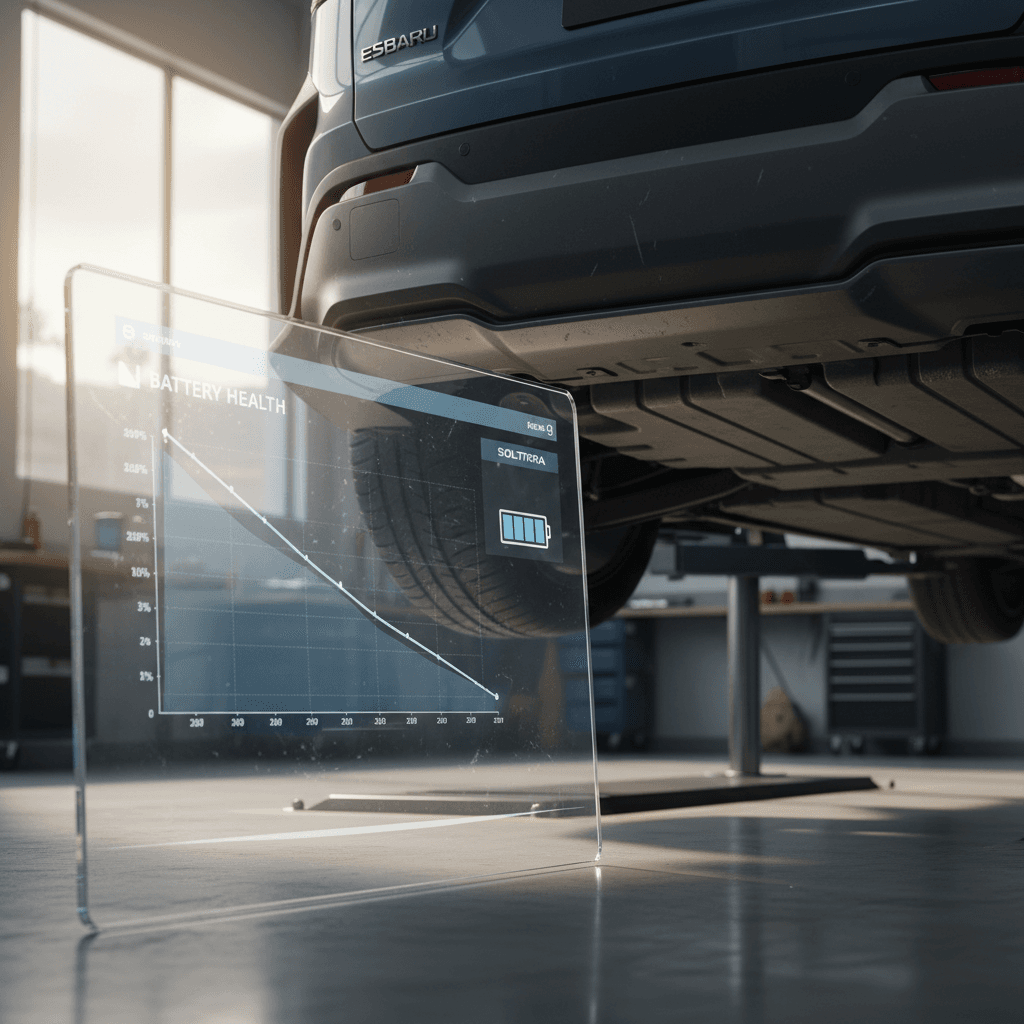
If you’re considering a Subaru Solterra, or shopping used, one of your first questions is probably: how much does the Solterra battery degrade per year? Because battery packs are the single most expensive component in an EV, understanding realistic degradation on the Solterra (and its Toyota twin, the bZ4X) is key to predicting long‑term range, value, and peace of mind.
Important context
Subaru Solterra battery degradation per year: the short answer
Solterra battery degradation at a glance
- Year 1: about 2–3% capacity loss as the pack “settles in.”
- Years 2–8: around 1–2% per year on average with normal use.
- Years 9–10+: degradation can continue, but most owners will still be above 70% capacity if they’ve treated the battery decently.
A word of caution
How the Solterra battery is engineered (and why that matters)
The Solterra shares its 71.4 kWh (about 71 kWh total, ~64–66 kWh usable depending on calibration) pack design with the Toyota bZ4X. Toyota designed this pack with longevity over headline‑grabbing specs: relatively modest fast‑charging power, conservative thermal management, and generous buffers that keep the cells away from their most stressful states of charge.
Key engineering choices that help Solterra battery life
Why Toyota/Subaru prioritized durability over bragging rights
Conservative usable window
Active thermal management
Moderate DC fast charge speeds
Think like an engineer, not a marketer
What the Solterra battery warranty implies about yearly degradation
In the U.S., Subaru backs the Solterra’s high‑voltage battery and drive unit for 8 years or 100,000 miles, whichever comes first, and specifies that the pack should retain at least 70% of its original capacity by then. Similar coverage applies in other regions, sometimes with distance expressed in kilometers.
Solterra battery warranty basics
What Subaru is implicitly telling you about degradation risk.
| Item | Coverage | What it suggests about degradation |
|---|---|---|
| High‑voltage battery warranty | 8 years / 100,000 miles | Engineers are confident the pack will stay above 70% capacity for the vast majority of typical owners. |
| Capacity threshold | 70% of original | Subaru is willing to replace or repair packs that fall well outside normal degradation patterns. |
| Normal capacity loss | Explicitly called out | Warranty language acknowledges that gradual loss is expected and not, by itself, a defect. |
Exact terms can vary slightly by market; always confirm with your local Subaru documentation.
If you divide that 30% allowable loss by 8 years, you might think Subaru is assuming ≈3.75% degradation per year. In reality, degradation is front‑loaded: more in the first year or two, then a slower decline. Toyota has publicly targeted only ~10% loss over 10 years for this battery family in some markets, which implies an average of about 1% per year for typical use, with substantial safety margin baked into that 70% warranty floor.
Early years
Most lithium‑ion packs, including the Solterra’s, lose the first few percent of capacity relatively quickly as the cells stabilize. That’s why seeing 2–3% down after 12–18 months is normal, not alarming.
Later years
From there, the curve usually flattens. With sane charging habits, many owners see just 1–2% capacity loss per year after the initial drop, often less in mild climates and moderate mileage use.
Early real‑world Solterra and bZ4X battery data
Because the Solterra and bZ4X only hit the road in 2022–2023, the best we have today is short‑term real‑world data combined with Toyota’s durability targets and Subaru’s warranty stance. That said, the early signs are encouraging.
- Owners with 12–24 months and ~15,000–25,000 miles often report little to no measurable capacity loss when they track energy used versus miles or use third‑party apps, suggesting real‑world degradation is modest so far.
- Dealers and independent shops doing state‑of‑health (SOH) checks on Solterra packs typically see 2–3% loss after the first year, which matches expectations for many modern EVs.
- Toyota’s own statements around the bZ4X platform aim for ~90% capacity remaining after 10 years, indicating that the engineering team is designing well below the 70% legal warranty floor.
- Anecdotal reports of more dramatic range loss in the first few months are often tied to cold‑weather efficiency swings or software estimates, not true battery degradation. As the BMS learns your usage and the seasons change, displayed range usually stabilizes.
What this means in plain English
7 factors that speed up Solterra battery degradation
Every EV battery ages. The question is whether you end up on the low end of that 1–2% per‑year range, or push the pack harder and see more. For a Solterra, these are the big levers that move degradation in the wrong direction:
Main drivers of faster Solterra battery degradation
1. High average state of charge
Keeping the Solterra parked at or near 100% most of the time is stressful for the cells. It’s fine for a road trip, but if your daily routine has you plugged in and full all week, you’re nudging the chemistry toward faster wear.
2. Frequent deep discharges
Regularly running the pack down into the single digits (or to 0%) before charging adds stress at the low end. Occasional deep discharges are okay, but living between roughly 10–90% is kinder to the battery.
3. Heavy DC fast‑charging use
Fast‑charging several times per week, especially from very low SOC to near‑full, drives more heat and higher internal currents. The Solterra’s conservative charging curve softens the blow, but chemistry is chemistry: frequent DC use will age the pack faster than mostly Level 2 charging.
4. High‑heat parking
Parking outside in direct sun in hot climates, especially at high SOC, accelerates long‑term degradation. Think of leaving a phone on a hot dashboard, EV cells don’t love that either.
5. High annual mileage
If you’re piling on 25,000–30,000 miles per year or more, you’ll hit the mileage‑driven portion of degradation sooner than a typical 10,000–12,000‑mile‑per‑year driver.
6. Aggressive driving and towing
Frequent hard acceleration, high‑speed cruising, or towing heavy loads all mean higher currents and more heat in the pack. The Solterra is not rated to tow in all markets, and regularly operating at the edge of its design envelope isn’t ideal for longevity.
7. Poor maintenance or software neglect
Skipping software updates or ignoring warning lights can let small thermal‑management or BMS issues snowball. That’s rare, but if the cooling system isn’t doing its job, degradation can spike.
The one scenario to avoid
How to slow Subaru Solterra battery degradation
The good news is that you don’t have to baby your Solterra to get solid longevity. A few practical habits go a long way toward keeping yearly degradation toward the low end of the range.
Everyday habits that protect your Solterra battery
Simple changes that make a measurable difference over 8–10 years
Use Level 2 for routine charging
Set a daily SOC limit
Manage heat and cold smartly
5 best practices for long Solterra battery life
1. Aim for the 20–80% “comfort zone”
You don’t need to obsess over every percent, but if most of your driving happens between ~20% and 80%, you’re already doing better than average for long‑term health.
2. Avoid sitting at 0% or 100% for long periods
A few hours at 100% before a trip is fine. Days at 100% or repeated run‑to‑zero events are less ideal. Think: full when you leave, not full for an entire weekend.
3. Keep software up to date
Battery management and charging behavior can improve over time via software updates. Keeping your Solterra current ensures you benefit from refinements to thermal control and charge‑curve tuning.
4. Schedule periodic battery health checks
Every couple of years, or before buying/selling a used Solterra, have a shop with EV expertise run a state‑of‑health test. At Recharged, this is built into our <strong>Recharged Score</strong> so you see verified pack health before you buy.
5. Drive normally, not obsessively
Moderate acceleration and highway speeds are good for range and the battery, but you don’t have to hypermile. These packs are designed for real‑world use, not lab conditions.
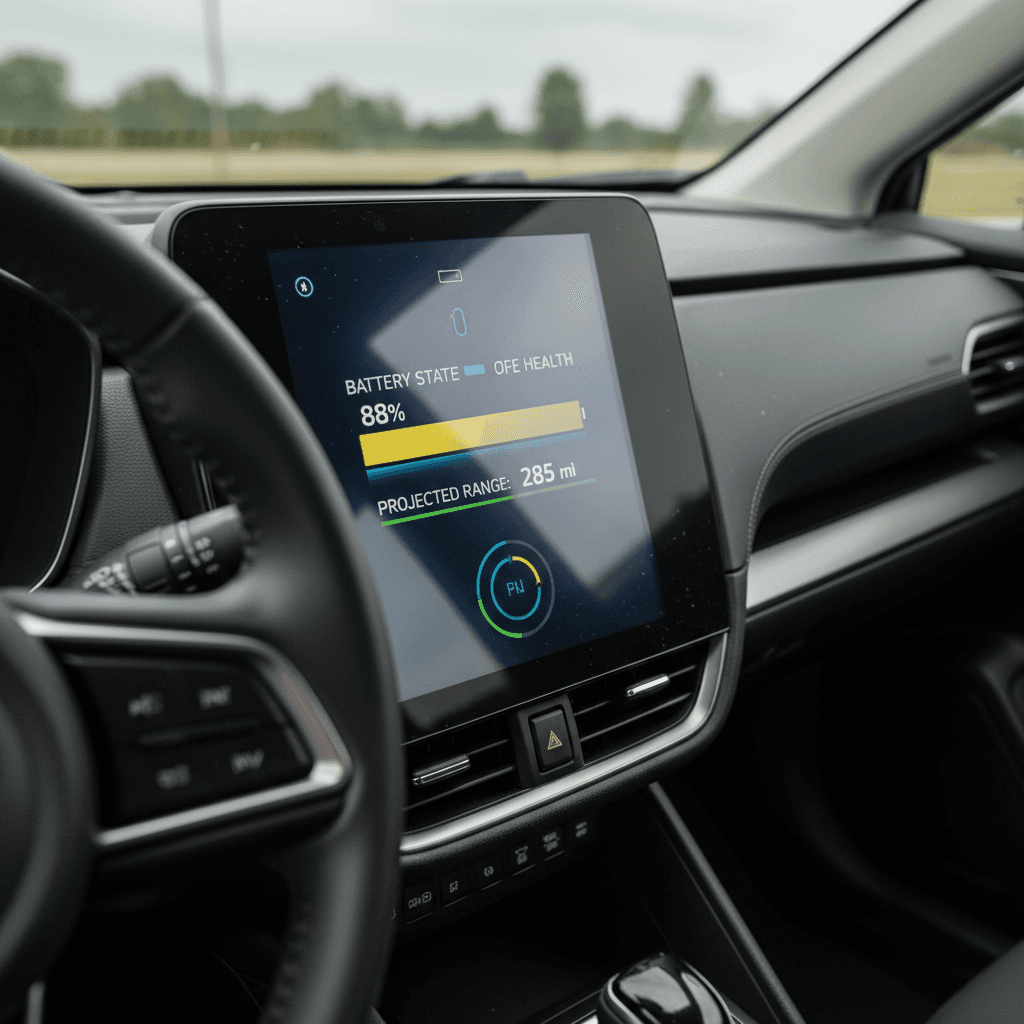
Evaluating battery health on a used Subaru Solterra
If you’re shopping for a used Subaru Solterra, the real question isn’t “what does an average car lose per year?” It’s: “What has this specific car lost so far, and why?” Because degradation can vary dramatically based on how the previous owner charged and drove it, the car in front of you matters more than the model‑wide average.
What to check on a used Solterra’s battery
Combine owner history, simple checks, and proper diagnostics.
| Check | What to look for | What it can reveal |
|---|---|---|
| Owner and usage history | Annual mileage, climate, road‑trip usage, home charging vs DC fast‑charging | Heavy DC fast‑charging and high‑heat climates raise the odds of above‑average degradation. |
| Charging habits | Daily charge target, whether they routinely ran to 0% or sat at 100% | Conservative charging habits often line up with healthier packs. |
| Service records | Software updates, thermal‑system work, warranty visits | Shows whether the pack and cooling system have been cared for or had past issues. |
| Professional SOH test | Measured usable kWh compared with factory spec | Gives you a real capacity number instead of guessing from the dash. |
| Third‑party battery report | Tools like Recharged Score that bundle battery data with pricing insights | Helps you see whether the asking price reflects the car’s actual battery health. |
A structured checklist helps you separate healthy packs from hard‑used ones when comparing used Solterras.
How Recharged helps
Ready to find your next EV?
Browse VehiclesSolterra battery degradation vs other compact EVs
It’s also useful to benchmark Solterra degradation expectations against other compact electric crossovers. On paper, the Solterra and bZ4X occupy a “conservative but durable” niche: not the longest range or fastest charging, but tuned for longevity.
How the Solterra’s degradation expectations compare
High‑level view of where Solterra lands among peers.
| Model | Battery warranty (U.S.) | Implied long‑term target | Relative degradation expectation |
|---|---|---|---|
| Subaru Solterra | 8 yrs / 100k mi (70% capacity minimum) | Toyota engineering goal of ~90% after 10 years for this pack family | ≈Average to slightly better‑than‑average among compact EVs. |
| Toyota bZ4X | 8 yrs / 100k mi (70%); Toyota publicly targets ~90% after 10 yrs | Very similar pack, tuning, and warranty | Effectively identical to Solterra; think of them as twins for degradation purposes. |
| VW ID.4 | 8 yrs / 100k mi (70%) | Real‑world data suggests ~15–20% loss over 10 years for typical drivers | Similar or slightly higher degradation, depending on usage and climate. |
| Hyundai Ioniq 5 | 10 yrs / 100k mi (70%) | Aggressive charging speeds but strong pack design | Fast‑charging more frequently may increase degradation, but pack is robust if used moderately. |
These are directional expectations based on warranties, engineering targets, and early data, not guarantees for any individual car.
Tradeoffs matter
Subaru Solterra battery degradation FAQs
Frequently asked questions about Solterra battery degradation
Bottom line: should you worry about Solterra battery degradation?
Viewed through the lens of engineering choices, warranty coverage, and early owner data, the Subaru Solterra’s battery degradation per year looks comfortably average, or slightly better, among compact EVs. You can expect a couple of percent of capacity loss out of the gate, then a gentle taper that leaves you with plenty of usable range at 8–10 years if you charge and drive sensibly.
If you’re buying used, focus less on generic degradation curves and more on the story of the specific car: where it lived, how it was charged, and what a real state‑of‑health test says. That’s exactly why Recharged bakes verified battery diagnostics into every Recharged Score Report, so a used Solterra with a well‑cared‑for pack can stand out, and hard‑used examples are priced accordingly.
Get those fundamentals right, and Solterra battery degradation becomes less of a looming question mark and more of a manageable, predictable part of EV ownership, one that shouldn’t stop you from enjoying a capable, all‑weather electric crossover for years to come.