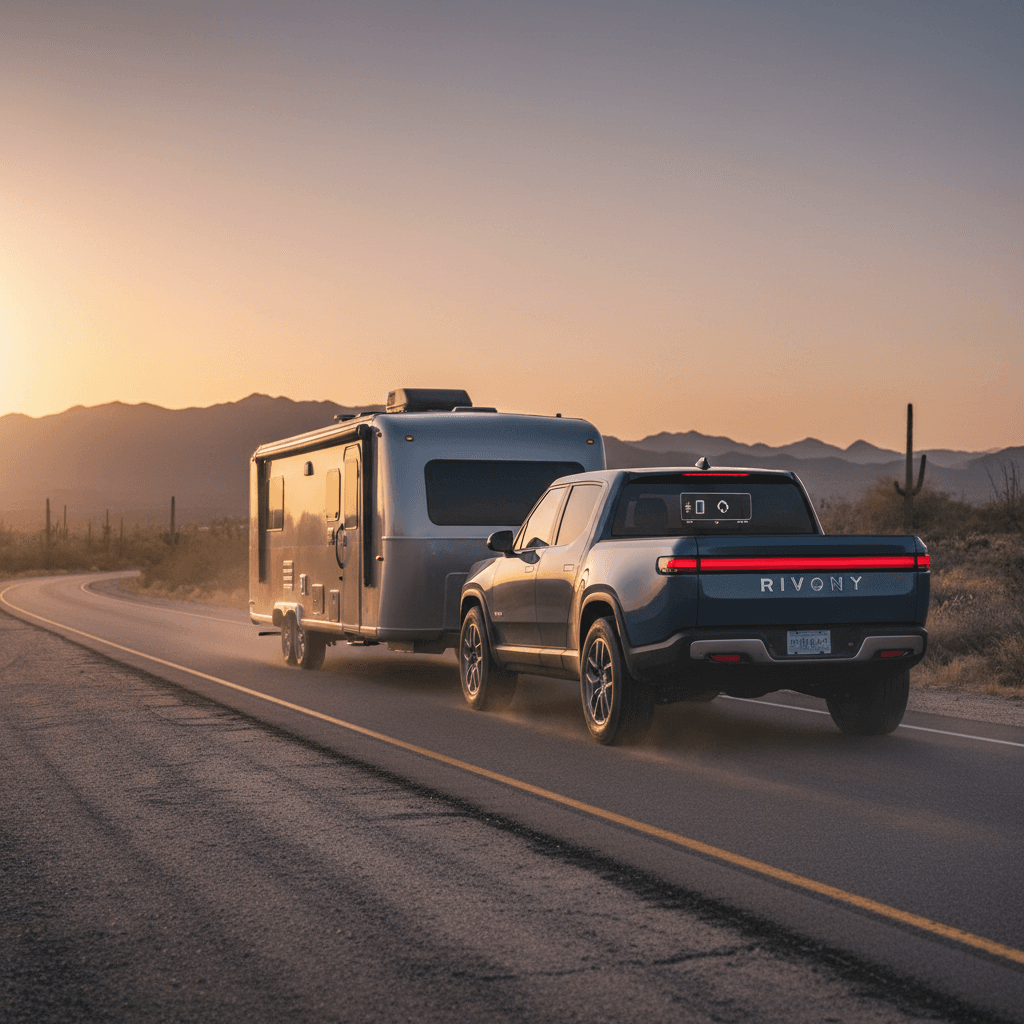
If you’re looking at a Rivian R1T as a tow rig, you’ve probably seen two very different stories: the glossy 11,000‑lb towing capacity in the brochure, and forum posts describing brutal range loss while towing. Both are true. This guide breaks down how the R1T actually tows in the real world, what kind of range you can expect with different trailers, and how to plan trips so you’re not sweating the next fast charger.
Quick takeaway
Rivian R1T towing basics: capacity, hitches, and payload
Core Rivian R1T towing specs (recent model years)
High-level towing and load specs for mainstream R1T configurations sold in the U.S. in the last few model years.
| Spec | Typical R1T Value | What it means for you |
|---|---|---|
| Maximum tow rating | 11,000 lbs (proper weight‑distributing hitch) | Matches or beats most half‑ton trucks on paper. |
| Tow rating with standard hitch | 5,000 lbs | Above this, Rivian requires a weight‑distributing setup. |
| Payload capacity | ≈1,700–1,800 lbs | Passengers, cargo, and trailer tongue weight all count here. |
| Tongue weight guideline | 10–15% of trailer weight | A 7,000‑lb trailer can put 700–1,050 lbs on the hitch. |
| Dinghy / flat towing | Not allowed | You can tow with an R1T; you can’t flat‑tow an R1T behind an RV. |
Exact specs vary by year, battery pack, motor configuration, and market; always confirm against the specific truck you’re considering.
On paper, the R1T sits in the same towing league as a traditional half‑ton pickup: up to 11,000 pounds of towing capacity when it’s properly equipped with a weight‑distributing hitch and within payload limits. Where it differs is how that towing plays with an electric powertrain: you get instant torque and outstanding control, but your effective range shrinks fast once you hang a big, boxy trailer in the air.
Mind payload as much as tow rating
How much range do you lose towing with a Rivian R1T?
Typical Rivian R1T range loss while towing
The single most important thing to understand about Rivian R1T towing capacity and range loss is that capacity is fixed, but range is highly variable. In owner logs and independent tests, a consistent picture emerges: with a mid‑size travel trailer or toy hauler in the 4,000–6,000‑lb range at highway speeds, most R1Ts see roughly 45–60% less usable range than they do driving solo.
That means if a particular configuration realistically does 260 miles on the highway without a trailer (which is already below the EPA label), you should think in terms of 110–150 miles between fast charges with a typical camper, less if you’re towing close to the 11,000‑lb max or driving fast in cold weather.
EPA labels don’t apply to towing
Real-world Rivian R1T towing range examples
Real‑world data from owners and testers lines up with Rivian’s own internal validation runs: range falls sharply as you add aerodynamic drag, weight, speed, and bad weather. Below are ballpark numbers you can use for planning, based on common 2023–2025 configurations and the 45–60% loss band most owners see with mid‑size trailers.
Approximate Rivian R1T towing range by battery pack
Rough planning numbers for highway‑heavy towing with a mid‑size (4,000–6,000‑lb) travel trailer or toy hauler.
| Pack & configuration (recent years) | Solo highway range (realistic) | Typical towing loss band | Practical towing range band |
|---|---|---|---|
| Standard / Standard+ Dual‑Motor | ~185–250 miles | ≈45–60% loss | ~75–135 miles per charge |
| Large Dual‑Motor | ~245–280 miles | ≈45–60% loss | ~110–150 miles per charge |
| Max Dual‑Motor | ~280–320 miles | ≈45–60% loss | ~125–175 miles per charge |
| Large Quad‑Motor (older builds) | ~200–260 miles (wheel/tire‑dependent) | ≈45–60% loss | ~90–140 miles per charge |
These are estimates, not guarantees. Conditions, speed, terrain, temperature, and trailer shape can swing results significantly.
Cold weather can be a double hit
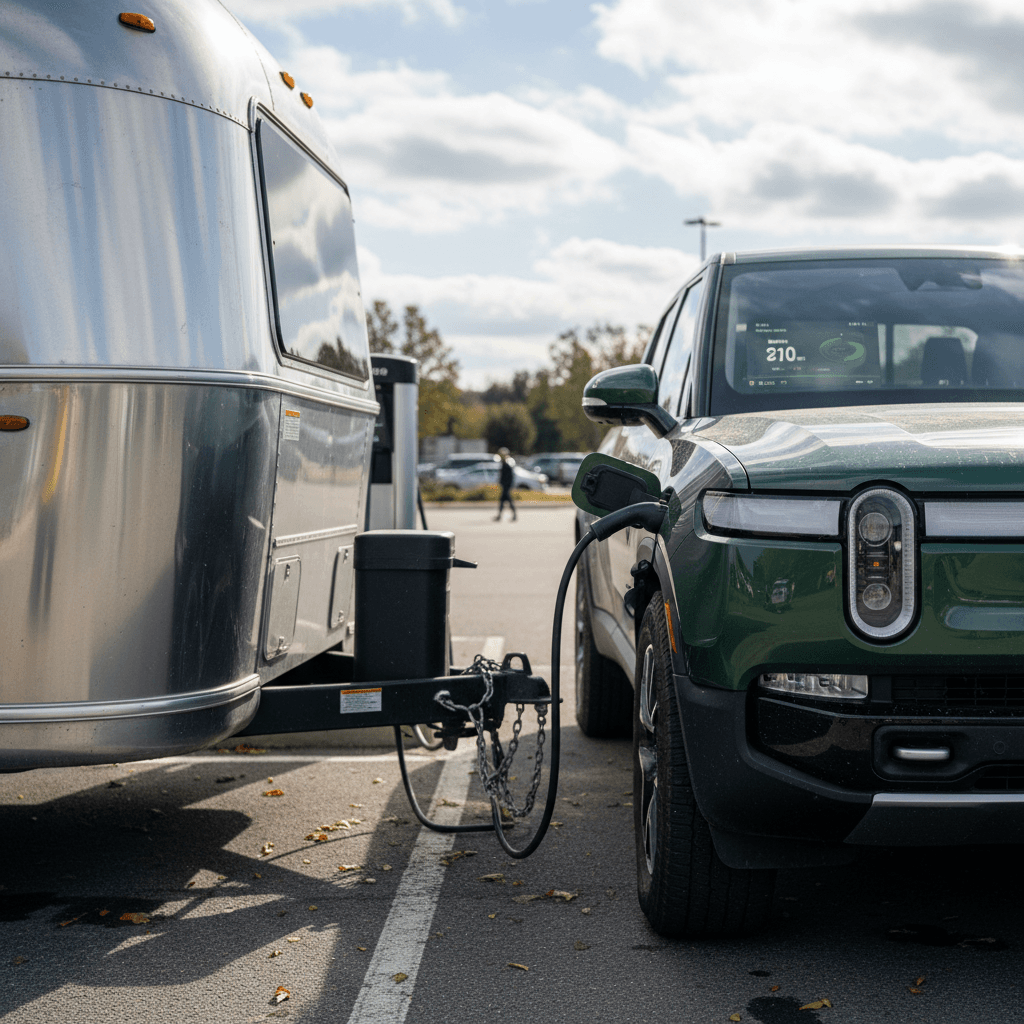
5 key factors that drive towing range loss
What actually eats R1T range when you tow?
Capacity is simple. Range is where things get complicated.
1. Aerodynamic drag
2. Trailer weight
3. Speed
4. Temperature
5. Terrain & wind
6. Driving style
Low, narrow trailers are your friend
Planning road trips with an R1T and trailer
Once you accept that your Rivian R1T towing capacity and range loss story is really about energy and airflow, trip planning becomes a math and routing exercise. The good news is that you don’t need to be an engineer to make it work, you just need to be conservative with your assumptions and intentional about your charging stops.
Towing trip‑planning checklist for R1T owners
1. Start from realistic solo range
Ignore the EPA label. Use real‑world 65–70 mph range data for your specific R1T configuration (battery, motors, wheels) as your baseline.
2. Apply a conservative loss factor
For a mid‑size camper, assume a 50–60% range loss at highway speeds. For small, low‑profile trailers, you might get by with 30–40%.
3. Plan legs at 60–70% of theoretical tow range
If the math says 140 miles of towing range, plan 80–100 mile legs. This builds in buffer for weather, headwinds, and detours.
4. Pre‑map fast chargers that allow trailer access
Not every fast charger is trailer‑friendly. Look for pull‑through spots or stations where you can briefly drop the trailer without blocking others.
5. Use lower speeds strategically
Dropping from 70 to 60 mph can meaningfully extend range. On empty stretches, that tradeoff is often worth it.
6. Have a Plan B for each stop
Especially when relying on third‑party networks, identify a backup charger within 20–30 miles in case your first choice is down or crowded.
How R1T trip planning changes with a trailer
Driving solo, you might comfortably stretch highway legs to 170–220 miles in many R1T configurations, using DC fast chargers every few hours. With a trailer, that shrinks to something more like 80–150 miles between stops, depending on conditions.
You’re also more sensitive to where chargers are located, pull‑through access matters, and to how accurately the truck and apps account for your trailer in their range estimates.
Use multiple planning tools
- Rivian’s built‑in planner is improving, but can still be optimistic with trailers.
- Third‑party apps like A Better Routeplanner (ABRP) let you model a custom consumption penalty for towing.
- Network apps from major fast‑charging providers help you check live status and amenities.
Cross‑checking these tools before a long trip can save you from surprise slow chargers or awkward, trailer‑unfriendly layouts.
Don’t rely blindly on the in‑truck tow estimate
Best drive modes and settings for R1T towing
The R1T’s software gives you real control over how the truck behaves under load. Picking the right drive modes and settings won’t magically eliminate range loss, but it will make towing more stable, predictable, and efficient.
Suggested Rivian R1T settings for towing
Focus on stability, efficiency, and predictable behavior.
Towing drive mode
Ride height and suspension
Speed discipline
Climate and HVAC
Watch live efficiency
Use regen smartly
Where the R1T shines as a tow rig
Rivian R1T vs other electric trucks for towing
If you’re cross‑shopping an R1T against other electric pickups, the pattern you’ll see is that all EV trucks take a big range hit when towing. The interesting differences are in how much energy they carry on board, how honest their range estimates are, and how easy it is to charge on your routes.
R1T vs other EV trucks: towing snapshot (high level)
Conceptual comparison of how the Rivian R1T stacks up against major electric truck competitors for towing‑centric use.
| Truck | Max tow rating | Battery size (approx) | Highway towing behavior (very broad strokes) |
|---|---|---|---|
| Rivian R1T | Up to 11,000 lbs | ~105–149 kWh usable, depending on pack | Strong tow rating and control; significant range loss but competitive with other EV trucks. |
| Ford F‑150 Lightning | Up to 10,000 lbs (certain configs) | ~98–131 kWh usable | Good tow manners; similar or slightly worse range under heavy load in some tests. |
| Chevy Silverado EV / GMC Sierra EV | Up to ~10,000–12,000 lbs (varies) | Large pack options (~165 kWh+) | Big battery packs help towing legs, but real‑world data is still emerging. |
| Tesla Cybertruck | Up to ~11,000 lbs (select trims) | Dual‑ or tri‑motor large packs | Aggressive aero and software help efficiency, but heavy loads still slash range. |
Exact specs and software behavior vary by year and configuration; always cross‑check current manufacturer data.
Think in energy, not just tow rating
Buying a used Rivian R1T specifically for towing
If you’re shopping the used market, the key question isn’t just “Can this R1T tow?”, it’s “Does this specific configuration and battery pack fit my towing use case?” Battery health, wheel choice, and software version all matter once you start pulling big loads.
Checklist: evaluating a used R1T as a tow vehicle
1. Confirm tow package and hitch condition
Make sure the factory tow package is installed, the receiver isn’t damaged or rusty, and you understand whether you’ll need a weight‑distributing hitch for your trailer.
2. Look for the right battery pack
If towing is a priority, favor Large or Max pack trucks over the smallest packs. That extra energy directly translates to fewer charging stops when you’re hitched.
3. Check wheel and tire setup
Aggressive off‑road tires look great but hurt efficiency. For frequent trailering, highway‑oriented 20–22" tires will give you better towing range.
4. Review real-world efficiency history
Ask the seller about typical highway consumption and any towing they’ve done. Screenshots of trip data are even better than memories.
5. Verify software and warranty status
Newer software builds often improve trip planning and tow behavior. Also check remaining battery and drivetrain warranty coverage, especially for high‑mileage trucks.
6. Get objective battery health data
Because towing leans heavily on the pack, knowing its actual state of health matters. A third‑party diagnostic like the <strong>Recharged Score</strong> can give you a clear, vehicle‑specific battery report before you commit.
How Recharged helps towing-focused buyers
Ready to find your next EV?
Browse VehiclesFAQ: Rivian R1T towing capacity and range loss
Common questions about R1T towing and range
Bottom line: Is the Rivian R1T good for towing?
The Rivian R1T’s story is one of serious towing capacity and serious range tradeoffs. As a tow rig, it’s genuinely impressive: quiet, composed, and powerful, with a tow rating that matches or beats many conventional half‑tons. But the physics of pushing a big trailer with electrons means that once you hang a camper or heavy toy hauler on the hitch, you’re living in an 80–150‑mile world between charges, not the 250–300‑mile world you might expect from the EPA label.
If your towing life is mostly regional, weekend trips to nearby lakes, campgrounds within a couple of hours, or occasional longer adventures you’re willing to plan around chargers, the R1T can be a fantastic solution. If you routinely drag a large trailer across sparsely charged parts of the country at high speeds, it may feel like more compromise than you want. Either way, going in with clear expectations about towing capacity and range loss is the difference between loving your electric truck and fighting it.
If you’re considering a used R1T, Recharged can help you line up the right truck, the right battery, and a transparent view of battery health so you know exactly what kind of towing range you’re buying. That kind of clarity matters a lot more once you’ve got 7,000 pounds of trailer hooked to the back.