When you’re looking at a Rivian R1T, especially on the used market, it’s natural to ask: **what does it actually cost per mile to drive**? The sticker price gets the headlines, but your *real* ownership experience is shaped by electricity prices, efficiency, and how often you fast‑charge. Let’s break down the Rivian R1T cost per mile to drive in clear, 2026‑relevant numbers.
Snapshot: Typical R1T cost per mile
How much does a Rivian R1T cost per mile to drive?
Rivian R1T cost per mile at a glance (2026)
Those ranges are wide on purpose. Your actual Rivian R1T cost per mile to drive depends on three main things:
- How efficient your R1T is in your climate and driving (mi/kWh, or its flip side kWh/100 mi).
- What you pay for electricity at home (¢/kWh) and on the road.
- How often you use DC fast charging versus cheaper overnight home charging.
Rule of thumb
Understanding R1T efficiency in kWh per 100 miles
To talk about Rivian R1T cost per mile, we have to start with **efficiency**, how much energy the truck uses to travel a given distance.
Miles per kWh vs kWh per 100 miles
Two ways to say the same thing
Miles per kWh (mi/kWh)
This is how many miles you travel on 1 kWh of energy. Many R1T owners report around 2.0–2.4 mi/kWh over the long term in mixed driving.
kWh per 100 miles
This is how many kWh you use to go 100 miles. It’s just the inverse of mi/kWh. If you get 2.2 mi/kWh, that’s about 45 kWh/100 miles.
EPA‑style data and owner reports give us a realistic working range for a Rivian R1T:
Realistic Rivian R1T efficiency ranges
Approximate whole‑truck energy use, including drivetrain and accessories.
| Condition | Approx. mi/kWh | Approx. kWh/100 mi |
|---|---|---|
| Mild weather, mixed driving | 2.2–2.5 | 40–45 |
| Highway 70–75 mph | 1.8–2.2 | 45–55 |
| Cold winter, short trips | 1.4–1.8 | 55–70+ |
Your numbers will swing with temperature, speed, tires, and load, but these ranges are a useful planning baseline.
Cold weather penalty
Home charging: R1T cost per mile at typical U.S. rates
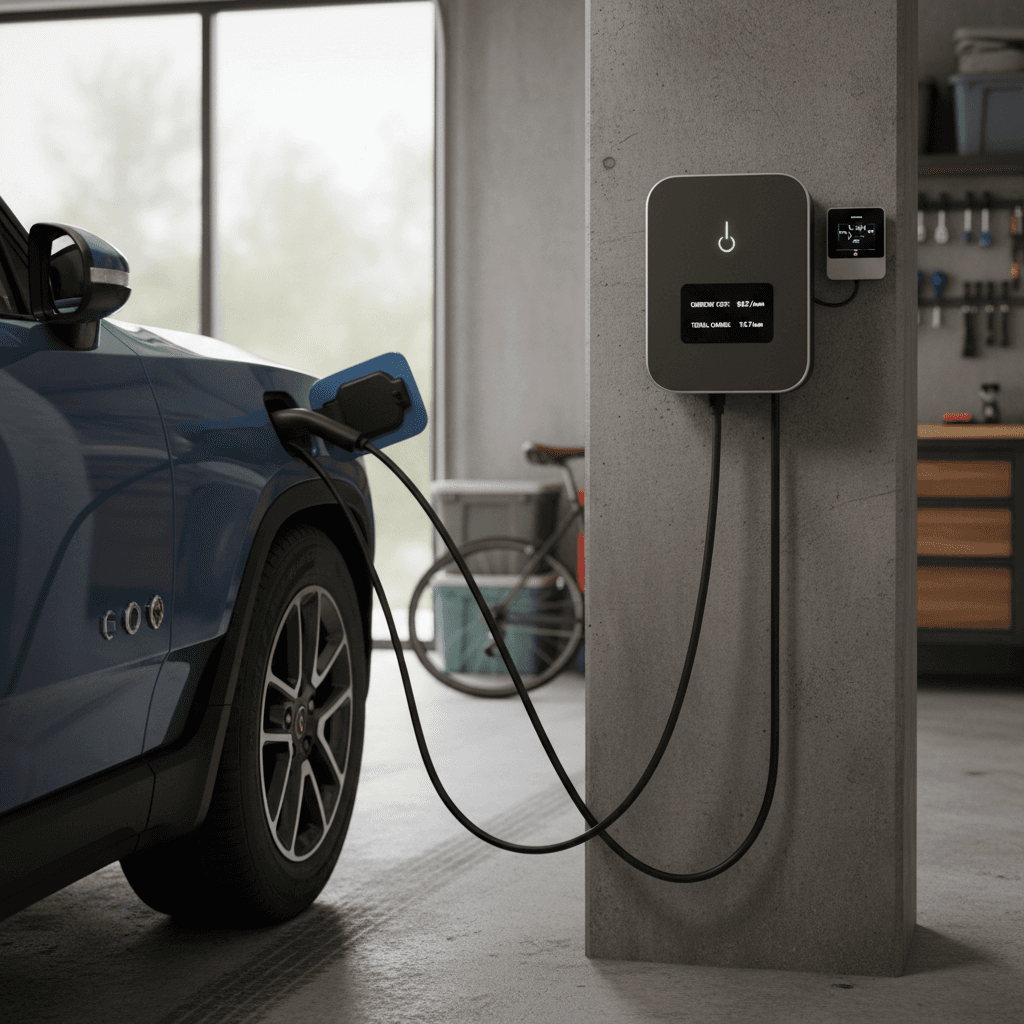
For most owners, **home charging is where the Rivian R1T shines on cost per mile**. As of late 2025, U.S. residential electricity averages around **$0.17–$0.19 per kWh**, with plenty of variation by state and utility. We’ll use $0.18/kWh as a realistic national baseline.
Scenario 1: Efficient mixed driving
Let’s say you see about 2.3 mi/kWh in mild weather mixed driving.
- That’s roughly 43.5 kWh per 100 miles.
- Energy cost per 100 miles: 43.5 × $0.18 = $7.83.
- Cost per mile: about $0.078/mi.
Rounded, that’s about **8 cents per mile** for energy when you charge at home.
Scenario 2: Real‑world highway at 70–75 mph
Now assume you’re closer to 2.0 mi/kWh on the highway.
- That’s roughly 50 kWh per 100 miles.
- Energy cost per 100 miles: 50 × $0.18 = $9.00.
- Cost per mile: about $0.09/mi.
Even in this less efficient scenario, you’re still under **10 cents per mile** on energy at home.
Bottom line for home charging
Public DC fast charging: what each R1T mile really costs
Road‑tripping your R1T or relying heavily on public DC fast charging changes the equation. Many U.S. fast chargers in 2026 bill somewhere between **$0.30 and $0.50 per kWh**, depending on the network and location.
R1T cost per mile on DC fast charging
Using common fast‑charger price points
At $0.30/kWh
- Assume 50 kWh/100 miles (2.0 mi/kWh)
- 50 × $0.30 = $15.00 per 100 mi
- $0.15/mi
At $0.40/kWh
- 50 × $0.40 = $20.00 per 100 mi
- $0.20/mi
At $0.50/kWh
- 50 × $0.50 = $25.00 per 100 mi
- $0.25/mi
Why heavy DC fast charging gets expensive
How the Rivian R1T compares to a gas pickup on cost per mile
To put these numbers in context, let’s compare the R1T to a typical full‑size gas pickup. Many half‑ton 4×4 trucks realistically deliver 17–20 mpg in mixed driving. We’ll use **18 mpg** as a conservative benchmark.
Rivian R1T vs gas pickup: energy cost per mile
Assumes 2.2 mi/kWh for the R1T at home, 2.0 mi/kWh on fast charge, and 18 mpg for the gas truck.
| Scenario | Energy price assumption | Cost per mile (R1T) | Cost per mile (gas pickup) |
|---|---|---|---|
| R1T – Home charging | $0.18/kWh; 2.2 mi/kWh | ≈ $0.075/mi | , |
| R1T – Heavy DC fast charging | $0.40/kWh; 2.0 mi/kWh | ≈ $0.20/mi | , |
| Gas truck – $3.00/gal | 18 mpg | , | ≈ $0.17/mi |
| Gas truck – $3.50/gal | 18 mpg | , | ≈ $0.19/mi |
| Gas truck – $4.00/gal | 18 mpg | , | ≈ $0.22/mi |
This compares only fuel/energy cost, not maintenance or other ownership costs.
When you mainly charge at home, the R1T’s energy cost per mile is **less than half** that of a comparable gas truck at $3–$4/gal. When you lean heavily on expensive DC fast charging, the advantage can shrink, or even disappear, depending on local gas prices.
But don’t forget maintenance
Factors that make your R1T cheaper or more expensive per mile
7 big levers that change your R1T cost per mile
1. Your local electricity price
Residential rates vary from under $0.12/kWh in some regions to well over $0.25/kWh in others. Two R1T owners with identical driving can see wildly different cost per mile just because of their utility.
2. How much you fast‑charge
Using DC fast charging for the occasional road trip is fine. Relying on it as your primary fuel source can double or triple your energy cost per mile compared with home charging.
3. Driving style and speed
It’s still a truck. Sustained 80+ mph driving or heavy use of the instant torque will push you toward 1.7–2.0 mi/kWh instead of 2.3–2.5 mi/kWh, raising your cost per mile by 15–30%.
4. Climate and trip length
Cold winters and frequent short hops mean more energy spent warming the battery and cabin. Long, steady drives in mild weather are where the R1T is most efficient.
5. Tires and wheels
All‑terrain tires and larger wheels look great but add drag. If low cost per mile is a priority, the more efficiency‑oriented wheel/tire packages are your friend.
6. Payload and towing
Hauling heavy gear or towing a trailer can cut your range in half. That won’t damage the truck, but it will double your kWh per 100 miles, and your energy cost per mile along with it.
7. Charging plan or time‑of‑use rates
Many utilities offer off‑peak EV or TOU plans. Charging overnight during cheaper windows can drop your effective energy cost per mile by 20–40% without changing how you drive.
Quick calculator: estimate your own R1T cost per mile
You don’t need a spreadsheet to ballpark your Rivian R1T cost per mile to drive. Here’s a simple mental model you can use with your own numbers.
Step 1: Find your electricity price
Look at a recent bill and divide the total electricity charge by total kWh. That’s your **all‑in ¢/kWh**, including fees.
- Example: $160 bill ÷ 800 kWh = $0.20/kWh.
Step 2: Pick your efficiency
Use the lifetime mi/kWh from your Rivian app if you have it. If not, assume:
- 2.3 mi/kWh for efficient mixed driving.
- 2.0 mi/kWh for heavier highway use.
Step 3: Use this shortcut formula
Cost per mile ≈ (Price per kWh) ÷ (mi/kWh)
Example with $0.20/kWh and 2.2 mi/kWh:
- $0.20 ÷ 2.2 ≈ $0.091/mi (about 9.1 cents per mile).
Or if you prefer per 100 miles:
- kWh/100 mi = 100 ÷ 2.2 ≈ 45.5 kWh.
- 45.5 × $0.20 = $9.10 per 100 miles.
Fast‑charge version of the same math
Practical tips to lower your R1T cost per mile
Six easy ways to drive your R1T for less
Without turning it into a science project
Charge off‑peak
Ask your utility about EV or off‑peak plans. Shifting most charging to cheaper night hours is often the single biggest lever you have.
Use efficient drive modes
Stick with the more efficient drive modes and moderate acceleration when you don’t need the full performance. You’ll see the difference in mi/kWh.
Watch your speed
A steady 68–70 mph can meaningfully beat 80+ mph on efficiency. Over thousands of miles, that trims real money off your operating cost.
Optimize tires
If you run aggressive all‑terrains but don’t off‑road often, consider a more efficiency‑oriented set for daily driving.
Plan towing days
Expect your cost per mile to spike on heavy towing days. If possible, do those trips when electricity is cheaper and speeds are moderate.
Treat DC fast charging as a tool, not a habit
Fast‑charge when you need to, but don’t rely on it for everyday local driving if you have any way to charge at home or work.
Buying a used R1T? Why battery health matters for cost per mile
The Rivian R1T’s battery is large, well into triple‑digit kWh depending on pack, and **battery health is central to your real‑world cost per mile**. A healthy pack lets you use more of that capacity, which means fewer charging stops and better efficiency on long drives.
Battery health and cost per mile
Where battery health really intersects with cost per mile is in **long‑term ownership and resale value**. A used R1T with a verified, healthy pack should hold its range and efficiency better over time, keeping your cost per mile predictable instead of creeping up as range shrinks.
How Recharged helps on used R1T costs
Ready to find your next EV?
Browse VehiclesIf you’re comparing two used R1Ts, say a Max Pack with more miles versus a Large Pack with fewer, it’s smart to look at both **battery health and your driving pattern**. For example, if you mostly commute and rarely road‑trip, a slightly smaller but healthier pack can still deliver a very attractive cost per mile.
Rivian R1T cost per mile: FAQ
Frequently asked questions about R1T cost per mile
The Rivian R1T isn’t just a conversation‑starter in the parking lot; it’s a fundamentally different way to think about the cost of driving a full‑size truck. If you can charge at home and you’re willing to be a little thoughtful about when and how you use its performance, you’re likely to see a **meaningful cost‑per‑mile advantage** over a comparable gas pickup, often by a wide margin. When you’re comparing R1Ts, especially used ones, look beyond the window sticker to battery health, charging options, and your real driving pattern. That’s how you make sure the truck you fall in love with is also the one that treats your wallet well mile after mile.