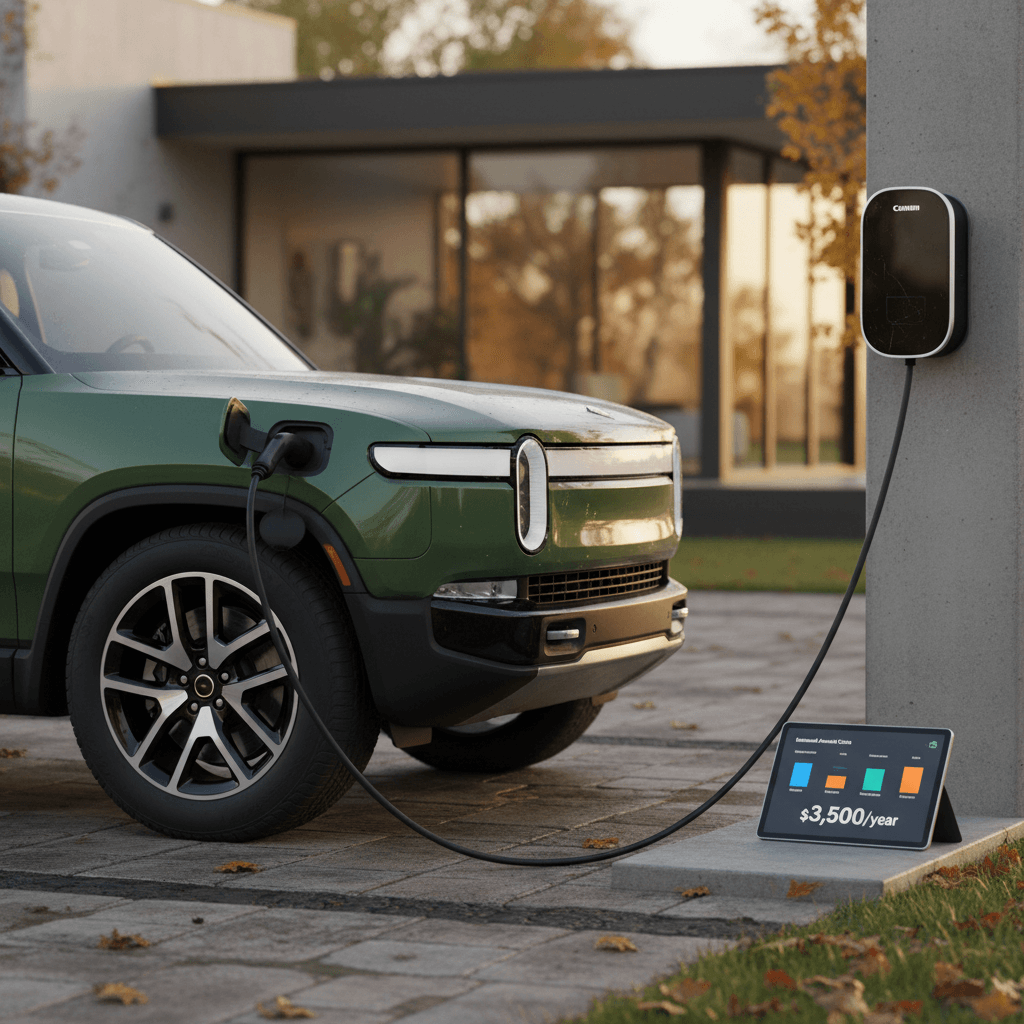
You don’t buy a Rivian R1S because it’s cheap to run. You buy it because it’s a towering, all‑electric Swiss Army knife that can drag a cabin and still out‑drag most German crossovers. But sooner or later every owner has the same question: how much does it cost to own a Rivian R1S per year once the honeymoon is over?
Short answer
Overview: What you’ll really spend each year
Typical annual Rivian R1S ownership costs (U.S. averages)
Those ranges assume a mainstream dual‑motor R1S, about 12,000 miles per year, charging mostly at home, and living in a normal‑ish insurance market, not Miami Beach, not rural Wyoming. We’ll walk through each cost line by line so you can plug in your own numbers and see where you land on that spectrum.
Key variables that move your R1S budget
What makes one R1S much cheaper (or pricier) to own than another?
Same truck, wildly different annual costs depending on how and where you use it.
Where you live
Electricity rates swing from ~10¢/kWh in some regions to 40¢+ in Hawaii. Insurance swings even more between states and ZIP codes.
How you drive
Highway speeds, roof racks, big off‑road tires, and constant DC fast charging all push consumption (and costs) up.
New vs. used
A brand‑new R1S can drop thousands per year in depreciation. A well‑bought used R1S sees much gentler value loss.
Rule of thumb
Charging costs: How much electricity your R1S uses
The R1S is a 7‑seat brick with the aerodynamics of a trendy apartment. It’s efficient for what it is, but not efficient in the abstract. In real‑world mixed driving, most owners see roughly 2.0–2.5 miles per kWh in a dual‑motor truck on normal tires, with the quad‑motor and off‑road packages dipping lower.
Annual charging cost examples for a Rivian R1S
Assuming 12,000 miles per year. Adjust the "Miles/year" column to match your own driving, and the kWh price to your utility bill.
| Scenario | Miles/year | Efficiency (mi/kWh) | kWh needed | kWh price | Annual cost |
|---|---|---|---|---|---|
| Mostly home charging, low‑cost state | 12,000 | 2.3 | ≈5,220 | $0.13 | ≈$680 |
| Mostly home charging, average U.S. rate | 12,000 | 2.3 | ≈5,220 | $0.17 | ≈$890 |
| Home + regular DC fast charging mix | 12,000 | 2.1 | ≈5,715 | Blended $0.22 | ≈$1,260 |
| High miles + lots of road trips (15k mi) | 15,000 | 2.0 | ≈7,500 | Blended $0.22 | ≈$1,650 |
Home charging is where EVs pay you back. Fast charging is like airport food: convenient and priced that way.
Watch your fast‑charging habit
Insurance: The luxury-SUV tax
Insurance is where many first‑time EV buyers get their rude awakening. The R1S is an expensive, heavy, aluminum‑intensive truck with a lot of sensors and not a lot of generic body shops that can repair it cheaply. Insurers price all of that in.
Typical R1S insurance ranges
- National ballpark: About $260–$320 per month for many drivers, or roughly $3,100–$3,800 per year, depending heavily on state, driving record, credit, and coverage levels.
- Best‑case owners: Safe‑driver, clean record, low‑risk ZIPs can see low‑$2,000s per year.
- High‑risk cases: Urban cores, young drivers, prior claims or tickets can push premiums well north of $4,000 annually.
How to keep premiums sane
- Shop multiple carriers, some still don’t know how to price EVs rationally.
- Raise comprehensive/collision deductibles to a level you can actually afford.
- Ask how many Rivians your preferred body shop has repaired. Experience matters.
- If you buy used, consider a slightly lower‑MSRP spec; cheaper hardware is cheaper to insure.
Buying used helps twice
Maintenance and repairs: What actually wears out
You don’t have oil changes, spark plugs, or transmission flushes on a Rivian. But you do have coolant, brake fluid, HVAC filters, alignment, and the occasional out‑of‑warranty gremlin. Over the first five years, mainstream cost guides and early real‑world data put scheduled maintenance for an R1S in the rough $300–$400 per year range on average, not including tires.
- Cabin air filters every ~2 years
- Brake fluid service on a multi‑year interval
- Periodic alignment (more often if you off‑road or run big AT tires)
- Occasional software‑related or hardware warranty visits
- Out‑of‑warranty items as the truck ages (door hardware, sensors, etc.)
Real‑world 5‑year picture
If you’re coming from a German SUV that eats $1,500 brake jobs for breakfast, this is refreshingly sane. The wildcard is how far you live from a Rivian service center and how much you enjoy being the beta tester for cutting‑edge software.
Tires: The silent budget killer
The R1S is heavy, torquey, often AWD, and frequently ordered with aggressive all‑terrain rubber. That’s a perfect recipe for shorter tire life and expensive replacement sets. This is the line item that sneaks up on a lot of owners.
What Rivian R1S tires really cost you each year
Tires are technically “maintenance,” but in the real world they deserve their own line item.
Street‑biased tires
Expect 30k–40k miles from a decent EV‑rated street tire if you rotate on schedule and avoid constant launches. At $1,400–$1,800 a set installed, that’s roughly $350–$600 per year for a 12k‑mile driver.
Aggressive all‑terrains
That heroic off‑road stance can drop you into the 20k–30k‑mile range per set. Same price band, less mileage, so figure $500–$900 per year depending on how hard you drive.
How to save on tires
Keep pressures correct, rotate on schedule, align after big potholes or off‑road seasons, and don’t treat every green light as a drag strip. The R1S will oblige, but your tires will rat you out.
Taxes, fees, and registration
Once the truck is in your driveway, most of the sales‑tax pain is behind you, but there are still yearly costs to keep it legal. In many states you’ll see a mix of registration fees, local property tax on vehicles, and sometimes an extra EV fee to make up for lost gas‑tax revenue.
Common annual fees for an R1S
Your state and county will set the real numbers, but this gives you a workable range for planning.
| Fee type | Low estimate | High estimate | Notes |
|---|---|---|---|
| Registration + plates | $100 | $300 | Often tied to vehicle age, weight or value. |
| Local property / excise tax | $0 | $400+ | Only in certain states and counties. |
| EV road‑use surcharge | $0 | $250 | Increasingly common as states chase gas‑tax revenue. |
For planning, many R1S owners pencil in <strong>$200–$600 per year</strong> for registration + EV surcharges, more in high‑tax states or for very new, high‑MSRP trucks.
Depreciation: The big invisible cost
Depreciation is the quiet killer of luxury‑EV budgets. You never get an invoice for it, but it’s usually your single biggest annual cost, especially if you bought new at or near MSRP.
If you bought new
Early Rivian resale data is still settling, but a realistic working assumption for a new R1S is on the order of $4,000–$6,000 per year in value loss over the first few years, depending on purchase price, incentives, and market conditions.
That’s not catastrophic for a $90k+ luxury EV, but it’s very real, roughly the price of your electricity, tires, and maintenance combined.
If you buy used instead
Letting the first owner eat the steepest part of the curve can drop your annual depreciation hit dramatically. A carefully‑bought used R1S might lose $2,000–$3,500 per year instead, depending on age, mileage, and market.
This is one of the strongest arguments for shopping the used R1S market rather than custom‑ordering new, especially if you’re payment‑ or value‑conscious.
Where Recharged fits in
New vs used Rivian R1S: Annual cost examples
Let’s put all of that into two simple, imperfect, but useful examples. These exclude your loan or lease payment, that’s between you and your lender, but include the ongoing costs of actually running the truck.
Sample annual cost scenarios for a Rivian R1S
Numbers are rounded estimates for a 12,000‑mile‑per‑year driver. Your real life will be messier, and that’s fine.
| Line item | New R1S (higher‑cost state) | Used R1S (average‑cost state) |
|---|---|---|
| Electricity / charging | $1,250 | $900 |
| Insurance | $3,600 | $2,800 |
| Maintenance (ex‑tires) | $500 | $400 |
| Tires | $700 | $500 |
| Taxes & fees | $400 | $250 |
| Depreciation (non‑cash) | $5,000 | $2,500 |
| Estimated annual total | ≈$11,450 | ≈$7,350 |
Use these as starting points, then adjust the line items that don’t look like your life.
Why we show depreciation separately
How Recharged helps you lower R1S ownership costs
If you like the idea of an R1S but not the idea of sponsoring Rivian’s depreciation curve, buying used, and buying smart, is your best ally. That’s exactly the job description at Recharged.
Ways Recharged can save you money on a Rivian R1S
Less guesswork, more data, and fewer surprises once the truck is in your driveway.
Verified battery health
Every R1S on Recharged comes with a Recharged Score, including pack diagnostics, charge history signals, and range performance, so you’re not gambling on the most expensive component in the truck.
Fair, transparent pricing
We benchmark against real‑world sales data to show you fair market pricing. You see where a given R1S sits, so you’re less likely to overpay and more likely to enjoy gentler depreciation.
Financing, trade‑in & delivery
One platform for financing, trade‑ins, instant offers or consignment, plus nationwide delivery and EV‑specialist support. Less time in fluorescent showrooms, more time planning road trips.
Ready to find your next EV?
Browse VehiclesWant to touch and feel?
Checklist: Build your own R1S annual cost estimate
Seven quick steps to your personalized R1S budget
1. Start with your miles per year
Look at the last 12 months of driving (or your phone’s location history) and write down a realistic mileage number. Don’t use your best‑case; use your actual life.
2. Estimate your kWh per mile
If you already own an R1S, pull the long‑term efficiency from the trip computer. New buyers can start with <strong>2.0–2.5 mi/kWh</strong> depending on wheels, tires, and climate.
3. Pull your electricity rates
Check your utility bill for your actual ¢/kWh. If you split between home and fast charging, assign a rough percentage to each and compute a blended rate.
4. Quote insurance with the VIN
Before signing anything, run quotes on the specific R1S you’re eyeing. Use the VIN if possible and the coverage levels you actually want, not the bare minimum.
5. Budget for tires & maintenance
Scan owner forums and cost guides for how long people are getting out of the tire you plan to run. Divide the installed tire cost by the mileage you expect, then multiply by your annual miles.
6. Add local fees and EV surcharges
Check your state DMV site for EV‑specific fees, property/excise taxes and registration costs for a vehicle in the R1S price band.
7. Decide how to treat depreciation
If you’re payment‑sensitive, treat depreciation like a real annual cost and include it. If you plan to keep the truck for a decade, you may be more comfortable treating it as a distant problem.
FAQ: Rivian R1S annual ownership costs
Frequently asked questions about R1S ownership costs
Bottom line: Is a Rivian R1S expensive to own?
The Rivian R1S is not a cheap date. It’s a high‑dollar, high‑capability machine whose energy and maintenance bills are surprisingly reasonable, but whose insurance and depreciation remind you you’re driving a six‑figure experiment in American EV adventurism.
If you charge mostly at home, keep tire choices sane, and shop insurance aggressively, the running costs look very competitive with the gas‑burning luxo‑bricks it replaces. The smartest move, from a pure cost perspective, is often to let someone else buy new and you buy smart used, with good data on battery health and fair pricing. That’s where platforms like Recharged earn their keep, turning a gorgeous but intimidating EV into a transparent ownership proposition.
Do the math with your own miles, your own utility rate, and your own quotes, not just internet averages. If the numbers still make sense, you’re free to make the only argument that really matters in the R1S: the emotional one, the feeling that this big, square, silent machine fits the life you actually want to live.