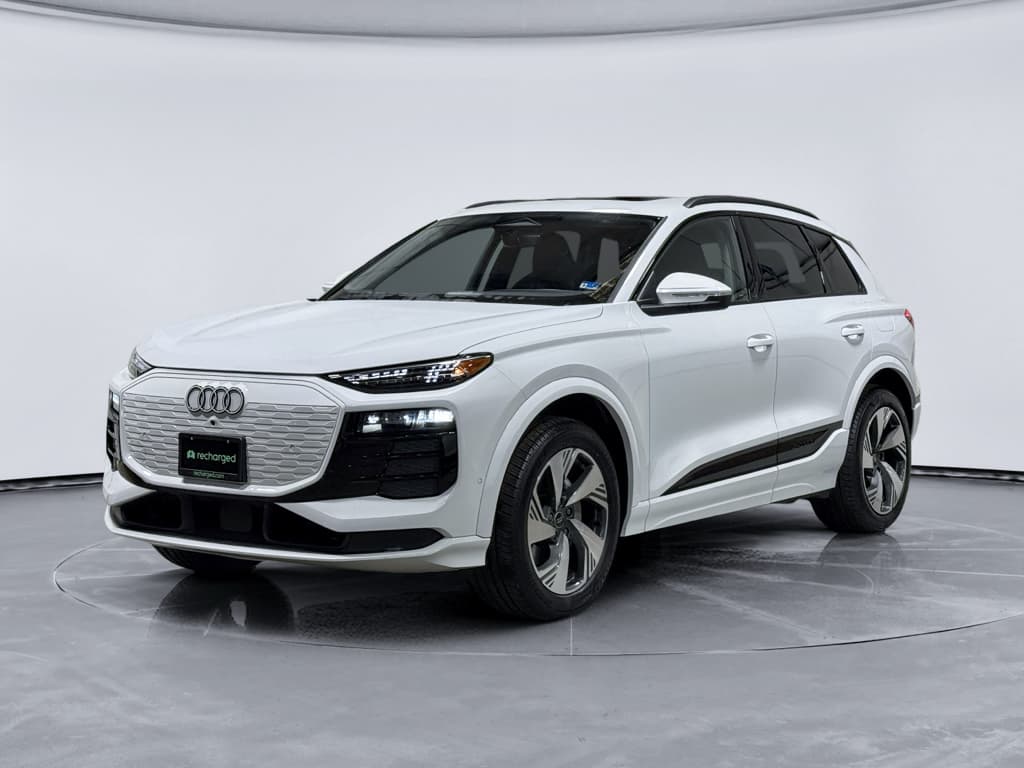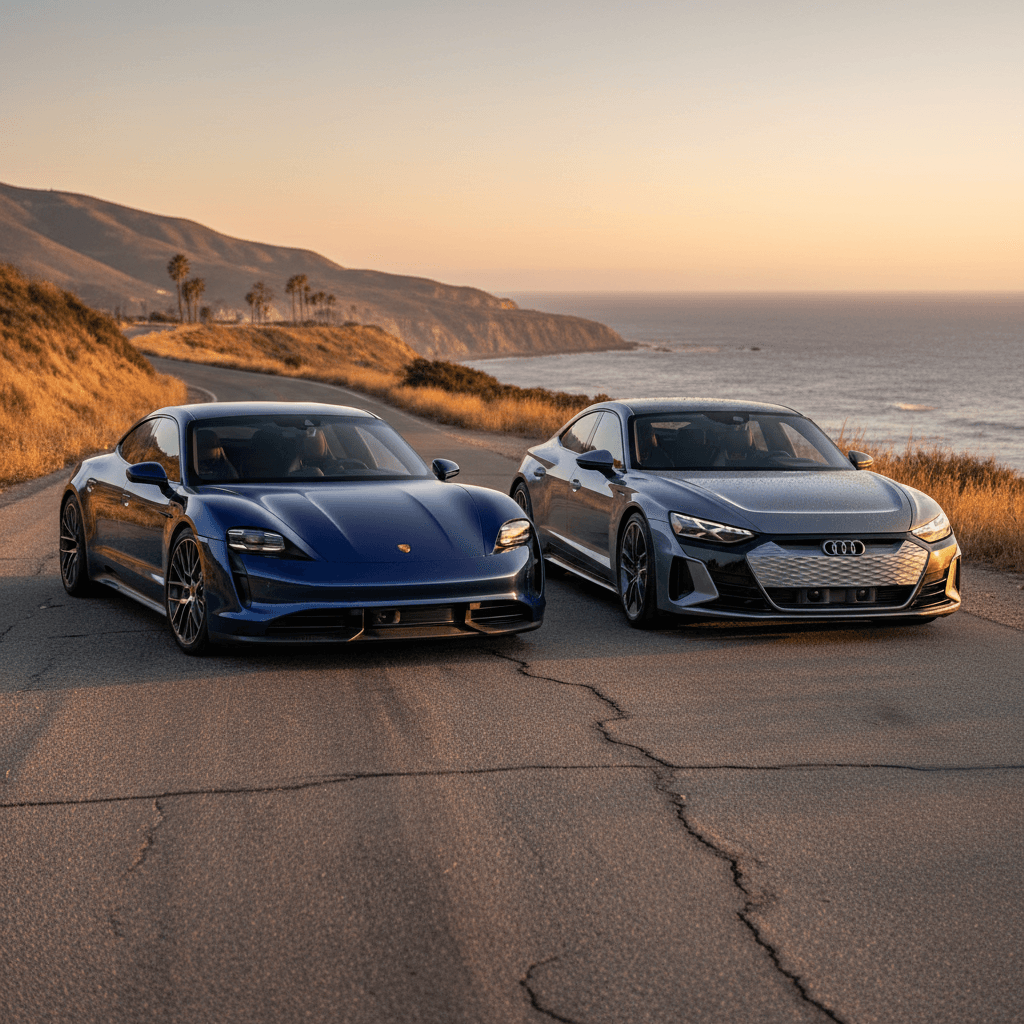
If you’re cross‑shopping the Porsche Taycan vs Audi e-tron GT and wondering which is better, you’re looking at two of the most compelling electric performance sedans on the market. They share a platform, but they don’t drive, feel, or cost the same, and those differences matter a lot once you’re the one making the payments.
Same bones, different personalities
Taycan vs e-tron GT: Quick Overview
Porsche Taycan: The driver’s choice
- Sharpened steering and chassis tuning aimed at enthusiasts
- Wide model range from base rear‑drive to Turbo GT
- Generally better real‑world range and efficiency than earlier years
- Often more expensive new and used, but also holds value better
Audi e-tron GT: The luxury GT
- Softer ride and quieter cabin, especially on standard air suspension
- Lineup topped by RS e-tron GT and new RS performance variants with up to ~900 hp in 2025+ models
- Improved battery for 2025 with up to roughly 300 EPA miles in the S e-tron GT
- Typically cheaper to buy used than an equivalent Taycan, with generous Audi scheduled service included on many cars
Porsche Taycan vs Audi e-tron GT by the Numbers (Typical 2025 U.S. Models)
Key Specs at a Glance
Porsche Taycan vs Audi e-tron GT: Core Specs (Typical 2025 U.S. Models)
Exact figures vary by trim and wheel/tire choice, but this gives you a realistic snapshot of what most shoppers will see.
| Category | Porsche Taycan (2025, typical 4S/“S” spec) | Audi e-tron GT (2025 S / RS e-tron GT) |
|---|---|---|
| Power (hp) | ~482–590 hp (4S/4S Performance Battery Plus, launch mode higher) | ~670 hp (S), up to ~900 hp (RS performance) |
| 0–60 mph | ~3.5 sec (4S), as low as 2.3–2.5 sec in Turbo/Turbo GT | ~3.0–3.4 sec (S/RS), ~2.5 sec in RS performance |
| Usable battery | Around 93–97 kWh depending on pack | Around 97 kWh usable (approx. 105 kWh gross) |
| Max DC fast‑charge rate | Up to ~320–350 kW on latest Taycan updates | Up to ~320 kW on 2025 RS e-tron GT |
| Approx. EPA range (best trims) | High‑200s to ~300+ miles when conservatively driven | S e-tron GT up to ~300 miles; RS variants lower due to power |
| Drivetrain | RWD base, AWD on most models | Standard AWD dual‑motor across the range |
| Body style | Sedan or Cross Turismo wagon | Sleek 4‑door coupe (liftback) only |
Always check the specific car’s window sticker or Recharged Score Report for precise specs and EPA ratings.
Specs vary by trim
Performance & Driving Feel
Even though the Taycan and e-tron GT share a lot of hardware, they don’t feel identical on the road. If you live for back‑road drives and late‑apex cornering, the Porsche’s tuning makes a difference. If you want a rapid, effortless highway GT that still looks and feels special, the Audi has a strong case.
How They Drive: Side‑by‑Side
Both are properly fast. The question is what you want to feel from behind the wheel.
Porsche Taycan driving experience
- Steering and chassis: Exceptionally precise, with more road feel than most EVs. Optional rear‑axle steering makes big cars feel small.
- Acceleration: Instant and repeatable; Porsche manages heat well so performance stays consistent.
- Ride: On air suspension, firm but controlled. Sportier wheel/tire packages can feel pretty stiff on broken pavement.
- Character: Feels like an electric 911’s long‑legged cousin, confidence‑inspiring even when you’re really using the power.
Audi e-tron GT driving experience
- Steering and chassis: Still sharp, but a bit less talkative. Feels wider and more relaxed in day‑to‑day driving.
- Acceleration: S and RS models are brutally quick, with the RS e-tron GT performance entering supercar territory.
- Ride: Adaptive air suspension tends to be plusher, especially in Comfort modes. It truly earns the "grand tourer" badge.
- Character: More of a high‑speed luxury GT. It’s happy eating miles at 75–80 mph in near silence.
Test‑drive tip
- Enthusiast verdict: Most reviewers and owners give the edge to Taycan for steering feel, body control, and overall driver engagement.
- Daily‑driver verdict: Many commuters and families prefer the e-tron GT’s softer edge and quieter, cocoon‑like ride on long trips.
Range, Battery & Charging
Early Taycans and e-tron GTs took some criticism for real‑world range versus EPA ratings. Both brands have steadily improved their packs and software. By the 2025 model year, you’re looking at significantly better range and charging performance, especially if you choose the higher‑capacity batteries and more efficient wheels.
Real‑world range expectations
- Porsche Taycan: Owners commonly report mid‑200s to low‑300s miles on highway trips in newer 4S and GTS models with the larger Performance Battery, when driven sensibly.
- Audi e-tron GT: With the updated ~97 kWh usable battery, the 2025 S e-tron GT can realistically approach ~300 miles; RS and RS performance versions give up some efficiency to gain power.
- Cold weather: Both lose range in winter; Taycan’s sophisticated thermal management tends to keep things more predictable, but either car will need more frequent charging in a Midwest or Northeast January.
Charging speed and network access
- Both cars use an 800‑volt electrical architecture, which allows very high DC fast‑charging rates on capable stations.
- Taycan and the latest e-tron GT variants can peak around the 300+ kW mark, meaning 10–80% in roughly 18–25 minutes when conditions are ideal.
- Both use CCS in the U.S. for now, but the industry’s shift to NACS (Tesla’s standard) means future adapters and native ports are on the horizon for many EVs.
- On AC Level 2 home charging, expect 10–11 kW onboard chargers on most trims, adding roughly 25–35 miles of range per hour depending on car and conditions.
Don’t assume all used cars charge the same
Comfort, Interior Quality & Tech
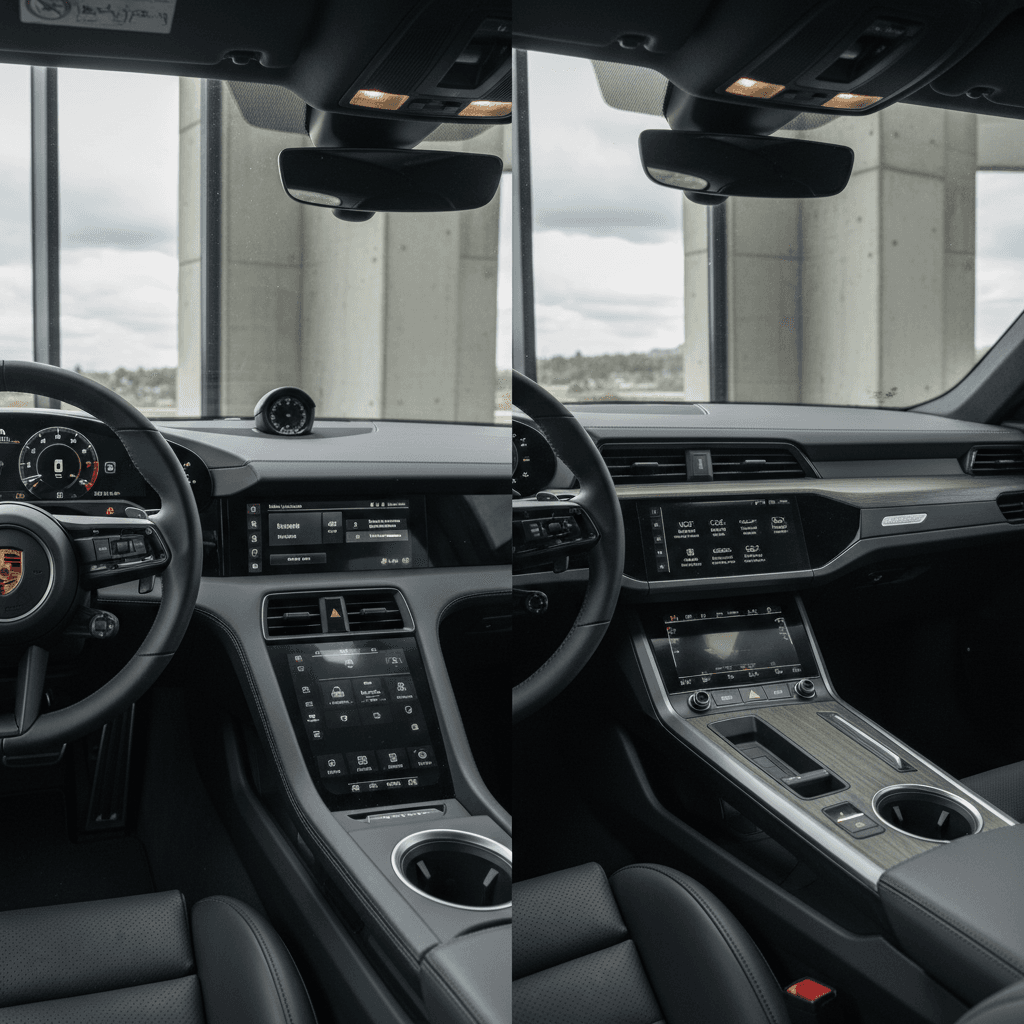
You’ll spend more time looking at the cabin than at the spec sheet, so comfort and technology should be high on your list. Both cars deliver truly premium interiors, but they take slightly different approaches.
Inside the Cabins: Porsche vs Audi
Similar materials and build quality, different moods.
Porsche Taycan interior
- Design: Clean, sporty, driver‑centric. Feels low‑slung and cockpit‑like, with a pronounced center tunnel.
- Materials: Excellent leather, metal switchgear, and optional Race‑Tex eco‑materials. Fit and finish are typically top‑notch.
- Infotainment: Multiple screens, including an optional passenger display. Porsche’s software has improved and feels quicker in the newest cars.
- Comfort: Front seats are supportive and firm; rear seats can be snug for taller adults, especially under the sloping roof.
Audi e-tron GT interior
- Design: A bit warmer and more traditional than the Taycan, with Audi’s familiar Virtual Cockpit and a cleaner center stack.
- Materials: Soft‑touch everything, rich leathers, and subtle ambient lighting. It’s a genuinely luxurious space.
- Infotainment: The newer MMI and Virtual Cockpit are intuitive, with crisp graphics and excellent voice control.
- Comfort: Slightly cushier seats and a calmer ride tuning make the e-tron GT an outstanding long‑distance cruiser.
If your passengers matter…
Ownership Costs, Reliability & Depreciation
Both the Taycan and e-tron GT are complex, high‑performance luxury EVs. That means high parts prices, sophisticated electronics, and the need for specialized service. On the flip side, their advanced battery and charging systems have aged better than many early‑generation EVs, especially when they’ve been charged and maintained properly.
Cost of Living With Each Car
Beyond the window sticker: what it’s like to own one.
Purchase price & depreciation
- New: Taycans are usually priced higher trim‑for‑trim, especially Turbo and GTS models.
- Used: e-tron GTs often list for significantly less than comparable Taycans, partly due to brand perception and early incentives.
- Resale: Historically, Porsche products retain value better than most rivals; early data suggest Taycans follow that pattern.
Maintenance & repairs
- Routine service: EVs need less routine maintenance than gas cars, but brakes, tires, coolant, and software updates still matter.
- Audi: Many e-tron GTs include multi‑year scheduled service, which helps control costs in the first 4–6 years.
- Porsche: Service is generally pricier, but dealer networks are accustomed to high‑end performance customers.
Reliability & battery health
- So far, neither car has shown systemic battery‑failure issues in normal use, though individual cases exist like any EV.
- Thermal management is excellent on both, and owners often report minimal range loss in the first 3–5 years.
- Software updates have improved efficiency and charging behavior on many cars post‑sale.
Watch the tires and brakes
Which One Fits You Best? Real-World Scenarios
Choosing between the Porsche Taycan and Audi e-tron GT isn’t about declaring one “objectively best.” It’s about matching each car’s personality to how you actually drive and live. Here’s how the decision typically shakes out for different kinds of owners.
Match the Car to Your Priorities
You live for driving and back roads
If carving up a twisty two‑lane is your happy place, the Taycan’s steering feel, body control, and overall feedback give it a real edge. Look at 4S, GTS, and Turbo variants if your budget allows.
You commute long distances on the highway
For a mostly‑highway life with a focus on comfort and quiet, the e-tron GT, especially in S form, is a superb, relaxing companion that still has sports‑car pace when you want it.
You want the most performance per dollar
On the used market, RS e-tron GT models often undercut equivalent Taycan Turbos on price, while offering outrageous power. If you care more about straight‑line shove than lap times, Audi can be a smarter value play.
You’re sensitive to ride quality
If your local roads are rough or you’ve had enough of stiff suspensions, the Audi’s softer tuning might make you happier day in and day out. That said, a Taycan on sensible wheels and air suspension can still ride very well.
You’re thinking about long‑term value
If you buy, keep for 7–10 years, and eventually sell, the Porsche badge and historically strong resale performance may tilt the math in favor of a Taycan, even if it costs more up front.
You care most about interior feel
Sit in both cars. Some drivers fall in love with the Taycan’s low, sport‑car cockpit; others instantly prefer the Audi’s warmer, more open cabin with familiar controls. Your gut reaction in the driver’s seat is important.
Buying Used: Taycan vs e-tron GT
In 2026, a lot of Porsche Taycans and Audi e-tron GTs on the road are coming off lease or moving into their second and third owners. That’s where the smart money often is, if you know what to look for.
Used Porsche Taycan vs Used Audi e-tron GT: What to Watch For
Key checks before you sign on the dotted line, regardless of which badge is on the hood.
| Check | Why It Matters | What to Look For |
|---|---|---|
| Battery health & fast‑charge history | High‑performance EVs see a lot of DC fast charging. Excessive abuse can speed up degradation. | State‑of‑health percentage, DC fast‑charge session count, and whether charging behavior looks normal. |
| Wheel/tire packages | 22‑inch and ultra‑low‑profile setups look great but can hurt range and ride. | Check tread depth, sidewall condition, and whether you’re OK with higher replacement costs. |
| Software & recall updates | Both brands have issued updates improving range, charging, and safety systems. | Service records or dealer printouts showing campaigns and software versions are current. |
| Brake wear | Heavy, fast EVs can go through brakes quickly if regenerative braking isn’t used much. | Rotor thickness, pad life, and any vibration under braking on the test drive. |
| Suspension & alignment | Aggressive driving and big wheels can knock alignment out, leading to uneven wear. | Uneven tire wear patterns and any pulling or wandering at highway speeds. |
Many of these items appear in the Recharged Score Report for Taycans and e-tron GTs listed on Recharged.
Leverage vehicle‑specific reports
How Recharged Makes Choosing Either One Easier
Whether you end up in the Porsche or the Audi, you’re buying into one of the most advanced EV platforms on sale. The challenge is finding a car that fits your budget and appetite for risk without sacrificing the magic that makes these cars special.
Shopping Taycan and e-tron GT on Recharged
Less guesswork, more confidence.
Objective battery health
Fair, transparent pricing
End‑to‑end EV support
Ready to find your next EV?
Browse VehiclesFrequently Asked Questions
Porsche Taycan vs Audi e-tron GT: FAQ
Bottom Line: Porsche Taycan vs Audi e-tron GT
If your main question is "Porsche Taycan vs Audi e-tron GT, which is better?" the honest answer is that it depends on whether you prioritize driving excitement or luxury comfort and value. The Taycan is the keener driver’s car with slightly stronger range in many real‑world scenarios and typically better long‑term resale. The e-tron GT counters with a calmer, more cosseting ride, often stronger value on the used market, and outrageous straight‑line shove in its RS variants.
The smart move is to be clear about what you need, test‑drive both over the same route, and then shop used examples with verified history and battery health. That’s exactly where Recharged comes in, pairing detailed Recharged Score Reports with EV‑specialist guidance, financing, and delivery so you can focus on choosing the car that genuinely fits your life. Pick well, and either of these electric flagships can make every drive feel like an occasion.