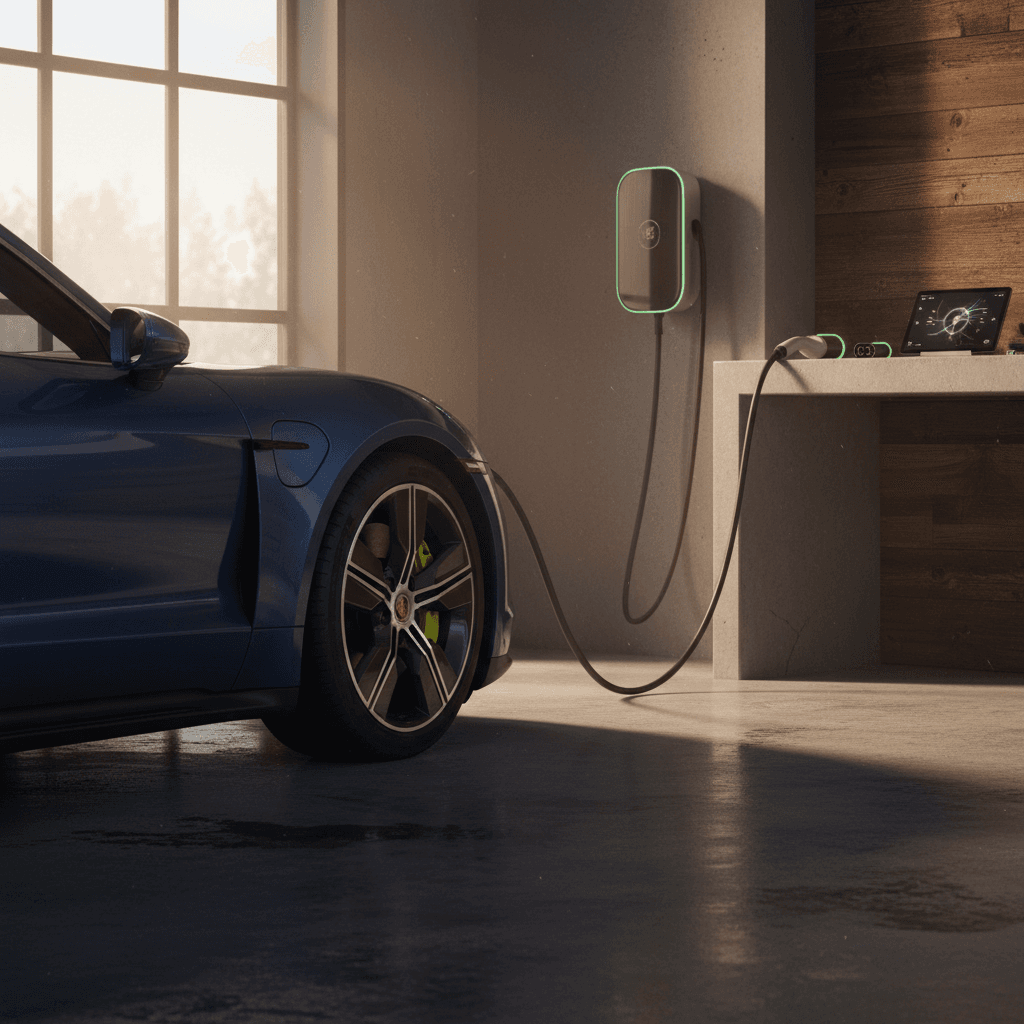
The Porsche Taycan is a four‑door electric sledgehammer, but at home it’s just another appliance fighting for space on your breaker panel. When people search “Porsche Taycan best home charger,” what they usually buy is not the best charger – it’s the biggest one. That’s often a waste of money and copper. Let’s walk through how fast the Taycan can actually charge on AC, which Level 2 chargers make sense in 2026, and how to keep both your battery and your electric bill happy.
Key takeaway in one sentence
Why your Porsche Taycan’s best home charger actually isn’t “the biggest one”
On paper, the Taycan is an overachiever: huge battery, 800‑volt architecture, DC fast charging up to about 270 kW. At home, though, you’re limited by two choke points: the car’s onboard AC charger and the size of the circuit feeding your wallbox. Plenty of owners get talked into 80‑amp hardware because it sounds suitably heroic for a six‑figure Porsche. Then they discover the car will only pull ~9.6–11 kW and finishes charging at 3 a.m. anyway.
The point of a home charger is not to refill a dead Taycan in 45 minutes – you have DC fast chargers for that. The point is to replace what you used that day quietly, safely and cheaply while you sleep. Once you look at the problem that way, the “best” home charger for a Porsche Taycan starts to look a lot more modest, and a lot more affordable.
Porsche Taycan home charging by the numbers
Taycan charging basics: how fast can it really charge at home?
Before you pick a home charger, you need to know what the Taycan can accept on AC. Think of the onboard charger as a valve: a stronger hose (bigger wallbox) doesn’t help if the valve is already wide‑open.
- Most U.S. Taycans are delivered with an AC onboard charger rated around 9.6–11 kW (roughly 40–48A at 240 V).
- Porsche offers – and has offered retrofits for – a 19.2 kW AC onboard charger on some models. To use it, you need a wallbox and circuit that can safely supply 80A at 240 V.
- At home you’re using Level 2 AC charging, not DC fast charging. That means maximum power is limited by the car’s onboard charger, not the station on the wall.
Don’t confuse DC and AC numbers
In practice, a Taycan with the standard onboard charger pulling about 9.6–11 kW will go from nearly empty to full in roughly 9–11 hours on a correctly wired Level 2. If you mostly arrive home with 30–50% remaining, you’re refilling just a portion of that overnight – which is why an oversized 19.2 kW setup is, for most owners, like installing a commercial pizza oven to reheat leftovers.
How much power you really need: 40A vs 48A vs 80A
40A (NEMA 14‑50 or hardwired on 50A circuit)
- Delivers ~9.6 kW – perfect match for most Taycans with standard onboard charger.
- Common, inexpensive for electricians to install.
- Often uses a NEMA 14‑50 receptacle with a plug‑in EVSE, or a hardwired 40A wallbox.
- Comfortably adds ~30+ miles of range per hour.
48A and up (60A–80A circuit)
- 48A (~11.5 kW) is a small but real bump in speed if your Taycan accepts it.
- 80A (~19.2 kW) only helps if your Taycan has the 19.2 kW onboard charger option or retrofit.
- Requires thicker wire, bigger breakers, and a panel that can spare the capacity.
- Best fit for very high daily mileage or multi‑EV households sharing a high‑power unit.
Rule of thumb for Taycan owners
The big 80A units sound impressive, but they tend to demand a 100A breaker and stout copper all the way back to the panel. By the time your electrician is done, you’ve spent real Porsche money to move your charge‑complete time from, say, 3:30 a.m. to 12:45 a.m. For most owners, that’s not value, it’s vanity.
Best home chargers for Porsche Taycan (2026 picks)
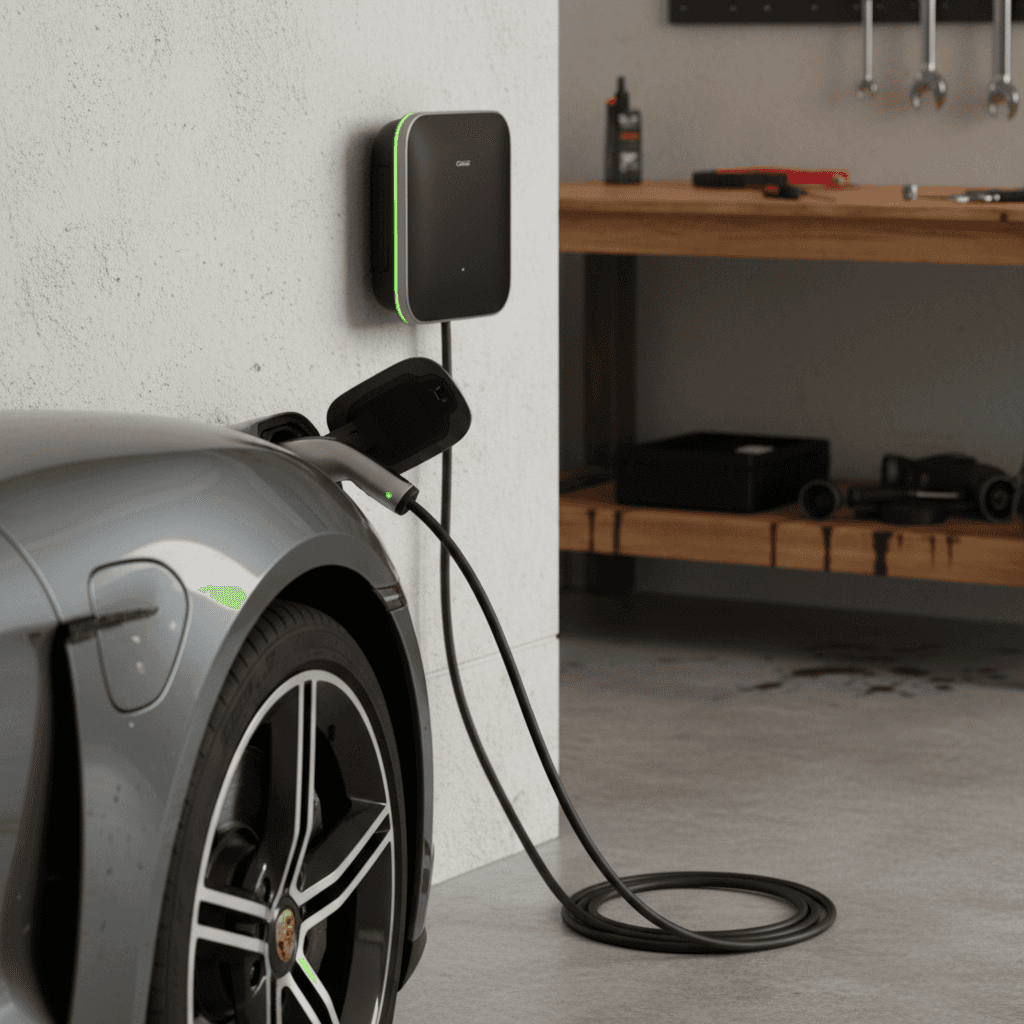
The right home charger for a Taycan doesn’t have to wear a Porsche crest. In 2026 the best units balance build quality, app experience, and amperage that actually matches the car. Here are strong options, all compatible with the Taycan’s J1772 inlet in the U.S. (or via adapter if you opt for a NACS‑only unit in the future).
Porsche Taycan home charger shortlist (U.S., 2026)
Power and features that pair well with the Taycan’s onboard AC charger.
| Charger | Max Amps / kW | Connector | Best for | Approx. Price |
|---|---|---|---|---|
| ChargePoint Home Flex | 50A–80A / up to 19.2 kW | J1772 | Owners with 19.2 kW onboard charger or future‑proofing | $649–$749 |
| Emporia Level 2 | 48A / ~11.5 kW | J1772 | Value‑focused Taycan owners who want smart features and energy monitoring | $400–$450 |
| Wallbox Pulsar Plus | 40A or 48A / up to ~11.5 kW | J1772 | Compact installs, good app, power‑sharing for multiple EVs | $599–$699 |
| Tesla Universal Wall Connector | 48A / ~11.5 kW | Built‑in J1772 + NACS | Households mixing a Taycan with a Tesla or future NACS EVs | $620–$675 |
| Grizzl‑E Smart or Classic | 40A / ~9.6 kW | J1772 | Harsh climates, outdoor installs, maximum durability over cosmetics | $350–$450 |
Pricing is ballpark street pricing in early 2026 and will vary by retailer and incentives.
Why these work well with the Taycan
You’re matching the car’s onboard charger, not chasing headline numbers.
Proper continuous‑duty ratings
Apps that don’t fight you
Flexible for your next EV
A charger you may already own
Porsche Wallbox vs third‑party chargers
Porsche would love to sell you a Porsche Wallbox and, to be fair, it’s a competent piece of hardware. It can deliver up to around 22 kW in markets whose grid supports it, and it pairs nicely with the brand’s apps and design language. In the U.S., though, many owners find that a reputable third‑party 40A–48A charger does the same real‑world job for less money and with more flexibility.
Reasons to buy the Porsche Wallbox
- You care about one‑brand integration for hardware, app, and dealer support.
- You have – or plan to retrofit – the 19.2 kW onboard charger and want to exploit it fully at home.
- Cosmetics matter: you want the charger to look like it came with the car.
Reasons to go third‑party
- Lower hardware cost for the same or similar power.
- Better ecosystem fit if you have other brands in the driveway now or later.
- Easier service or replacement if something fails after the warranty window.
Availability caveat
Installation, outlets and panel capacity: what to tell your electrician
The best Porsche Taycan home charger is only as good as the wiring behind it. This is where plenty of otherwise careful owners cut corners. A Taycan will happily pull 40+ amps for hours; your wiring and breaker need to be just as happy about it.
Installation checklist for Taycan home charging
1. Decide on target amps first
Pick your target charging current – typically 40A or 48A – before the electrician starts. They’ll size the breaker and wire accordingly (e.g., 50A breaker for a 40A continuous load).
2. Choose hardwired vs NEMA 14‑50
A <strong>hardwired</strong> charger is cleaner and avoids plug heat issues; a <strong>NEMA 14‑50 outlet</strong> gives you flexibility to move or replace chargers easily. Both can be safe if installed correctly with EV‑rated components.
3. Check panel capacity honestly
Have the electrician do a load calculation. If your main panel is already crowded with HVAC, range, dryer and a pool pump, a full 80A EV circuit may be unrealistic without a service upgrade.
4. Think about cable routing and length
The Taycan’s charge port location depends on body style and market. Place the charger where the cable reaches easily without draping across walking paths or where someone will drive over it.
5. Get the permit and inspection
In most U.S. jurisdictions, a new 240 V EV circuit requires a permit and inspection. It’s not bureaucracy for its own sake – it’s a second set of eyes on work that will carry heavy current for hours.
Don’t cheap out on the receptacle
Smart charging, scheduling and protecting your battery
The Taycan is smart enough to manage its own battery health, but your choice of home charger – and how you use it – still matters. The goal is boringly reliable charging that syncs with your utility’s cheapest rates and avoids holding the pack at 100% for no reason.
How a smart home charger helps a Taycan owner
Comfort, cost control, and a quieter battery life.
Off‑peak scheduling
Energy insights
Charge to 70–80% by default
DC fast charging is the spice, not the staple
If you’re buying a used Taycan: charging checks that matter
On the used market, the Taycan’s charging hardware can be an invisible differentiator. Two cars can look identical in the photos yet behave very differently once you plug them into a serious home charger.
Used Taycan charging checklist
Confirm onboard charger spec
Ask whether the car has the <strong>standard AC charger</strong> or the <strong>19.2 kW upgrade</strong>. The latter can justify spending more on a higher‑amp home unit if your panel supports it.
Review charging behavior
If possible, plug the car into a known good Level 2 charger and watch the current and power numbers. Unusual throttling or fault codes are worth investigating before you sign anything.
Inspect included charging gear
Many Taycans ship with a Mobile Charger or Mobile Charger Plus. Make sure it’s present, undamaged, and comes with the correct adapters for U.S. outlets.
Look for previous home charging
Evidence of a prior Level 2 install – a wallbox in the listing photos, for instance – suggests the car has been charged more gently than one living on DC fast chargers.
How Recharged helps used Taycan buyers
Porsche Taycan home charging FAQ
Frequently asked questions about Taycan home chargers
Bottom line: the best home charger setup for most Taycan owners
The Porsche Taycan is a brilliantly over‑specified machine; your home charger doesn’t have to be. For the way most people drive, the best home charger for a Taycan is a well‑installed 40A–48A Level 2 unit from a reputable brand, fed by a properly sized 240 V circuit, and paired with sensible charge limits and scheduling. Spend money on quality hardware and good electrical work, not on amperage you’ll never use.
If you’re cross‑shopping Taycan trims or looking at the used market, it’s worth factoring in how you’ll charge just as seriously as how you’ll spec the wheels. At Recharged, every used EV comes with a Recharged Score battery‑health report, transparent pricing, and EV‑savvy guidance on home charging, installation costs, and whether your panel is ready for prime time. A great Taycan deserves a great charging setup – but that doesn’t mean the most expensive one.