If you own, or are shopping for, a Polestar 2, you’ve probably heard about the car’s high‑voltage pack. But when a “12V battery low” message pops up in the Polestar app or on the screen, things get confusing fast. The auxiliary 12‑volt battery can quietly disable an otherwise healthy EV, so understanding Polestar 2 12V battery replacement, costs, and warning signs is critical to stress‑free ownership.
Quick takeaway
Why the Polestar 2 still uses a 12V battery
Like almost every modern EV, the Polestar 2 has two batteries:
- A large high‑voltage lithium‑ion pack (the one that gives you driving range).
- A smaller 12‑volt battery that powers control modules, locks, lights, infotainment, safety systems, and closes the contactors that connect the big pack.
Even though the traction battery is massive, the car still relies on this 12V “starter” battery to boot the computers and close the high‑voltage relays. If the 12V battery is weak or dead, your Polestar 2 can be completely immobilized: you may not be able to unlock it, shift into gear, or even start charging.
Don’t ignore 12V issues
Polestar 2 12V battery specs and location
Polestar’s own documentation lists the Polestar 2’s 12‑volt battery as an H6 AGM (Absorbent Glass Mat) unit with the following key specs:
Polestar 2 12V battery specifications
Factory‑specified characteristics for the original Polestar 2 12V battery.
| Spec | Value |
|---|---|
| Battery type | H6 AGM (Absorbent Glass Mat) |
| Voltage | 12 V |
| Capacity | 70 Ah |
| Cold Cranking Amps (CCA) | 760 A (EN rating) |
| Approx. dimensions | 277.7 × 174.4 × 188.5 mm (10.9 × 6.9 × 7.4 in) |
Always confirm against the label on your existing battery before ordering a replacement.
AGM batteries are sealed, spill‑resistant, and handle the stop‑start, accessory‑heavy life of an EV better than traditional flooded batteries. When you replace the 12V battery, use the same size, type, and similar CCA rating as the original label under the hood.
Location and access
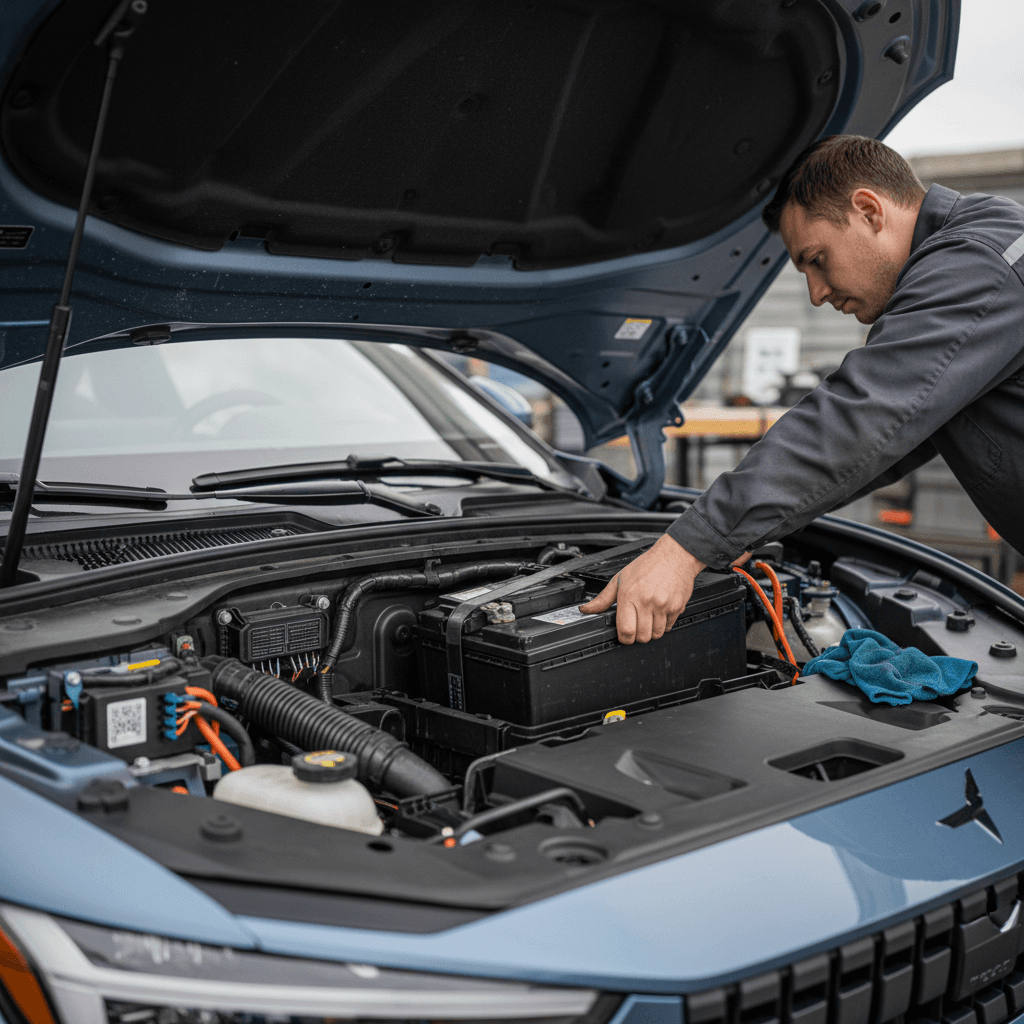
Symptoms of a failing 12V battery in a Polestar 2
The tricky part with the Polestar 2 is that a weak 12V battery doesn’t always show up the way it would on a gas car. You might not get a slow crank, or any crank at all, because there’s no starter motor. Instead, watch for these signs:
Common Polestar 2 12V battery warning signs
What owners often notice in the weeks or days before the 12V fails.
Warnings in the app
Many owners first see a “12V battery low” or “Low charge – 12V battery” message in the Polestar app. Sometimes the car itself shows no errors yet.
Strange behavior on startup
Blank or flickering center screen, delayed wake‑up, random error messages, or systems that won’t power on consistently can all point to a weak 12V.
Charging issues
If the 12V battery can’t reliably close the high‑voltage contactors, you may see failed charging attempts, especially after the car has been parked for days.
Car won’t “wake up”
In more advanced cases, the car may not respond to the door handles, won’t shift into gear, or appears completely dead even with a full traction battery.
Intermittent dash warnings
You might see sporadic warnings about electrical system faults or power‑steering/safety systems that clear themselves after a restart.
Age and climate
If your Polestar 2 is 3–5 years old, especially in a hot or very cold climate, the 12V is simply entering the normal replacement window.
App glitch vs. real problem
Is it safe to drive with a 12V warning?
If you see a low 12V warning only in the app, the car powers on normally, and you’re not seeing any new errors on the driver display, you’re probably not in immediate danger. But you shouldn’t ignore it either.
Mild cases: monitor and test
- If the car starts and drives normally, you can typically finish short trips.
- Schedule a 12V battery test with a dealer or trusted independent shop.
- A battery monitor or multimeter can confirm resting voltage (a healthy AGM battery is usually 12.6 V or higher at rest).
Serious warnings: don’t push it
- If you see dashboard warnings about 12V, loss of power steering, or multiple system faults, treat it as urgent.
- Driving with a failing 12V battery can leave you stranded, unable to shift into Park or Start.
- Have the car inspected or towed rather than repeatedly cycling the power.
Remember: the 12V is a mission‑critical part
Replacement interval and real-world cost
For most Polestar 2s, the 12‑volt battery is a 3–5 year wear item, similar to a conventional car. Some last longer in mild climates; some die earlier if the car sits for long stretches or sees frequent software updates and short trips.
Polestar 2 12V battery replacement at a glance
Actual cost depends on your market, labor rates, and whether you choose an OEM‑branded battery or a high‑quality aftermarket AGM unit. The important thing is to match type (AGM), size (H6/LN3‑style) and capacity so charging behavior and fitment remain correct.
Ask about goodwill or warranty
DIY vs. dealer: what’s realistic for 12V replacement?
Replacing the 12‑volt battery on a Polestar 2 is more involved than on a basic sedan, but it’s not rocket science. The main question is your comfort level with modern electrical systems and trim removal.
DIY vs. dealer Polestar 2 12V replacement
How to decide which route makes sense for you.
DIY replacement
- Requires basic tools and comfort removing trim panels.
- You must follow the correct sequence (disconnect negative first, reconnect last).
- No direct access to Polestar’s diagnostic tools or software resets.
- Best if you’re out of warranty and used to working on cars.
Dealer or EV‑savvy shop
- Technicians follow the official Polestar 12V replacement protocol.
- They can perform software resets and checks after replacement.
- Higher parts and labor cost, but fewer surprises.
- Smart choice if you’re under warranty or uncomfortable around EV high voltage.
High‑voltage safety first
Step‑by‑step overview: Polestar 2 12V battery replacement
If you’re evaluating whether DIY is realistic, or just want to understand what your technician is doing, here’s a high‑level overview of the typical Polestar 2 12V battery replacement process. This is not a full factory manual, but it will help you ask the right questions.
High-level Polestar 2 12V battery replacement steps
1. Park safely and power down
Park on a flat surface, engage Park, and switch the car off. Open the hood and keep the key well away from the car to prevent it from trying to wake up during the work.
2. Remove plastic covers and trim
Remove the front compartment covers and panels that sit over the 12V battery. On the Polestar 2, this usually involves a few plastic clips and fasteners.
3. Disconnect the negative (–) terminal first
Always disconnect the <strong>negative cable first</strong> to reduce the risk of short circuits. Secure it away from the battery post so it cannot spring back into contact.
4. Disconnect the positive (+) terminal and securing hardware
Loosen and remove the positive terminal and any bracket or clamp that holds the battery in place. Take note of any vent tubes or wiring harnesses attached to the battery.
5. Lift out the old AGM battery
AGM batteries are heavy. Lift straight up with good posture and avoid contacting exposed metal parts. Keep the battery upright to prevent any residual acid from escaping.
6. Install the new AGM battery
Place the replacement H6 AGM battery into the tray, making sure it sits flat and is oriented the same way. Reattach the clamp or bracket and any vent connections.
7. Reconnect positive (+) then negative (–)
Reconnect the <strong>positive terminal first</strong>, then the negative. Tighten the clamps securely, but don’t overtighten to the point of damaging the posts.
8. Reinstall covers and verify operation
Reinstall all trim panels and covers. Wake the car, check for warning lights, and confirm that locks, screens, and charging all behave normally. In some cases, software resets may be performed at a service center.
Acid and explosion risk
What 12V battery health means if you’re buying used
If you’re shopping the used market, especially for an early 2021–2022 Polestar 2, a tired 12V battery is not unusual. But you don’t want to discover a failing auxiliary battery the first time you leave the car parked for a week.
Questions to ask the seller
- Has the 12V battery ever been replaced? If so, when and with what brand/spec?
- Have they seen low 12V warnings in the app or on the dash?
- Has the car ever been unable to wake or stuck in Park due to battery issues?
- Any recent software updates or repair orders mentioning the 12V system?
Red flags during a test drive
- Center screen takes an unusually long time to boot or flickers.
- Multiple random error messages that clear themselves.
- Charging attempts fail or abort without explanation.
- The car has clearly sat for long periods with a low main battery.
Budgeting for a used Polestar 2
How Recharged checks Polestar 2 12V and HV battery health
Because the 12V system is so central to an EV’s reliability, Recharged puts extra emphasis on it when we inspect any used Polestar 2 for our marketplace.
Battery checks included with every Polestar 2 on Recharged
We look at both the big pack and the small but critical 12V.
Recharged Score battery diagnostics
Every Recharged Polestar 2 comes with a Recharged Score Report that summarizes high‑voltage battery health, charge history, and usage patterns so you aren’t guessing about long‑term durability.
12V battery condition check
Our technicians check 12V voltage and behavior during wake‑up and charging. If the auxiliary battery shows signs of weakness, it’s addressed before the car is listed.
Specialist guidance end‑to‑end
Not sure how to read a 12V warning, or whether to replace the battery now or later? Our EV specialists can talk you through trade‑offs, and our digital buying process can include financing and nationwide delivery on a used Polestar 2.
Ready to find your next EV?
Browse VehiclesIf you’d rather not inherit someone else’s deferred maintenance, buying through Recharged means the high‑voltage and 12V systems on your next Polestar 2 have already been checked, documented, and priced fairly, without the usual mystery of a private‑party sale.