
If you own a Nissan Rogue, your service schedule is the difference between a smooth, quiet crossover and one that eats brakes, wears out tires, and risks costly CVT repairs. The good news: the Rogue’s maintenance needs are simple once you break them down by mileage, and you don’t have to memorize the entire owner’s manual to stay on top of it.
Applies to most model years
How often should you service a Nissan Rogue?
Most late‑model Nissan Rogue service schedules are built around a 5,000–10,000 mile rhythm. Many U.S. dealers recommend visits every 5,000 miles or 6 months for an oil change, tire rotation, and inspections, even if the official warranty booklet allows slightly longer intervals under ideal conditions.
- Oil and filter change: usually every 5,000–7,500 miles (6 months)
- Tire rotation: typically every 5,000–7,500 miles, often done with the oil change
- Brake fluid: about every 20,000–40,000 miles or every 2–3 years
- Engine air filter: around 30,000 miles (more often in dusty areas)
- Cabin air filter: about every 15,000–30,000 miles
- CVT fluid: inspect regularly; many dealers replace between 30,000 and 60,000 miles depending on use
Simple rule of thumb
Nissan Rogue service schedule by mileage
Below is a practical, combined Nissan Rogue maintenance schedule up to 120,000 miles, based on common dealer schedules across the U.S. It’s designed for gasoline Rogues with the CVT transmission; hybrids or earlier generations may differ slightly.
Typical Nissan Rogue service schedule (up to 120,000 miles)
Use this table as a quick reference, then confirm details in your owner’s manual for your specific model year.
| Mileage / Time | Main Services |
|---|---|
| 5,000 miles / 6 months | Replace engine oil & filter; rotate tires; basic brake and fluid inspection |
| 10,000 miles / 12 months | Oil & filter; brakes inspection; CVT fluid visual check; suspension & steering inspection |
| 15,000 miles / 18 months | Oil & filter; replace cabin (in‑cabin) microfilter; inspect key fob battery, brakes, tires |
| 20,000 miles / 24 months | Oil & filter; replace brake fluid; inspect EVAP & fuel lines; brakes, CVT fluid, differential/transfer case (AWD), suspension, exhaust |
| 30,000 miles / 36 months | Oil & filter; replace engine air filter; replace cabin filter; replace key fob battery; inspect brakes, CVT fluid, differential/transfer case (AWD) |
| 40,000 miles / 48 months | Oil & filter; inspect drive belt; replace brake fluid; inspect EVAP & fuel lines, brakes, CVT, AWD components, suspension, exhaust |
| 60,000 miles / 72 months | Oil & filter; engine air filter; cabin filter; key fob battery; drive belt inspection; brake fluid; full inspection of brakes, CVT, AWD, suspension, exhaust |
| 90,000 miles / 108 months | Oil & filter; engine air filter; cabin filter; key fob battery; drive belt inspection; brakes, CVT, AWD & suspension inspection |
| 100,000 miles / 120 months | Oil & filter; brake fluid; major inspection of brakes, CVT, AWD system, suspension, exhaust, fuel lines; spark plugs on older models |
| 120,000 miles / 144 months | Oil & filter; air & cabin filters; drive belt inspection; brake fluid; full chassis and fluid inspection similar to 60,000‑mile service |
Mileage intervals are either/or: follow whichever comes first, miles or time.
Model‑year differences matter
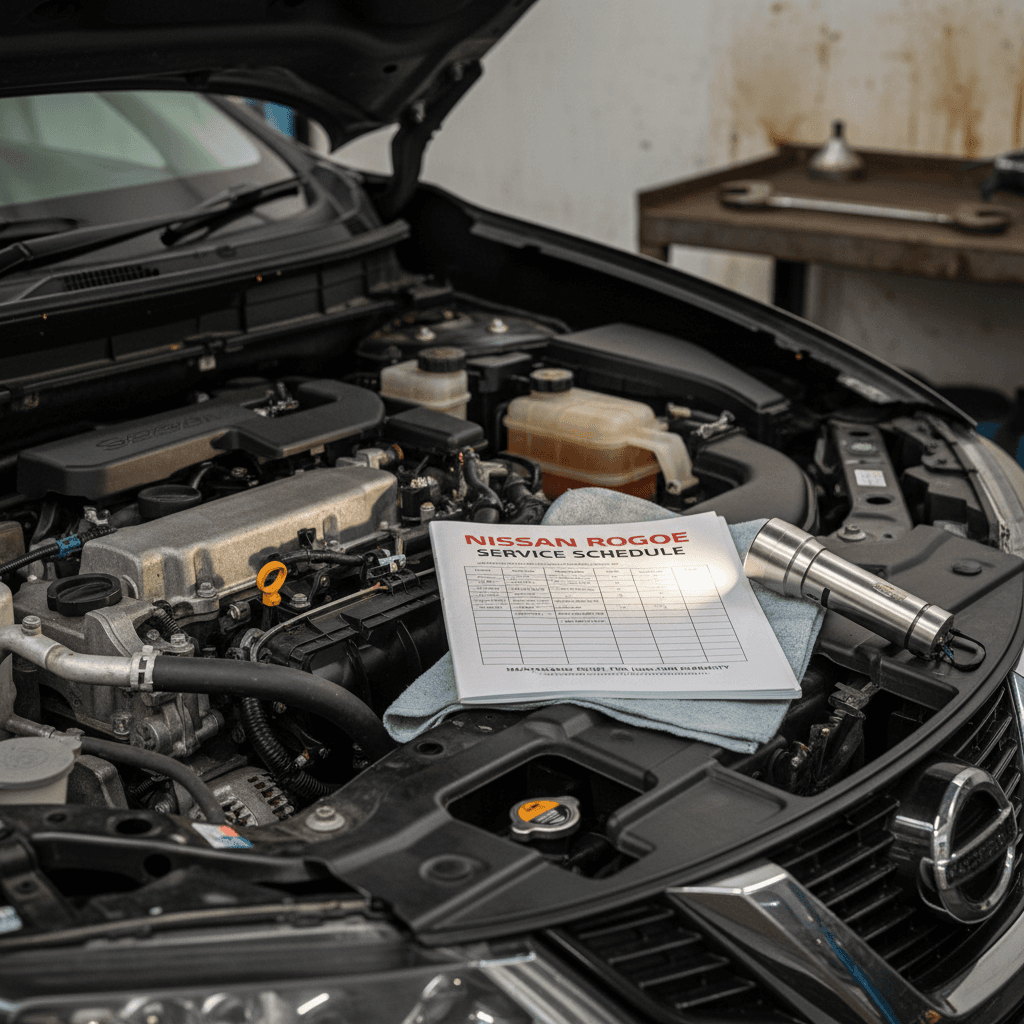
Normal vs. severe Nissan Rogue service schedules
Nissan, like most automakers, actually publishes two maintenance schedules: one for normal driving and one for severe conditions. Many Rogue owners are surprised to learn they fall into the severe category.
- Frequent short trips (under 5 miles) in cold weather
- Stop‑and‑go commuting in heavy traffic
- Regular driving on dusty, unpaved, or muddy roads
- Towing, roof cargo boxes, or fully loaded road trips
- Extended idling or low‑speed driving in hot weather
Why severe use matters for your CVT
Normal service pattern
- Oil & filter every 7,500–10,000 miles (if specified by your manual)
- Brake fluid roughly every 30,000–40,000 miles
- CVT fluid often inspected only until 60,000+ miles
Severe service pattern
- Oil & filter every 5,000 miles or 6 months
- More frequent brake fluid and CVT checks
- Earlier replacement of filters and possibly CVT fluid
If your driving matches severe conditions, follow the more aggressive schedule even if your dashboard reminder hasn’t lit up yet.
Key Nissan Rogue services explained
What each major Nissan Rogue service actually does
You don’t need to know every part number – just what each service protects and when it matters.
Oil & filter change
Fresh oil keeps the 2.5L or turbo‑3 engine lubricated and cool. Old oil breaks down and can thicken, especially if you make a lot of short trips.
When: 5,000–7,500 miles for most owners; check your manual.
CVT fluid service
The continuously variable transmission depends on clean, correct‑spec CVT fluid. It’s not a lifetime fluid, especially if you tow, drive in heat, or keep the car past 100,000 miles.
When: inspect regularly; many shops recommend changing between 30,000–60,000 miles depending on use.
Brake fluid replacement
Brake fluid absorbs moisture over time, which can lead to a soft pedal and internal corrosion in calipers and ABS components.
When: roughly every 20,000–40,000 miles or 2–3 years.
Engine & cabin air filters
The engine air filter protects the engine from dust; the cabin filter traps pollen and odors in the HVAC system.
When: engine filter around 30,000 miles; cabin filter every 15,000–30,000 miles.
Inspections & adjustments
At each service, technicians check belts, hoses, steering, suspension, exhaust, and tires. Catching a small leak or torn CV boot early is far cheaper than replacing major components later.
Tires, brakes & alignment
Rotating tires and monitoring alignment keeps your Rogue tracking straight and can easily add thousands of miles to tire life.
When: every 5,000–7,500 miles, usually with the oil change.
CVT service: let the pros handle it
High‑mileage Nissan Rogue: 100,000 miles and beyond
By the time your Nissan Rogue crosses the 100,000‑mile mark, the maintenance story changes from "keeping the warranty happy" to "keeping the vehicle dependable and predictable." A well‑maintained Rogue can go far beyond this point, but it needs a few big‑picture checks.
- Comprehensive brake system check: pads, rotors, hoses, and fluid condition
- CVT fluid inspection (and likely replacement if it hasn’t been done yet)
- Suspension wear: struts, control arm bushings, sway‑bar links
- Exhaust system and heat shields for rust and rattles
- Engine drive belt inspection or replacement
- Spark plugs on older or higher‑mileage engines (check your manual for interval)
Why maintenance matters when buying used
This is exactly why, at Recharged, every used EV we list includes a Recharged Score Report with verified battery health, service history insights, and fair‑market pricing. When you eventually move from a gas Rogue to an electric SUV, that kind of transparency makes your next ownership experience much calmer.
Service costs and dealer vs. independent shops
Knowing the Nissan Rogue service schedule is only half the equation; you also need a realistic sense of what each visit might cost and where to go. Prices vary by region, but the pattern is pretty consistent.
Nissan dealer advantages
- Factory‑trained technicians and Nissan‑specific diagnostic tools
- Access to technical service bulletins and software updates
- Correct CVT fluid and procedures
- Maintenance records in Nissan’s system, which can help with goodwill repairs
Independent shop advantages
- Often lower labor rates once your warranty period is over
- More flexible about parts brands and repair options
- Good choice for brakes, tires, and routine fluid changes
For CVT work and complex diagnostics, a dealer or transmission specialist is usually the safest bet. For oil, brakes, and tires, a trusted independent shop is perfectly fine.
Ballpark cost ranges
How a good service schedule protects resale value
The Rogue is a mass‑market family crossover, which means the used‑car market is very sensitive to signs of neglect. Two Rogues with identical mileage can be thousands of dollars apart in value based purely on maintenance history and how they drive on a short test loop.
Three ways a solid service history pays you back
Stronger paper trail
A complete set of invoices showing 5,000‑mile services and major milestones makes a future buyer (or dealer) relax instantly. It says someone cared.
Better test drive
A well‑maintained Rogue shifts smoothly, brakes straight, and feels tight over bumps. That driving impression translates directly into higher offers.
More leverage when selling or trading
When you can show meticulous maintenance, you have a stronger case asking top‑of‑market money – whether you’re selling privately or trading in.
If you’re thinking ahead to your next vehicle, this is exactly what buyers will look for when you eventually sell your Rogue and shop for a used EV. Marketplaces like Recharged are built around transparent history and verified battery health, so staying organized with your records now will pay off later.
Quick Nissan Rogue service checklist
Nissan Rogue maintenance cheat sheet
1. Set a 5,000‑mile reminder
Use your phone or maintenance minder to schedule an oil change, tire rotation, and general inspection every 5,000 miles or 6 months, whichever comes first.
2. Track the big milestones
Highlight 20,000, 30,000, 60,000, 90,000, and 100,000‑mile services in your calendar. These visits usually include extra items like filters, brake fluid, or CVT checks.
3. Match the schedule to your driving
If you do short trips, heavy traffic, or dusty roads, follow the severe‑use schedule: more frequent oil changes and earlier fluid inspections.
4. Keep every receipt
Save digital or paper copies of all service invoices. They’re your proof of maintenance for warranties and resale value.
5. Use the right fluid for the CVT
Make sure any shop working on the transmission uses the correct Nissan‑spec CVT fluid and knows the proper fill procedure.
6. Don’t ignore noises or warning lights
A squeal, shudder, or dashboard light is your Rogue asking for help. Catching problems early is almost always cheaper than waiting.
Nissan Rogue service schedule FAQ
Frequently asked questions about Nissan Rogue service
If you treat the Nissan Rogue service schedule as a simple checklist instead of a mystery, the crossover that shuttles your family and your stuff will feel newer for longer, and cost less to keep on the road. Start with a 5,000‑mile rhythm, match the schedule to how and where you drive, and keep every receipt. Whether you keep your Rogue for the long haul or trade into a used EV on Recharged, a well‑maintained car always gives you more options.