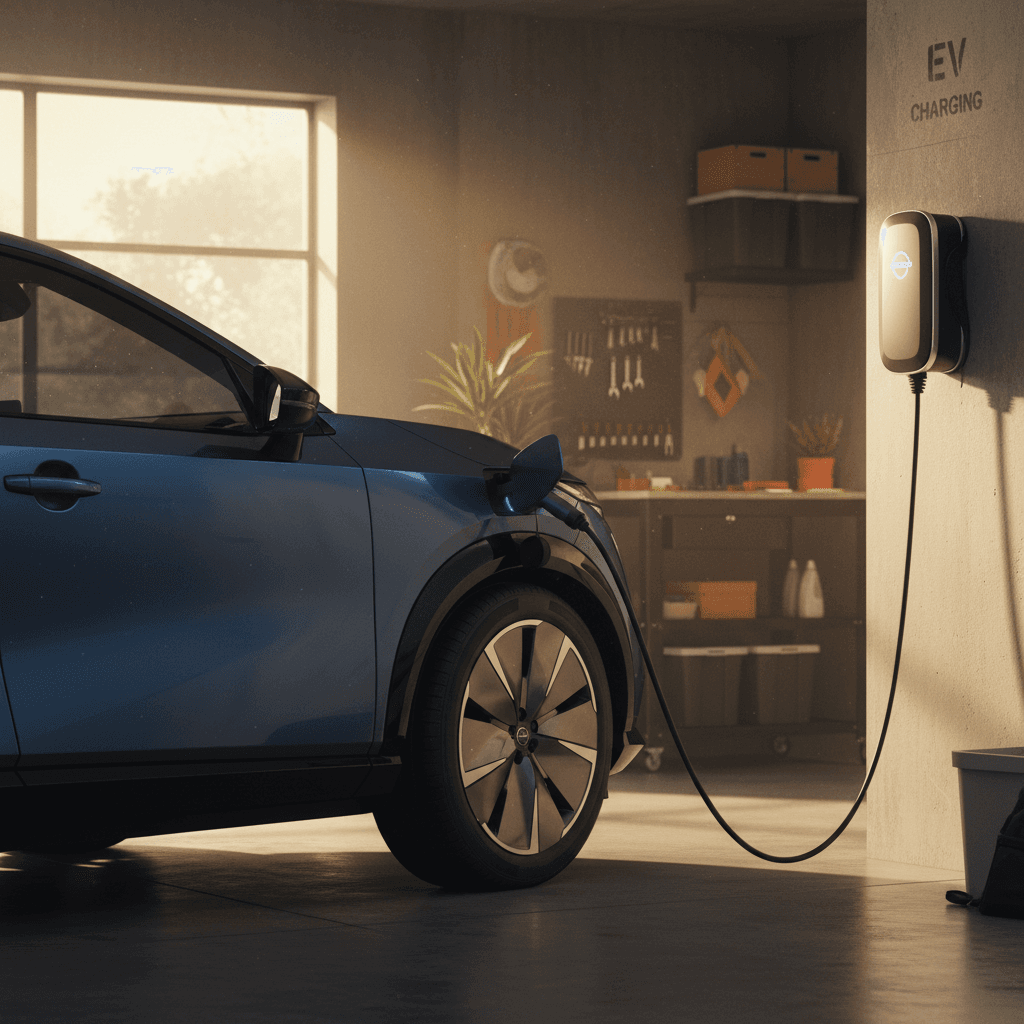
If you drive a Nissan Ariya, a good Level 2 home charger is one of the best upgrades you can make. The right unit can turn your garage into a personal “fuel station,” cut your time at public chargers, and keep your battery in its sweet spot. This guide breaks down the Nissan Ariya’s home charging needs, then compares several of the best home chargers for the Nissan Ariya available in 2026.
Quick takeaway
Nissan Ariya home charging basics
Before you pick hardware, it helps to understand how the Ariya handles charging. In North America, the Ariya’s onboard AC charger is rated around 7.2–7.4 kW, which is what limits your maximum home charging speed, not the wallbox. In simple terms, that’s roughly 28–32 miles of range added per hour of charging for most trims.
- Connector: J1772 for Level 1 and Level 2 AC charging (home and most public stations).
- Onboard AC charger (U.S.): ~7.2–7.4 kW peak on most trims, so anything above that on the wallbox is mostly future‑proofing.
- DC fast charging: Up to 130 kW at CCS1 public fast chargers or compatible Tesla Superchargers for road trips, not for home use.
- Battery sizes: Roughly mid‑60 kWh and high‑80 kWh packs, depending on trim and market year. Larger packs take longer to fill but also deliver more range.
What this means in practice: a Level 2 charger on a 240‑volt circuit will fill an Ariya from low state of charge to 100% overnight. Level 1 charging from a standard 120‑volt outlet technically works, but it’s painfully slow and best reserved for emergencies or very light daily use.
Safety first
How fast can a home charger refill an Ariya?
Typical Nissan Ariya home charging speeds
Because the Ariya tops out around 7.2–7.4 kW on AC, a charger capable of 32 amps continuous (7.7 kW at 240 V) will already let the car operate near its limit. Higher‑amp units, 40 A, 48 A, even 50 A, won’t significantly speed up the Ariya today, but they can be useful if you plan to replace it later with an EV that accepts 11 kW or more.
Rule of thumb
Top home chargers for the Nissan Ariya
There’s no single “official” best home charger for the Nissan Ariya, but a few Level 2 units stand out for reliability, app experience, and Ariya‑friendly power levels. Below are strong options widely available in the U.S. as of 2026.
Four standout Level 2 chargers for Nissan Ariya owners
All of these work with the Ariya’s J1772 port and 7.2–7.4 kW onboard charger.
ChargePoint Home Flex
Best all‑around, name‑brand choice
- Adjustable 16–50 A output with NEMA 14‑50 plug‑in or hardwire options.
- Capable of up to 11.5 kW, so it easily covers the Ariya’s ~7.2–7.4 kW needs and future EVs.
- Well‑polished app, scheduled charging, energy tracking, and utility rate support.
- Backed by a major charging‑network brand with wide service coverage.
Ideal if you want a mature app ecosystem, proven reliability, and the option to reuse the unit for a higher‑powered EV later.
Emporia Smart EV Charger
Best value with deep energy insights
- Up to 48 A (11.5 kW) when hardwired; current can be dialed down to match your circuit.
- Excellent app with detailed consumption data, solar integration, and load management.
- Often priced below big‑brand competitors while still UL‑listed and robust.
- Great fit if you care about optimizing off‑peak charging and managing home energy use.
Pairing Emporia with an Ariya gives you strong performance today and room to grow.
Wallbox Pulsar Plus
Compact charger for tight garages
- Small, stylish unit offering up to 40–48 A depending on configuration.
- Strong app with scheduling, dynamic power sharing if you add a second unit, and Alexa/Google integration.
- Good choice if you want a discreet charger that doesn’t dominate the wall.
Perfect for townhomes or garages where space and aesthetics matter.
Grizzl‑E Classic
Rugged, no‑nonsense workhorse
- Up to 40 A, heavy‑duty metal case, simple hardware switches for current settings.
- Fewer smart features but extremely durable, especially in harsh climates.
- NEMA 14‑50 plug‑in or hardwire options; long, thick J1772 cable.
Choose this if you value toughness and simplicity over apps and bells and whistles.
Good news for Ariya owners
Side‑by‑side comparison of Ariya home chargers
Here’s a quick look at how some of the top contenders stack up for a Nissan Ariya driver installing a new Level 2 charger at home.
Popular Level 2 home chargers for Nissan Ariya
Key specs that matter when pairing a charger with the Nissan Ariya’s 7.2–7.4 kW onboard AC charger.
| Charger | Max Amps (240 V) | Max kW | Plug‑in or Hardwire | Smart App & Wi‑Fi | Best For |
|---|---|---|---|---|---|
| ChargePoint Home Flex | 50 A | Up to 11.5 kW | Plug‑in or hardwire | Yes | Owners who want a polished app and brand support |
| Emporia Smart EV Charger | 48 A | Up to 11.5 kW | Hardwire (with plug option on some bundles) | Yes | Value shoppers and data/energy nerds |
| Wallbox Pulsar Plus | 40–48 A | Up to ~11.5 kW | Plug‑in or hardwire | Yes | Drivers who want a small, stylish unit |
| Grizzl‑E Classic | 40 A | Up to 9.6 kW | Plug‑in or hardwire | No (basic) | Rugged, simple, cold‑climate setups |
All of these units deliver more than enough power for an Ariya; differences come down to price, features, and future‑proofing.
Installation and electrical setup for Ariya owners
Matching the charger to your household electrical service is just as important as picking the brand. The National Electrical Code treats EV charging as a continuous load, so your charger’s continuous current should be no more than 80% of the circuit breaker rating. That’s why a 40 A charger typically requires a 50 A breaker, and a 48 A charger calls for 60 A.
Home installation checklist for your Nissan Ariya charger
1. Confirm electrical panel capacity
Have an electrician confirm your main panel’s available capacity. Many homes can support a new 40–50 A circuit; some older panels may need an upgrade or load management device.
2. Choose breaker and wire size
Match the breaker and wire gauge to the charger’s maximum current. For example, a 40 A setting usually needs a 50 A breaker and appropriately sized copper wire.
3. Decide plug‑in vs. hardwire
Plug‑in (NEMA 14‑50) chargers are easier to swap later. Hardwired setups are cleaner and often allow higher amp settings, but they’re more permanent.
4. Pick the mounting location
Mount the unit close enough to reach your Ariya’s front‑side charge port without stretching or tripping over the cable, typically 18–25 feet of cable is ideal.
5. Plan for weather exposure
If your charger will live outdoors, choose a unit with a solid NEMA enclosure rating and robust cable. Consider a pedestal or protective cover in snowy or coastal climates.
6. Schedule professional installation
Have a licensed electrician pull permits where required, run the circuit, and test the charger with your Ariya before signing off.
Where Recharged can help
Smart features, apps, and energy management
Since a higher‑powered charger doesn’t make the Ariya charge much faster, smart features often become the real differentiator. A well‑designed app can save you money, simplify life, and even play nicer with your home’s electrical limits.
Smart chargers (ChargePoint, Emporia, Wallbox)
- Scheduled charging lets you automatically start sessions in off‑peak rate windows.
- Energy tracking shows how many kWh and dollars go into your Ariya each month.
- Load management can keep your house from overloading if multiple big appliances run at once.
- Some integrate with utility demand‑response programs that offer bill credits.
Basic chargers (Grizzl‑E, simple “dumb” units)
- Often cheaper up front and extremely reliable.
- No Wi‑Fi: you rely on the Ariya’s in‑car settings and odometer for energy estimates.
- Fewer failure points because there’s no extra software stack.
- Best if you’re on a flat electricity rate and just want dependable overnight charging.
Don’t forget the Ariya’s own settings
How to choose the right charger for your Ariya
Choosing the best home charger for a Nissan Ariya comes down to matching your driving pattern, budget, and home wiring, not chasing the biggest kilowatt number on the box.
Ariya home‑charger buyer’s checklist
Clarify your daily mileage
If you drive 30–50 miles a day, even a 7.2 kW effective rate will refill that in roughly two hours. Heavy commuters or multi‑EV homes benefit more from 40–48 A units.
Check your electricity rates
If your utility offers cheaper off‑peak hours, a smart charger with robust scheduling and rate support will pay for itself faster.
Think about future EVs
If you may replace the Ariya with a higher‑powered EV, lean toward a 40–48 A charger and size the circuit accordingly, even though the Ariya won’t use all of it today.
Decide how much you value data
If charts and usage history matter, prioritize chargers like Emporia or ChargePoint. If not, a simpler unit may be smarter spending.
Plan for resale and flexibility
Plug‑in 14‑50 units are easy to move to a new home or repurpose in a different garage, helpful if you rent or anticipate moving soon.
Factor in total installed cost
Compare not just the charger price but also electrician labor, permits, panel upgrades, and potential utility rebates in your area.
Common Nissan Ariya home‑charging mistakes to avoid
- Oversizing the charger “just because” without checking whether your panel can support a larger circuit safely.
- Undersizing the circuit, running a 40 A charger on wire and a breaker that are only appropriate for 30 A loads.
- Mounting the charger too far from the Ariya’s charge port, causing cable strain or creating a tripping hazard.
- Ignoring local permits and inspections, which can cause headaches if you sell the home or have an insurance claim.
- Relying on Level 1 trickle charging long‑term when your daily miles and schedule really demand Level 2.
Don’t DIY beyond your comfort zone
Frequently asked questions about Nissan Ariya home chargers
Nissan Ariya home‑charging FAQ
Bottom line: the best home charger for a Nissan Ariya
For most drivers, the “best” home charger for a Nissan Ariya is a 32–40 A Level 2 unit from a reputable brand, installed on a properly sized 240‑volt circuit. Models like the ChargePoint Home Flex, Emporia Smart EV Charger, Wallbox Pulsar Plus, and Grizzl‑E Classic all pair very well with the Ariya’s 7.2–7.4 kW onboard AC charger and offer different mixes of smart features, toughness, and price.
Focus on safety, installation quality, and features that fit your lifestyle, not just the biggest amperage number. And if you’re still shopping for an Ariya, remember that Recharged can help you evaluate used examples with verified battery health through the Recharged Score and guide you through home‑charging decisions so that your first night with the car is as simple as plugging in and waking up to a full battery.