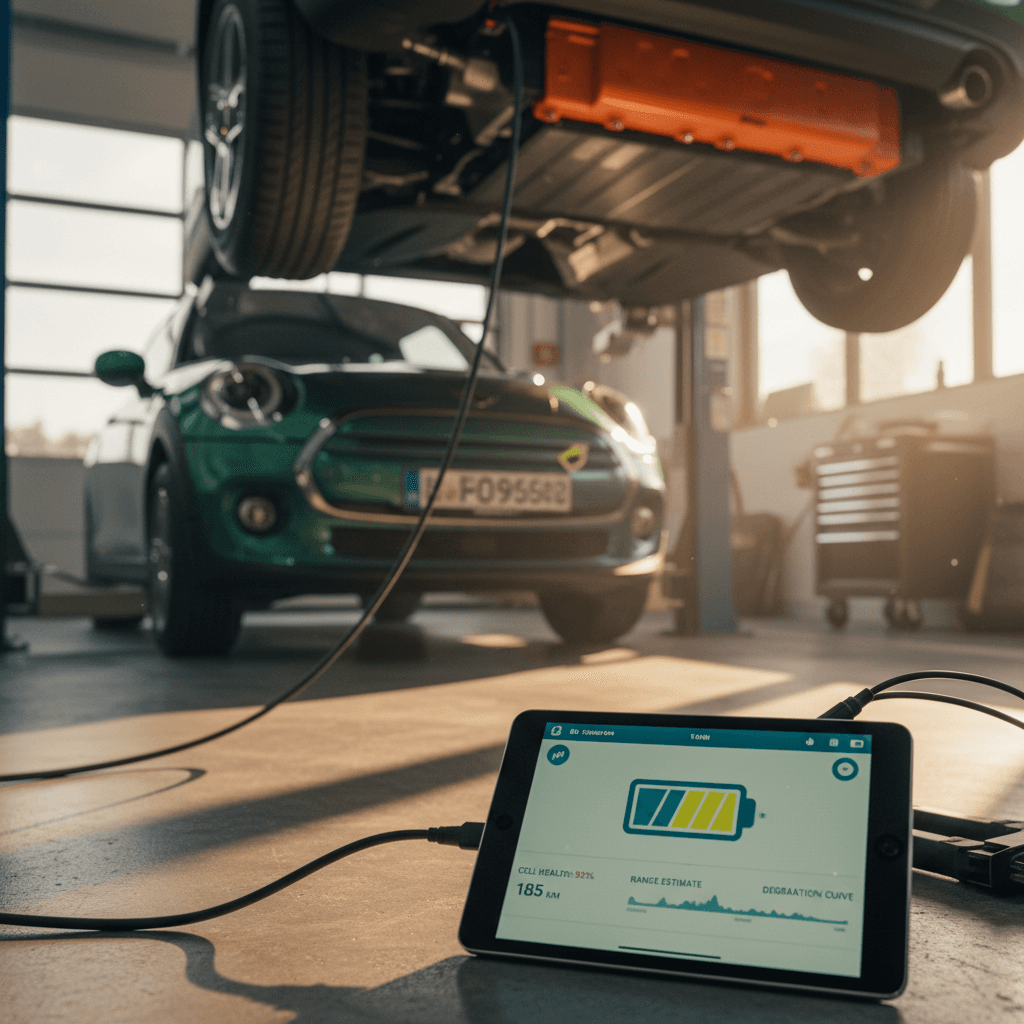
If you own, or are eyeing, a Mini Cooper SE, battery health is the whole ballgame. With a relatively small pack and city-focused range, even modest degradation can feel dramatic. The good news: you can perform a solid Mini Cooper SE battery health check using the car’s own displays, a bit of real-world driving, and (if you want to go deeper) inexpensive diagnostic tools or a professional report like the Recharged Score.
Before you start
Why battery health matters on a Mini Cooper SE
Every EV depends on its battery, but the Mini Cooper SE lives and dies by it. With a usable battery capacity in the mid‑20 kWh range and EPA range around 110–120 miles when new, losing even 10–15% of capacity can noticeably pinch your daily flexibility. That’s why knowing how to check Mini Cooper SE battery health isn’t just a nerdy exercise, it’s the difference between a perfect city runabout and a car that always feels on the edge.
What good vs. bad Mini SE battery health feels like
Same car, very different ownership experience
Healthy battery
Feels like the range estimate is honest and predictable. You comfortably cover your daily routes with buffer to spare, even in winter.
Moderate degradation
You start trimming optional trips, charging more often, and noticing the car hit low‑state‑of‑charge warnings sooner than expected.
Severely degraded
Range swings wildly, you’re planning around chargers constantly, and the car no longer fits your routine without compromises.
Mini Cooper SE battery basics and what “normal” degradation looks like
Before you poke at numbers, it helps to understand what’s under the floor. The Mini Cooper SE uses a T‑shaped lithium‑ion pack shared with BMW’s early EV tech. As with any modern pack, you’ll see some initial degradation in the first few years, then a slower decline over time. Real‑world owners commonly report a small but noticeable drop in range after the first 20–40,000 miles, then a gentler taper.
- Most healthy used Mini SEs show roughly 5–10% capacity loss after several years of normal use.
- Abuse, constant DC fast charging, parking hot and full, or lots of 0%–100% cycles, can accelerate degradation.
- Because the original EPA range is modest, even normal loss can feel bigger than it is. Losing 10% of a large‑pack SUV is annoying; losing 10% on a small‑pack Mini is noticeable every day.
Warranty vs. reality
Quick self-check: using your daily driving data
The easiest Mini Cooper SE battery health check starts with what you already see every day: state of charge (SoC), estimated range, and how many miles you actually drive. You don’t need tools for this, just a notepad or notes app and a consistent driving loop.
5-minute at-home Mini SE battery self-check
1. Pick a repeatable route
Choose a drive you can repeat on similar conditions: for example, a 20–30 mile loop or your normal commute, mostly the same speeds and roads.
2. Start at a known SoC
Charge the car to a clear starting point, say <strong>90%</strong>. Note the percent and the estimated miles on the dash before you drive.
3. Drive normally, not gently
Drive the route as you usually would. Extreme hyper‑miling or hooning only makes the data noisy. Climate control on as you’d normally use it.
4. Record end SoC and miles driven
At the end of the trip, note remaining SoC and your actual miles traveled from the trip odometer. This tells you how many miles you used per percent of battery.
5. Estimate effective full‑pack range
Divide miles driven by % of battery used, then multiply by 100. If you drove 25 miles and used 30% of the pack, 25 ÷ 0.30 ≈ 83 miles effective range in those conditions.
Repeat for confidence
Step-by-step Mini Cooper SE battery health check
If you want a more deliberate process, especially when evaluating a used Mini Cooper SE, combine that simple self‑check with a structured inspection. Here’s a practical, driveway‑friendly sequence.
- Check the odometer and charging history. Low miles don’t always mean a perfect battery if the car sat fully charged in heat. Ask the seller how it was usually charged (home Level 2 vs. constant DC fast charging).
- Look at estimated range at a moderate SoC. With the car at ~80–90%, note the range estimate in Comfort or Mid mode. Compare it to what new Minis of the same model year typically show (roughly 80–100 miles at that SoC in mild weather).
- Do a controlled test drive. On your test route, reset a trip meter. Drive at mixed city speeds for 20–30 minutes. Note SoC drop vs. miles driven, as in the quick self‑check above.
- Watch how the gauge behaves near low SoC. If possible, safely bring the car down toward 20–30% at the end of your testing. Does the range drop smoothly, or does it suddenly fall off a cliff? Big jumps can hint at cell imbalance.
- Scan for warnings. Any high‑voltage battery, drivetrain, or reduced‑power warnings are a red flag. Even if they’re not on right now, ask about history and service records.
- Review service history and warranty. A dealer can often provide high‑voltage system service notes. If the pack has been replaced or had modules serviced, you’ll want to know when and why.
Reading between the lines: range estimates vs. reality
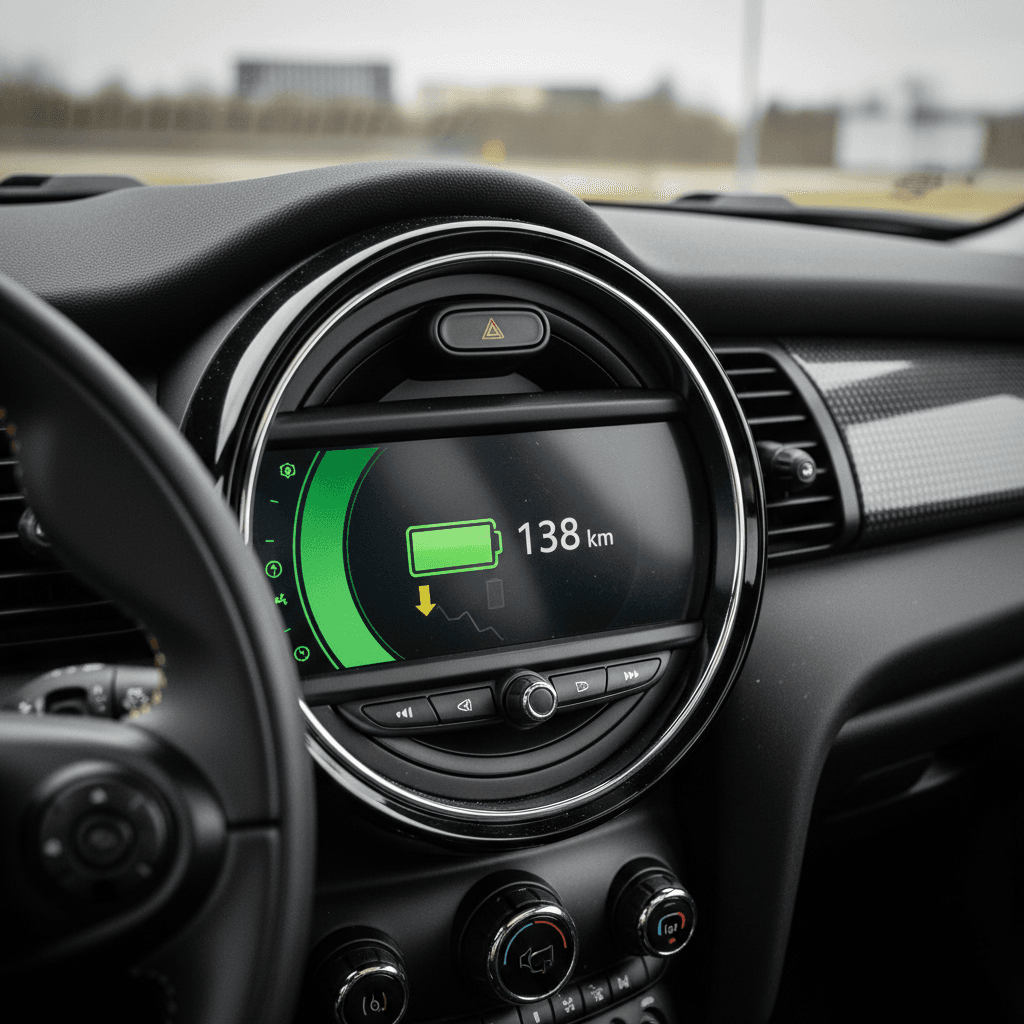
The Mini’s range estimate is not a pure battery‑health meter. It’s a rolling guess based on recent driving and conditions. To use it as part of your Mini Cooper SE battery health check, you have to separate software mood swings from true capacity loss.
Things that mimic degradation
- Frequent short trips with lots of HVAC use.
- Cold weather, especially below freezing.
- High average speed or lots of highway miles.
- Aggressive driving and heavy braking.
All of these can drop your effective range without the battery itself being unhealthy.
True degradation clues
- Lower range in similar conditions over months.
- Noticeable loss of miles at the same SoC year over year.
- Sudden big drops near the bottom of the battery gauge.
- Range that feels poor even in mild weather and gentle driving.
That’s when you dig deeper with diagnostics or a professional report.
Seasonal sanity check
Advanced tools: OBD apps and professional battery reports
Once you’ve done the basic checks, you may want harder numbers: state of health (SOH), usable kWh, cell balance, and charge cycles. For that, you either plug into the Mini’s diagnostics via OBD or lean on a professional evaluation.
Two ways to go deeper on Mini Cooper SE battery health
DIY data vs. professional diagnostics
DIY OBD + app
What you need:
- An OBD-II Bluetooth or Wi‑Fi dongle compatible with BMW/Mini EVs.
- A smartphone app that can interpret Mini EV battery parameters.
These setups can reveal pack voltage, individual module data, and estimated SOH. They require some tech comfort and careful interpretation.
Professional battery report
What you get:
- Standardized battery health metric (e.g., SOH).
- Clear explanation of remaining capacity vs. when new.
- Context against similar vehicles of the same age and mileage.
At Recharged, every used EV comes with a Recharged Score Report that includes independent battery health diagnostics, so you don’t have to guess what’s happening inside the pack.
Be careful with third-party tools
Buying a used Mini Cooper SE: battery health red flags
The Mini Cooper SE can be a brilliant used EV, low running costs, city‑friendly size, and often lower prices than bigger‑battery competitors. But because the pack is smaller, you need to be picky about battery health when shopping the used market.
Mini Cooper SE battery health: signs to pause and dig deeper
Use this quick table as a checklist when evaluating a used Mini SE.
| Sign | What you see | Why it matters |
|---|---|---|
| Aggressive range loss | Car shows far less range than similar Minis at the same SoC in mild weather. | May indicate above‑average degradation or a poorly maintained pack. |
| Inconsistent gauge | Range estimate drops in big chunks, especially below 30% SoC. | Can hint at cell imbalance or a pack that’s out of calibration. |
| Lots of DC fast charging | Seller relied on DC fast chargers instead of home or workplace Level 2. | Frequent high‑power charging can accelerate long‑term degradation. |
| Missing service history | No documentation of high‑voltage system checks or software updates. | Harder to know if past issues were resolved or just cleared from the dash. |
| Frequent warning lights | Stories of drivetrain, high‑voltage, or reduced power warnings. | Even if “fixed,” you’ll want to know root cause and verify with diagnostics. |
One red flag doesn’t always kill the deal, but two or three together should send you looking for a stronger candidate or a professional battery report.
How Recharged de-risks used Minis
Ready to find your next EV?
Browse VehiclesHow to protect your Mini Cooper SE battery going forward
Once you know where your battery stands today, the next question is simple: how do you keep it there as long as possible? You don’t have to baby the car, but a few habits will meaningfully slow future degradation.
Everyday habits that extend Mini Cooper SE battery life
Stay in the 20–80% sweet spot
Whenever it’s practical, avoid living at the extremes. Use daily charging targets around 70–80%, and try not to leave the car parked at 0–10% or 95–100% for days at a time.
Limit unnecessary DC fast charging
Fast charging is fine for road trips or the occasional busy week, but don’t treat it like your daily fuel pump. Regular Level 2 charging is easier on the pack.
Watch the heat
High temperatures are hard on lithium‑ion batteries. If you can, park in shade or a garage during hot summers, and avoid baking the car at 100% in direct sun.
Use scheduled charging
Take advantage of scheduled charging so the car finishes charging closer to when you leave, instead of sitting full all night. That’s good for the battery and usually for your power bill.
Keep software up to date
Battery management tweaks often arrive via software updates. Keeping your Mini current helps it manage charging, cooling, and regeneration more intelligently.
Check in on range yearly
Once a year, repeat your simple range‑vs‑SoC test on a mild‑weather day. Keeping a log lets you spot trends early rather than being surprised later.
Mini Cooper SE battery health FAQ
Common questions about Mini Cooper SE battery health
Key takeaways
You don’t need a lab to run a useful Mini Cooper SE battery health check. Start with what the car gives you, state of charge, range estimate, and a few repeatable drives, then layer in more advanced tools if something doesn’t feel right. Remember that the Mini’s small pack exaggerates every mile of loss, so being a little choosy about battery health pays off, especially in the used market.
If you’d rather skip the detective work, shopping through Recharged means every used EV, including the Mini Cooper SE, comes with a Recharged Score Report that spells out battery health, fair pricing, and how that specific car compares to its peers. Whether you DIY your checks or lean on pro diagnostics, the goal is the same: a Mini that delivers the playful, effortless electric drive it was built for, without range anxiety riding shotgun.