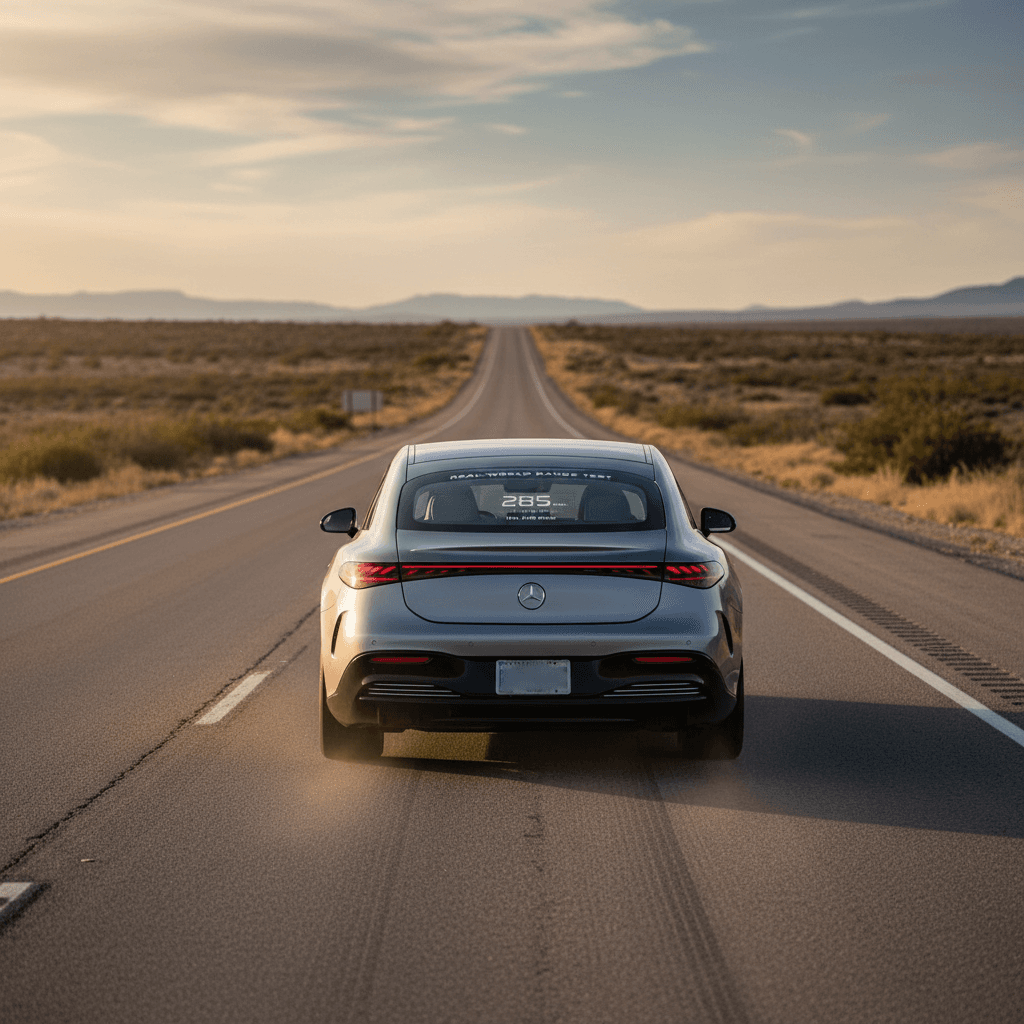
On paper, the Mercedes EQS charging speed test looks like a slam dunk: up to 200 kW DC fast charging, a big battery, and a sleek body that slices the air like a German sushi knife. But specs are brochure fiction. What you care about is simple: how fast does an EQS really charge in the wild, on an actual road trip, with a line of restless families behind you at the charger.
Headline number vs lived reality
Why Mercedes EQS charging speed really matters
The EQS is a rolling business-class lounge: quiet, heavy, and designed to vaporize highway miles. That makes charging speed more than a tech spec, it’s a quality-of-life metric. If you live on DC fast charging, slow charging turns a luxury sedan into a very expensive waiting room. If you mostly charge at home, you care less about peak kW and more about how quickly you can add a comfortable buffer before a long drive.
- On long trips, you’re really measuring miles of range added per minute, not just kW on the screen.
- Luxury EV drivers expect short, predictable stops, 20 minutes feels fine; 45 minutes feels like punishment.
- On the used market, a car that still hits strong charging speeds can signal healthier battery condition and better long-term value.
Think in 10–80%, not 0–100%
Mercedes EQS battery and charging specs at a glance
Core Mercedes EQS charging and battery numbers
Those are the numbers Mercedes would like you to memorize. They’re useful, but they’re also like EPA range ratings: an aspirational starting point. The real story is how the EQS ramps up to that peak power and how long it stays there.
Mercedes EQS charging specs by common trim
Approximate specs for the most common EQS variants you’ll see on the new and used market.
| Model | Battery (usable) | Official peak DC kW | Typical 10–80% DC time | Onboard AC charger |
|---|---|---|---|---|
| EQS 450+ RWD | ≈107.8 kWh | Up to 200 kW | ≈31–34 minutes | Up to 9.6 kW |
| EQS 580 4MATIC | ≈107.8 kWh | Up to 200 kW | ≈31–34 minutes | Up to 9.6 kW |
| EQS SUV 450+/580* | ≈108 kWh | Up to 200 kW | ≈32–35 minutes | Up to 9.6 kW |
Exact specs vary by year and market; always confirm details for the specific VIN you’re considering.
One platform, similar charging behavior
How a Mercedes EQS charging speed test actually works
Before you trust anyone’s Mercedes EQS charging speed test, look at the methodology. It’s easy to cherry-pick a sprint run on a brand‑new car at the perfect charger, in perfect weather. Realistic testing tries to mimic how you’d actually use the car.
A sensible EQS DC charging speed test recipe
1. Start around 10% state of charge
Below 10%, many packs are nervous, software is cautious, and the display can be less accurate. 10% is a good, repeatable real-world starting point.
2. Precondition the battery
Use the built-in navigation to route to the charger so the EQS can warm or cool the battery. Without this, you’ll often see disappointing peak speeds, especially in cold weather.
3. Use a known-good high-power charger
Look for a 150–350 kW DC fast charger with a solid reputation. A weak or overloaded station will make any EQS look bad.
4. Log power and SOC over time
Record charging power (kW), state of charge, and elapsed minutes at regular intervals, say every 5% or every 2 minutes, to plot a realistic charge curve.
5. Stop at 80%
Above 80%, the EQS tapers hard to protect the battery. For road-trip math, 10–80% is where the car earns its keep.
6. Note temperature and conditions
Ambient temperature, prior driving, and even wind can influence results. A careful test always records the context.
DIY charging test for your own EQS
Real-world Mercedes EQS DC fast charging curve
So what does an EQS actually do when you plug into a healthy 150–350 kW charger with a properly conditioned battery? Numbers vary charger to charger, but the general pattern is consistent, and very German: disciplined, orderly, and a little conservative.
Three phases of a typical Mercedes EQS charging session
Approximate behavior on a strong DC fast charger, from 10–80%.
Phase 1: Ramp & peak (10–35%)
Power: Rises quickly toward the 180–200 kW zone.
From about 10–20% the EQS ramps hard, often peaking somewhere near its advertised 200 kW, assuming the charger can deliver and the battery is warm enough.
Phase 2: High plateau (35–55%)
Power: Hovers in the 140–180 kW region.
This is the sweet spot. The car is stuffing electrons at an impressive clip, and most of your road‑trip energy comes in this window.
Phase 3: Taper (55–80%)
Power: Gently steps down to around 80–90 kW by 80%.
Charging slows progressively as the pack fills. Still usable for a quick top‑up, but you feel the deceleration.
Illustrative Mercedes EQS 10–80% DC charging profile
Approximate values for a healthy EQS sedan on a strong 150–350 kW charger. Your exact results will vary.
| State of charge | Approx. charging power | Time from 10% mark | Energy added since 10% | Approx. highway miles added* |
|---|---|---|---|---|
| 10% | ≈60–80 kW (ramping) | 0 min | 0 kWh | 0 mi |
| 20% | ≈180–200 kW | ≈5–7 min | ≈12–15 kWh | ≈30–40 mi |
| 40% | ≈160–180 kW | ≈12–15 min | ≈32–38 kWh | ≈80–95 mi |
| 60% | ≈120–150 kW | ≈20–23 min | ≈52–58 kWh | ≈130–150 mi |
| 80% | ≈80–90 kW | ≈31–34 min | ≈75–80 kWh | ≈185–205 mi |
These numbers are illustrative, not lab‑certified. They show the typical shape of an EQS charging session more than precise guarantees.
A note on miles added
From charts to highways: what EQS charging speed means on a road trip
All the kW talk is cute, but you care about how long you’re parked next to a humming transformer while your kids ask for snacks. Let’s turn that Mercedes EQS charging speed test into road‑trip math.
Scenario: 500‑mile highway day
You’re driving an EQS 450+ on mostly interstate, mild weather, starting at 90% and aiming to cover 500 miles.
- Realistic highway range at 70–75 mph: ~250–275 miles on a 90% charge.
- Drive until ~15%: you’ve covered ~220–240 miles.
- Stop to DC fast charge 15–70%: roughly 20–25 minutes on a good charger.
- Drive another 220–240 miles to your destination.
Total charging time: One solid stop of ~25 minutes, maybe a short top‑up if conditions are rough.
Scenario: 800‑mile long‑haul day
Now you’re trying to crush 800 miles in a day, well into the "why are we doing this" zone.
- Start at 90%, run down to 15%: ~220–240 miles.
- 20–25 minute charge 15–70%: add ~200–220 miles.
- Repeat that pattern about three times.
- By the third or fourth stop, you and the car are both ready for a hotel.
Total charging time: Expect ~70–90 minutes of fast‑charging spread over the day if conditions are favorable.
The EQS is a genuinely capable road‑tripper
Home charging speed vs DC fast charging in an EQS
Most EQS owners won’t live on fast chargers; they’ll plug in at home, treat electrons like a flat‑rate utility, and only hit DC when they leave their ZIP code. In that world, the EQS’s AC charging speed matters as much as its 200 kW headline.
Home vs DC fast charging: which matters more for EQS owners?
Different tools for different jobs.
Home Level 2 (AC) charging
- Power: Up to ~9.6 kW on a 40A circuit.
- Speed: Roughly 25–30 miles of range per hour.
- Use case: Overnight refills from 20–80% without thinking about it.
- Experience: Quietly brilliant; you wake up with a "full tank" every morning.
DC fast charging on the road
- Power: Peaks near 200 kW, tapers down as SOC rises.
- Speed: 10–80% in roughly 30–35 minutes on a good station.
- Use case: Road trips, emergency top‑ups, apartment living without home charging.
- Experience: Still more intrusive than gas, but much better than it was even 5 years ago.
Don’t overspend on oversized home hardware
How driving style, temperature, and SOC change your results
If you’ve read this far, you’re probably the kind of person who notices the wind direction on your commute. You already know this: the Mercedes EQS charging speed test you see online isn’t necessarily the one you’ll get on a wet, 35°F Thursday night with a ski box on the roof.
- Temperature: Cold batteries hate to charge quickly. Even with preconditioning, winter sessions can show noticeably lower peak power and a slower ramp.
- Prior driving: Arriving at the charger after an hour on the highway usually gives better results than a short hop from home; the pack is already warm and awake.
- State of charge when you arrive: Plugging in at 40% vs 10% can knock off the highest‑power part of the curve, your average kW over the session will fall.
- Driving speed and aero: Blast at 80–85 mph and your consumption skyrockets. On a long trip that can mean an extra stop, not just a longer one.
Cold‑soaked EQS, cold‑soaked results
Used Mercedes EQS: what charging speed reveals about battery health
On the used market, a luxury EV is only as good as its battery, and the fastest way to feel whether a pack is still in its prime is to watch it charge. You don’t need lab gear; you just need one or two well‑observed sessions.
Healthy charging behavior
- Reaches high power quickly (well over 150 kW) on a strong charger between 10–30% SOC.
- Maintains a robust plateau through at least 40–50% SOC before tapering.
- Shows consistent results across different sessions and stations.
- Estimated range at 100% still looks roughly in line with original ratings, adjusted for conditions.
Concerning signs
- Struggles to climb past ~90–100 kW even on a clearly under‑utilized high‑power charger.
- Tapers aggressively by 40–50% SOC, dragging out that 10–80% window.
- Big inconsistencies between similar sessions without obvious external causes.
- Displayed range at 100% looks heavily deflated compared with expectations.
How Recharged approaches used EQS battery health
Tips to charge your Mercedes EQS faster and smarter
Practical ways to get the best EQS charging speeds
1. Always navigate to the charger in‑car
Use the EQS’s native navigation to select the fast charger. That prompts the car to precondition the battery and meet the charger warm and ready.
2. Arrive low, leave around 70–80%
Plan your stops so you plug in at roughly 10–20% SOC and unplug around 70–80%. You’ll spend the most time in the fastest part of the curve.
3. Prefer higher‑power, newer stations
A fresh 250–350 kW unit in a busy, well‑maintained site is far more likely to deliver strong numbers than a lonely 50 kW relic behind a strip mall.
4. Avoid daisy‑chaining short hops
If you’re fast‑charging from 40–70% repeatedly, you’re living in the slower part of the curve. Let the car dip lower between stops for better average speed.
5. Watch the average, not just the peak
A momentary 200 kW screenshot is social‑media candy. A sustained 140–160 kW average over your session is what actually shortens your day.
6. Keep your software up to date
OEM updates can tweak charging behavior and improve reliability with certain networks. Make sure your EQS is running the latest software before a big trip.
Use DC fast charging as a tool, not a lifestyle
FAQ: Mercedes EQS charging speeds and tests
Frequently asked questions about Mercedes EQS charging speed tests
Bottom line: is the Mercedes EQS a fast charger?
Viewed through the cold eye of a Mercedes EQS charging speed test, the car is convincingly quick where it counts. No, it won’t always splash a perfect 200 kW headline across the screen, and cold weather or tired chargers can humble anything. But in the real world, on functioning high‑power stations, with a warmed‑up battery, and a driver who understands the 10–80% game, the EQS charges fast enough that the limiting factor on a road trip is usually your own spine, not the car.
If you’re cross‑shopping luxury EVs, the EQS’s combination of big battery, efficient aero, and solid fast‑charging makes it an excellent long‑distance partner. And if you’re stepping into a used Mercedes EQS, pay attention to how it charges and insist on clear battery‑health data. Recharged bakes that diligence into every sale with our Recharged Score Report, EV‑specialist support, and flexible financing, so you can spend your time planning road trips, not spreadsheets.