If you’re looking at a Tesla Model 3, you’ve probably heard it has a small trunk. The truth is more nuanced. With the rear seats folded down, the Model 3 turns into a surprisingly capable cargo hauler, especially for a sedan. In this guide, we’ll break down the hard numbers, real-world dimensions, and practical examples so you know exactly what “Tesla Model 3 cargo space with seats down” looks like in everyday use.
Quick answer
Tesla Model 3 cargo space overview
Tesla doesn’t make it easy on shoppers by publishing a neat “maximum cargo volume seats folded” number for the Model 3. Instead, you get a few different figures: space behind the second row, total cargo volume with five passengers, and the frunk volume. To understand how much space you truly have with the rear seats down, you need to combine official specs with real-world measurements from owners and testers.
Key Tesla Model 3 cargo stats
Official Tesla Model 3 cargo specs
Let’s start with what Tesla itself publishes. In the current Model 3 owner’s manual, you’ll find three key cargo specs for U.S. cars:
Official Tesla Model 3 cargo volume (U.S. spec)
Published cargo specs for recent Model 3 sedans. These numbers are with the rear seats in the upright position unless noted.
| Area | Volume (cu ft) | What it includes |
|---|---|---|
| Front trunk (frunk) | 3.1 | Small front storage compartment under the hood |
| Behind 2nd row | 19.8 | Main trunk area behind the rear seats (seats up) |
| Max cargo with 5 passengers | 22.9 | Main trunk + sub-trunk + frunk, all seats up |
Tesla doesn’t publish an official “maximum seats-down” number for the Model 3, so owners and reviewers rely on measurements and real-world testing.
Don’t be misled by the 15 cu ft number
Those numbers, however, only tell you part of the story. They describe cargo space with all five seats in use. Most shoppers who search for "Tesla Model 3 cargo space with seats down" want to know what happens when you’re willing to drop the rear backrest and turn the car into a two-seater with a big load area.
Real-world cargo space with seats down
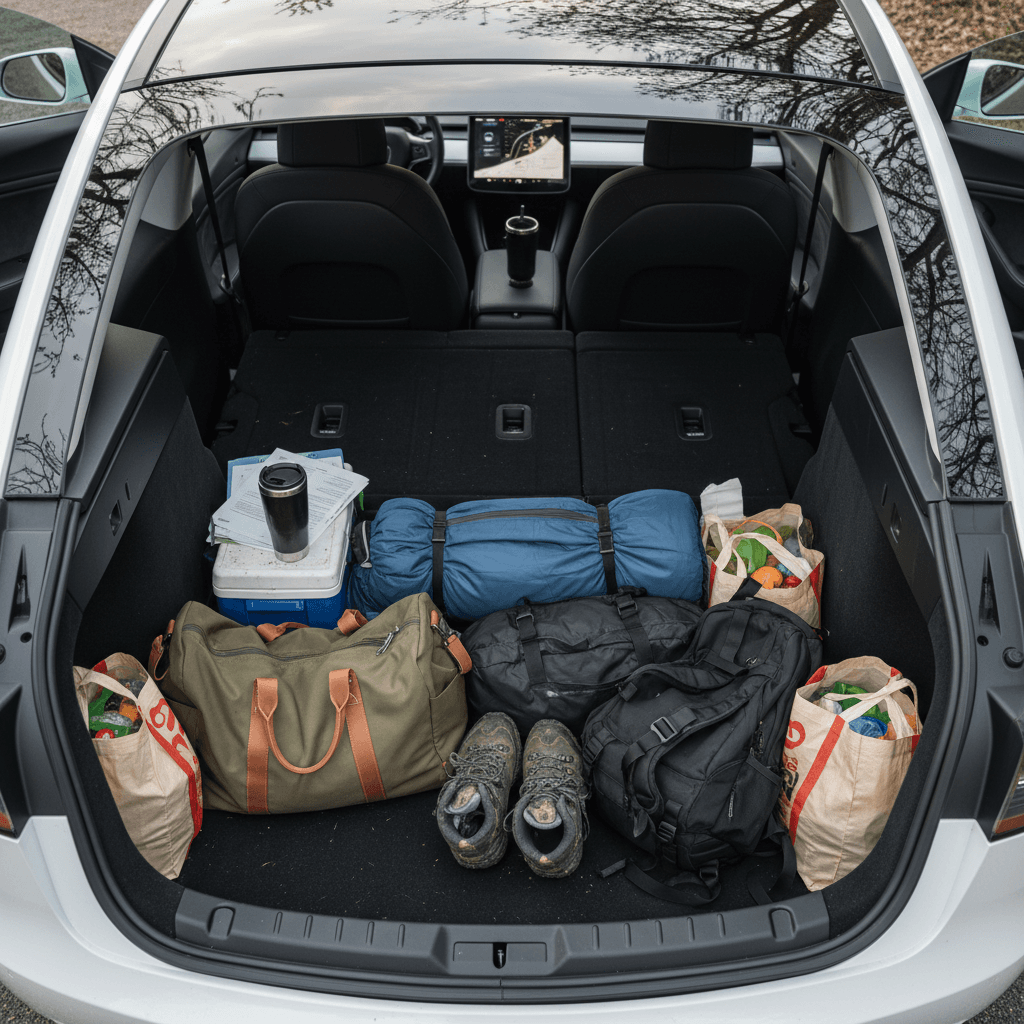
Because Tesla doesn’t publish an official maximum seats-down volume for the Model 3, we have to lean on measurements from owners and independent testers. The good news is they’re remarkably consistent: with the 60/40 split rear seat folded flat, the car offers cargo volume in the mid-30-cubic-foot range.
Approximate interior dimensions (seats folded)
- Length: ~75 inches from trunk latch to back of front center console (about 6.25 feet)
- Width: ~43 inches between the narrowest part of the trunk opening; wider inside the cabin
- Height: ~18–20 inches under the rear glass near the trunk; more over the folded seatbacks in the cabin area
These measurements vary slightly by model year and who’s holding the tape measure, but they’re useful planning numbers.
Practical volume estimates
- Seats up: ~23 cu ft total (frunk + trunk + sub-trunk)
- Seats down: roughly 34–35 cu ft of combined trunk and cabin volume that you can actually pack, plus the 3.1 cu ft frunk
- Usability: Flat load floor with a slight angle toward the front, which makes sliding long items easier
Think of the Model 3 as offering about two-thirds of a compact SUV’s space, but in a low, aerodynamic sedan body.
Use the sub-trunk and frunk
What you can actually fit in a Model 3
Specs are useful, but at some point you just want to know: will my stuff fit? Based on owner experiences and those ~75-inch interior length measurements, here are realistic scenarios for a Tesla Model 3 with the seats down.
Common real-world cargo scenarios
How a Model 3 handles everyday hauling with the rear seats folded
Airport or family trip luggage
- 3–4 large checked suitcases (28–30") on their sides
- Plus 2–3 carry-on rollers and several backpacks
- Sub-trunk great for shoes or smaller bags
For a family of four flying out of town, the Model 3 is usually enough if you’re willing to fold the rear seats.
Camping & outdoor gear
- 4-person tent, sleeping bags, pads, camp stove
- Cooler plus folding chairs
- Still room left for duffels and food bins
Many owners use the Model 3 for long camping trips by carefully stacking gear and using the frunk for valuables.
Bikes and sporting gear
- One adult bike with front wheel removed fits diagonally
- Two smaller bikes or one bike + stroller possible with creative packing
- Snowboards and skis up to ~6 ft can slide through
If you’ll haul bikes often, a hitch rack or roof solution is easier, but it can be done inside if needed.
- Flat-pack furniture (IKEA-style boxes) up to about 6 feet long can lie flat with the front passenger seat adjusted forward.
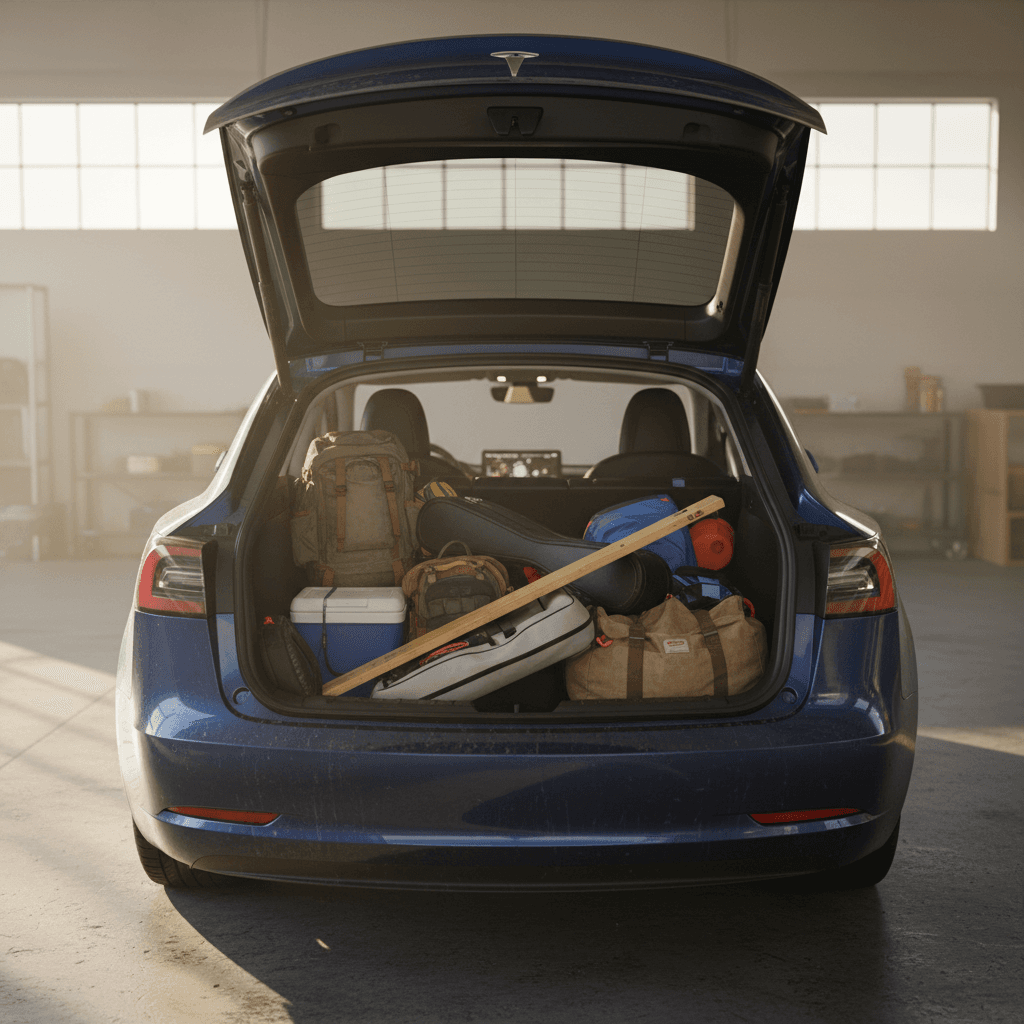
- Lumber or PVC pipe up to around 10 feet can fit if you run it from the trunk to the front footwell at an angle, just protect interior surfaces.
- Large flat items like TVs in the 55–65" range can be carried, but you must angle them carefully through the trunk opening and protect the screen.
- For pet owners, folding the seats and adding a cargo liner turns the back into a comfortable, easy-to-clean dog area.
Watch the trunk opening height and angle
Model 3 vs. Model Y cargo space with seats down
If you’re cargo-conscious, the natural cross-shop is the Tesla Model Y. It shares the same basic platform as the Model 3 but adds a taller body, hatchback opening, and more vertical room. So how does the Model 3 with seats down stack up?
Tesla Model 3 vs Tesla Model Y cargo space
Approximate cargo capacities for recent U.S. models. Model Y numbers are based on Tesla documentation and widely cited testing; Model 3 seats-down volume is an estimate since Tesla does not publish it officially.
| Metric | Tesla Model 3 | Tesla Model Y (5-seat) |
|---|---|---|
| Cargo behind rear seats (seats up) | ~19.8 cu ft | ~30–30.2 cu ft |
| Estimated max with seats down | ~34–35 cu ft | ~68–72 cu ft |
| Frunk volume | 3.1 cu ft | ~4.0–4.1 cu ft |
| Load opening style | Conventional trunk | Hatchback (large liftgate) |
If cargo space is your top priority, the Model Y clearly wins, but the Model 3 is closer than you might think for most everyday hauling.
When the Model 3 is enough
From a shopper’s perspective, the decision often comes down to this: the Model Y offers roughly double the max cargo volume of a Model 3 when both have their seats down. But in day-to-day use, a well-packed Model 3 will still cover the needs of many households, especially if you’re not trying to carry passengers and big cargo at the same time.
Smart packing strategies for maximum space
Getting the most out of your Tesla Model 3 cargo space with seats down is less about raw volume and more about how you pack. Here are practical strategies owners use to make the most of the car’s footprint.
How to maximize Model 3 cargo space
1. Fold the correct section of the 60/40 seat split
You don’t always need both sides down. For long items plus one or two passengers, fold just the smaller or larger side of the 60/40 split and leave one seat up. That keeps the cabin usable while still extending your load floor.
2. Load long items first, then stack
Start with skis, boards, or lumber diagonally along the floor from the trunk latch toward the front console. Once the long pieces are in place, stack duffels, soft bags, and boxes around and above them.
3. Use soft-sided bags instead of hard luggage
Duffel bags, soft coolers, and compressible storage cubes are far easier to Tetris into the curved roofline of the Model 3 than hard-shell suitcases. Reserve hard luggage for the lower section and sub-trunk.
4. Reserve the frunk for dense or fragile items
The frunk is perfect for items you don’t want crushed, camera gear, laptops, or groceries that shouldn’t be stacked. Filling the frunk first gives you more freedom to stack bulky cargo in the rear.
5. Protect the interior before you load
Lay down a cargo mat or moving blankets over the folded seats and trunk floor. This protects the upholstery, reduces noise, and makes it easier to slide heavy objects in and out.
6. Think vertically, but not dangerously
You can stack cargo up to the bottom of the rear glass without affecting rearward visibility too much. Anything higher should be soft items like pillows or sleeping bags, secured so they won’t move under braking.
Use the screen to check your rear view
Buying a used Model 3 when cargo space matters
If you’re shopping the used Tesla Model 3 market, cargo space considerations should sit alongside range, battery health, and price. The basic trunk layout has remained consistent across model years, but there are a few details worth thinking about if hauling is part of your life.
Cargo-space questions to ask about a used Model 3
Especially important if you’re replacing an SUV or minivan
Check for wear in the cargo area
Heavy use can show up as:
- Scratches on the trunk sill and plastic trim
- Tears or stains on rear seatbacks
- Damaged or missing cargo covers and floor panels
None of this is necessarily a deal-breaker, but it can affect value and your ownership experience.
Prioritize battery health and range
If you’re planning road trips with a full trunk, usable range matters as much as cubic feet.
- Look for a documented battery health report
- Compare real-world range expectations to your typical trips
- Factor in weather and elevation if you’ll drive fully loaded
How Recharged can help
If you regularly haul bikes, home-improvement materials, or large pets, be honest about your needs during the shopping process. A Model 3 can do more than many shoppers assume, but a used Model Y, or another hatchback-style EV, may still be the better fit. A transparent conversation about how you use your vehicle will save you from regret later.
Frequently asked questions about Model 3 cargo space
Tesla Model 3 cargo space FAQ
Bottom line: Is Tesla Model 3 cargo space enough?
If you’re expecting the cavernous cargo bay of a compact SUV, the Tesla Model 3 will come up short, especially with all five seats in use. But if your main concern is what happens with the seats folded down, the story is much more positive. Roughly 34–35 cubic feet of usable space, a long load floor, and extra storage in the sub-trunk and frunk make the Model 3 far more practical than its sleek sedan shape suggests.
The right choice comes down to your lifestyle. For many buyers, couples, small families, and commuters who take the occasional road trip, a Model 3 will comfortably handle luggage, camping gear, and the odd IKEA run. If you routinely carry tall, boxy cargo while also seating rear passengers, a Model Y or other hatchback EV is the safer bet. Either way, if you’re shopping used, working with a specialized EV retailer like Recharged gives you battery health transparency, fair pricing, and expert guidance so cargo space is one more box you can confidently check off.