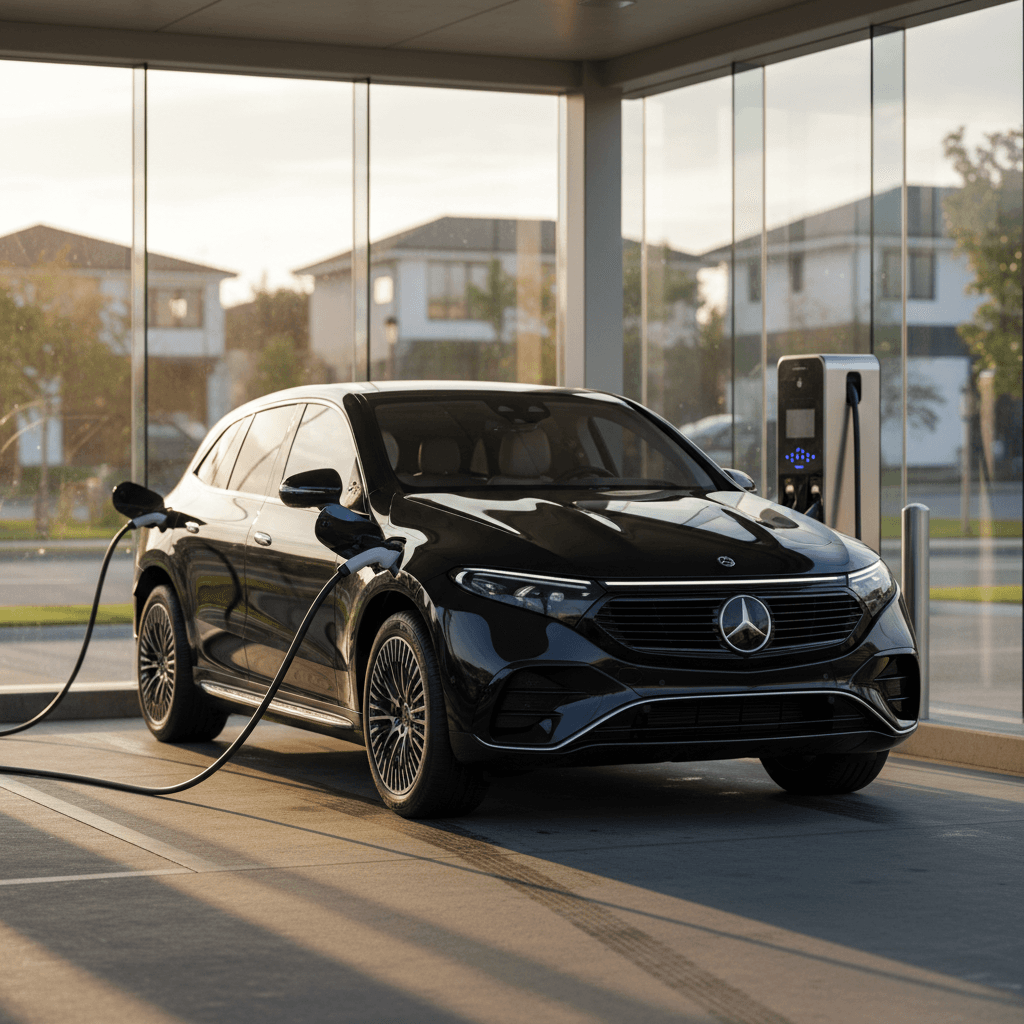
If you’re trying to understand Mercedes EQS charging speed, you’ll quickly run into a mess of numbers: 200 kW DC, 9.6–22 kW AC, 10–80% in “about 30 minutes,” and so on. This guide breaks those claims down into realistic, real‑world expectations so you know how long your EQS will actually take to charge, at home, on road trips, and at Tesla or Mercedes‑branded DC fast chargers.
Who this guide is for
Overview: How fast does the Mercedes EQS really charge?
Mercedes EQS headline charging numbers
Those are the brochure numbers. In practice, your actual charging speed depends on battery temperature, your starting and ending state of charge (SoC), the health of the pack, and the quality of the charger itself. To make this useful, we’ll stick to the scenarios that matter: 10–80% DC fast charging for road trips, and overnight AC charging at home or hotels.
Mercedes EQS battery and charging basics
Key battery and charging hardware on the EQS
Different trims share broadly similar charging behavior
Battery size
Most EQS sedans and SUVs use a pack with roughly 108–118 kWh usable capacity, depending on year and trim. That’s big, which is why the car can go far, but it also means you’re moving a lot of energy when you charge.
DC fast charging
Current EQS models support up to 200 kW DC fast charging on CCS in North America. On a good charger, that’s enough for a strong 10–40% ramp before the curve tapers.
Onboard AC charger
In the U.S., the onboard AC charger is typically up to ~9.6–11 kW on a 240 V Level 2 circuit. Some overseas trims offer 22 kW AC, but if you’re in North America, assume ~10 kW max on Level 2.
The important takeaway: the EQS has a big battery, respectable DC fast‑charging power, and solid Level 2 performance. That combination is great for comfort and range, but you need to understand the charging curve to avoid sitting at a charger longer than you have to.
Mercedes EQS DC fast charging speed (10–80%)
When most people ask about Mercedes EQS charging speed, they mean DC fast charging on road trips. That’s where the 200 kW headline figure and “10–80% in about 30 minutes” claims come from.
Typical EQS DC fast charging performance (sedan & SUV)
Approximate real‑world times on a healthy EQS pack at a good 150–350 kW DC fast charger, starting with a warm battery.
| Scenario | Start–End SoC | Energy added | Typical time | What it feels like |
|---|---|---|---|---|
| Quick top‑up | 10–50% | ≈40% of pack (~43–47 kWh) | ≈18–22 minutes | Enough for a few hours of highway driving. |
| Standard stop | 10–80% | ≈70% of pack (~75–83 kWh) | ≈30–34 minutes | Classic “bathroom + snack” DC stop. |
| Stretch stop | 10–90% | ≈80% of pack (~86–94 kWh) | ≈40–45 minutes | You’ll clearly notice the taper after ~80%. |
| Arrive high, leave high | 40–90% | ≈50% of pack (~54–59 kWh) | ≈35–40 minutes | Slow at the beginning and end, least efficient use of your time. |
Numbers are rounded and will vary slightly by trim, weather, charger quality, and driving style.
Think in miles per minute, not kW
Home and destination charging: Level 1 vs Level 2
DC fast charging matters on road trips. The rest of the time, your quality of life with an EQS comes down to AC charging at home and at destinations (hotels, workplaces, friends’ houses).
Level 1 (120 V household outlet)
Level 1 is the slow lane. On a regular 120 V outlet in the U.S., you’ll usually see 2–4 miles of range per hour of charging. For such a large battery, that means:
- Overnight (10–12 hours) might net you only 25–40 miles of additional range.
- Fine for an emergency or very light daily driving.
- Not realistic as your only solution if you regularly drive an EQS.
Level 2 (240 V home or destination)
Level 2 is where the EQS is designed to live. On a 40–48 A Level 2 charger with a good circuit, you can expect up to 9.6–11 kW into the car, which translates to roughly:
- 30–40 miles of range per hour of charging under typical conditions.
- 0–100% in roughly 10–12 hours, depending on trim and conditions.
- Comfortable overnight replenishing even after long commutes.
Watch your circuit limits
Charging curves: Why your EQS slows down past 60–80%
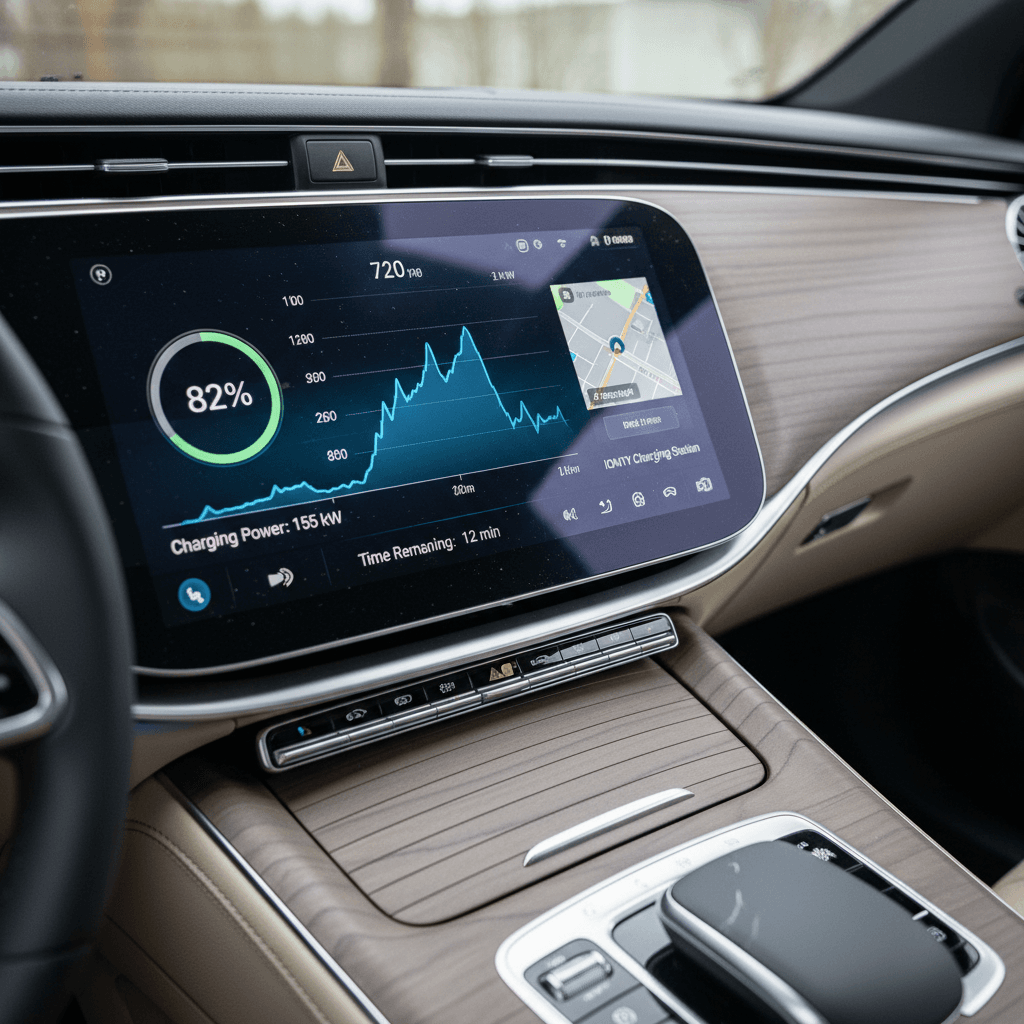
If you’ve watched the EQS charging screen, you’ve probably noticed a familiar pattern: charge power ramps quickly, holds near the peak for a bit, and then falls off as the battery fills. That’s not a bug; it’s battery chemistry and longevity management at work.
- From roughly 10–40% SoC, an EQS on a strong DC charger can hold close to its peak power (up to ~200 kW).
- By 50–60%, power is already easing off; by 70–80%, you’re well below peak.
- Past ~80%, the curve drops sharply, often into the double‑digit kW range by 90%+ SoC.
- Cold batteries start slower and may never hit full peak until they’ve warmed up through driving or a preconditioning cycle.
Why Mercedes plays it conservative early in the curve
Road-trip strategies: Getting the most miles per minute
On a long drive, your goal isn’t to brag about peak kW, it’s to minimize time parked at chargers for the miles you cover. Because of the EQS charging curve, that means leaning into shorter, smarter sessions instead of filling to 100% every stop.
EQS road-trip charging playbook
1. Arrive low, leave around 70–80%
Plan your legs so you arrive at DC fast chargers around 5–15% and unplug somewhere in the 70–80% window. That keeps you in the faster part of the curve and minimizes slow top‑off time.
2. Stack more, shorter stops
Two 20‑minute 10–70% sessions are usually faster door‑to‑door than one 45‑minute 10–95% session. You get more miles per minute and better mental breaks.
3. Precondition the battery when you can
Use navigation to a DC fast charger so the car can warm or cool the pack before arrival (where supported). A properly conditioned battery hits higher power sooner and avoids painfully slow cold‑soaking.
4. Don’t chase 100% unless you must
Going from 90–100% can take as long as 20–30–40% took earlier in the session. Save that full charge for remote stretches between chargers, not every stop.
5. Watch station reliability, not just power
A “350 kW” station that’s broken or derated to 60 kW is worse than a reliable 150 kW site. For road‑trip sanity, prioritize <strong>stable, plentiful stalls</strong> over theoretical max power.
6. Mix in Level 2 at hotels
If your overnight stop offers Level 2, plug in there and arrive at the next morning’s first DC stop already in the efficient 20–60% range rather than starting the day at a half‑empty battery.
Tesla Superchargers, NACS adapters, and Mercedes “branded” chargers
More and more EQS owners in North America are asking the same question: What about Tesla Superchargers? With Mercedes adopting Tesla’s NACS standard and launching its own “Mercedes‑branded” high‑power sites, the picture is finally getting clearer, but there are a few moving pieces to understand.
Using Tesla Superchargers with an EQS
Depending on when and where your EQS was built, you’ll either:
- Use a NACS–to–CCS adapter approved by Mercedes to plug into select Tesla Superchargers, with activation and billing handled via the Mercedes app or in‑car system.
- Or, on later models once Mercedes fully transitions to NACS, plug directly into NACS posts without an adapter.
In both cases, your charging curve and 10–80% times look similar to other quality 150–250 kW DC chargers. The main advantage is network density and reliability, not a dramatic bump in kW.
Mercedes-branded high‑power chargers
Mercedes is also rolling out its own branded fast‑charging hubs, often co‑located with established providers. For EQS drivers, the perks typically include:
- High‑power DC posts sized for large vehicles and trailers.
- Better lighting, amenities, and reservations in some locations.
- Seamless activation and payment through the Mercedes ecosystem.
If you drive an EQS regularly on the highway, it’s worth learning where these hubs are along your usual corridors.
Good news for used EQS shoppers
Charging speed vs battery health: How to treat your EQS pack
The EQS’s charging strategy is already fairly conservative, but your habits still matter, especially if you’re planning to own the car for a long time or you’re weighing the battery health of a used EQS.
Simple EQS charging habits that protect the pack
You don’t need to baby the car, just avoid extremes
Make 20–80% your daily comfort zone
For daily use, it’s healthy to live mostly in the 20–80% SoC window. Use the car’s charge limits to avoid sitting at 100% for long stretches unless you’re heading straight out on a trip.
Avoid repeated hot‑soak DC sessions
Back‑to‑back full‑power DC sessions on a hot day are harder on any big battery. When possible, mix in cool‑down time at Level 2 or aim for shorter DC bursts rather than yo‑yoing between 5% and 95% repeatedly.
Don’t fear DC, just use it wisely
Occasional DC fast charging, especially 10–70% or 15–80%, is well within what the pack is designed to handle. Problems tend to come from constant fast charging to 100%, heat, and neglect, not normal road‑trip use.
What early battery abuse looks like on a used EQS
Charging questions to ask when buying a used EQS
Because the EQS has such a large and expensive pack, understanding charging behavior on a specific used car is just as important as knowing its accident history. A lightly used EQS that still charges quickly and holds strong range can be a tremendous value; one that’s been hammered on DC every day is a different story.
Used EQS charging checklist for shoppers
1. Ask about home vs DC usage
A car that mostly lived on Level 2 at home and only used DC on road trips is usually a better bet than one fast‑charged multiple times per week.
2. Verify realistic range at 80–90%
Have the seller share photos or data from a full charge and typical consumption. Does the displayed range at 80–90% align with what other EQS owners see?
3. Look at an actual DC fast‑charge session
If possible, test‑charge the car or review logs/screenshots from a 10–80% DC session. You’re looking for a healthy ramp to high power and a normal‑looking taper, not unusually low power across the board.
4. Get independent battery health data
Whenever you can, rely on a <strong>third‑party battery health report</strong> rather than guesses. At Recharged, every used EV comes with a Recharged Score that includes <strong>verified pack health and charging performance</strong>, so you’re not buying blind.
5. Confirm NACS/adapter support
For North American cars, understand whether the specific EQS you’re considering supports approved <strong>NACS–to–CCS adapters</strong> or has direct NACS capability. That can materially affect your real‑world charging options.
6. Check included charging equipment
Make sure the car comes with the factory portable charger and, ideally, any approved DC adapters the prior owner purchased. Replacing lost hardware after the fact isn’t cheap.
Mercedes EQS charging speed FAQ
Frequently asked questions about Mercedes EQS charging
Bottom line: Making EQS charging work for you
The Mercedes EQS doesn’t chase the wildest charging numbers on the spec sheet, but it delivers consistent, comfortable real‑world performance when you understand how to work with its curve. Plan DC fast‑charge stops around 10–70 or 10–80%, lean on solid Level 2 at home and hotels, and avoid obsessing over the last 10–15% of the battery. Do that, and even a cross‑country trip in an EQS becomes predictable rather than stressful.
If you’re considering a used Mercedes EQS, charging speed is more than a convenience, it’s a window into battery health. That’s exactly why every EV on Recharged comes with a Recharged Score battery‑health report, transparent pricing, and expert EV‑specialist support. You get to enjoy the EQS’s effortless comfort and quiet, with clear data about how its pack has been treated and what you should expect at the plug.