If you own a Mercedes EQS, or you’re about to buy one, the best upgrade you can make is a proper Level 2 home charger. The right charger will let your EQS refill quietly overnight, protect your electrical system, and keep your total cost of ownership in check. This guide breaks down the best home chargers for the Mercedes EQS in 2025, how fast they’ll charge, and how to pick the right unit for your home and budget.
Quick answer
Why home charging matters for your Mercedes EQS
The EQS is a large, luxury EV with a big battery, roughly 107–118 kWh usable capacity depending on model year and trim. That size is great for long range, but it also means that relying on public DC fast charging for everyday use can get expensive, inconvenient, and hard on your battery over time. Home charging turns your driveway or garage into a personal "fuel station," letting you wake up to a full battery and reserve fast charging for road trips.
- Lower cost per mile than DC fast charging or gasoline, especially on off‑peak electric rates
- Convenience: plug in at night, unplug in the morning, no detours for fuel
- Less battery stress when you mostly charge slowly on AC power
- Easier to precondition the cabin while plugged in, preserving range in hot or cold weather
Tip for new EQS owners
How fast can a Mercedes EQS charge at home?
To choose the best home charger for a Mercedes EQS, you first need to know what the car itself can accept. The limiting factor for AC (home) charging is the onboard charger inside the EQS, which converts AC from your house into DC for the battery.
Mercedes EQS AC charging basics
What your EQS can actually use from a home Level 2 charger.
| EQS version | Onboard AC charger (max) | Typical U.S. home voltage | Max useful home charger setting | Real‑world full charge time* |
|---|---|---|---|---|
| EQS sedan (most U.S. trims) | ≈9.6–11 kW | 240 V | 40–48 amps | About 10–12 hours from low to full |
| EQS SUV (most U.S. trims) | ≈9.6 kW | 240 V | 40 amps | Around 11–13 hours from low to full |
Exact specs can vary slightly by model year and market, always confirm in your owner’s manual.
What this means in plain English
EQS home charging by the numbers
Key features the best home charger for an EQS needs
There’s no such thing as a "Mercedes‑only" charger; your EQS uses the standard J1772 connector for AC charging in North America (with an adapter if your charger has the newer NACS plug). The best home charger for your EQS is the one that fits your electrical panel, your parking layout, and how you actually drive. Focus on these features:
What to look for in a Mercedes EQS home charger
Power, reliability, and smart control matter more than branding.
Amperage & power
Your EQS can use up to about 9.6–11 kW on AC. That translates to:
- 40 amps on a 50 amp circuit ≈ 9.6 kW
- 48 amps on a 60 amp circuit ≈ 11.5 kW
If your panel can handle it, a 40–48 A charger is the sweet spot.
Safety & certifications
Look for UL or ETL listing, a solid weather rating (NEMA 3R or better), and built‑in ground fault protection. A quality unit plus proper installation matters more than fancy styling.
Smart features
App control lets you schedule off‑peak charging, track energy use, and integrate with solar. For a high‑end EV like the EQS, those features help you actually see what your luxury is costing, or saving, you.
Nice‑to‑have features
- Adjustable amperage so an electrician can dial the charger back to match your circuit
- Long cable (20–25 ft) to reach the EQS charge port in different parking orientations
- Load management if you might add a second EV or already have a big load (hot tub, AC, etc.)
- Solar‑aware modes if you have rooftop solar
Usually overkill for an EQS
- Chargers rated far above 48 amps if your home panel can’t realistically support them
- Exotic bidirectional/V2H features your EQS and home likely don’t support yet
- Expensive proprietary "brand" chargers that don’t add useful capability vs good third‑party units
Don’t overspend on speed you can’t use
Top home charger picks for the Mercedes EQS
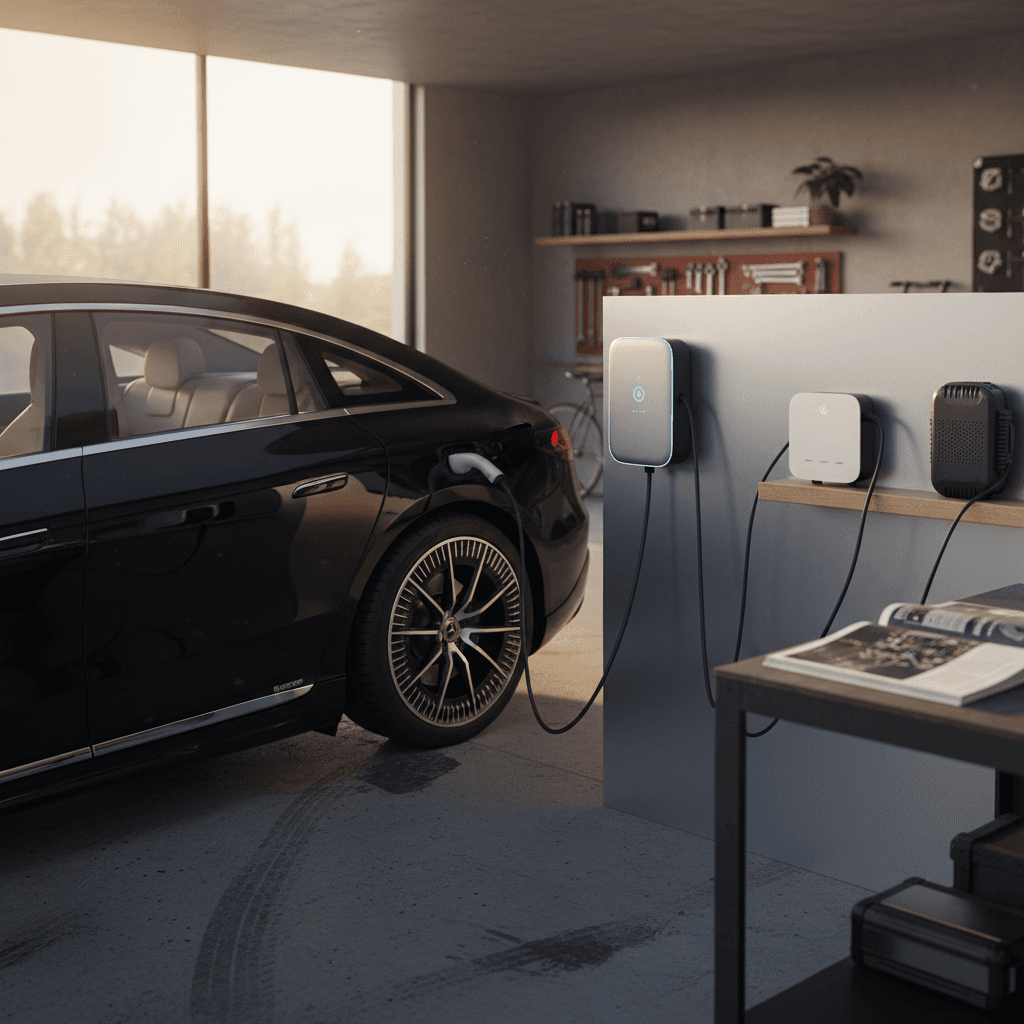
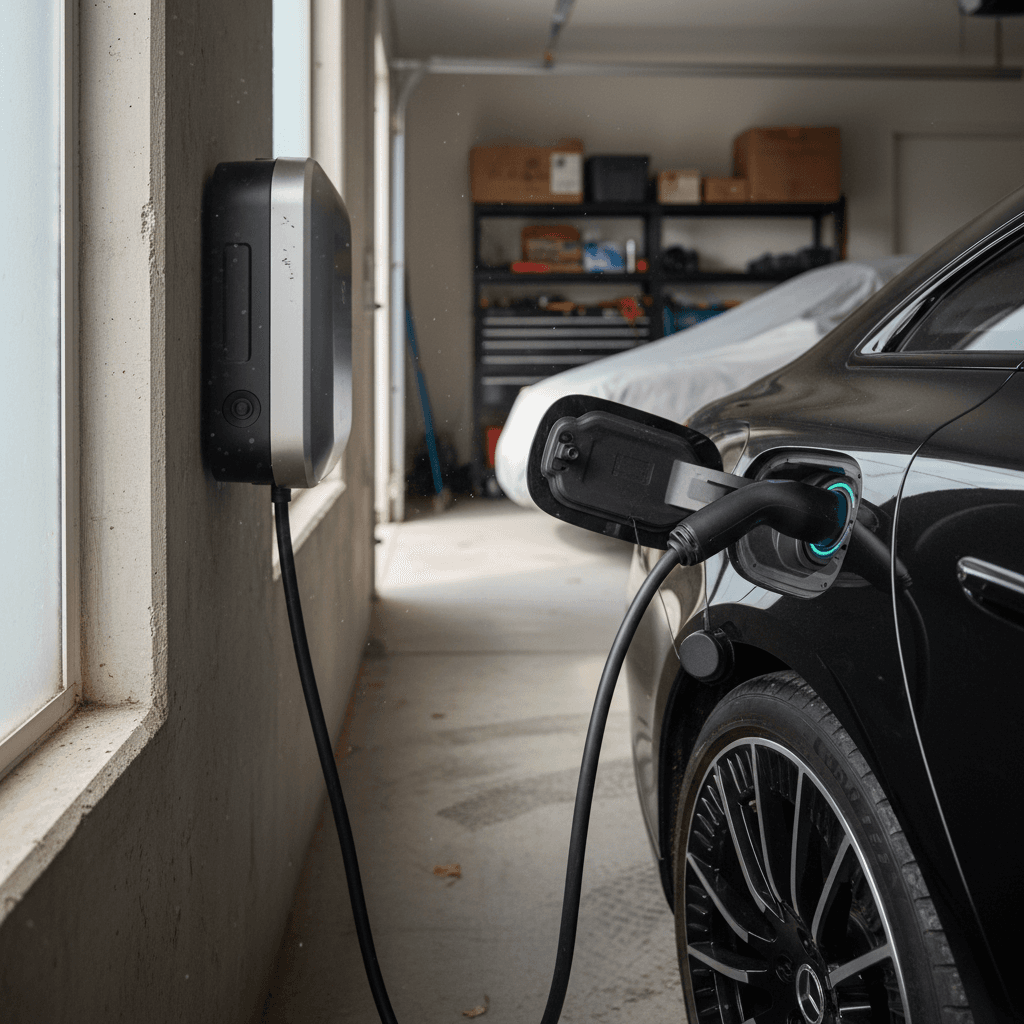
There are dozens of solid Level 2 chargers on the market. For a Mercedes EQS, you want 40–48 amp capability, strong reliability, and a good app. Here are several well‑regarded options that fit those requirements as of 2025, along with how they pair with an EQS.
Recommended Level 2 home chargers for Mercedes EQS
All of these will comfortably support the EQS’s AC charging capability when installed on an appropriate circuit.
| Charger | Max amps / kW | Connection type | Why it works well for EQS | Ideal EQS owner |
|---|---|---|---|---|
| Emporia Level 2 Smart Charger | 48 A / ~11.5 kW | Hardwired or NEMA 14‑50 | Excellent value, deep energy monitoring, solar‑friendly options; easily delivers full AC power the EQS can use. | Data‑minded owners who want insight into energy use and may have solar. |
| ChargePoint Home Flex | 50 A (48 A usable) | Hardwired or plug‑in | Mature app, strong brand reputation, flexible amperage settings; widely recommended by EQ owners. | Owners who value a polished app experience and may add another EV later. |
| Tesla Universal Wall Connector | 48 A / ~11.5 kW | Hardwired, NACS plug with built‑in J1772 adapter | NACS plug future‑proofing plus integrated adapter for J1772 vehicles; solid build and good pricing. | Households that may own both Tesla and non‑Tesla EVs, or plan for future NACS‑equipped cars. |
| Wallbox Pulsar Plus (40 A or 48 A) | 40–48 A | Hardwired or NEMA 14‑50 (40 A) | Compact form factor, robust app, good for tight garages; 40 A version still fully adequate for EQS overnight. | Owners with limited wall space or who prefer a small, discreet unit. |
Pricing is approximate retail in early 2025 and can vary with promos and installers.
A real‑world pairing that works
Mercedes Wallbox vs third‑party chargers
Mercedes offers a branded home "Wallbox" in some markets, and dealers may be eager to bundle it with an EQS sale or lease. While it’s fully compatible with your car, it’s not the only good option, and often not the best value.
Pros of the Mercedes Wallbox
- Brand‑matched hardware and styling to your EQS
- Dealers sometimes bundle installation in lease or purchase packages
- Basic smart features and app integration in many markets
Why many EQS owners choose third‑party chargers instead
- Lower cost for equal or better specs and smart features
- More flexible options (plug‑in vs hardwired, 40 vs 48 amps, cable length choices)
- Easier to use the same charger with other brands if you add a second EV
- Often better energy monitoring, solar integration, and app refinement
Judge the charger, not the badge
Installation & electrical considerations for EQS owners
A home charger is only as good as the wiring behind it. Before you order hardware for your EQS, it pays to understand what your electrical panel can realistically support and what installation will cost.
Pre‑installation checklist for your EQS home charger
1. Check your main panel rating
Most newer U.S. homes have a 200 amp panel, which can usually support a 50–60 amp EV circuit. Older 100 amp panels may require careful load calculations or an upgrade before adding a 40–48 amp charger.
2. Decide on hardwired vs plug‑in
Hardwired units are often required for 48 amp operation and look cleaner. Plug‑in chargers on a NEMA 14‑50 outlet top out at 40 amps continuous but are easier to replace or move later.
3. Plan charger location and cable routing
The EQS charge port is typically on the rear passenger side. Measure from your panel to your ideal parking spot and choose a cable length (often 20–25 ft) that reaches comfortably without tripping hazards.
4. Confirm circuit size and derating
By code, continuous loads are limited to 80% of breaker rating. That means a 50 A breaker supports 40 A charging; a 60 A breaker supports 48 A. Your electrician and charger app can set the appropriate limit.
5. Get multiple installer quotes
Installation costs vary widely by distance, wall type, and whether your panel needs work. It’s worth getting 2–3 quotes before committing, especially on longer runs or panel upgrades.
Safety first: don’t DIY beyond your skills
Smart charging strategies for lower bills
The Mercedes EQS is designed to be charged often, ideally at home and at moderate power. With the right home charger and a bit of planning, you can cut your charging cost dramatically without sacrificing convenience.
Make the most of your EQS home charger
A few tweaks can save real money over a 3‑ or 4‑year ownership period.
Use off‑peak schedules
Most smart chargers and many utilities support off‑peak or time‑of‑use pricing. Set your EQS or your charger app to start charging late at night when rates are lowest.
Charge for your routine, not to 100%
For daily use, charging to about 70–80% is usually enough and can be healthier for long‑term battery life. Save 100% charges for big trips.
Track energy & costs
Use your charger’s app to monitor how many kWh your EQS consumes each month. That data helps you compare home charging to what you’d pay for public fast charging, or gasoline.
Solar and EQS home charging
How this applies when you buy a used Mercedes EQS
If you’re considering a used Mercedes EQS, home charging is even more important. A previous owner’s charging habits, plus your own, will shape long‑term battery health and running costs. At Recharged, every EV we list, including EQS models, comes with a Recharged Score battery health report, so you can see how the pack has aged before you buy.
Questions to ask when shopping used
- Was the EQS mostly charged at home on Level 2 or fast‑charged on road trips?
- Did the previous owner have a dedicated home charger, or rely on public networks?
- Is there any documentation of software or charging‑system updates?
How Recharged can help
- Recharged Score shows verified battery health so you know what you’re buying.
- Our EV specialists can help you estimate home charging costs for your specific commute.
- We can walk you through home charger selection so you’re ready to plug in the day your EQS is delivered.
From charger choice to delivery, all in one place
Ready to find your next EV?
Browse VehiclesFrequently asked questions: Mercedes EQS home charging
Mercedes EQS home charging FAQ
Bottom line: choosing the best home charger for your EQS
A Mercedes EQS deserves more than a trickle from a 120 V outlet. The best home charger for your EQS is a quality 40–48 amp Level 2 unit installed on a properly sized 240 V circuit, with solid safety certifications and an app you’ll actually use. Whether you prefer the data‑rich Emporia, the polished ChargePoint Home Flex, a compact Wallbox Pulsar Plus, or the versatile Tesla Universal Wall Connector, any of them, installed correctly, will let your EQS recharge comfortably overnight and keep ownership simple.
If you’re also deciding which EQS to buy, or you’re comparing one against other luxury EVs, Recharged can help you evaluate battery health, fair pricing, financing, and home charging all together. That way, when your EQS rolls into your driveway, whether it’s new to you or brand‑new, you’ll already have the right charger on the wall, ready to plug in.