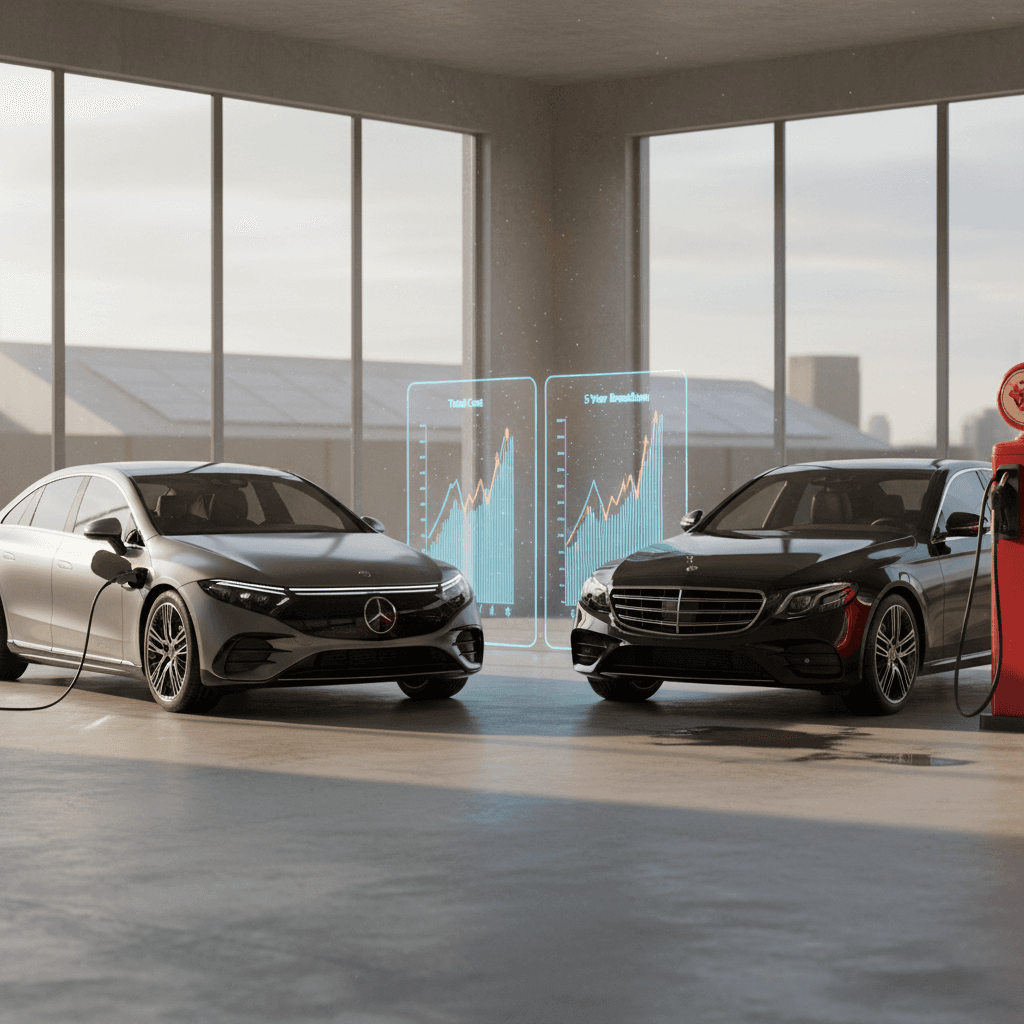
If you’re cross‑shopping a Mercedes EQE against a gas‑powered Mercedes‑Benz E‑Class, sticker price alone doesn’t tell you which one is the smarter money over time. To answer that, you need to look at total cost of ownership, energy, maintenance, depreciation, and more, over several years.
Quick answer
Why compare Mercedes EQE vs gas E‑Class?
The EQE sits in the same space as the traditional Mercedes E‑Class: midsize luxury sedan, similar interior room, similar badge prestige. Many buyers are essentially asking, “Do I buy the electric version or stick with the gas car I know?” That’s why Mercedes EQE total cost vs gas car equivalent is such a useful lens, it forces you to think beyond MSRP and into how you’ll actually spend money over the next 5 to 10 years.
- EQE 350 and 500 compete directly with E 350 and E 450 on size and luxury.
- Both are commonly leased or financed for 3–6 years, so financing cost and depreciation matter.
- Energy and maintenance costs behave very differently between EVs and gas cars.
Think in years, not months
Assumptions and key specs for this cost comparison
To keep this grounded in reality, we’ll use simple, conservative assumptions and publicly available efficiency data. Treat this as a framework you can tweak for your own situation.
Models we’ll compare
Real‑world EQE vs gas E‑Class equivalents
Mercedes EQE 350 4MATIC
- Type: Battery‑electric sedan
- EPA efficiency: ~39 kWh/100 miles (about 2.56 mi/kWh)
- Use case: Commuting plus regular highway trips
Mercedes‑Benz E 350 4MATIC (gas)
- Type: 2.0L turbo gas sedan
- EPA fuel economy: ~28 mpg combined (typical modern E‑Class four‑cylinder)
- Use case: Same mileage profile as EQE
Key 5‑year ownership assumptions
Your numbers will differ
Purchase price, incentives, and financing
New for new, a Mercedes EQE typically carries a higher MSRP than a comparable gas E‑Class. However, EV incentives and dealer discounts can narrow that gap, especially on remaining 2024–2025 inventory as Mercedes pivots its lineup.
Approximate new purchase economics (illustrative)
These are ballpark figures for a well‑equipped EQE 350 4MATIC vs a similarly equipped E 350 4MATIC. Always check actual local pricing and incentives.
| Item | EQE 350 4MATIC | E 350 4MATIC (gas) |
|---|---|---|
| MSRP (well equipped) | $82,000 | $73,000 |
| Typical dealer discount | -$4,000 | -$2,000 |
| Potential EV tax credit* | Up to $7,500 | N/A |
| Effective transaction price | ≈ $71,000 | ≈ $71,000 |
Illustrative 2026 pricing; your market may be higher or lower.
About that EV tax credit
Financing assumptions
- 5‑year loan, 10% down
- Interest rate: ~5–7% depending on credit
- Both cars financed similarly, so financing cost is essentially a wash in our comparison.
Lease vs buy
On a 3‑year lease, Mercedes often subvents the gas E‑Class more aggressively than the EQE. That can make the monthly payment on the gas car look lower even when total cost (with fuel) may be higher. If you plan to keep the car 5+ years, buying a discounted or used EQE can be the more rational play.
Energy costs: electricity vs gasoline
This is where EVs usually earn their keep. Let’s run the math for 60,000 miles over 5 years using our baseline assumptions.
5‑year energy cost comparison (60,000 miles)
Using EQE efficiency of ~39 kWh/100 mi and gas E‑Class efficiency of ~28 mpg, with $0.17/kWh electricity and $4.00/gal gasoline.
| Metric | Mercedes EQE 350 | Gas E 350 |
|---|---|---|
| Efficiency | 39 kWh/100 mi | 28 mpg |
| Energy needed for 60,000 mi | 23,400 kWh | 2,143 gallons |
| Assumed energy price | $0.17/kWh | $4.00/gal |
| 5‑year energy cost | ≈ $3,978 | ≈ $8,572 |
| Per‑mile energy cost | ≈ $0.07/mi | ≈ $0.14/mi |
Energy costs assume 80% home charging and 20% public/DC fast charging blended into the average rate.
Energy savings headline
What if your electricity is cheaper?
If you pay closer to $0.12/kWh (common in some central and southern states or off‑peak TOU rates), the EQE’s 5‑year electricity cost drops to about $2,800. That pushes your savings vs gas to roughly $5,700 over 5 years.
What if you mostly fast‑charge?
Frequent DC fast charging at $0.35–$0.45/kWh could push your effective rate close to or even beyond gasoline on a per‑mile basis. In that scenario, the EQE’s fuel advantage largely disappears, and the gas E‑Class can become cheaper to fuel on a road‑trip‑heavy lifestyle.
Public charging is not the same as home charging
Maintenance and repairs: where EVs really shine
EVs eliminate oil changes, spark plugs, exhaust systems, and a lot of routine engine maintenance. Luxury gas cars, meanwhile, tend to be maintenance‑intensive once they’re a few years old.
Typical 5‑year maintenance patterns
EQE vs gas E‑Class (out of warranty and beyond “free service” promos)
Mercedes EQE 350
- No oil changes or transmission fluid.
- Far fewer moving parts in the drivetrain.
- Brake wear is low thanks to strong regeneration.
- Software updates can fix some issues remotely.
Estimated 5‑year maintenance: ≈ $2,000–$3,000 (tires, cabin filters, brake fluid, alignment, etc.).
Gas E 350 4MATIC
- Regular oil changes and inspections.
- Engine‑related repairs as the car ages.
- More complex exhaust and emissions systems.
- Transmission service in some cases.
Estimated 5‑year maintenance: ≈ $4,000–$6,000, potentially more beyond warranty.
Don’t forget tires
Depreciation and resale value for EQE vs gas E‑Class
Depreciation is the biggest single cost of owning a luxury car, gas or electric. Early EQE models, like many luxury EVs, have depreciated faster than traditional E‑Class sedans, largely because technology is moving quickly and incentives reduce effective new prices.
Illustrative 5‑year depreciation
- New EQE 350: From ~$71,000 effective transaction price to ~$30,000–$35,000 after 5 years.
- New E 350 gas: From ~$71,000 to ~$33,000–$38,000 after 5 years.
Under these assumptions, depreciation is similar in dollar terms, with the EQE sometimes falling a bit faster early and then flattening as the market stabilizes.
Used EQE sweet spot
Because first‑owner depreciation on EQEs has already been steep, a 2‑ to 4‑year‑old EQE can be a bargain relative to its original MSRP. Buying used shifts the equation dramatically in favor of the EV, if, and this is critical, the battery health checks out.
That’s where tools like a Recharged Score battery health report matter. They help you verify remaining capacity and understand how the previous owner actually used and charged the car.
Battery life and resale value
Insurance, tires, and “everything else”
Beyond fuel and maintenance, you’ll pay for insurance, registration, and other odds and ends. These costs don’t differ as dramatically between an EQE and an E‑Class as people sometimes assume, but there are a few wrinkles.
- Insurance: EVs can be slightly more expensive to insure than equivalent gas cars because of higher repair costs and parts pricing, but advanced driver‑assistance systems can reduce accident severity. For our 5‑year comparison, it’s reasonable to assume insurance costs are within ±10% of each other.
- Registration/taxes: Some states charge higher registration fees for EVs to replace gas‑tax revenue; others discount fees or offer rebates. Over 5 years, this difference is usually in the low thousands of dollars at most.
- Parking and tolls: A few cities discount parking or tolls for EVs; most don’t. Don’t bank on this as a major cost lever unless you live in a policy‑heavy city.
- Home charging installation: If you don’t already have a 240V outlet or Level 2 charger, budget $800–$2,000 one‑time for equipment and installation. Spread over 5 years, that might add $150–$400 per year to your EQE’s “fuel” infrastructure cost.
Cheap bodywork? Not on these cars
5‑year total cost summary: Mercedes EQE vs gas equivalent
Pulling all of this together, let’s look at a simplified 5‑year, 60,000‑mile total cost picture. These are rough, illustrative numbers designed to show directionally how the EQE stacks up against a gas E‑Class when you own rather than lease.
Illustrative 5‑year total cost of ownership (60,000 miles)
Assumes both cars bought new at similar effective prices after discounts; EQE mostly home‑charged; average maintenance and depreciation. Numbers rounded for simplicity.
| Cost category | Mercedes EQE 350 | Gas E 350 |
|---|---|---|
| Purchase + fees (net of incentives) | $71,000 | $71,000 |
| 5‑year depreciation (value lost) | $37,000 | $35,000 |
| Energy (electricity/gas) | $4,000 | $8,600 |
| Maintenance & repairs | $2,500 | $5,000 |
| Extra EV registration fees, etc. | $1,000 | $0 |
| Home charging setup (amortized) | $1,000 | $0 |
| Insurance (difference vs baseline) | ≈ same | ≈ same |
| Total 5‑year ownership cost | ≈ $45,500 + purchase cost | ≈ $48,600 + purchase cost |
Use this as a template, swap in your own prices, mileage, and energy rates.
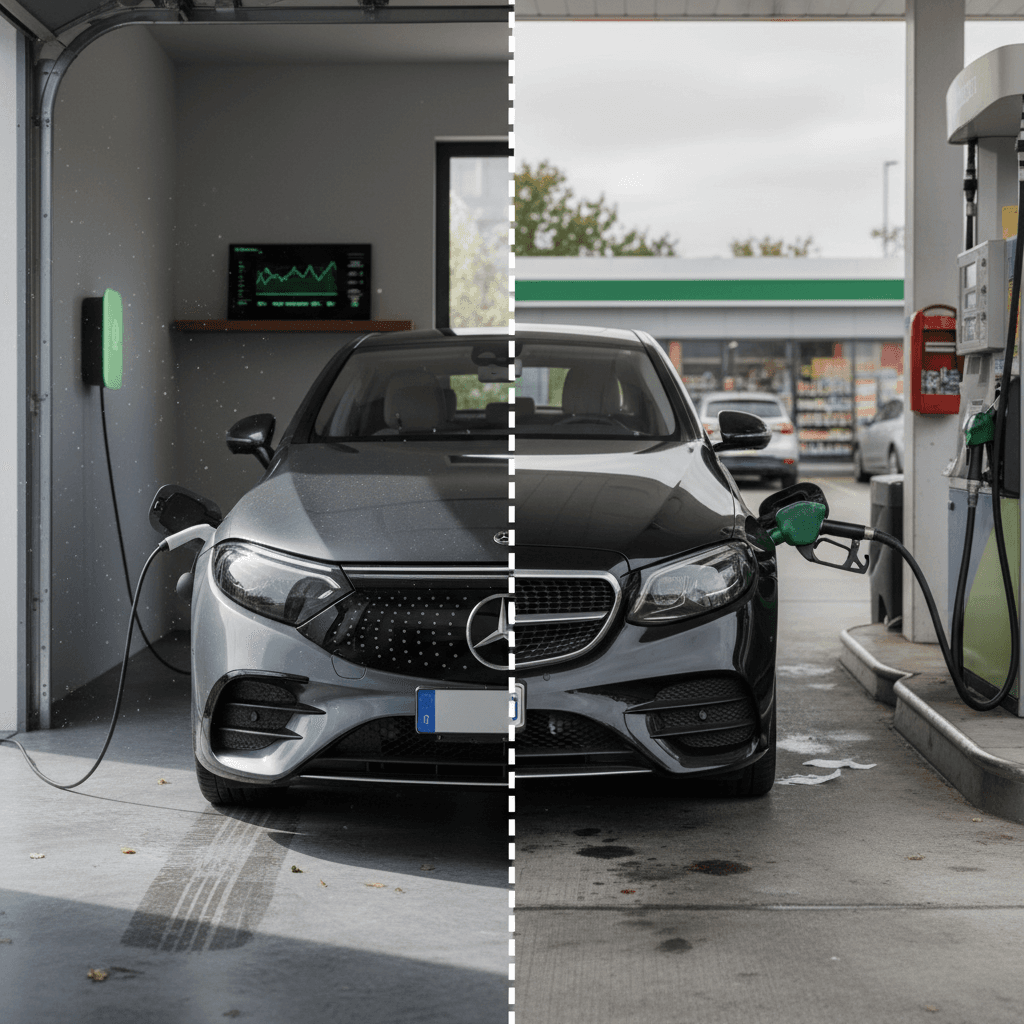
Because we treat depreciation as the value you “use up,” the comparison that matters is the difference in non‑recoverable costs. In this scenario, the EQE ends up around $3,000 cheaper to own over 5 years than the gas car, mainly thanks to energy and maintenance savings offsetting slightly heavier depreciation and EV‑specific fees.
Think in delta, not totals
New vs used EQE: why used can tilt the math
Where the Mercedes EQE really starts to look compelling is on the used market. First‑owner depreciation on premium EVs has been steep, which means a 2‑ to 3‑year‑old EQE can sell for a fraction of its original MSRP while still offering modern tech and plenty of battery life.
Advantages of buying a used EQE vs a new gas E‑Class
1. Depreciation already “paid”
A previous owner has absorbed the painful first 30–40% of value loss. Your 5‑year depreciation bill can be dramatically lower on a used EQE than on a new gas E‑Class.
2. Lower absolute purchase price
A well‑optioned used EQE can often be priced like a modestly equipped new gas E‑Class, putting a higher‑class cabin and more tech within reach.
3. Battery health transparency
When you shop with a <strong>Recharged Score battery health report</strong>, you’re not guessing about degradation, you can see how the pack has held up and pay accordingly.
4. Similar or lower running costs
You still benefit from cheaper electricity (if you home‑charge) and lower maintenance, but you’re doing it on a car that cost you much less upfront.
How Recharged fits into this picture
When a Mercedes EQE makes financial sense (and when it doesn’t)
EQE is likely the better financial choice if…
- You can charge at home on a reasonably priced electricity plan.
- You drive at least 10,000–15,000 miles per year, so energy savings add up.
- You plan to keep the car 5+ years, spreading out purchase and installation costs.
- You buy a used EQE with verified battery health at a significant discount to new.
- You live in a region with EV‑friendly incentives or toll/parking benefits.
The gas E‑Class may make more sense if…
- You can’t install home charging and rely heavily on DC fast charging.
- Your local electricity price is very high while gas is relatively cheap.
- You lease for just 2–3 years and care most about the lowest possible lease payment right now.
- You live in an area with limited public charging and dense dealer/service coverage for gas models.
Lifestyle fit first, spreadsheet second
FAQ: Mercedes EQE total cost vs gas car equivalent
Frequently asked questions
Bottom line: cost is only part of the EQE story
On paper, the Mercedes EQE can match or slightly beat a comparable gas E‑Class on 5‑year total cost if you have affordable home charging and drive a typical amount. In high‑electricity‑cost areas without good charging, or if you lease for just a couple of years, the gas car can still win on pure dollars. But in either case, the real leverage comes from how you buy: letting someone else take the initial depreciation hit on a used EQE, verifying battery health, and structuring your ownership around your actual driving and charging reality.
If you’re ready to run the numbers on a real car, not just a spreadsheet example, start by browsing used EQEs with Recharged Score battery diagnostics. You’ll see transparent pricing, battery health, and expert guidance that let you compare your options with eyes wide open, whether you ultimately land in an EQE or decide a gas E‑Class still fits your life better.